



Eukaryotic Release Factor (eRF)
Eukaryotic release factors terminate protein biosynthesis by recognizing stop codons and promoting peptidyl-tRNA hydrolysis on the ribosome[1][2]. Mechanistically, eRF1 recognizes UAA, UAG, and UGA stop codons, whereas eRF3 acts as a GTPase that cooperates with eRF1 to accelerate nascent polypeptide release[2][3]. In mRNA quality control, eRF1 and eRF3 also participate in the SMG1-UPF1-eRF1-eRF3 SURF complex that links translation termination to nonsense-mediated mRNA decay[4]. In disease models, premature termination codon readthrough provides an experimental route for studying nonsense-mutation disorders, and eRF3 degradation enhances G418-induced readthrough while altering NMD-related protein levels[5]. Compared with eRF3b, eRF3a silencing markedly increases premature nonsense codon readthrough in human cells, while eRF3b overexpression compensates for termination defects caused by eRF3a depletion[6]. Therefore, eRF3a and eRF3b are not fully equivalent release-factor isoforms, because eRF3a mainly maintains mammalian termination-complex formation and eRF1 stability[6]. For experimental applications, eRF3a degraders including CC-90009, CC-885, and SJ6986 support studies of premature stop codon readthrough and CFTR nonsense-mutation rescue[5][7].eRF research connects translation termination, stop codon recognition, GTP hydrolysis, and nonsense-mediated decay.
eRF3a and eRF3b isoform differences guide mammalian termination-complex and readthrough experiments.
eRF3a degraders support CFTR nonsense mutation rescue and premature stop codon readthrough studies.
- [1]. Song H, et al. The crystal structure of human eukaryotic release factor eRF1--mechanism of stop codon recognition and peptidyl-tRNA hydrolysis. Cell. 2000;100(3):311-321. [Content Brief]
- [2]. Alkalaeva EZ, et al. In vitro reconstitution of eukaryotic translation reveals cooperativity between release factors eRF1 and eRF3. Cell. 2006;125(6):1125-1136. [Content Brief]
- [3]. Cheng Z, et al. Structural insights into eRF3 and stop codon recognition by eRF1. Genes Dev. 2009;23(9):1106-1118. [Content Brief]
- [4]. Kashima I, et al. Binding of a novel SMG-1-Upf1-eRF1-eRF3 complex (SURF) to the exon junction complex triggers Upf1 phosphorylation and nonsense-mediated mRNA decay. Genes Dev. 2006;20(3):355-367. [Content Brief]
- [5]. Baradaran-Heravi A, et al. Effect of small molecule eRF3 degraders on premature termination codon readthrough. Nucleic Acids Res. 2021;49(7):3692-3708. [Content Brief]
- [6]. Chauvin C, et al. Involvement of human release factors eRF3a and eRF3b in translation termination and regulation of the termination complex formation. Mol Cell Biol. 2005;25(14):5801-5811. [Content Brief]
- [7]. Lee RE, et al. Small-molecule eRF3a degraders rescue CFTR nonsense mutations by promoting premature termination codon readthrough. J Clin Invest. 2022;132(18):e154571. [Content Brief]
Eukaryotic Release Factor (eRF) Isoform Specific Products
All Product Categories
-
Eukaryotic Release Factor (eRF) Related Products (59)
Related Products (59)

-
Eukaryotic Release Factor (eRF) Isoform Comparison
-
ABS-752 hydrochloride
 0 ImagesABS-752 hydrochloride is an orally active prodrug targeting CRBN-modulating molecular glue with selectivity in protein degradation. ABS-752 hydrochloride preferentially degrades GSPT1 and induces cytotoxicity through this degradation, while it also degrades NEK7, SALL4 and CK1α, with weaker degradation potency against CK1α. As a prodrug, ABS-752 hydrochloride requires metabolic activation to ABT-002 to form the active complex; VAP-1 mediates its conversion to an aldehyde intermediate. ABS-752 hydrochloride induces cell death, reduces cell viability, and exhibits antitumor activity, leading to regression and inhibition of tumor growth. ABS-752 hydrochloride shows no cytotoxicity in primary human hepatocytes. ABS-752 hydrochloride can be used in the research of hepatocellular carcinoma.
-
AN5777
 0 ImagesAN5777 is a GSPT1 Molecular glue degrader with a DC50 of less than 10 μM. AN5777 degrades GSPT1 in a CRBN-dependent manner via the ubiquitin-proteasome system. AN5777 induces G1 phase arrest and Apoptosis in cancer cells. AN5777 is applicable to research related to acute myeloid leukemia, multiple myeloma, and chronic myeloid leukemia.
-
PROTAC erf3a Degrader-1
 0 ImagesPROTAC erf3a Degrader-1 (Compound C63) is an orally active PROTAC erf3a Degrader. PROTAC erf3a Degrader-1 inhibits cancer cell proliferation (eg: 22Rv1). PROTAC erf3a Degrader-1 can be used for research of prostate cancer, ovarian cancer, liver cancer, cervical cancer, leukemia, breast cancer.
-
XYD049
 0 ImagesXYD049 is a CRBN-based molecular glue degrader targeting GSPT1, with a DC50 of 19 nM. XYD049 mediates the formation of a ternary complex between CRBN and GSPT1, thereby triggering CRBN- and proteasome-dependent degradation of GSPT1. By degrading GSPT1, XYD049 downregulates castration-resistant prostate cancer (CRPC)-related oncogenes, including BCL2, CDK2, E2F3, EGFR, HSP90B1, TMPRSS2, AR, AR-V7, PSA and c-Myc. XYD049 inhibits cancer cell growth and suppresses tumor growth in mice. XYD049 can be used for research on castration-resistant prostate cancer. XYD049 consists of a linker (black part) NH2-C5-NH-Boc (HY-W004710), a CRBN-based E3 ligase ligand (blue part) Thalidomide 4-fluoride (HY-41547), and a target protein ligand (red part) GSPT1 ligand-1 (HY-170821), among which the E3 ligase ligand plus linker forms the conjugate E3 Ligase Ligand-linker Conjugate 158 (HY-170822).
-
GSPT1 degrader-15
 0 ImagesCat. No.: HY-177761CAS No.: 3060504-66-4GSPT1 degrader-15 (Compound Lib-B-15O) is a potent and highly selective GSPT1 molecular gel degrader, with a DC50 of 154 nM. GSPT1 degrader-15 has almost no effect on the expression of other proteins. GSPT1 degrader-15 exhibits significant anti-proliferative activity against leukemia cells and lymphoma cells. GSPT1 degrader-15 can be used in leukemia and lymphoma research.
-
XYD113
 0 ImagesCat. No.: HY-184896CAS No.: 3032314-99-8XYD113 is an orally active, selective GSPT1 Molecular glue degrader. XYD113 promotes the formation of the CRBN-GSPT1 ternary complex and mediates GSPT1 degradation in a CRBN-dependent manner via the ubiquitin-proteasome system. XYD113 downregulates genes associated with the occurrence and progression of prostate cancer (c-Myc, AR, AR-V7, KLK3, KLK2, TMPRSS2). XYD113 exhibits anticancer activity against prostate cancer. XYD113 can be used in the research of prostate cancer.
-
FM-74-103
 0 ImagesCat. No.: HY-184248FM-74-103 is a selective GSPT1 PROTAC degrader and broad-spectrum antiviral agent. FM-74-103 recruits GSPT1 to the Cereblon E3 ligase to form a ternary complex, thereby driving GSPT1 ubiquitination and proteasomal degradation. FM-74-103 inhibits the replication of IAV, SARS-CoV-2 and CMV (including Nucleozin (HY-50001)-resistant influenza A virus). FM-74-103 can be used in research related to influenza A virus infection, SARS-CoV-2 infection and cytomegalovirus infection.

-
GSPT1 degrader-4
 0 ImagesCat. No.: HY-162533CAS No.: 3034764-32-1
-
GSPT1 degrader-16
 0 ImagesCat. No.: HY-177765CAS No.: 3060504-68-6GSPT1 degrader-16 (Compound Lib-B-18J) is a potent and selective cereblon-based molecular glue degrader that targets G1 to S phase transition 1 (GSPT1). GSPT1 degrader-16 shows inhibitory effect to RS4;11, Molt4, and MM.1S cells with IC50 values of 0.002, 0.26 and 0.37 μM. GSPT1 degrader-16 can be used for the research of cancer, such as acute lymphoblastic leukemi.
-
TD-522
 0 ImagesCat. No.: HY-177750CAS No.: 2417647-40-4TD-522 is a potent and selective molecular glue GSPT1 degrader, with a DC50 of 0.269 nM. TD-522 exhibits strong anti-proliferative effects and induces apoptosis in acute myeloid leukemia (AML) and diffuse large B-cell lymphoma (DLBCL) cells. TD-522 suppresses tumor growth in a TMD-8 xenograft model. TD-522 can be used for AML and DLBCL research.

-
BWA-6047
 0 ImagesCat. No.: HY-176128BWA-6047 is an oral active PROTAC degrader targeting AR/AR-V7 and GSPT1 with DC50 values of 3.7, 3.0 and 1.2 nM in 22Rv1 cells. BWA-6047 suppresses the expression of AR downstream target genes and and transcriptional activity. BWA-6047 inhibits cancer cells proliferation, causes G1 phase cell cycle arrest and induces apoptosis. BWA-6047 increases cleaved-PARP-1 and cleaved-caspase-3 levels. BWA-6047 reduces growth of LNCaP xenograft tumors in mice models without obvious toxicity. BWA-6047 can be used for the research of prostate cancer.

-
AG6033
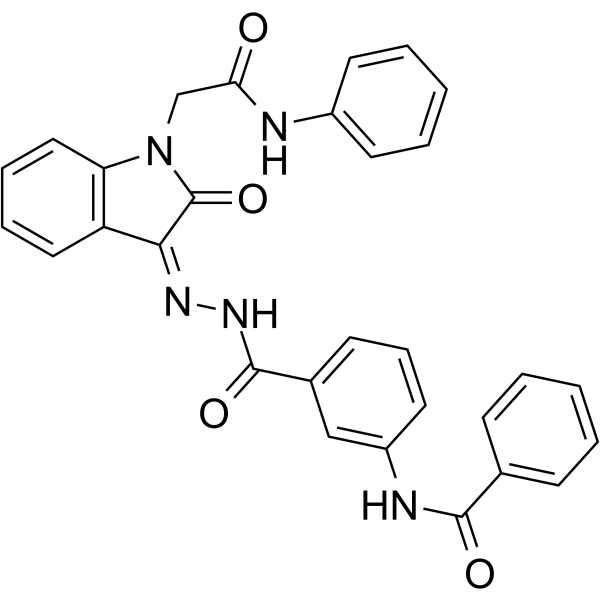 0 ImagesCat. No.: HY-143435CAS No.: 329706-62-9AG6033 is a CRBN-dependent molecular glue degrader targeting GSPT1 (DC50 of 2.5 μM) and IKZF1. AG6033 induces degradation of GSPT1 via π-π stacking and hydrogen bonding with CRBN in a partially CRBN-dependent manner, decreases IKZF1 levels, and promotes degradation of CRBN substrates. AG6033 induces apoptosis in lung adenocarcinoma cells. AG6033 can be used for the research of lung cancer.
-
GSPT1 degrader-1
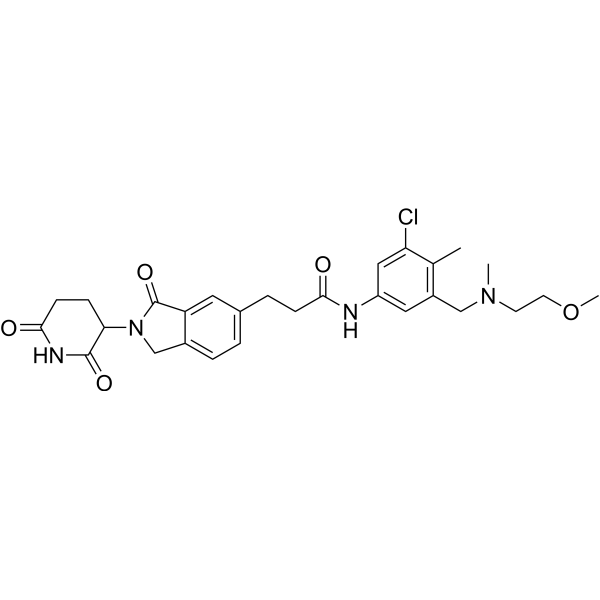 0 ImagesCat. No.: HY-155552CAS No.: 3037491-05-4GSPT1 degrader-1 is a highly selective degrader targeting GSPT1. GSPT1 degrader-1 induces degradation via the ubiquitin-proteasome system. GSPT1 degrader-1 induces G0/G1 phase arrest, apoptosis (apoptosis) and inhibits proliferation in leukemia cells. GSPT1 degrader-1 reduces the levels of CDK6 and Cyclin B1, while increases the levels of activated caspase-3 and caspase-9 in leukemia cells. GSPT1 degrader-1 can be used in leukemia research.
-
DIX-01
 0 ImagesCat. No.: HY-180836DIX-01 is a CRBN-recruiting molecular glue and cytotoxic agent targeting GSPT1, with an EC50 of 173 nM against human GSPT1. DIX-01 drives proteasomal degradation of GSPT1, IKZF1 and IKZF3, and induces cytotoxicity in cancer cells. DIX-01 inhibits tumor growth in a zebrafish xenograft model and can be used for research on acute myeloid leukemia and prostate cancer.
-
GSPT1 degrader-2
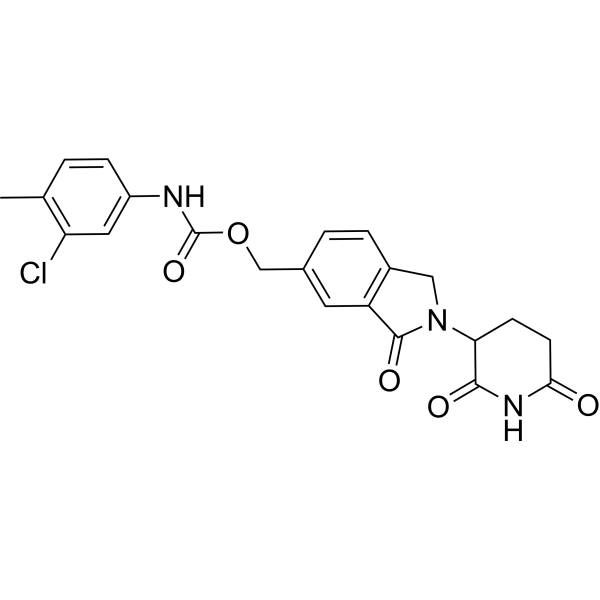 0 ImagesCat. No.: HY-156747CAS No.: 2803879-60-7GSPT1 degrader-2 is an orally active GSPT1 molecular glue degrader that promotes the degradation of intracellular GSPT1 protein, with DC50 values of 3 nM and 22 nM in NCI-H1155 and ABC-1 cells with high N-Myc expression, respectively. GSPT1 degrader-2 can be used in the research of N-Myc-driven cancers, such as lung cancer.
-
ABT-002
 0 ImagesCat. No.: HY-175283CAS No.: 2438239-83-7ABT-002 is a molecular glue degrader targeting GSPT1 and NEK7. ABT-002 is the active metabolite of ABS-752 (HY-W599279). ABT-002 is promising for research of hepatocellular carcinoma (HCC).
-
PROTAC BCL6/GSPT1 Degrader-1
 0 ImagesCat. No.: HY-181084CAS No.: 3039500-55-2PROTAC BCL6/GSPT1 Degrader-1 is a dual-target PROTAC degrader that targets BCL6 and GSPT1. PROTAC BCL6/GSPT1 Degrader-1 inhibits cell proliferation, promotes DNA damage, and induces cell cycle arrest and apoptosis in diffuse large B-cell lymphoma. PROTAC BCL6/GSPT1 Degrader-1 can be used for research on tumors such as lymphoma.



