



BSJ-02-162

Based on 1 Customer Validation
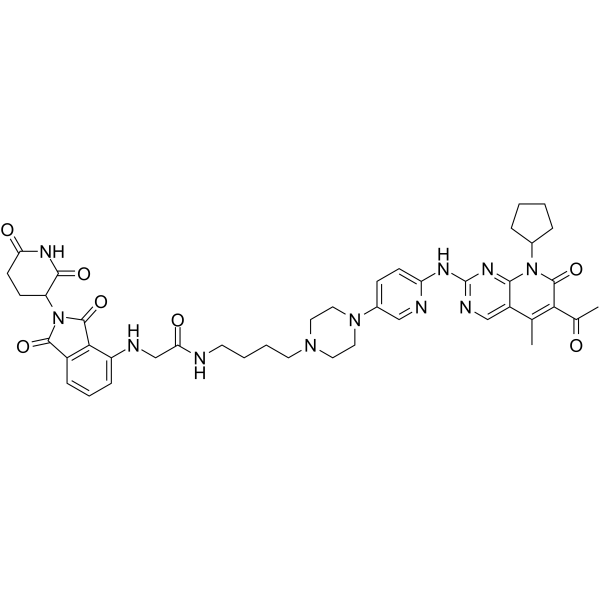
BSJ-02-162 (CDK4/6-IN-11) is a CDK4/CDK6 and IKZF1/IKZF3 degrader, with DC50 values of 32 nM and 6.1 nM against CDK4 and CDK6, respectively; its IC50 ranges from 1 to 50 nM. BSJ-02-162 induces G1-phase cell cycle arrest, reduces phosphorylated retinoblastoma protein levels, and exerts antiproliferative activity in mantle cell lymphoma cells. BSJ-02-162 is applicable to research related to mantle cell lymphoma.
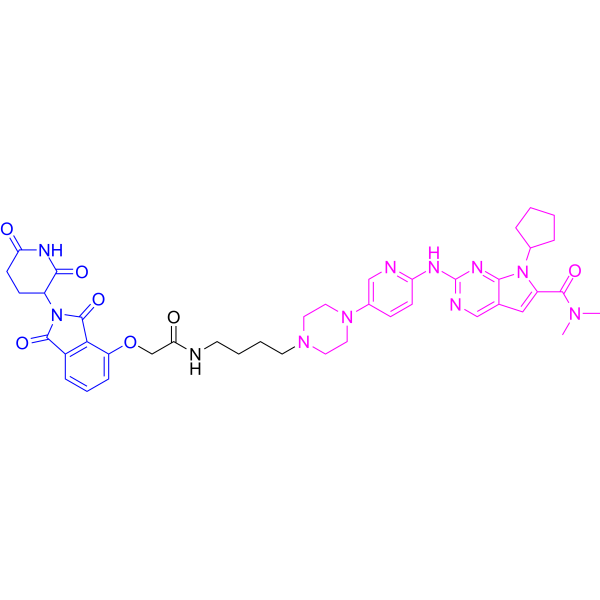
(Pink: CDK4 and CDK6 ligand (HY-50767); Blue: Cereblon ligand (HY-131717); Black: linker (HY-W007803)).
Nur für Forschungszwecke. Wir verkaufen nicht an Patienten.
- Reinheit : 98.07%
- CAS. Nr.: 2139329-47-6
- Formel: C43H49N11O7
- Molecular Weight:831.92
-
Speicherung:Powder -20°C, 3 years , 4°C, 2 years ; In solvent -80°C, 6 months , -20°C, 1 month

To place orders, for customer services and technical support, please contact: MedChemExpress USA
Tel: 609-228-6898 E-mail: [email protected] [email protected]


-
 Biologische Aktivität
-
Chemical Information
-
Lösungsmittel & Löslichkeit
- Protokoll
- Reinheit & Dokumentation
- Verweise
-
 Help & FAQs


Alle PROTACs Isoform-spezifische Produkte anzeigen
More

Biologische Aktivität
Beschreibung
IC50 & Target
[1]|
CDK4 32 nM (DC50) |
CDK6 6.1 nM (DC50) |
IKZF1 |
IKZF3 |
In Vitro
BSJ-02-162 (1 μM; 4 h) induces CRBN-dependent degradation of CDK4, CDK6, IKZF1 and IKZF3 proteins in Jurkat cells[2].
BSJ-02-162 (0.1-1 μM; 24 h) induces CRBN-dependent G1 cell cycle arrest in wild-type Jurkat and MCL cells[2].
MedChemExpress (MCE) has not independently confirmed the accuracy of these methods. They are for reference only. Further protocols information, click here.
-
Cell Line:Jurkat T cells
-
Concentration:1 μM
-
Incubation Time:4 h
-
Result:Induced degradation of both CDK4 and CDK6 proteins, as well as degradation of IKZF1 and IKZF3 proteins.
Showed no effect on CDK4/6 or IKZF1/3 abundance in CRBN-knockout Jurkat cells, confirming degradation was dependent on functional CRBN.
-
Cell Line:Jurkat and MCL cells
-
Concentration:0.1 and 1 μM
-
Incubation Time:24 h
-
Result:Induced profound G1 cell cycle arrest.


Chemical Information
-
CAS. Nr. 2139329-47-6
-
Appearance Solid
-
Molecular Weight 831.92
-
Formel C43H49N11O7
-
Color Light yellow to yellow
-
SMILES
O=C(NCCCCN1CCN(C2=CC=C(NC3=NC=C(C(C)=C(C(C)=O)C(N4C5CCCC5)=O)C4=N3)N=C2)CC1)CNC6=CC=CC(C(N7C(CC8)C(NC8=O)=O)=O)=C6C7=O
-
Synonyms
CDK4/6-IN-11
-
Versand
Room temperature in continental US; may vary elsewhere.
-
Speicherung
Powder -20°C 3 years 4°C 2 years In solvent -80°C 6 months -20°C 1 month


Lösungsmittel & Löslichkeit
In Vitro:
DMSO : 25 mg/mL (30.05 mM; Need ultrasonic; Hygroscopic DMSO has a significant impact on the solubility of product, please use newly opened DMSO)
Please refer to the solubility information to select the appropriate solvent. Once prepared, please aliquot and store the solution to prevent product inactivation from repeated freeze-thaw cycles.
Storage method and period of stock solution: -80°C, 6 months; -20°C, 1 month. When stored at -80°C, please use it within 6 months. When stored at -20°C, please use it within 1 month.
Please refer to the solubility information to select the appropriate solvent. Once prepared, please aliquot and store the solution to prevent product inactivation from repeated freeze-thaw cycles.
Storage method and period of stock solution: -80°C, 6 months; -20°C, 1 month. When stored at -80°C, please use it within 6 months. When stored at -20°C, please use it within 1 month.
Konzentration (Stammlösung) × Volumen (Stammlösung) = Konzentration (Ziellösung) × Volumen (Ziellösung)

Protokoll
-
Flow cytometric DNA-content cell-cycle staining
Flow cytometric DNA-content cell-cycle staining measures the fluorescence intensity of DNA-bound fluorochromes in single cells or nuclei to estimate DNA content distributions, allowing assignment of populations to G0/G1, S, and G2/M phases by DNA histogram deconvolution. Propidium iodide (PI) intercalates into DNA, and PI fluorescence is proportional to cellular DNA content when staining is performed under conditions that make DNA accessible and minimize non-DNA signal. Cells with G2/M DNA content are expected to show approximately twice the fluorescence intensity of G0/G1 cells, while S-phase cells occupy intermediate fluorescence values. PI-based DNA-content analysis can also detect cells with fractional DNA content, often reported as sub-G1, when DNA fragmentation and extraction during staining reduce retained DNA signal in apoptotic cells. DAPI is an alternative DNA fluorochrome for univariate DNA-content analysis, while bivariate approaches combining DNA content with proliferation
-
BrdU Incorporation Assay
Bromodeoxyuridine (BrdU) incorporation assay is based on the principle that BrdU, a thymidine analog, is incorporated into newly synthesized DNA during the S phase of the cell cycle, thereby serving as a marker of DNA replication and cellular proliferation. Incorporated BrdU can be detected using anti-BrdU antibodies following DNA denaturation, enabling visualization or quantification of proliferating cells through immunochemical detection methods such as immunofluorescence or immunohistochemistry.
-
Protocol for Cell Cycle
Cell-cycle analysis by flow cytometry measures DNA content in single cells to estimate the fraction of cells in G0/G1, S, and G2/M phases. Propidium iodide intercalates into DNA, and after RNA removal with RNase, fluorescence intensity reflects cellular DNA content: 2N cells are assigned to G0/G1, cells between 2N and 4N to S phase, and 4N cells to G2/M. DNA-content analysis alone cannot reliably separate G0 from G1 or G2 from M. Ki-67 can distinguish quiescent G0 cells from cycling cells, EdU or BrdU incorporation marks active DNA synthesis in S phase, and phospho-histone H3 staining identifies mitotic cells within the 4N population.
-
Cell Viability Determination by MTT Colorimetric Assay
The following protocol uses the MTT colorimetric assay as a classic literature-established method for assessing cell viability/metabolic activity in cultured mammalian cells. MTT[3-(4,5-dimethylthiazol-2-yl)-2,5-diphenyltetrazolium bromide] is reduced by metabolically active cells to a colored formazan product; the amount of formazan is quantified spectrophotometrically and provides an indirect measure of metabolically active viable cells. Importantly, MTT reduction reflects cellular oxidoreductase/metabolic activity rather than an absolute direct count of living cells, so changes in cellular metabolism can alter the signal independently of cell number.


Reinheit & Dokumentation
-
Data Sheet (271 KB)
-
SDS (254 KB)
- English - EN (254 KB)
- Français - FR (254 KB)
- Deutsch - DE (254 KB)
- Norwegian - NO (254 KB)
- Español - ES (254 KB)
- Swedish - SV (254 KB)
- Italian - IT (254 KB)
- Korean - KR (254 KB)
- Portuguese - PT (254 KB)
-
Handling Instructions (2659 KB)
Verweise


Complete Stock Solution Preparation Table
Please refer to the solubility information to select the appropriate solvent. Once prepared, please aliquot and store the solution to prevent product inactivation from repeated freeze-thaw cycles.
Storage method and period of stock solution: -80°C, 6 months; -20°C, 1 month. When stored at -80°C, please use it within 6 months. When stored at -20°C, please use it within 1 month.
| Optional Solvent | Concentration Solvent Mass | 1 mg | 5 mg | 10 mg | 25 mg |
|---|---|---|---|---|---|
| DMSO | 1 mM | 1.2020 mL | 6.0102 mL | 12.0204 mL | 30.0510 mL |
| 5 mM | 0.2404 mL | 1.2020 mL | 2.4041 mL | 6.0102 mL | |
| 10 mM | 0.1202 mL | 0.6010 mL | 1.2020 mL | 3.0051 mL | |
| 15 mM | 0.0801 mL | 0.4007 mL | 0.8014 mL | 2.0034 mL | |
| 20 mM | 0.0601 mL | 0.3005 mL | 0.6010 mL | 1.5025 mL | |
| 25 mM | 0.0481 mL | 0.2404 mL | 0.4808 mL | 1.2020 mL | |
| 30 mM | 0.0401 mL | 0.2003 mL | 0.4007 mL | 1.0017 mL |


BSJ-02-162 Related Classifications
HY-144995 Related Classifications
 Powered by Bioz