



CFT8634
Based on 3 publication(s) in Google Scholar
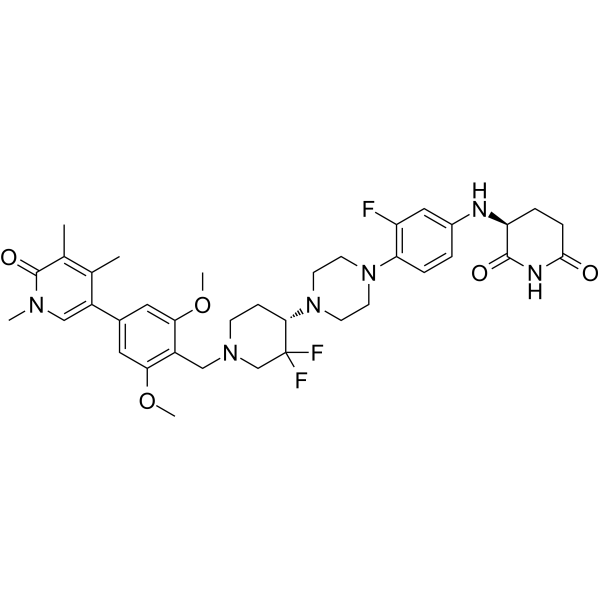
CFT8634 is an orally active BRD9 PROTAC degrader with a DC50 of 0.003 μM (HEK293T.166). CFT8634 recruits the CRBN E3 ubiquitin ligase to form a ternary complex, triggering CRBN-catalyzed BRD9 polyubiquitination and 26S proteasome-mediated degradation. CFT8634 induces sustained tumor regression and inhibits tumor growth in mouse models. CFT8634 can be used in research related to synovial sarcoma, SMARCB-1-deficient cancers, acute myeloid leukemia, malignant rhabdoid tumors, and multiple myeloma.
(Pink: BRD9 ligand (HY-169988); Blue: Cereblon ligand (HY-169989); Black: linker (HY-169991)).
For research use only. We do not sell to patients.
- Purity : 98.10%
- CAS No.: 2704617-96-7
- Formula: C37H45F3N6O5
- Molecular Weight:710.79
-
Storage:
4°C, protect from light, stored under nitrogen
* In solvent : -80°C, 6 months; -20°C, 1 month (protect from light, stored under nitrogen)

To place orders, for customer services and technical support, please contact: MedChemExpress USA
Tel: 609-228-6898 E-mail: [email protected] [email protected]


-
 Biological Activity
-
Chemical Information
-
Solvent & Solubility
- Protocols
- Purity & Documentation
- References
-
 Help & FAQs


-
HY-138642
VepdegestrantPROTAC ER Degrader -
HY-138641
BavdegalutamideAR PROTAC Degrader -
HY-145483
KT-474PROTAC IRAK4 Degrader -
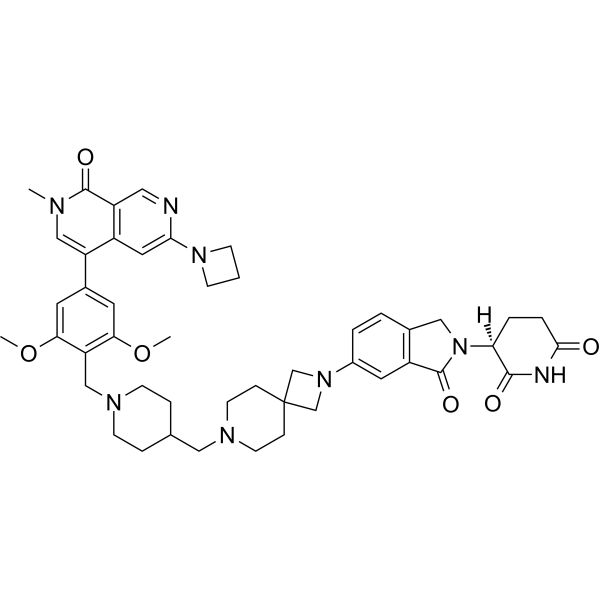
HY-153367
FHD-609BRD9 PROTAC Degrader -
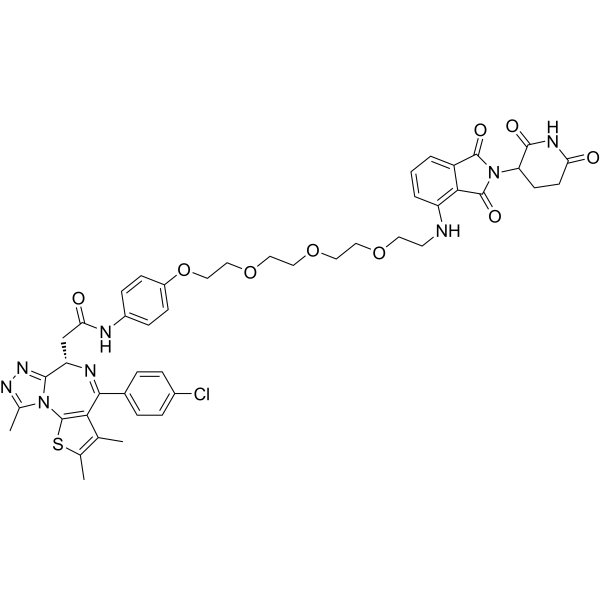
HY-16954
ARV-825PROTAC BRD2/BRD3/BRD4 Degrader -
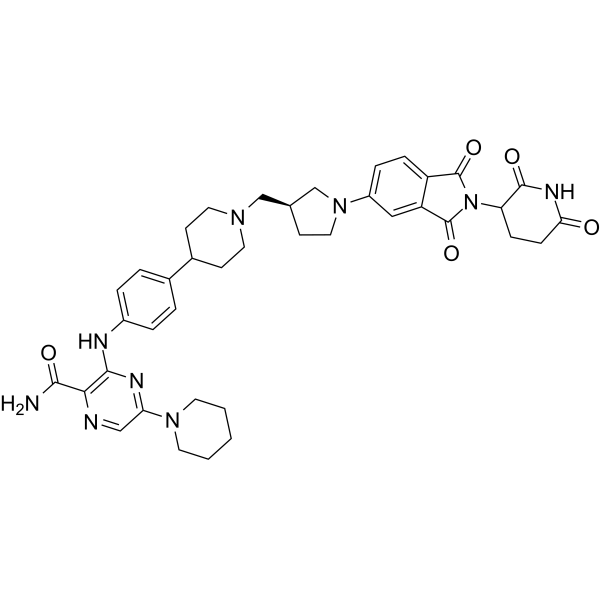
HY-153220
ZelebrudomideBTK PROTAC Degrader -
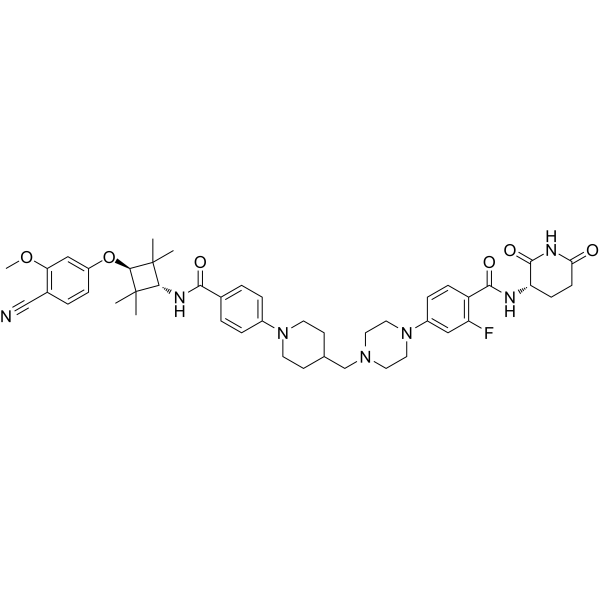
HY-153342
LuxdegalutamidePROTAC -
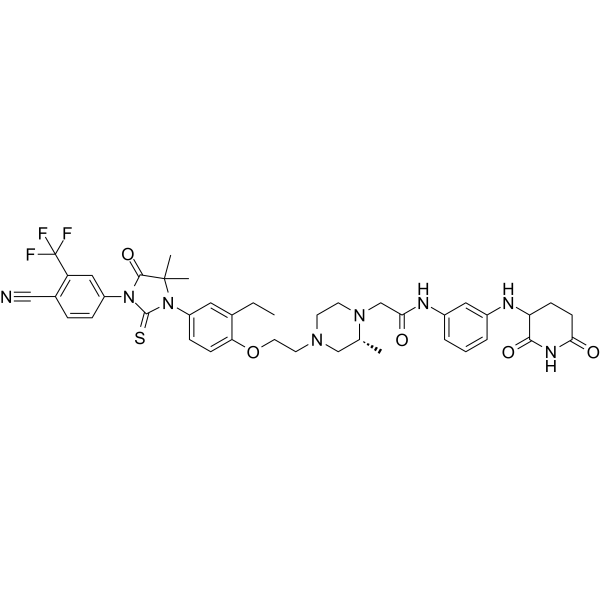
HY-158101
BMS-986365PROTAC AR Degrader -
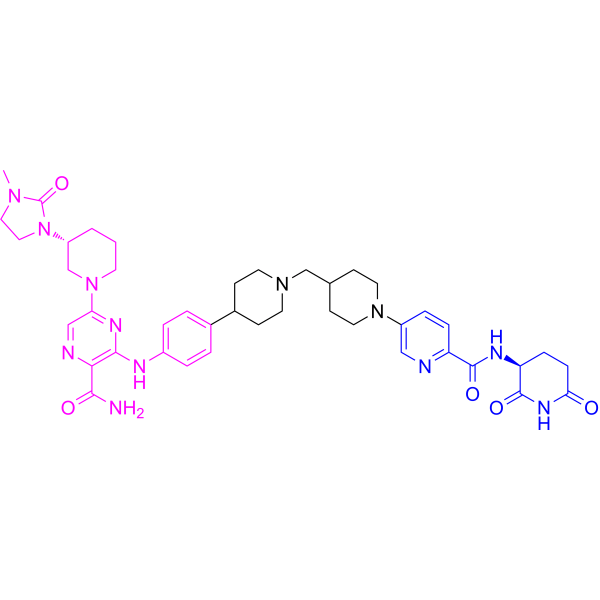
HY-153321
BexobrutidegBTK Degrader -

HY-156730
KT-333STAT3 Degrader -
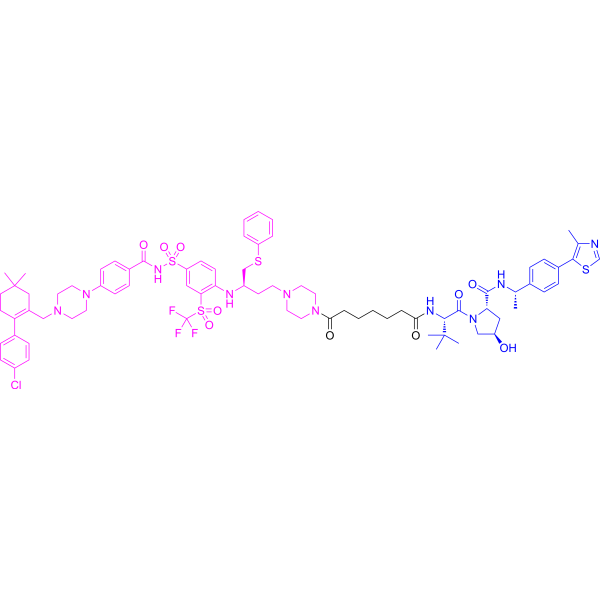
HY-130604
DT2216PROTAC BCL-XL Degrader -
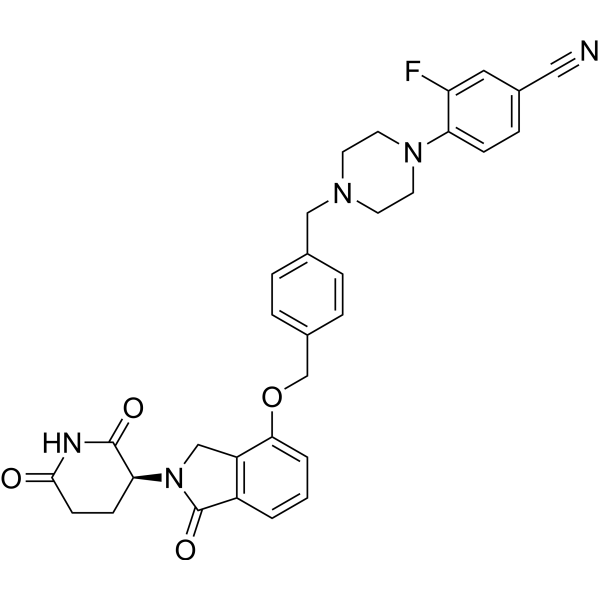
HY-129395
MezigdomideCereblon E3 Ubiquitin Ligase Modulating Agent
Publications Citing Use of MedChemExpress (MCE) CFT8634
MoreAll PROTACs Isoforms
More

Biological Activity
Description
IC50 & Target
[1]|
BRD9 0.003 μM (DC50) |
Cereblon |
In Vitro
CFT8634 potently and selectively degrades BRD9 in synovial sarcoma and SMARCB-1-deficient cells, with a DC50 of 2.7 nM[1].
CFT8634 (10 μM; 2 h) potently degrades BRD9 in HEK293T.166 cells, with a DC50 of 0.003 μM and an Emax of 4%[2].
CFT8634 (100 nM; 4 h) selectively degrades BRD9 in HSSYII human synovial sarcoma cells[2].
The degradation of BRD9 induced by CFT8634 (1 μM; 4 h) in Yamato-SS cells depends on the ubiquitin-proteasome system, BRD9 binding, and CRBN binding[2].
MedChemExpress (MCE) has not independently confirmed the accuracy of these methods. They are for reference only.
-
Cell Line:Yamato-SS human synovial sarcoma cells
-
Concentration:1 μM (CFT8634); 10 μM (competitor agents: Bortezomib (HY-10227), MLN-4924 (HY-70062), BI-7273 (HY-100351), CRBN binder)
-
Incubation Time:4 h (CFT8634 incubation); 1 h (competitor pre-incubation) followed by 4 h (co-incubation with CFT8634)
-
Result:Induced BRD9 degradation that was rescued by co-treatment with bortezomib, BI-7273, MLN-4924, or a CRBN binder.
Did not reduce BRD9 levels when competitors were used alone.
Parmacokinetics
| Species | Dose | Route | CL | T1/2 | Vdss | Bioavailability |
|---|---|---|---|---|---|---|
| Mice[2] | 2 mg/kg | i.v. | 6.2 mL/min/kg | 3.7 h | 2.0 L/kg | / |
| Mice[2] | 10 mg/kg | p.o. | / | 3.5 h | / | 74 % |
| Rat[2] | 1 mg/kg | i.v. | 16.6 mL/min/kg | 3.9 h | 4.0 L/kg | / |
| Rat[2] | 10 mg/kg | p.o. | / | 5.4 h | / | 97 % |
| Dog[2] | 1 mg/kg | i.v. | 4.7 mL/min/kg | 10.2 h | 2.2 L/kg | / |
| Dog[2] | 1 mg/kg | p.o. | / | 9.8 h | / | 86 % |
In Vivo
CFT8634 (0.01-30 mg/kg; p.o.; once daily; for 21 consecutive days) induces dose-dependent BRD9 degradation in SA13412 synovial sarcoma xenografts, achieving up to 100% tumor growth inhibition[2].
MedChemExpress (MCE) has not independently confirmed the accuracy of these methods. They are for reference only.
-
Animal Model:BALB/c nude (female, 6-8 weeks old, 18-22 g, subcutaneous inoculation of Yamato-SS cells)[2]
-
Dosage:0.3-50 mg/kg (daily dosing for 21 days); 0.3-50 mg/kg (single dose)
-
Administration:p.o.; daily; 21 days; p.o.; single dose
-
Result:Achieved ≥90% BRD9 degradation in tumors by 4 hours at doses ≥1 mg/kg.
Maintained maximal BRD9 degradation for 24 hours at 30 and 50 mg/kg single doses.
Produced dose-dependent tumor growth inhibition (TGI): 31% at 0.3 mg/kg, 92% at 50 mg/kg.
Caused only mild weight loss at the three highest doses, with overall good tolerance.
-
Animal Model:NOD/SCID nude (female, 6-9 weeks old, subcutaneous implantation of SA13412 patient-derived tumor fragments)[2]
-
Dosage:0.01-30 mg/kg (daily dosing for 21 days); 0.01-30 mg/kg (single dose)
-
Administration:p.o.; daily; 21 days; p.o.; single dose
-
Result:Achieved ~90% BRD9 degradation in tumors by 4 hours at 1 and 30 mg/kg single doses.
Maintained maximal BRD9 degradation for 24 hours at 30 mg/kg single dose.
Produced dose-dependent tumor growth inhibition (TGI): 72% at 0.1 mg/kg, 95% at 1 mg/kg, 100% at 30 mg/kg.
Was well-tolerated across all doses tested.
Clinical Trial
| NCT Number | Sponsor | Condition | Start Date |
Phase

|
|---|---|---|---|---|
| NCT01329991 | Plexxikon| | 2011-05 | PHASE1 |


Chemical Information
-
CAS No. 2704617-96-7
-
Appearance Solid
-
Molecular Weight 710.79
-
Formula C37H45F3N6O5
-
Color Light green to gray
-
SMILES
CC(C(C1=CC(OC)=C(C(OC)=C1)CN2CC(F)([C@@H](N3CCN(C4=C(C=C(C=C4)N[C@@H]5C(NC(CC5)=O)=O)F)CC3)CC2)F)=CN6C)=C(C)C6=O
-
Shipping
Room temperature in continental US; may vary elsewhere.
-
Storage
4°C, protect from light, stored under nitrogen
* In solvent : -80°C, 6 months; -20°C, 1 month (protect from light, stored under nitrogen)


Publications (3)
-
Journal Impact Factor
-
Most Recent


Solvent & Solubility
In Vitro:
DMSO : 100 mg/mL (140.69 mM; Need ultrasonic; Hygroscopic DMSO has a significant impact on the solubility of product, please use newly opened DMSO)
Please refer to the solubility information to select the appropriate solvent. Once prepared, please aliquot and store the solution to prevent product inactivation from repeated freeze-thaw cycles.
Storage method and period of stock solution: -80°C, 6 months; -20°C, 1 month (protect from light, stored under nitrogen). When stored at -80°C, please use it within 6 months. When stored at -20°C, please use it within 1 month.
Please refer to the solubility information to select the appropriate solvent. Once prepared, please aliquot and store the solution to prevent product inactivation from repeated freeze-thaw cycles.
Storage method and period of stock solution: -80°C, 6 months; -20°C, 1 month (protect from light, stored under nitrogen). When stored at -80°C, please use it within 6 months. When stored at -20°C, please use it within 1 month.
Concentration (start) × Volume (start) = Concentration (final) × Volume (final)
In Vivo:
Select the appropriate dissolution method based on your experimental animal and administration route.
- For the following dissolution methods, please ensure to first prepare a clear stock solution using an In Vitro approach and then sequentially add co-solvents:
- To ensure reliable experimental results, the clarified stock solution can be appropriately stored based on storage conditions. As for the working solution for In Vivo experiments, it is recommended to prepare freshly and use it on the same day.
- The percentages shown for the solvents indicate their volumetric ratio in the final prepared solution. If precipitation or phase separation occurs during preparation, heat and/or sonication can be used to aid dissolution.
Add each solvent one by one: 10% DMSO 40% PEG300 5% Tween-80 45% Saline
Solubility: ≥ 2.5 mg/mL (3.52 mM); Clear solution
This protocol yields a clear solution of ≥ 2.5 mg/mL (saturation unknown).
Taking 1 mL working solution as an example, add 100 μL DMSO stock solution (25.0 mg/mL) to 400 μL PEG300, and mix evenly; then add 50 μL Tween-80 and mix evenly; then add 450 μL Saline to adjust the volume to 1 mL.
Preparation of Saline: Dissolve 0.9 g sodium chloride in ddH₂O and dilute to 100 mL to obtain a clear Saline solution.
Add each solvent one by one: 10% DMSO 90% (20% SBE-β-CD in Saline)
Solubility: ≥ 2.5 mg/mL (3.52 mM); Clear solution
This protocol yields a clear solution of ≥ 2.5 mg/mL (saturation unknown).
Taking 1 mL working solution as an example, add 100 μL DMSO stock solution (25.0 mg/mL) to 900 μL 20% SBE-β-CD in Saline, and mix evenly.
Preparation of 20% SBE-β-CD in Saline (4°C, storage for one week): 2 g SBE-β-CD powder is dissolved in 10 mL Saline, completely dissolve until clear.
In Vivo Dissolution Calculator
Please enter the basic information of animal experiments:
-
-
-
-
Recommended: Prepare an additional quantity of animals to account for potential losses during experiments.
Please enter your animal formula composition:
-
%DMSO +
Recommended: Keep the proportion of DMSO in working solution below 2% if your animal is weak.
-
%+
-
+%Tween-80 + +
-
%Saline +
The co-solvents required include: DMSO, . All of co-solvents are available by MedChemExpress (MCE). , Tween 80. All of co-solvents are available by MedChemExpress (MCE).
Working solution concentration: 0.22 mg/mL
Method for preparing stock solution: mg drug dissolved in μL DMSO. Stock solution concentration: mg/mL. * In solvent : -80°C, 6 months; -20°C, 1 month (protect from light, stored under nitrogen)
1. Take μL DMSO stock solution;
2. Add μL .
μL , mix evenly;
3. Then add μL Tween 80, mix evenly;
4. Then add μL
Please ensure that the stock solution in the first step is dissolved to a clear state, and add co-solvents in sequence. You can use ultrasonic heating (ultrasonic cleaner, recommended frequency 20-40 kHz), vortexing, etc. to assist dissolution.


Purity & Documentation
-
Data Sheet (277 KB)
-
SDS (252 KB)
- English - EN (252 KB)
- Français - FR (252 KB)
- Deutsch - DE (252 KB)
- Norwegian - NO (252 KB)
- Español - ES (252 KB)
- Swedish - SV (252 KB)
- Italian - IT (252 KB)
- Korean - KR (252 KB)
- Portuguese - PT (252 KB)
-
Handling Instructions (2659 KB)
References
[1]. Zeng S, et al. Current advances and development strategies of orally bioavailable PROTACs. European journal of medicinal chemistry. 2023 Dec 05;261:115793. [Content Brief]
[2]. Jackson KL, et al. Discovery of CFT8634, a Potent, Selective, and Orally Bioavailable Heterobifunctional Degrader of BRD9. Journal of medicinal chemistry. 2025 Dec 11;68(23):24848-24868. [Content Brief]


Complete Stock Solution Preparation Table
Please refer to the solubility information to select the appropriate solvent. Once prepared, please aliquot and store the solution to prevent product inactivation from repeated freeze-thaw cycles.
Storage method and period of stock solution: -80°C, 6 months; -20°C, 1 month (protect from light, stored under nitrogen). When stored at -80°C, please use it within 6 months. When stored at -20°C, please use it within 1 month.
| Optional Solvent | Concentration Solvent Mass | 1 mg | 5 mg | 10 mg | 25 mg |
|---|---|---|---|---|---|
| DMSO | 1 mM | 1.4069 mL | 7.0344 mL | 14.0689 mL | 35.1721 mL |
| 5 mM | 0.2814 mL | 1.4069 mL | 2.8138 mL | 7.0344 mL | |
| 10 mM | 0.1407 mL | 0.7034 mL | 1.4069 mL | 3.5172 mL | |
| 15 mM | 0.0938 mL | 0.4690 mL | 0.9379 mL | 2.3448 mL | |
| 20 mM | 0.0703 mL | 0.3517 mL | 0.7034 mL | 1.7586 mL | |
| 25 mM | 0.0563 mL | 0.2814 mL | 0.5628 mL | 1.4069 mL | |
| 30 mM | 0.0469 mL | 0.2345 mL | 0.4690 mL | 1.1724 mL | |
| 40 mM | 0.0352 mL | 0.1759 mL | 0.3517 mL | 0.8793 mL | |
| 50 mM | 0.0281 mL | 0.1407 mL | 0.2814 mL | 0.7034 mL | |
| 60 mM | 0.0234 mL | 0.1172 mL | 0.2345 mL | 0.5862 mL | |
| 80 mM | 0.0176 mL | 0.0879 mL | 0.1759 mL | 0.4397 mL | |
| 100 mM | 0.0141 mL | 0.0703 mL | 0.1407 mL | 0.3517 mL |


CFT8634 Related Classifications
HY-145925B Related Classifications
 Powered by Bioz