



GM-90257
Based on 1 publication(s) in Google Scholar
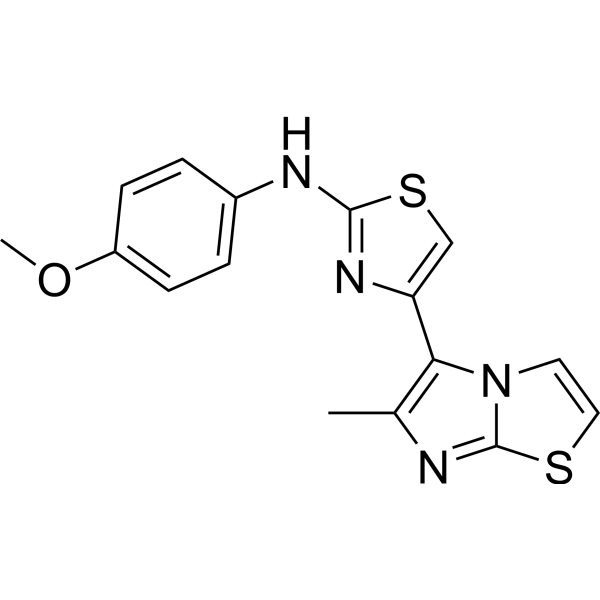
GM-90257 is a microtubule acetylation inhibitor. GM-90257 binds directly to α-tubulin. GM-90257 prevents the recruitment of α-tubulin acetyltransferase 1 (αTAT1) to the K40 residue in α-tubulin. GM-90257 causes Apoptosis, downregulates BCl-2, and activates JNK and PARP. GM-90257 has anticancer activity against breast cancer.
Nur für Forschungszwecke. Wir verkaufen nicht an Patienten.
- Reinheit : 99.90%
- CAS. Nr.: 315703-81-2
- Formel: C16H14N4OS2
- Molecular Weight:342.44
-
Speicherung:
-20°C, protect from light
* In solvent : -80°C, 6 months; -20°C, 1 month (protect from light)

To place orders, for customer services and technical support, please contact: MedChemExpress USA
Tel: 609-228-6898 E-mail: [email protected] [email protected]


-
 Biologische Aktivität
-
Chemical Information
-
Lösungsmittel & Löslichkeit
- Protokoll
- Reinheit & Dokumentation
- Verweise
-
 Help & FAQs


Publications Citing Use of MedChemExpress (MCE) GM-90257
More

Biologische Aktivität
Beschreibung
|
Bcl-2 |
In Vitro
GM-90257 (500-1000 nM) significantly reduces the colony formation of MDA-MB-231 cells in a concentration-dependent manner[1].
GM-90257 (500 nM) increases apoptosis in MDA-MB-231 cells, downregulating the anti-apoptotic protein BCl-2[1].
GM-90257 (1 μM; 24 h) induces TNBC cell death through JNK activation[2].
MedChemExpress (MCE) has not independently confirmed the accuracy of these methods. They are for reference only.
-
Cell Line:MDA-MB-231; α-TAT1 KO MDA-MB-231 cells
-
Concentration:500 nM, 1000 nM
-
Incubation Time:30 min (microtubule acetylation)
-
Result:Downregulated the anti-apoptotic protein Bcl-2 and activated PARP cleavage.
Reduced microtubule acetylation.
-
Cell Line:MDA-MB-231
-
Concentration:1 μM
-
Incubation Time:24 h
-
Result:Increased the phosphorylation of c-Jun, and ATF2.
Increased c-Fos protein levels.
Decreased Bcl2 expression.
In Vivo
GM-90257 (25 mg/kg; i.p.; every 2 days) inhibits tumor growth and metastasis and prolongs the survival of mice in the breast cancer xenograft model of NOD.Cg-Prkdscid/J mice[2].
MedChemExpress (MCE) has not independently confirmed the accuracy of these methods. They are for reference only.
-
Animal Model:Female NOD/SCID mice (8-12 weeks old), breast cancer xenograft model[1]
-
Dosage:25 mg/kg (DMSO)
-
Administration:Intraperitoneal injection, 15 days
-
Result:Significantly reduced the growth of tumors in mice.
Decreased the final tumor volume and weight in a concentration-dependent manner.
Markedly decreased the expression levels of acetyl-α-tubulin and Ki67 in sectioned tumor tissues.


Chemical Information
-
CAS. Nr. 315703-81-2
-
Appearance Solid
-
Molecular Weight 342.44
-
Formel C16H14N4OS2
-
Color Light brown to brown
-
SMILES
CC(N=C1SC=CN12)=C2C3=CSC(NC4=CC=C(C=C4)OC)=N3
-
Versand
Room temperature in continental US; may vary elsewhere.
-
Speicherung
-20°C, protect from light
* In solvent : -80°C, 6 months; -20°C, 1 month (protect from light)


Publications (1)
-
Journal Impact Factor
-
Most Recent


Lösungsmittel & Löslichkeit
In Vitro:
DMSO : 12.5 mg/mL (36.50 mM; ultrasonic and warming and heat to 60°C; Hygroscopic DMSO has a significant impact on the solubility of product, please use newly opened DMSO)
Please refer to the solubility information to select the appropriate solvent. Once prepared, please aliquot and store the solution to prevent product inactivation from repeated freeze-thaw cycles.
Storage method and period of stock solution: -80°C, 6 months; -20°C, 1 month (protect from light). When stored at -80°C, please use it within 6 months. When stored at -20°C, please use it within 1 month.
Please refer to the solubility information to select the appropriate solvent. Once prepared, please aliquot and store the solution to prevent product inactivation from repeated freeze-thaw cycles.
Storage method and period of stock solution: -80°C, 6 months; -20°C, 1 month (protect from light). When stored at -80°C, please use it within 6 months. When stored at -20°C, please use it within 1 month.
Konzentration (Stammlösung) × Volumen (Stammlösung) = Konzentration (Ziellösung) × Volumen (Ziellösung)
In Vivo:
Select the appropriate dissolution method based on your experimental animal and administration route.
- For the following dissolution methods, please ensure to first prepare a clear stock solution using an In Vitro approach and then sequentially add co-solvents:
- To ensure reliable experimental results, the clarified stock solution can be appropriately stored based on storage conditions. As for the working solution for In Vivo experiments, it is recommended to prepare freshly and use it on the same day.
- The percentages shown for the solvents indicate their volumetric ratio in the final prepared solution. If precipitation or phase separation occurs during preparation, heat and/or sonication can be used to aid dissolution.
Add each solvent one by one: 10% DMSO 40% PEG300 5% Tween-80 45% Saline
Solubility: ≥ 1.25 mg/mL (3.65 mM); Clear solution
This protocol yields a clear solution of ≥ 1.25 mg/mL (saturation unknown).
Taking 1 mL working solution as an example, add 100 μL DMSO stock solution (12.5 mg/mL) to 400 μL PEG300, and mix evenly; then add 50 μL Tween-80 and mix evenly; then add 450 μL Saline to adjust the volume to 1 mL.
Preparation of Saline: Dissolve 0.9 g sodium chloride in ddH₂O and dilute to 100 mL to obtain a clear Saline solution.
Add each solvent one by one: 10% DMSO 90% (20% SBE-β-CD in Saline)
Solubility: ≥ 1.25 mg/mL (3.65 mM); Clear solution
This protocol yields a clear solution of ≥ 1.25 mg/mL (saturation unknown).
Taking 1 mL working solution as an example, add 100 μL DMSO stock solution (12.5 mg/mL) to 900 μL 20% SBE-β-CD in Saline, and mix evenly.
Preparation of 20% SBE-β-CD in Saline (4°C, storage for one week): 2 g SBE-β-CD powder is dissolved in 10 mL Saline, completely dissolve until clear.
In Vivo Dissolution Calculator
Please enter the basic information of animal experiments:
-
-
-
-
Recommended: Prepare an additional quantity of animals to account for potential losses during experiments.
Please enter your animal formula composition:
-
%DMSO +
Recommended: Keep the proportion of DMSO in working solution below 2% if your animal is weak.
-
%+
-
+%Tween-80 + +
-
%Saline +
The co-solvents required include: DMSO, . All of co-solvents are available by MedChemExpress (MCE). , Tween 80. All of co-solvents are available by MedChemExpress (MCE).
Working solution concentration: 0.22 mg/mL
Method for preparing stock solution: mg drug dissolved in μL DMSO. Stock solution concentration: mg/mL. * In solvent : -80°C, 6 months; -20°C, 1 month (protect from light)
1. Take μL DMSO stock solution;
2. Add μL .
μL , mix evenly;
3. Then add μL Tween 80, mix evenly;
4. Then add μL
Please ensure that the stock solution in the first step is dissolved to a clear state, and add co-solvents in sequence. You can use ultrasonic heating (ultrasonic cleaner, recommended frequency 20-40 kHz), vortexing, etc. to assist dissolution.


Reinheit & Dokumentation
-
Data Sheet (281 KB)
-
SDS (252 KB)
- English - EN (252 KB)
- Français - FR (252 KB)
- Deutsch - DE (252 KB)
- Norwegian - NO (252 KB)
- Español - ES (252 KB)
- Swedish - SV (252 KB)
- Italian - IT (252 KB)
- Korean - KR (252 KB)
- Portuguese - PT (252 KB)
-
Handling Instructions (2659 KB)
Verweise
[1]. Ahreum Kwon, et al. Potent Small-Molecule Inhibitors Targeting Acetylated Microtubules as Anticancer Agents Against Triple-Negative Breast Cancer. Biomedicines. 2020 Sep 9;8(9):338. [Content Brief]
[2]. Ahn S, et al. Microtubule Acetylation-Specific Inhibitors Induce Cell Death and Mitotic Arrest via JNK/AP-1 Activation in Triple-Negative Breast Cancer Cells. Mol Cells. 2023 Jun 30;46(6):387-398. [Content Brief]


Complete Stock Solution Preparation Table
Please refer to the solubility information to select the appropriate solvent. Once prepared, please aliquot and store the solution to prevent product inactivation from repeated freeze-thaw cycles.
Storage method and period of stock solution: -80°C, 6 months; -20°C, 1 month (protect from light). When stored at -80°C, please use it within 6 months. When stored at -20°C, please use it within 1 month.
| Optional Solvent | Concentration Solvent Mass | 1 mg | 5 mg | 10 mg | 25 mg |
|---|---|---|---|---|---|
| DMSO | 1 mM | 2.9202 mL | 14.6011 mL | 29.2022 mL | 73.0055 mL |
| 5 mM | 0.5840 mL | 2.9202 mL | 5.8404 mL | 14.6011 mL | |
| 10 mM | 0.2920 mL | 1.4601 mL | 2.9202 mL | 7.3005 mL | |
| 15 mM | 0.1947 mL | 0.9734 mL | 1.9468 mL | 4.8670 mL | |
| 20 mM | 0.1460 mL | 0.7301 mL | 1.4601 mL | 3.6503 mL | |
| 25 mM | 0.1168 mL | 0.5840 mL | 1.1681 mL | 2.9202 mL | |
| 30 mM | 0.0973 mL | 0.4867 mL | 0.9734 mL | 2.4335 mL |


GM-90257 Related Classifications
HY-155956 Related Classifications
 Powered by Bioz