



Bcl-2 Family
Bcl-2 is a family of evolutionarily related proteins. These proteins govern mitochondrial outer membrane permeabilization (MOMP) and can be either pro-apoptotic (Bax, Bad, Bak and Bok among others) or anti-apoptotic (including Bcl-2 proper, Bcl-xL, and Bcl-w, among an assortment of others). There are a total of 25 genes in the Bcl-2 family known to date. Human genes encoding proteins that belong to this family include: Bak1, Bax, Bal-2, Bok, Mcl-1.
Bcl-2 Family Isoform Specific Products
-
Bcl-2 Family
(450)
View all products
-
Bcl-2
(328)
View all products
-
Bcl-xL
(123)
View all products
-
Bcl-W
(17)
View all products
-
Mcl-1
(99)
View all products
-
Bfl-1
(11)
View all products
-
Bcl-B
(6)
View all products
-
Bax
(220)
View all products
-
Bak
(14)
View all products
-
Bim
(14)
View all products
-
BNIP3
(1)
View all products
-
Bad
(10)
View all products
All Product Categories
-
Bcl-2 Family Inhibitors
(567)
View all products
-
Bcl-2 Family Agonists
(5)
View all products
-
Bcl-2 Family Antagonists
(9)
View all products
-
Bcl-2 Family Activators
(90)
View all products
-
Bcl-2 Family Modulators
(153)
View all products
-
Bcl-2 Family Inducers
(13)
View all products
-
Bcl-2 Family Degraders
(21)
View all products
-
Bcl-2 Family Controls
(2)
View all products
-
Bcl-2 Family Ligands
(9)
View all products
-
Bcl-2 Family Related Products (1047)
Related Products (1047)

-
Antibodies (31)
-
Bcl-2 Family Signaling Pathway
-
Bcl-2 Family Isoform Comparison
-
EGFR-IN-109
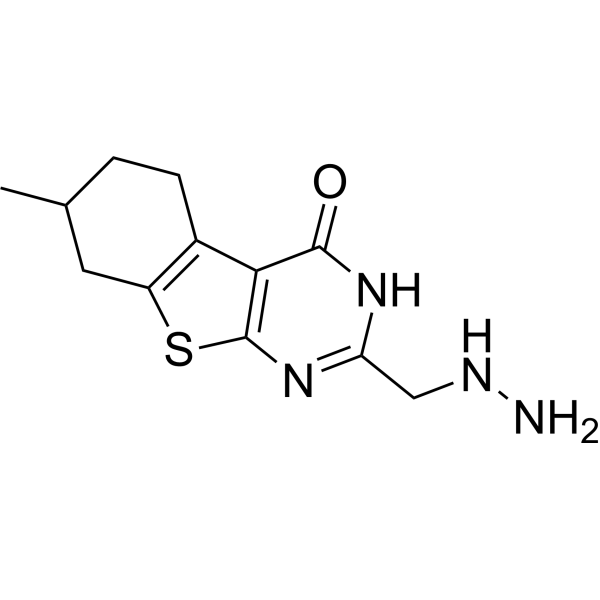 0 ImagesCat. No.: HY-162360CAS No.: 3019971-97-9
-
Mcl1-IN-3
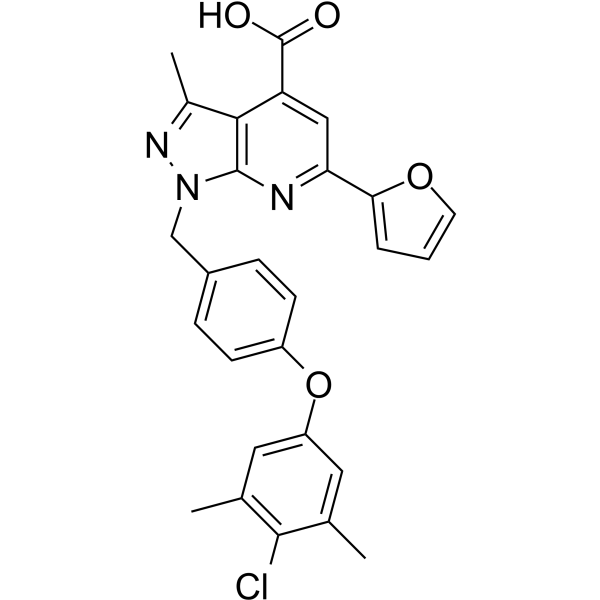 0 ImagesCat. No.: HY-111468CAS No.: 1814891-79-6Mcl1-IN-3 is an inhibitor of Mcl1 extracted from patent WO2015153959A2, compound example 57; has an IC50 and Ki of 0.67 and 0.13 μM, respectively.
-
HDAC-IN-91
 0 ImagesCat. No.: HY-175021HDAC-IN-91 is a multiple inhibitor of HDAC (IC50 = 134.22 nM for HDAC1, 66.29 nM for HDAC2), carbonic anhydrase (CA) (Ki = 72.03 nM for CA IX, 50.76 nM for XII), and tubulin polymerization ( IC50 = 2.56 μM). HDAC-IN-91 inhibits PARP1 and increases the Bax/Bcl-2 ratio. HDAC-IN-91 blocks the cell cycle at the G2/M phase and induces apoptosis through a mitochondrial apoptosis activation mechanism. HDAC-IN-91 can exert potent cytotoxic activity through tubulin polymerization inhibition. HDAC-IN-91 can be used in breast, colorectal, cervical and lung cancer research.
-
Clitocine (Standard)
 0 ImagesCat. No.: HY-118341RCAS No.: 105798-74-1H-Chpro-OH.HCl (Standard) is the analytical standard of H-Chpro-OH.HCl. This product is intended for research and analytical applications. H-Chpro-OH.HCl is a proline derivative.


-
Bfl-1-IN-6
 0 ImagesCat. No.: HY-170434CAS No.: 3106363-91-8Bfl-1-IN-6 is an orally active BFL1 inhibitor with an IC50 of 19 nM. Bfl-1-IN-6 selectively binds covalently to BFL1, stabilizes the protein and displaces BIM from BFL1, thereby inducing apoptosis activity. Bfl-1-IN-6 stabilizes BFL1 protein, activates cleaved caspase 3, and exhibits antitumor activity in mouse models. Bfl-1-IN-6 can be used for the research of hematological malignancies.
-
trans-Vaccenic acid (Standard)
 0 ImagesCat. No.: HY-113427RCAS No.: 693-72-1trans-Vaccenic acid (Standard) is the analytical standard of trans-Vaccenic acid (HY-113427). This product is intended for research and analytical applications. trans-Vaccenic acid is a naturally occurring trans fatty acid (TFA). trans-Vaccenic acid inhibits nasopharyngeal carcinoma (NPC) cell growth and induces apoptosis through the inhibition of Bad/Akt phosphorylation. trans-Vaccenic acid is a precursor for the synthesis of saturated fatty acid in the rumen and of conjugated Linoleic acid (CLA) at the tissue level. trans-Vaccenic acid exerts hypolipidemic effects in a rat model of obesity.

-
p53 DUBTAC modulator-1
 0 ImagesCat. No.: HY-180618CAS No.: 3133073-71-6p53 DUBTAC modulator-1 (Compound A1) is a p53 Y220C DUBTAC modulator (Kd = 12.09 µM). p53 DUBTAC modulator-1 effectively reactivates and deubiquitinates mutant p53 Y220C. p53 DUBTAC modulator-1 upregulates p53 Y220C protein levels. p53 DUBTAC modulator-1 induces Apoptosis, reduces Bcl-2, inhibits Wnt signaling. p53 DUBTAC modulator-1 has anti-cancer activity against liver cancer.
-
Multitarget AD-IN-8
 0 ImagesCat. No.: HY-189262Multitarget AD-IN-8 is a blood-brain barrier-penetrant, orally active multitarget inhibitor. Multitarget AD-IN-8 inhibits abnormal Tau phosphorylation at Thr181 and Ser396 sites and attenuates NF-κB phosphorylation. Multitarget AD-IN-8 downregulates BACE1 expression to reduce Aβ production, inhibits the Bax/Bcl-2 pathway, and suppresses Caspase-1 activation. Multitarget AD-IN-8 attenuates p38, ERK1/2, and JNK phosphorylation and inhibits Aβ25-35-induced Apoptosis. Multitarget AD-IN-8 exhibits neuroprotective effects against Aβ25-35-induced injury, ameliorates learning and memory deficits in AD mouse models, and alleviates hippocampal neuronal pathological damage. Multitarget AD-IN-8 can be used for research on Alzheimer's disease.

-
Bcl2l11 Mouse Pre-designed siRNA Set A
 0 ImagesCat. No.: HY-RS01428
Bcl2l11 Mouse Pre-designed siRNA Set A contains three designed siRNAs for Bcl2l11 gene (Mouse), as well as a negative control, a positive control, and a FAM-labeled negative control.
-
Bcl2a1 Rat Pre-designed siRNA Set A
 0 ImagesCat. No.: HY-RS01419
Bcl2a1 Rat Pre-designed siRNA Set A contains three designed siRNAs for Bcl2a1 gene (Rat), as well as a negative control, a positive control, and a FAM-labeled negative control.
-
EGFR-IN-201
 0 ImagesCat. No.: HY-181659CAS No.: 3103654-99-2EGFR-IN-201 is a potent EGFR inhibitor, with an IC50 of 0.091 μM against wild-type EGFR; for mutant EGFR variants, the IC50 values of EGFRT790M, EGFRL858R and EGFRC797S are 0.147 μM, 0.221 μM and 0.703 μM, respectively. EGFR-IN-201 inhibits EGFR downstream signaling proteins AKT1 (IC50 = 0.225 μg/mL) and ERK1 (IC50 = 0.705 μg/mL). EGFR-IN-201 induces G0/G1 cell cycle arrest, apoptosis and low-level necrosis in cancer cells. EGFR-IN-201 is applicable to research on cancers such as colon cancer.
-
EGFR-IN-134
 0 ImagesCat. No.: HY-168623EGFR-IN-134 (compound 3f), a triazolo[3,4-a]isoquinoline derivative, is a potent EGFR inhibitor with an IC50 of 0.023 µM. EGFR-IN-134 induces apoptosis and necrosis. EGFR-IN-134 initiates cell cycle arrest at the G2/M and pre-G1 phases, downregulates anti-apoptotic protein Bcl2 and upregulates pro-apoptotic proteins: p53, Bax, and caspases 3, 8, and 9. EGFR-IN-134 shows antiproliferative and anticancer activity.
-
FL113
 0 ImagesCat. No.: HY-187844CAS No.: 104155-89-7
-
Bcl-2-IN-26
 0 ImagesCat. No.: HY-184443CAS No.: 3119834-80-6Bcl-2-IN-26 is an inhibitor targeting β-tubulin and BCL-2. Bcl-2-IN-26 disrupts the intracellular microtubule network and interferes with cell mitosis, inducing G2/M phase cell cycle arrest. Bcl-2-IN-26 suppresses antiapoptotic BCL-2 function via p53 upregulation, thereby triggering mitochondrial dysfunction, elevated ROS production and robust tumor cell apoptosis. Bcl-2-IN-26 can be used in lung cancer research.
-
Rosomidnar
 0 ImagesCat. No.: HY-153494CAS No.: 871597-03-4Synonyms: PNT100PNT100 is a 24-base, chemically unmodified DNA oligonucleotide sequence that is complementary to the regulatory region upstream of the BCL-2 gene. Exposure of tumor cells to PNT100 results in suppression of proliferation and cell death.
-
PQ-1
 0 ImagesCat. No.: HY-14584CAS No.: 955995-48-9PQ-1 is a gap junction enhancer.




