



Epigenetic Reader Domain
Epigenetic regulators of gene expression and chromatin state include so-called writers, erasers, and readers of chromatin modifications.Well-characterized examples of reader domains include bromodomains typically binding acetyllysine and chromatin organization modifier (chromo), malignant brain tumor (MBT), plant homeodomain (PHD), and Tudor domains generally associating with methyllysine. Research on epigenetic readers has been tremendously influenced by the discovery of selective inhibitors targeting the bromodomain and extraterminal motif (BET) family of acetyl-lysine readers. The human genome encodes 46 proteins containing 61 bromodomains clustered into eight families. Distinct experimental approaches are used to identify the first BET inhibitors, GSK 525762A and (+)-JQ-1.
The Polycomb group (PcG) protein, enhancer of zeste homologue 2 (EZH2), has an essential role in promoting histone H3 lysine 27 trimethylation (H3K27me3) and epigenetic gene silencing. This function of EZH2 is important for cell proliferation and inhibition of cell differentiation, and is implicated in cancer progression. Cyclin-dependent kinases regulate epigenetic gene silencing through phosphorylation of EZH2. In many types of cancers including lymphomas and leukemia, EZH2 is postulated to exert its oncogenic effects via aberrant histone and DNA methylation, causing silencing of tumor suppressor genes.
p300/CBP is not only a transcriptional adaptor but also a histone acetyltransferase.
Epigenetic Reader Domain Isoform Specific Products
-
Epigenetic Reader Domain
(448)
View all products
-
Brd
(3)
View all products
-
BRPF1
(9)
View all products
-
BRPF2
(5)
View all products
-
BRPF3
(2)
View all products
-
BRD2
(66)
View all products
-
BRD3
(61)
View all products
-
BRD4
(298)
View all products
-
BRDT
(26)
View all products
-
CECR2
(4)
View all products
-
BD1
(9)
View all products
-
BD2
(9)
View all products
-
BRD7
(9)
View all products
-
BRD9
(55)
View all products
-
BET
(22)
View all products
-
BAZ
(1)
View all products
All Product Categories
-
Epigenetic Reader Domain Inhibitors
(589)
View all products
-
Epigenetic Reader Domain Agonists
(3)
View all products
-
Epigenetic Reader Domain Antagonists
(2)
View all products
-
Epigenetic Reader Domain Activators
(11)
View all products
-
Epigenetic Reader Domain Modulators
(3)
View all products
-
Epigenetic Reader Domain Chemicals
(2)
View all products
-
Epigenetic Reader Domain Inducer
(1)
View all products
-
Epigenetic Reader Domain Degraders
(171)
View all products
-
Epigenetic Reader Domain Controls
(13)
View all products
-
Epigenetic Reader Domain Substrate
(1)
View all products
-
Epigenetic Reader Domain Ligands
(28)
View all products
-
Epigenetic Reader Domain Related Products (902)
Related Products (902)

-
Antibodies (109)
-
Epigenetic Reader Domain Isoform Comparison
-
(S)-dHTC1
 0 ImagesCat. No.: HY-173631CAS No.: 3081383-46-9(S)-dHTC1 is a molecular glue degrader targeting the transcriptional co-activator ENL. (S)-dHTC1 binds the ligase with high affinity only after forming the ENL:dHTC1 complex with an IC50 value of 93 nM. (S)-dHTC1 degrades ENL in MV4;11 cells with a DC50 value of 26 nM. (S)-dHTC1 can be used for acute myeloid leukemia study.
-
PROTAC BRD4 Degrader-23
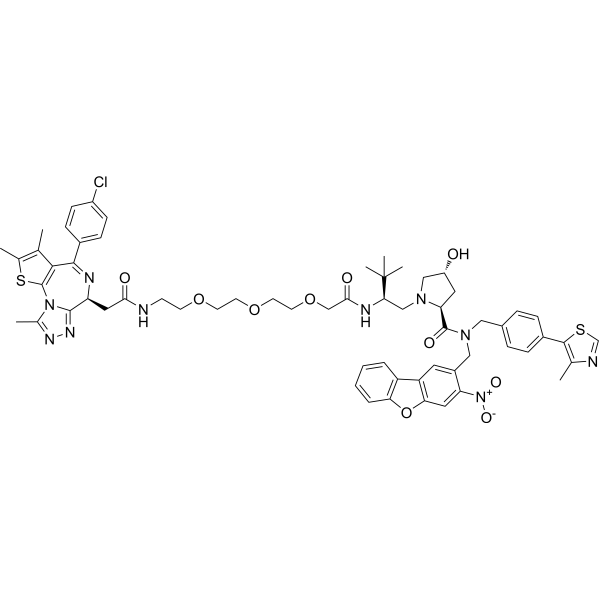 0 ImagesCat. No.: HY-161093PROTAC BRD4 Degrader-23 is a visible light-regulated BRD4 PROTAC degrader, with DC50 values of 6871 nM and < 30 nM in the dark and under light exposure, respectively; its IC50 values are 1172 nM and 140 nM under the corresponding conditions. PROTAC BRD4 Degrader-23 shows inhibited activity in dark environments, and recovers BRD4 degradation ability upon irradiation with 405 nm visible light. PROTAC BRD4 Degrader-23 inhibits tumor cell proliferation in a visible light-dependent manner. PROTAC BRD4 Degrader-23 can be used in studies of BRD4-dependent B-cell lymphoma.
-
PROTAC BRD4 Degrader-28
 0 ImagesCat. No.: HY-170808PROTAC BRD4 Degrader-28 is a PROTAC degrader targeting BRD4, with a DC50 of 5.4 nM for BRD4 in HEK293 cells. PROTAC BRD4 Degrader-28 binds to the CRBN E3 ubiquitin ligase, forms a ternary complex with BRD4, and thereby mediates the ubiquitination and proteasomal degradation of BRD4. PROTAC BRD4 Degrader-28 can be used in cancer research.
-
BRD9 ligand-5
 0 ImagesCat. No.: HY-169988CAS No.: 2633634-64-5
-
PROTAC BRD4 Degrader-27
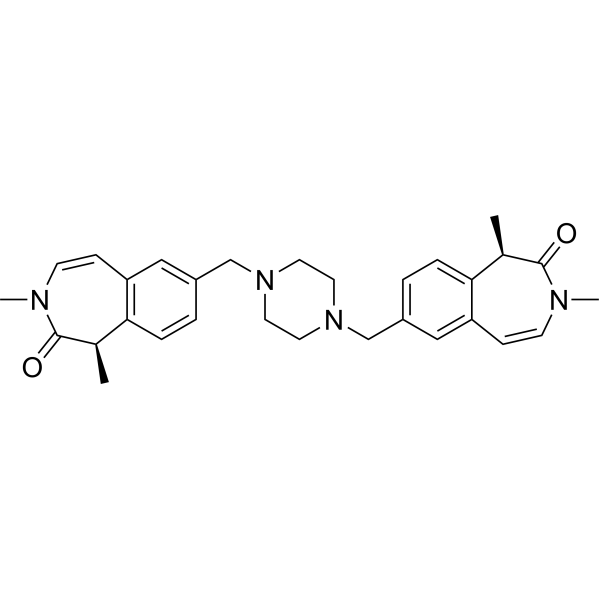
 0 ImagesCat. No.: HY-162875CAS No.: 2407163-44-2PROTAC BRD4 Degrader-27 is a selective cereblon-mediated BRD4 PROTAC degrader. PROTAC BRD4 Degrader-27 exhibits anticancer activity, induces G1 phase arrest, and inhibits DNA synthesis and colony formation. PROTAC BRD4 Degrader-27 suppresses HCC1806 tumor growth in xenograft mouse models. PROTAC BRD4 Degrader-27 can be used in breast cancer-related research.
-
BET-IN-7
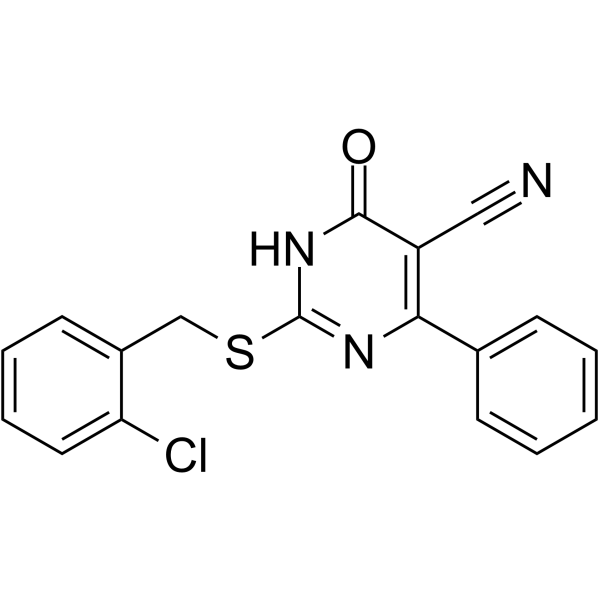 0 ImagesCat. No.: HY-146291CAS No.: 303985-05-9

-
PARP1/BRD4-IN-2
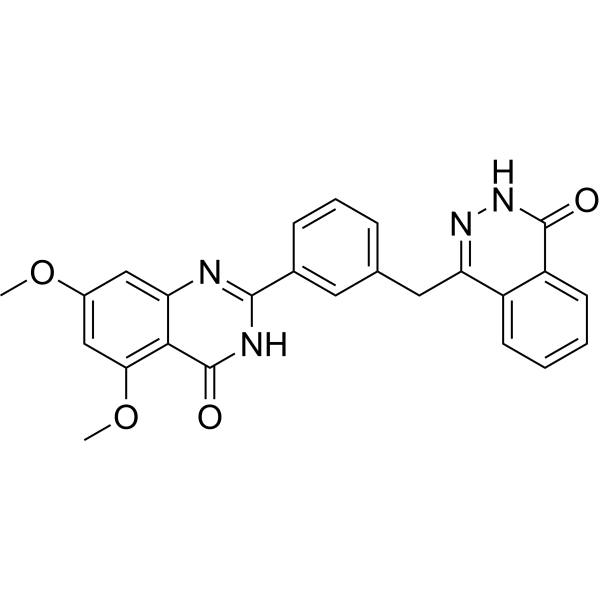 0 ImagesCat. No.: HY-150613CAS No.: 3037993-97-5PARP1/BRD4-IN-2 is a potent and selective PARP1 and BRD4 inhibitor with IC50 values of 197 nM and 238 nM, respectively. PARP1/BRD4-IN-2 inhibits DNA damage repair, arrests G0/G1 transition and induces apoptosis. PARP1/BRD4-IN-2 has anti-tumor activity in MDA-MB-468 xenograft mouse model. PARP1/BRD4-IN-2 can be used for researching triple-negative breast cancer (TNBC).
-
BET-IN-21
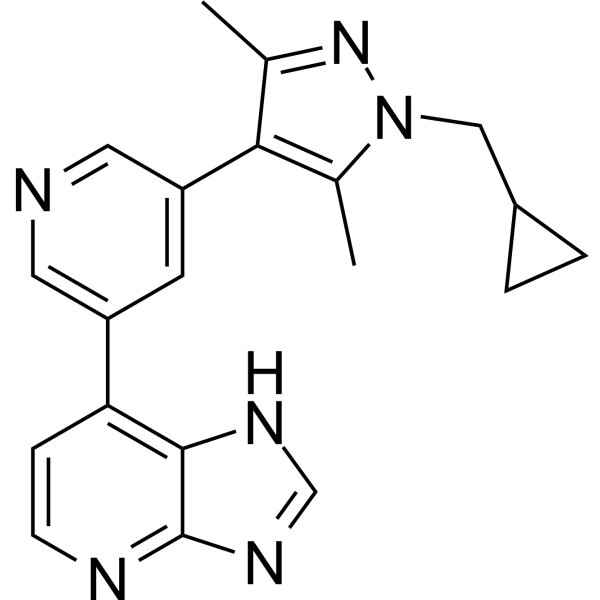 0 ImagesCat. No.: HY-157430CAS No.: 3014815-06-3BET-IN-21 (compound 16) is a blood-brain barrier-permeable extra terminal domain (BET) inhibitor with the Ki of 230 nM. BET-IN-21 inhibits microglia activation and has ameliorative effects on experimental autoimmune encephalomyelitis mice.

-
LGF308
 0 ImagesCat. No.: HY-181756CAS No.: 3061406-69-4LGF308 is a PROTAC degrader of BRD4 that exhibits selective cytotoxicity toward cancer cells over normal cells. LGF308 mediates the formation of a ternary complex between BRD4 and DCAF11 to achieve BRD4 degradation. LGF308 induces tumor cell apoptosis by upregulating apoptosis-related proteins. LGF308 inhibits tumor cell proliferation and migration in breast cancer and triple-negative breast cancer cell lines. LGF308 can be used for the research of breast cancer.
-
Artepillin C (Standard)
 0 ImagesCat. No.: HY-N10319RCAS No.: 72944-19-5Artepillin C (Standard) is the analytical standard of Artepillin C (HY-N10319). This product is intended for research and analytical applications. Artepillin C is an orally active CREB/CRTC2 inhibitor and TRPA1 covalent agonist (EC50=1.8 μM). Artepillin C inhibits CREB/CRTC2-mediated gene transcription and downregulates BMAL1 expression to regulate glucose and lipid metabolism. Artepillin C can also activate TRPA1 channels to induce spicy taste signals. Artepillin C can inhibit tumor cell proliferation, induce apoptosis, improve insulin resistance and inhibit liver lipid synthesis. Artepillin C can be used in the study of metabolic syndrome, tumor prevention and treatment, and inflammation.
-
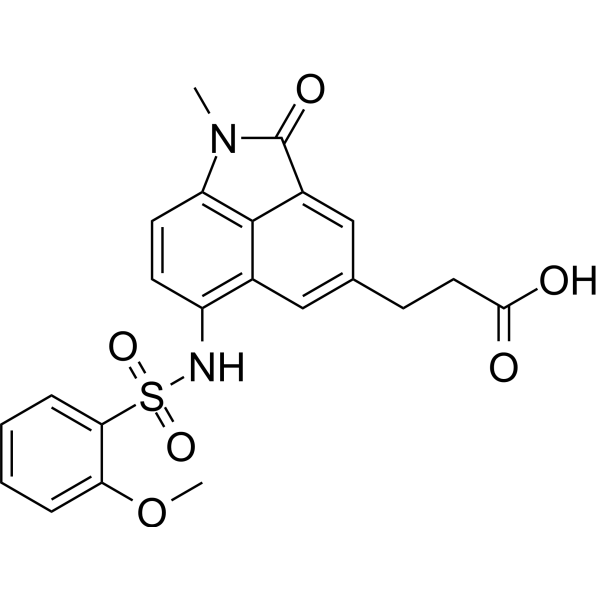
EP300/CBP ligand 2
 0 ImagesCat. No.: HY-161960EP300/CBP ligand 2 (compound S19) is a ligand targeting the bromodomain of CREB binding protein (CBP) and E1A-associated protein (EP300). EP300/CBP ligand 2 can be used as a target protein ligand in the PROTAC structure, and can be coupled to the E3 ubiquitin ligase ligand through the PTOTAC Linker to synthesize PROTAC molecules with degradation effects. For example, EP300/CBP ligand 2 can be coupled with the conjugate (E3 ubiquitin enzyme ligand + Linker) Thalidomide-NH-C10-Boc (HY-161961) to produce the PROTAC molecule dCE-2 (HY-161958).
-
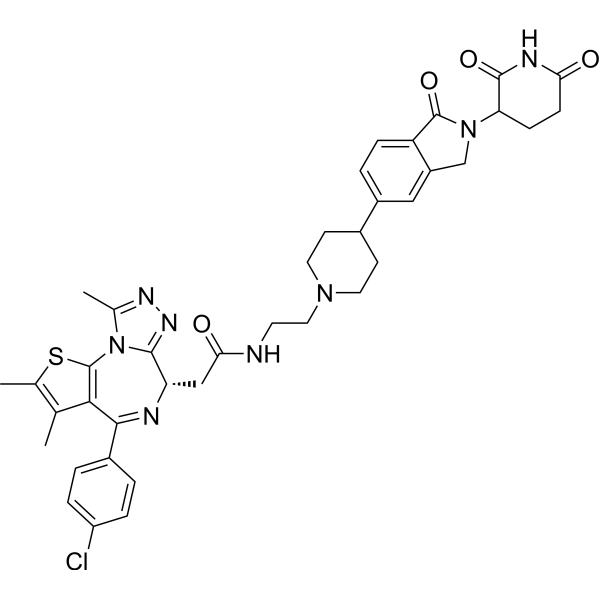
CPI-203-PEG1-C3-O-COOH
 0 ImagesCat. No.: HY-42429CAS No.: 1997304-12-7CPI-203-PEG1-C3-O-COOH is a conjugate of the BRD4 ligand (HY-78695) and the linker (HY-42427). CPI-203-PEG1-C3-O-COOH can be used for synthesizing PROTAC BRD4 degrader ARV-771 (HY-100972).
-
BET-IN-18
 0 ImagesCat. No.: HY-155891CAS No.: 874594-37-3BET-IN-18 (Compound 3) is a pan-BET bromodomain small-molecule inhibitor, with Ki values of 0.69 μM and 0.37 μM, and Kd values of 1.6 μM and 8.4 μM against BrdT (1) and Brd4 (1) bromodomains, respectively. BET-IN-18 potently and competitively inhibits the binding of the known BET inhibitor (+)-JQ1 (HY-13030) to Brd4 (1) and BrdT (1), with IC50 values of 1.0 μM and 2.3 μM, respectively. BET-IN-18 also competitively inhibits the binding of acetylated histone substrates to Brd4 (1) (IC50 = 0.90 μM). BET-IN-18 can be used in the research of multiple myeloma.
-
PROTAC BRD4 Degrader-37
 0 ImagesCat. No.: HY-175225PROTAC BRD4 Degrader-37 is a BRD4 PROTAC degrader with a DC50 of 36.4 nM. PROTAC BRD4 Degrader-37 recruits the E3 ubiquitin ligase TRIM21, binds to the PRYSPRY domain of TRIM21 (KD = 123 nM), and thereby mediates the ubiquitination and degradation of BRD4. PROTAC BRD4 Degrader-37 exhibits cytotoxicity against PANC-1 cells (GI50 = 0.282 μM). PROTAC BRD4 Degrader-37 can be used in studies related to pancreatic cancer.
-
PCAF/GCN5 ligand 1
 0 ImagesCat. No.: HY-181279CAS No.: 1209224-91-8PCAF/GCN5 ligand 1 is a PCAF/GCN5 ligand with high binding affinity. PCAF/GCN5 ligand 1 shows no functional effect on PCAF/GCN5 activity. PCAF/GCN5 ligand 1 undergoes optimization into a potent and selective PCAF/GCN5 ligand GSK4027 (HY-101027).




