



Minoxidil sulfate

Based on 1 Customer Validation
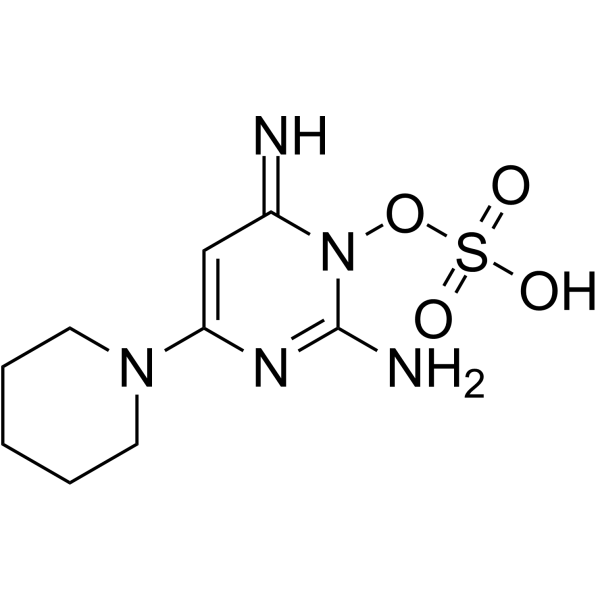
Minoxidil sulfate (U10858 sulfate) is an orally active ATP-sensitive potassium channel opener and vasodilator. Minoxidil sulfate activates Wnt/β-catenin signaling pathway, increases ERK and Akt phosphorylation, upregulates Bcl-2 and downregulates Bax, thereby promoting dermal papilla cell proliferation and hair follicle elongation. Minoxidil sulfate downregulates IL-1α, inhibits T lymphocyte activity, reduces 5α-reductase expression, and attenuates the transcriptional activity of androgen receptor. Minoxidil sulfate is converted by hair follicle sulfotransferase to Minoxidil sulfate, shortening telogen and prolonging anagen. Minoxidil sulfate can be used in research related to hair loss.
Nos produits utilisent uniquement pour la recherche. Nous ne vendons pas aux patients.
- Pureté : 99.77%
- CAS No.: 83701-22-8
- Formule: C9H15N5O4S
- Masse moléculaire:289.31
-
Stockage:
-20°C, sealed storage, away from moisture and light
* In solvent : -80°C, 6 months; -20°C, 1 month (sealed storage, away from moisture and light)

To place orders, for customer services and technical support, please contact: MedChemExpress USA
Tel: 609-228-6898 E-mail: [email protected] [email protected]


-
 Activité biologique
-
Chemical Information
-
Solvant et solubilité
- Protocole
- Pureté et documentation
- Références
-
 Help & FAQs




Activité biologique
Description
|
IL-1α |
Bax |
Bcl-2 |
Akt |
In Vitro
Minoxidil sulfate slightly increases 5α-reductase activity in dermal papilla cells from balding scalp, but has no such effect in cells from non-balding scalp[1].
Minoxidil sulfate identifies responder and non-responder samples in the isolated hair follicle sulfotransferase assay with an OD cutoff of 0.4, with a sensitivity of 95% and a specificity of 73%[1].
Minoxidil (0.01-1.0 μM; 5 days) sulfate promotes the proliferation of human DPCs, with 1.0 μM producing the largest reported increase (108%)[2].
Minoxidil (0.1-1.0 μM; 1 h) sulfate activates ERK and Akt phosphorylation in human DPCs, with 1.0 μM producing the maximum increase[2].
Minoxidil (0.01-1.0 mM; 10 days) sulfate prolongs human scalp hair follicles in organ culture, with 1.0 mM producing the maximum reported elongation (1.6 mm; 51%) in concentration-response experiments[2].
Minoxidil sulfate increases the passage cell count of confluent neonatal foreskin keratinocytes, with activity reaching maximum at 6‑12 μg/mL; however, it cannot extend the passage number of log-phase neonatal foreskin keratinocytes on 3T3 feeder layers, and countable cells can only be maintained until passage 6[1].
Minoxidil sulfate does not increase the 7-day cell number of NORAH 1 human keratinocytes grown without a 3T3 feeder layer under SC1, SC3, or SC8 conditions, indicating a failure to maintain the germinative pool during logarithmic-phase growth[3].
Minoxidil sulfate increases the passage cell count of confluent human keratinocytes maintained for 4 weeks, but cholera toxin reduces this effect, consistent with a mechanism independent of cyclic adenosine monophosphate elevation[3].
Minoxidil sulfate increases the cell number of cultured human keratinocytes across the 2-40 mM calcium range and protects against high-calcium growth inhibition, with a count of 8.30 × 10⁻⁵[3] at 2 mM.
Minoxidil (0.1-100 µM; 2-7 days) sulfate does not alter the proliferation of human ASCs[5].
Minoxidil (20-50 µM; 2-4 days) sulfate increases human ASC migration in scratch wound healing and Transwell assays[5].
Minoxidil (20-50 µM) sulfate upregulates CXCL1, PD-ECGF, and PDGF-C mRNA in human ASCs; it induces the expression of PD-ECGF and PDGF-C in human ASCs through ERK phosphorylation, whereas the upregulation of CXCL1 is independent of ERK[5].
Minoxidil (0.01-5 mM; 7 days) sulfate inhibits the proliferation of proliferating hRPE and hTCF cells, with half-maximal effective concentrations of 1.5 mM and 2.5 mM, respectively, whereas the number of cells in density-arrested cultures changes minimally, with hRPE viability decreasing only at 5 mM[7].
Minoxidil (5 mM; 15 minutes-7 days) sulfate produces a duration-of-exposure-dependent antiproliferative effect, with hRPE reaching half-maximal effect at 15 hours and hTCF at 80 hours[7].
Minoxidil sulfate persistently inhibits hRPE and hTCF proliferation at 3-5 mM during a 7-day reagent-free recovery period, whereas 1-2 mM allows partial regrowth[7].
Minoxidil (7 days) sulfate exposure of density-arrested hRPE reduces reattachment at 3-4 mM, 4 mM prevents subsequent proliferation, while 1-3 mM permits proliferation similar to the control[7].
Minoxidil (1-5 mM) sulfate induces dose-dependent morphological changes in hRPE and hTCF, which are more pronounced in proliferating cells and show obvious reversal after removal[7].
Minoxidil sulfate inhibits hRPE lysyl hydroxylase activity by up to 71% at 1 mM after 72 hours and does not affect prolyl hydroxylase, with the inhibition completely reversed within 48 hours after removal[7].
MedChemExpress (MCE) has not independently confirmed the accuracy of these methods. They are for reference only.
In Vivo
Minoxidil (5%; topical administration; five times per week) sulfate accelerates hair regrowth in the LPS-induced telogen effluvium mouse model, with a regrowth rate of 98.9% on day 13 and complete regrowth on day 17[4].
Minoxidil (preconditioned adipose-derived stem cells; subcutaneous injection; single administration) sulfate promotes the transition of hair follicles from telogen to anagen, increases the number of mature hair follicles, and induces Ki67-positive cell proliferation in the dermal papilla in telogen C3H/HeN mice, exerting a stronger hair growth-promoting effect[5].
Minoxidil (2%; topical administration; for 14 consecutive days) sulfate alone produces lower hair weight in C3H/HeN shaved mice than when combined with CXCL1, PD-ECGF, or PDGF-C[5].
MedChemExpress (MCE) has not independently confirmed the accuracy of these methods. They are for reference only.
- Western Blot
- RNA extraction experimental
- BrdU Incorporation Assay
- Somatic Cell Culture
- CFSE Dye Dilution Proliferation Assay
- Dye-dilution cell tracking and proliferation staining
- CCK-8/WST-8 Cell Proliferation Assay
- Protocol for Cell Cycle
- Cell Counting-Based Growth Curve Assay
- Colony Formation (Clonogenic) Assay
- Cell Viability Determination by MTT Colorimetric Assay
- Kinase activity and phosphorylation assays
- EdU Incorporation Assay (Click Chemistry-Based DNA Synthesis Measurement)
- Dual Luciferin reporter gene assay
- Ki-67 Immunostaining Proliferation Assay
- PCNA Immunodetection Proliferation Assay
- Protocol for Cell Counting and Cell Density Analysis
- Research Protocol for Endocrine Diseases
- Protocol for Kinase activity and phosphorylation assays
- MTT Cell Proliferation Assay


Chemical Information
-
CAS No. 83701-22-8
-
Appearance Solid
-
Masse moléculaire 289.31
-
Formule C9H15N5O4S
-
Color White to off-white
-
SMILES
NC1=NC(N2CCCCC2)=CC(N1OS(=O)(O)=O)=N
-
Livraison
Room temperature in continental US; may vary elsewhere.
-
Stockage
-20°C, sealed storage, away from moisture and light
* In solvent : -80°C, 6 months; -20°C, 1 month (sealed storage, away from moisture and light)


Solvant et solubilité
In Vitro:
DMSO : 100 mg/mL (345.65 mM; Need ultrasonic; Hygroscopic DMSO has a significant impact on the solubility of product, please use newly opened DMSO)
Please refer to the solubility information to select the appropriate solvent. Once prepared, please aliquot and store the solution to prevent product inactivation from repeated freeze-thaw cycles.
Storage method and period of stock solution: -80°C, 6 months; -20°C, 1 month (sealed storage, away from moisture and light). When stored at -80°C, please use it within 6 months. When stored at -20°C, please use it within 1 month.
Concentration (start) × Volume (start) = Concentration (final) × Volume (final)
In Vivo:
Select the appropriate dissolution method based on your experimental animal and administration route.
- For the following dissolution methods, please ensure to first prepare a clear stock solution using an In Vitro approach and then sequentially add co-solvents:
- To ensure reliable experimental results, the clarified stock solution can be appropriately stored based on storage conditions. As for the working solution for In Vivo experiments, it is recommended to prepare freshly and use it on the same day.
- The percentages shown for the solvents indicate their volumetric ratio in the final prepared solution. If precipitation or phase separation occurs during preparation, heat and/or sonication can be used to aid dissolution.
Add each solvent one by one: 10% DMSO 40% PEG300 5% Tween-80 45% Saline
Solubility: 2.5 mg/mL (8.64 mM); Clear solution; Need ultrasonic
This protocol yields a clear solution of 2.5 mg/mL.
Taking 1 mL working solution as an example, add 100 μL DMSO stock solution (25.0 mg/mL) to 400 μL PEG300, and mix evenly; then add 50 μL Tween-80 and mix evenly; then add 450 μL Saline to adjust the volume to 1 mL.
Preparation of Saline: Dissolve 0.9 g sodium chloride in ddH₂O and dilute to 100 mL to obtain a clear Saline solution.
Add each solvent one by one: 10% DMSO 90% (20% SBE-β-CD in Saline)
Solubility: ≥ 2.5 mg/mL (8.64 mM); Clear solution
This protocol yields a clear solution of ≥ 2.5 mg/mL (saturation unknown).
Taking 1 mL working solution as an example, add 100 μL DMSO stock solution (25.0 mg/mL) to 900 μL 20% SBE-β-CD in Saline, and mix evenly.
Preparation of 20% SBE-β-CD in Saline (4°C, storage for one week): 2 g SBE-β-CD powder is dissolved in 10 mL Saline, completely dissolve until clear.
In Vivo Dissolution Calculator
Please enter the basic information of animal experiments:
-
-
-
-
Recommended: Prepare an additional quantity of animals to account for potential losses during experiments.
Please enter your animal formula composition:
-
%DMSO +
Recommended: Keep the proportion of DMSO in working solution below 2% if your animal is weak.
-
%+
-
+%Tween-80 + +
-
%Saline +
The co-solvents required include: DMSO, . All of co-solvents are available by MedChemExpress (MCE). , Tween 80. All of co-solvents are available by MedChemExpress (MCE).
Working solution concentration: 0.22 mg/mL
Method for preparing stock solution: mg drug dissolved in μL DMSO. Stock solution concentration: mg/mL. * In solvent : -80°C, 6 months; -20°C, 1 month (sealed storage, away from moisture and light)
1. Take μL DMSO stock solution;
2. Add μL .
μL , mix evenly;
3. Then add μL Tween 80, mix evenly;
4. Then add μL
Please ensure that the stock solution in the first step is dissolved to a clear state, and add co-solvents in sequence. You can use ultrasonic heating (ultrasonic cleaner, recommended frequency 20-40 kHz), vortexing, etc. to assist dissolution.


Pureté et documentation


Références

Complete Stock Solution Preparation Table
Please refer to the solubility information to select the appropriate solvent. Once prepared, please aliquot and store the solution to prevent product inactivation from repeated freeze-thaw cycles.
Storage method and period of stock solution: -80°C, 6 months; -20°C, 1 month (sealed storage, away from moisture and light). When stored at -80°C, please use it within 6 months. When stored at -20°C, please use it within 1 month.
| Optional Solvent | Concentration Solvent Mass | 1 mg | 5 mg | 10 mg | 25 mg |
|---|---|---|---|---|---|
| DMSO | 1 mM | 3.4565 mL | 17.2825 mL | 34.5650 mL | 86.4125 mL |
| 5 mM | 0.6913 mL | 3.4565 mL | 6.9130 mL | 17.2825 mL | |
| 10 mM | 0.3456 mL | 1.7282 mL | 3.4565 mL | 8.6412 mL | |
| 15 mM | 0.2304 mL | 1.1522 mL | 2.3043 mL | 5.7608 mL | |
| 20 mM | 0.1728 mL | 0.8641 mL | 1.7282 mL | 4.3206 mL | |
| 25 mM | 0.1383 mL | 0.6913 mL | 1.3826 mL | 3.4565 mL | |
| 30 mM | 0.1152 mL | 0.5761 mL | 1.1522 mL | 2.8804 mL | |
| 40 mM | 0.0864 mL | 0.4321 mL | 0.8641 mL | 2.1603 mL | |
| 50 mM | 0.0691 mL | 0.3456 mL | 0.6913 mL | 1.7282 mL | |
| 60 mM | 0.0576 mL | 0.2880 mL | 0.5761 mL | 1.4402 mL | |
| 80 mM | 0.0432 mL | 0.2160 mL | 0.4321 mL | 1.0802 mL | |
| 100 mM | 0.0346 mL | 0.1728 mL | 0.3456 mL | 0.8641 mL |


Minoxidil sulfate Related Classifications
HY-B1445 Related Classifications
 Powered by Bioz
Keywords
- Minoxidil
- 83701-22-8
- Potassium Channel
- 5 alpha Reductase
- Interleukin Related
- PERK
- Akt
- Bcl-2 Family
- Wnt
- β-catenin
- KcsA
- 5α-reductase
- IL
- Protein kinase R-like endoplasmic reticulum kinase
- PKR-like endoplasmic reticulum kinase
- PKB
- Protein kinase B
- Beta catenin
- ATP-sensitive potassium channel opener
- Akt phosphorylation
- ERK phosphorylation
- HIF-1α/VEGF-mediated follicular capillary fenestration
- Wnt/β-catenin signaling
- androgen receptor
- androgenetic alopecia
- dermal papilla cell proliferation
- vasodilator
- Inhibitor
- inhibitor
- inhibit