1. Search Result
Search Result
Pathways Recommended: Stem Cell/Wnt Cell Cycle/DNA Damage
Results for "

PC3 human prostate cancer cell

" in MedChemExpress (MCE) Product Catalog:

18

Inhibitors & Agonists

1

Fluorescent Dyes

1

Peptides

5

Natural
Products

Cat. No. Product Name Target Research Areas Chemical Structure
  • HY-P5990

    PSMA Cancer
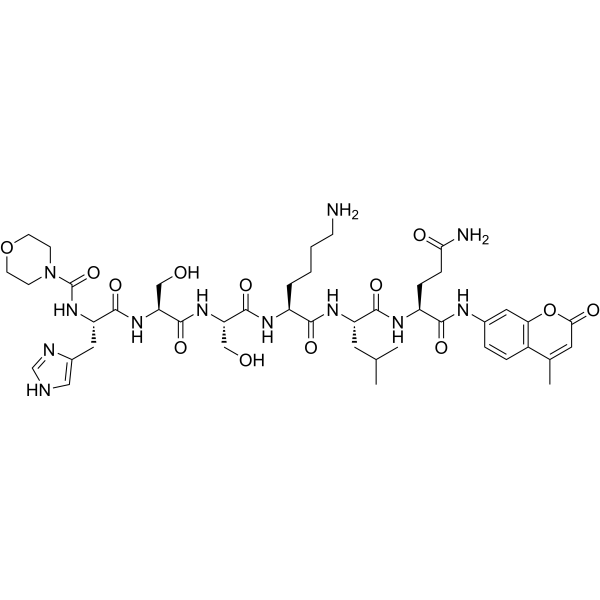
    Prostate Specific Antigen Substrate is a highly specific fluorescent peptide substrate can be used for measuring prostate-specific antigen (PSA) enzymatic activity .
    Prostate Specific Antigen Substrate
  • HY-N16066

    CHNQD-0803

    AMPK Apoptosis NF-κB TNF Receptor Inflammation/Immunology
    Candidusin A (CHNQD-0803) (Compound 4) is a AMPK activator with a KD of 47.28 nM. Candidusin A can be isolated from marine fungus Aspergillus candidus. Candidusin A has cytotoxic activity and induces apoptosis in human prostate cancer cells (22Rv1, PC-3 and LNCaP cells). Candidusin A reduces adipogenesis genes expression and fat deposition, negatively regulates the NF-κB-TNFα inflammatory axis to suppress inflammation, and ameliorates liver injury and fibrosis. Candidusin A can be used for non-alcoholic steatohepatitis (NASH) research .
    Candidusin A
  • HY-A0287

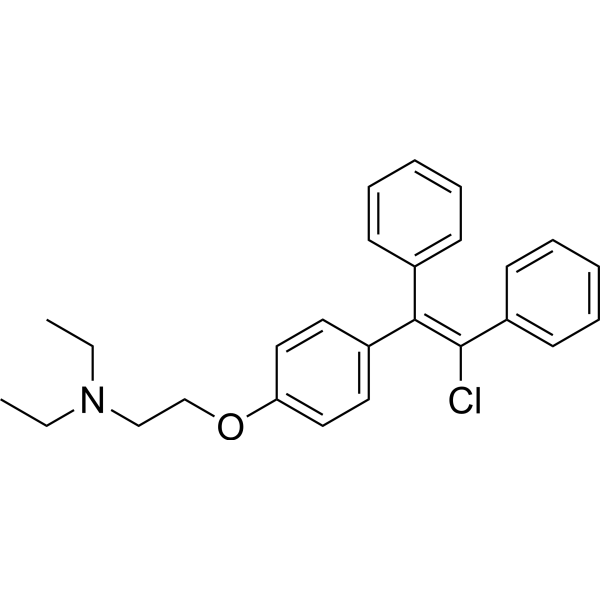
    Clomifene; (Z/E)-Enclomiphene; (Z/E)-Enclomifene

    Estrogen Receptor/ERR Metabolic Disease Cancer
    Clomiphene (Clomifene; (Z/E)-Enclomiphene; (Z/E)-Enclomifene) is an orally active ovulation-inducing agent. Clomiphene binds to hypothalamic estrogen receptors to elevate FSH levels, and exhibits antiestrogenic or estrogenic properties. Clomiphene can induce erturbations during meiotic maturation and cytogenetic abnormalities in mouse oocytes. Clomiphene ameliorates memory impairment in PCOS models. Clomiphene mobilizes cytosolic calcium and reduces viability in prostate cancer cells. Clomiphene can be used for the research of polycystic ovary syndrome (PCOS) and prostate cancer .
    Clomiphene
  • HY-157404

    Pim Cancer
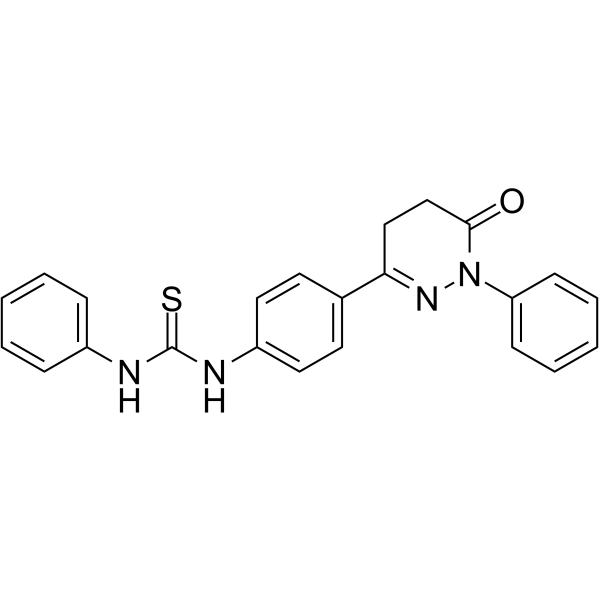
    Pim-1/2 kinase inhibitor 2 (compound 5b) is a competitive PIM-1 and PIM-2 kinase inhibitor with IC50s of 1.31 μM and 0.67 μM, respectively. Pim-1/2 kinase inhibitor 2 shows in-vitro low cytotoxicity against normal human lung fibroblast Wi-38 cell line and potent in-vitro anticancer activity against myeloid leukaemia (NFS-60), liver (HepG-2), prostate (PC-3), and colon (Caco-2) cancer cell lines .
    Pim-1/2 kinase inhibitor 2
  • HY-178133

    Pim Apoptosis Caspase Cancer
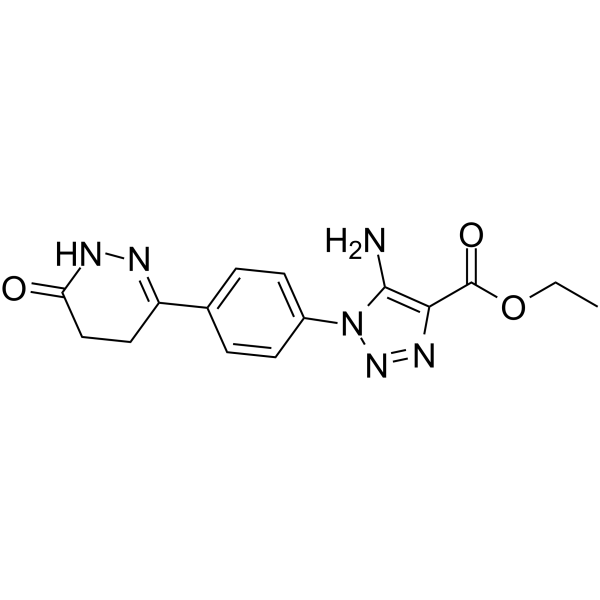
    Pim-1 kinase-IN-14 is a PIM-1 kinase inhibitor with an IC50 value of 94 nM. Pim-1 kinase-IN-14 shows broad-spectrum and high-efficiency anticancer activity against multiple human cancer cell lines, including liver cancer (HepG-2), colon cancer (Caco-2), myeloid leukemia (NFS-60), and prostate cancer (PC-3) cells. Pim-1 kinase-IN-14exerts its anticancer effects by inducing apoptosis and activating caspase 3/7. Pim-1 kinase-IN-14 can be used for the study of cancers associated with PIM-1 kinase overexpression .
    Pim-1 kinase-IN-14
  • HY-146170

    Reactive Oxygen Species (ROS) EGFR Apoptosis Cancer
    Anticancer agent 69 (Compound 34), a potent and selective anticancer agent , potently and selectively inhibits human prostate cancer cell line PC3 (IC50=26 nM). Anticancer agent 69 increases ROS level, down-regulates EGFR and induces apoptosis .
    Anticancer agent 69
  • HY-147854

    Raf Apoptosis Cancer
    B-Raf IN 9 (compound 8b) is a potent B-Raf inhibitor, with an IC50 of 24.79 nM. B-Raf IN 9 induces apoptosis and shows cell cycle arrest at G2/M phase. B-Raf IN 9 exhibits potent antitumor activity against human prostate cancer PC-3 cell line, with an IC50 of 7.83 µM .
    B-Raf IN 9
  • HY-N16426

    Parasite Infection Cancer
    Mycoleptone A is an azafluorenone compound. Mycoleptone A exhibits certain anti-leishmanial activity, with an LD50 of 28.5 μM against L. major. Mycoleptone A shows cytotoxicity against human prostate cancer cell line PC3, with an IC50 of 10.0 μM. Mycoleptone A can be used in research on anti-parasitic and anti-tumor aspects .
    Mycoleptone A
  • HY-147852

    Raf Cancer
    B-Raf IN 7 (compound 6a) is a potent B-Raf inhibitor, with an IC50 of 110.23 nM. B-Raf IN 7 exhibits antitumor activity against colon carcinoma (HCT-116), mammary gland (MCF-7), hepatocellular carcinoma (HEPG-2), human cervical carcinoma (Hela) and human prostate cancer (PC-3) cells, with IC50 values of 7.50, 9.87, 10.57, 11.63 and 12.83 µM .
    B-Raf IN 7
  • HY-147853

    Raf Cancer
    B-Raf IN 8 (compound 7g) is a potent B-Raf inhibitor, with an IC50 of 70.65 nM. B-Raf IN 8 exhibits antitumor activity against hepatocellular carcinoma (HEPG-2), colon carcinoma (HCT-116), mammary gland (MCF-7) and human prostate cancer (PC-3) cells, with IC50 values of 9.78, 13.78, 18.52 and 29.85 µM .
    B-Raf IN 8
  • HY-176836

    Endonuclease Cancer
    PNR-3-82 is a highly selective inhibitor of endonuclease G (EndoG) with an IC50 value of 0.61 μM against EndoG. As a non-competitive inhibitor, PNR-3-82 blocks EndoG-mediated DNA fragmentation. PNR-3-82 enhances the in vivo delivery efficiency of plasmid DNA and exhibits bioprotective effects against drug-related injuries and other cell/tissue damages. PNR-3-82 can be used in studies related to prostate cancer .
    PNR-3-82
  • HY-N17795

    Others Cancer
    26-Hydroxyl-20(S)-protopanaxadiol is an inhibitor of prostate cancer cell proliferation, with an IC50 value of 27.2 μM against human prostate cancer cells DU-145 and an IC50 value of 18.5 μM against PC-3 cells .
    26-Hydroxyl-20(S)-protopanaxadiol
  • HY-W753557

    Drug Derivative Insecticide Bacterial Infection Inflammation/Immunology Cancer
    Avocadene is a natural product isolated from Persea americana leaves, with anticancer, insecticidal, anti-Helicobacter pylori, and anti-inflammatory activity. Avocadene exerts antibacterial and anti‑inflammatory effects by suppressing Helicobacter pylori growth and inhibiting protein denaturation. Avocadene displays obvious cytotoxic activity against human prostate cancer PC‑3 cells with an IC50 of 0.5 μg/mL. Avocadene can be used for research of Helicobacter pylori‑associated gastrointestinal inflammation, gastroduodenal injury and prostate tumors .
    Avocadene
  • HY-D3189

    Fluorescent Dye PSMA Cancer
    5GluAF-2MeTG is an activatable fluorescent probe targeting the glutamate carboxypeptidase (CP) activity of PSMA (Ex/Em=490/500-600 nm). After being hydrolyzed by PSMA, 5GluAF-2MeTG releases a cell membrane-permeable fluorescent product, and achieves fluorescence activation by disrupting donor-excited photoinduced electron transfer (d-PeT). 5GluAF-2MeTG enables fluorescence imaging of live PSMA-expressing prostate cancer cells in vitro and visualizes the carboxypeptidase activity of PSMA. 5GluAF-2MeTG can be used to detect prostate cancer regions in preclinical excised tissue specimens .
    5GluAF-2MeTG
  • HY-181694

    Topoisomerase HDAC Apoptosis Kinesin RAD51 Cancer
    SeSA-HCPT is an orally active dual-target inhibitor integrating Topo I and HDAC inhibition. SeSA-HCPT induces potent DNA damage, apoptosis, S-phase arrest in prostate cancer cells. SeSA-HCPT inhibits cancer cells proliferation and migration. SeSA-HCPT impairs homologous recombination by suppressing KIF4A-RAD51 signaling. SeSA-HCPT markedly inhibits CRPC tumor growth with minimal systemic toxicity .
    SeSA-HCPT
  • HY-156484

    PI3K mTOR Cancer
    SPR519 is a selective, orally active dual PI3Kα/mTOR kinase inhibitor, with an IC50 of 0.03 μM against PI3Kα and an IC50 of 0.01 μM against mTOR. SPR519 exhibits anticancer effects in ovarian cancer and colon cancer xenograft models. SPR519 can be used for the research of solid tumors (ovarian cancer, colon cancer) .
    SPR519
  • HY-N17074

    Others Cancer
    Ethyl (10E,12E)-9-oxooctadeca-10,12-dienoate is a conjugated ketonic fatty acid that can be found in the leaves of Vernicia fordii. Ethyl (10E,12E)-9-oxooctadeca-10,12-dienoate shows no significant cytotoxic activity against cancer cells .
    Ethyl (10E,12E)-9-oxooctadeca-10,12-dienoate
  • HY-185269

    Microtubule/Tubulin Drug Derivative Cancer
    2'-Deoxy-PTX is a Paclitaxel (HY-B0015) derivative and microtubule assembly inducer. 2'-Deoxy-PTX binds to GMPcPP-stabilized microtubules, with a Kaapp of 0.50 × 10 6 M -1. 2′-Deoxy-PTX induces Tubulin to assemble into normal microtubules. 2'-Deoxy-PTX can be used for the research of prostate cancer .
    2'-Deoxy-PTX

Inquiry Online

Your information is safe with us. * Required Fields.

Salutation


Country or Region *

Applicant Name *


Organization Name *

Department *


Email Address *


Product Name *

Cat. No.


Requested quantity *

Phone Number *


Remarks

Inquiry Online

Inquiry Information

Product Name:
Cat. No.:
Quantity:
MCE Japan Authorized Agent:

