



Reactive Oxygen Species (ROS) Activator
-
β-Elemonic acid (Standard)
 0 ImagesCat. No.: HY-N2454RCAS No.: 28282-25-9
β-Elemonic acid (Standard) is the analytical standard of β-Elemonic acid. This product is intended for research and analytical applications. β-Elemonic acid is a triterpene isolated from Boswellia carterii. β-Elemonic acid induces cell apoptosis, reactive oxygen species (ROS) and COX-2 expression and inhibits prolyl endopeptidase. β-Elemonic acid exhibits anticancer and anti-inflammatory effects.
-
AlbA-DCA
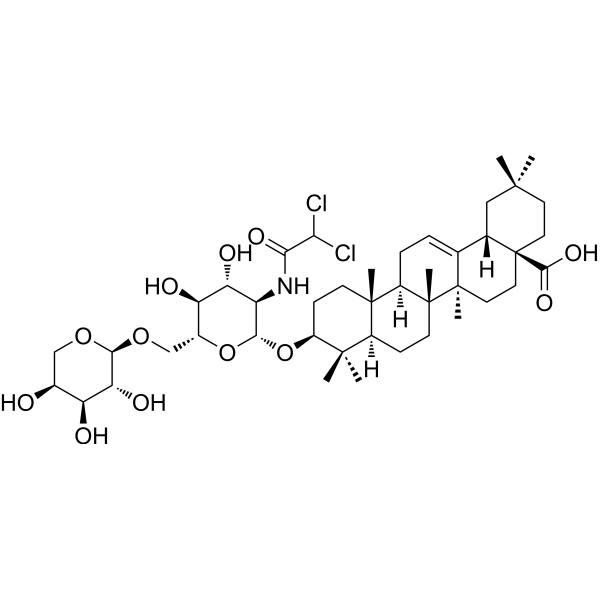 0 ImagesCat. No.: HY-130117CAS No.: 2413716-79-5
AlbA-DCA is a conjugate formed by the attachment of Albiziabioside A (AlbA) to a dichloroacetate acid (DCA) subunit. AlbA-DCA can induce a marked increase in intracellular ROS and alleviate the accumulation of lactic acid in tumor microenvironment (TME), and also selectively kills cancer cells and induce apoptosis.
-
Prexigebersen
 0 ImagesCat. No.: HY-153495CAS No.: 202484-91-1Synonyms: BP1001
Prexigebersen (BP1001) is an antisense oligonucleotide targeting Bcl-2 and Grb2. Prexigebersen exhibits antileukemic activity in cell models. Prexigebersen induces apoptosis (apoptosis), cell cycle arrest and ROS production in leukemia cells. Prexigebersen inhibits Grb2 expression, thereby suppressing tumor growth and survival. Prexigebersen can be used in studies related to acute myeloid leukemia.
-
Verteporfin liposome
 0 ImagesCat. No.: HY-185390Synonyms: Liposomal verteporfin
Liposomal verteporfin is a liposome-encapsulated form of Verteporfin (HY-B0146). Verteporfin is a photosensitizer used in photodynamic therapy, which generates reactive oxygen species (ROS) upon irradiation at 690 nm to mediate photodynamic effects. Liposomal verteporfin can promote the release of Oxaliplatin (HY-17371) from endolysosomes via photochemical internalization (PCI), prolong the drug circulation time and enable sustained release, accumulate the drug in neovascular vessels, and enhance its cytotoxicity in tumor models. Liposomal verteporfin can be used in studies related to neovascular eye diseases and pancreatic cancer[1][2][3].
-
Diallyl Trisulfide (Standard)
 0 ImagesCat. No.: HY-117235RCAS No.: 2050-87-5
Diallyl Trisulfide (Standard) is the analytical standard of Diallyl Trisulfide. This product is intended for research and analytical applications. Diallyl Trisulfide is an orally active anticancer agent that can be isolated from garlic. Diallyl Trisulfide has the ability to induce apoptosis and exhibits anticancer, anti-inflammatory, antioxidant, and antibacterial activities. Diallyl Trisulfide can be used to study a variety of cancers, including liver, colon and prostate cancer[1][2][3][4].
-
Dihydroartemisinin-d3
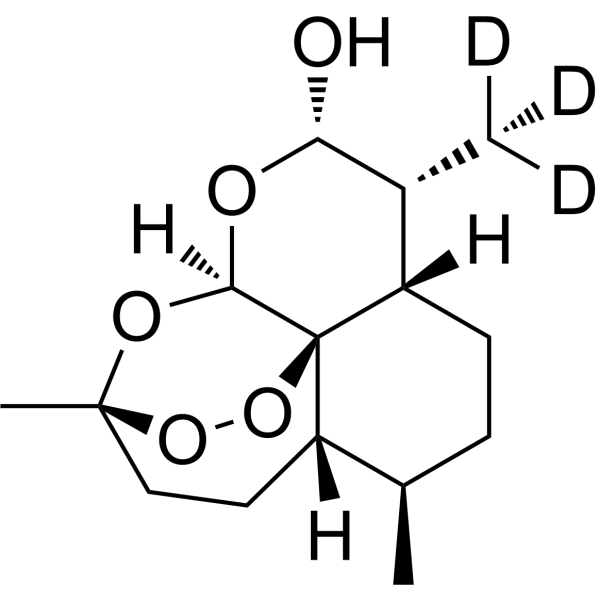 0 ImagesCat. No.: HY-N0176SCAS No.: 176774-98-4Synonyms: Dihydroqinghaosu-d3; β-Dihydroartemisinin-d3; Artenimol-d3
Dihydroartemisinin-d3 (Dihydroqinghaosu-d3) is the d3-labeled Dihydroartemisinin (HY-N0176). Dihydroartemisinin is an orally active metabolite of rtemisinin (HY-B0094) and antimalarial agent. Dihydroartemisinin induces Autophagy by inhibiting NF-κB activation. Dihydroartemisinin promotes ROS accumulation. Dihydroartemisinin exhibits anticancer activity in esophageal cancer cells. Dihydroartemisinin shows schistosomicidal activity against juvenile and adult worms of Schistosoma japonicum, reduces worm burden, and displays antiparasitic activity. Dihydroartemisinin can be used in research related to multiple myeloma, promyelocytic leukemia, esophageal cancer, and Schistosoma japonicum infection.
-
(R)-Alyssin
 0 ImagesCat. No.: HY-116920ACAS No.: 167963-06-6
(R)-Alyssin is a enantiomer of Alyssin (HY-116920). Alyssin, found in Cruciferous Vegetables, exerts anticancer activity in HepG2 by increasing intracellular reactive oxygen species and tubulin depolymerization.
-
Necroptosis inducer 1
 0 ImagesCat. No.: HY-181718
Necroptosis inducer 1 is a necroptosis inducer. Necroptosis inducer 1 inhibits the activity of thioredoxin reductase (TrxR), elevates intracellular ROS levels, triggers ROS-mediated necroptosis, and induces necroptosis-dependent immunogenic cell death. Necroptosis inducer 1 inhibits tumor growth, remodels the tumor immune microenvironment, and exerts a synergistic effect with anti-PD-1 in animal models. Necroptosis inducer 1 is applicable to the research of colon cancer.
-
BRD4-BD1-IN-4
 0 ImagesCat. No.: HY-187207
BRD4-BD1-IN-4 is a selective BRD4 BD1 inhibitor with an IC50 of 0.82 μM and a Kd of 0.98 μM. BRD4-BD1-IN-4 downregulates the expression of c-myc and anti-apoptotic proteins, elevates ROS levels, reduces mitochondrial membrane potential, induces DNA damage and triggers apoptosis. BRD4-BD1-IN-4 inhibits the migration and proliferation of cancer cells. BRD4-BD1-IN-4 can be used in the research of lung cancer, breast cancer and colon cancer.
-
PRDX1-IN-4
 0 ImagesCat. No.: HY-182287
PRDX1-IN-4 is a PRDX1 inhibitor with an IC50 of 122 nM against human targets and high subtype selectivity. PRDX1-IN-4 covalently binds to PRDX1 to promote ROS accumulation. PRDX1-IN-4 inhibits NLRP3 inflammasome activation, blocks hepatic stellate cell activation and reduces collagen deposition. PRDX1-IN-4 induces apoptosis in activated hepatic stellate cells. PRDX1-IN-4 has good safety profile, with no significant body weight loss or hepatotoxicity observed in mice at a dose of 20 mg/kg. PRDX1-IN-4 ameliorates CCl4-induced liver injury and liver fibrosis in mice at a dose of 1 mg/kg. PRDX1-IN-4 can be used for the research of liver fibrosis.
-
Antibacterial agent 349
 0 ImagesCat. No.: HY-184237
Antibacterial agent 349 is an antibacterial agent. Antibacterial agent 349 impairs reactive oxygen species clearance, disrupts citrate cycle homeostasis and induces metabolic stress. Antibacterial agent 349 compromises bacterial membrane integrity, increases permeability, and causes intracellular component leakage. Antibacterial agent 349 can be used for the research of bacterial leaf streak.
-
ISR/ROS-activator-1
 0 ImagesCat. No.: HY-184243CAS No.: 3099924-90-7
ISR/ROS-activator-1 is a naphthoquinone compound derived from Shikonin (HY-N0822), and also dual activator of the ISR/ROS pathway. ISR/ROS-activator-1 induces Apoptosis and Ferroptosis. ISR/ROS-activator-1 selectively inhibits gastric cancer. ISR/ROS-activator-1 is applicable to gastric cancer-related research.
-
CDK4/6-IN-28
 0 ImagesCat. No.: HY-183771CAS No.: 3110098-09-1
CDK4/6-IN-28 is a potent, orally active, and selective CDK4/6 inhibitor IC50 values of 14.02 and 10.03 nM, respectively. CDK4/6-IN-28 inhibits breast cancer cell colony formation, migration, and proliferation. CDK4/6-IN-28 induces G1-phase cell cycle arrest and apoptosis in breast cancer cells. CDK4/6-IN-28 exhibits tumor inhibitory activity in breast cancer xenograft mouse models. CDK4/6-IN-28 can be used for the research of breast cancer.
-
Microtubule-IN-14
 0 ImagesCat. No.: HY-180147
Microtubule-IN-14 (Compound 10u) is a microtubule inhibitor. Microtubule-IN-14 inhibits the polymerization of tubulin, thereby preventing the formation of the spindle apparatus in cell mitosis and blocking the cell cycle at the G2/M phase. Microtubule-IN-14 induces a decrease in mitochondrial membrane potential and a burst of reactive oxygen species (ROS), promoting tumor cell apoptosis. Microtubule-IN-14 can be used for the study of non-small cell lung cancer and liver cancer.
-
PARP1-IN-49
 0 ImagesCat. No.: HY-179406
PARP1-IN-49 is a selective PARP1 inhibitor with an IC50 of 23.56 nM and a Kd of 17.78 nM. PARP1-IN-49 shows a selectivity for PARP1 over PARP2. PARP1-IN-49 leads to the induction of DNA damage, cell cycle arrest, and apoptosis. PARP1-IN-49 also increases intracellular ROS levels and inhibits cell migration. PARP1-IN-49 can be used for the research of breast cancer and ovarian cancer.
-
Aspafilioside B
 0 ImagesCat. No.: HY-122465CAS No.: 131123-73-4
Aspafilioside B is a steroidal saponin. Aspafilioside B is extractable from Asparagus filicinus. Aspafilioside B activates the ERK, c-Raf and p38 MAPK signaling pathways, and upregulates H-Ras and N-Ras. Aspafilioside B mediates G2/M cell cycle arrest by altering the expression of cell cycle regulatory proteins. Aspafilioside B induces Apoptosis. Aspafilioside B increases intracellular ROS levels. Aspafilioside B is applicable to research related to hepatocellular carcinoma.
-
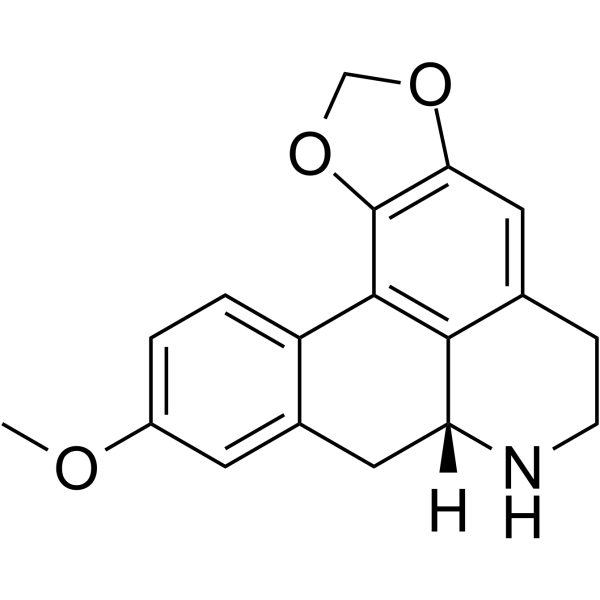
CXCR2-IN-3
 0 ImagesCat. No.: HY-179387
CXCR2-IN-3 is a CXCR2 inhibitor with an IC50 of 11.37 μM. CXCR2-IN-3 mediates CXCR2-Ca2+ signalling inhibition halted autophagic flux, subsequently facilitating ROS-mediated apoptotic cell death. CXCR2-IN-3 suppresses the CXCR2-NLRP3 canonical pathway, suppressing pre-tumorigenic markers. CXCR2-IN-3 causes autophagy-dependent cell death in polyploid giant cancer cells (PGCCs). CXCR2-IN-3 can be used for the research of oral squamous cell carcinoma (OSCC).
-
CDK9-IN-45
 0 ImagesCat. No.: HY-179023
CDK9-IN-45 (Compound B11) is a highly selective CDK9 inhibitor with IC50 values for CDK9 and CDK1 of 7.13 and 489.5 nM respectively. CDK9-IN-45 exhibits a potent inhibitory effect on colorectal cancer cells. CDK9-IN-45 induces cell apoptosis and leads to significant accumulation of ROS. CDK9-IN-45 activates Caspase-3, downregulates Mcl-1, XIAP, and c-Myc. CDK9-IN-45 can be used for research on colorectal cancer.
-
DHODH-IN-32
 0 ImagesCat. No.: HY-178941
DHODH-IN-32 (Compound A1) is a DHODH inhibitor. DHODH-IN-32 shows significant cytotoxicity against NCI-60 cell lines, especially being sensitive to breast cancer, prostate cancer and leukemia cell lines. DHODH-IN-32 can induce cell apoptosis by activating the Caspase pathway. DHODH-IN-32 causes G0/G1 phase cell cycle arrest and inhibits cellular metabolism by ROS. DHODH-IN-32 exhibits significant anti-tumor properties in mouse breast cancer models. DHODH-IN-32 can be used for the study of breast cancer.



