



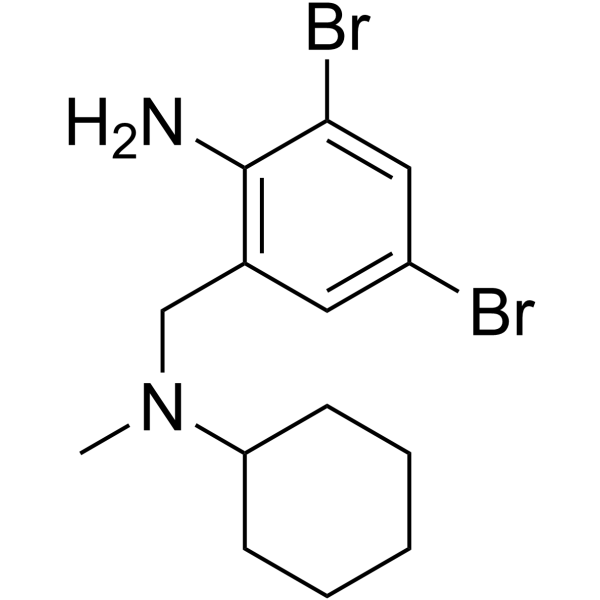
Bromhexine
Based on 4 publication(s) in Google Scholar
Bromhexine is an orally active mucolytic activator. Bromhexine acts as a TMPRSS2 inhibitor and binds hACE2, with an IC50 of 17.3 μM against Omicron pseudovirus infection, disrupting the interaction between the SARS‑CoV‑2 spike protein and hACE2. Bromhexine reduces IDO expression and kynurenine pathway activation, tissue levels of TLR-4 and NF-κB, and TNF-alpha secretion, exerts antioxidant activity, and alleviates acute pruritus. Bromhexine promotes mucin and lipid secretion in conjunctival fornix epithelial cells. Bromhexine attenuates glandular pathological damage in Sjögren's syndrome models. Bromhexine can be used in research on viral infections, pruritus, inflammation-related diseases, and respiratory diseases.
Nos produits utilisent uniquement pour la recherche. Nous ne vendons pas aux patients.
- CAS No.: 3572-43-8
- Formule: C14H20Br2N2
- Masse moléculaire:376.13
-
Stockage:Powder -20°C, 3 years ; In solvent -80°C, 6 months , -20°C, 1 month

To place orders, for customer services and technical support, please contact: MedChemExpress USA
Tel: 609-228-6898 E-mail: [email protected] [email protected]
Other In-stock Forms of Bromhexine


-
 Activité biologique
-
Chemical Information
- Protocole
- Pureté et documentation
- Références
-
 Help & FAQs




Activité biologique
Description
|
TNF-α |
IDO |
NF-κB |
TLR4 |
In Vitro
Bromhexine (0.56-5 μM; 24 h) increases MUC5AC secreted by primary human conjunctival fornix epithelial cells, with a 2-fold increase at 0.56 μM and a peak level at 1.67 μM, while MUC5AC in cell lysates is also detectable by ELISA[2].
Bromhexine (0.01-500 µM; 2 h pretreatment; 48 h pseudovirus infection) inhibits Omicron pseudovirus infection in HEK-293/ACE2 cells with an IC50 of 17.3 µM[4].
Bromhexine (40 µM; 48 h infection) reduces Alpha, Beta, and Delta pseudovirus infection in HEK-293/ACE2 cells by approximately 40%[4].
Bromhexine (0.56-5 μM) increases Ki67 expression in primary human conjunctival fornix epithelial cells, increases mucin staining, and promotes the production of neutral lipid droplets[2].
Bromhexine upregulates CHML expression in primary human conjunctival fornix epithelial cells at 1.67 μM[2].
MedChemExpress (MCE) has not independently confirmed the accuracy of these methods. They are for reference only.
In Vivo
Bromhexine reduces glomerular volume in Streptozotocin (HY-13753)-induced diabetic rats[1].
Bromhexine (60 mg/kg; continuously from 20 weeks of age for 10-17 weeks) significantly inhibits pathological changes in the parotid glands of the Sjögren's syndrome model NZB‑NZW‑F1 mice and improves mouse survival[3].
MedChemExpress (MCE) has not independently confirmed the accuracy of these methods. They are for reference only.
Essai clinique
| NCT Number | Sponsor | Condition | Start Date |
Phase

|
|---|---|---|---|---|
| NCT01329991 | 2011-05 | PHASE1 |


Chemical Information
-
CAS No. 3572-43-8
-
Appearance Solid
-
Masse moléculaire 376.13
-
Formule C14H20Br2N2
-
Color White to off-white
-
SMILES
BrC1=CC(Br)=CC(CN(C)C2CCCCC2)=C1N
-
Livraison
Room temperature in continental US; may vary elsewhere.
-
Stockage
Powder -20°C 3 years In solvent -80°C 6 months -20°C 1 month


Publications (4)
-
Journal Impact Factor
-
Most Recent
-
Biochem Pharmacol
ALOX5 Promotes Autophagy-dependent Ferroptosis by Activating the AMPK/mTOR Pathway in Melanoma. [Abstract]2023 Jun:212:115554. PMID: 37080437 -
Int Immunopharmacol
A natural product, Piperlongumine (PL), increases tumor cells sensitivity to NK cell killing. [Abstract]2021 Jul:96:107658. PMID: 33887610 -
BMJ Open Respir Res
Respiratory syncytial virus-induced SIGLEC1 upregulation inhibits macrophage autophagy and facilitates inflammatory mediator secretion. [Abstract]2026 Apr 20;13(1):e003586. PMID: 42009498 -
FEBS Lett
Bromhexine elevates REP2 expression to stimulate secretion from human primary conjunctiva fornix epithelial cells. [Abstract]2020 Jan;594(1):153-160. PMID: 31365127


Pureté et documentation


Références

Calculators
Concentration (start) × Volume (start) = Concentration (final) × Volume (final)


Bromhexine Related Classifications
HY-B0372 Related Classifications
 Powered by Bioz
Keywords
- Bromhexine
- 3572-43-8
- Antibiotic
- Bacterial
- SARS-CoV
- TNF Receptor
- Toll-like Receptor (TLR)
- NF-κB
- Indoleamine 2,3-Dioxygenase (IDO)
- SARS coronavirus
- Tumor Necrosis Factor Receptor
- TNFR
- Nuclear factor-κB
- Nuclear factor-kappaB
- ACE2
- IDO
- Omicron
- SARS-CoV-2
- TMPRSS2
- TNF-alpha
- kynurenine pathway
- mucolytic
- secretolytic
- Inhibitor
- inhibitor
- inhibit