



Ipivivint
Based on 2 publication(s) in Google Scholar
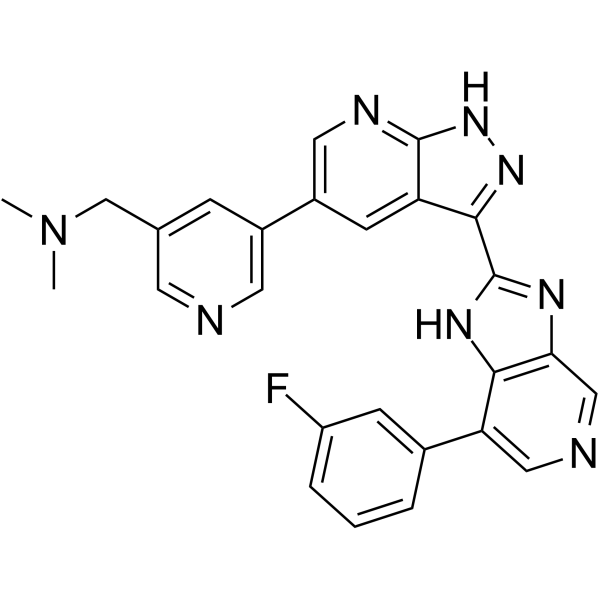
Ipivivint (Compound 38) is an orally active and potent CDC-like kinase (CLK) inhibitor with EC50 of 1 nM and 7 nM for CLK2 (human) and CLK3 (human), respectively. Ipivivint also inhibits the Wnt pathway (EC50=13 nM) and tyrosine phosphorylation-regulated kinase 1A (human) (EC50=5 nM).
For research use only. We do not sell to patients.
- Purity : 99.95%
- CAS No.: 1481617-15-5
- Formula: C26H21FN8
- Molecular Weight:464.50
-
Storage:Powder -20°C, 3 years , 4°C, 2 years ; In solvent -80°C, 6 months , -20°C, 1 month

To place orders, for customer services and technical support, please contact: MedChemExpress USA
Tel: 609-228-6898 E-mail: [email protected] [email protected]


-
 Biological Activity
-
Chemical Information
-
Solvent & Solubility
- Protocols
- Purity & Documentation
- References
-
 Help & FAQs



Publications Citing Use of MedChemExpress (MCE) Ipivivint
More

Biological Activity
Description
IC50 & Target
[1]|
CDK2 1 nM (EC50) |
CDK3 7 nM (EC50) |
In Vitro
-
Cell Line:SW480 cells
-
Concentration:0.01~10 μM
-
Incubation Time:1 hour
-
Result:Potently inhibited SRSF5/6 phosphorylation.
-
Cell Line:SW480 cells
-
Concentration:0.01~10 μM
-
Incubation Time:0.03 μM~3 μM
-
Result:Induced apoptosis.
-
Cell Line:HEK-293T cells
-
Concentration:0.3~3 μM
-
Incubation Time:1 hour
-
Result:Inhibited Wnt/β-catenin signaling induced by Wnt3a.
-
Cell Line:SW480 cells
-
Concentration:0.3~10 μM
-
Incubation Time:6 hours
-
Result:Increased nuclear speckle enlargement.
In Vivo
-
Animal Model:Foxn1 mice[1]
-
Dosage:25 mg/kg
-
Administration:P.o.
-
Result:Potently inhibited tumor SRSF6 phosphorylation.
Clinical Trial
| NCT Number | Sponsor | Condition | Start Date |
Phase

|
|---|---|---|---|---|
| NCT01329991 | Plexxikon| | 2011-05 | PHASE1 |


Chemical Information
-
CAS No. 1481617-15-5
-
Appearance Solid
-
Molecular Weight 464.50
-
Formula C26H21FN8
-
Color Off-white to light yellow
-
SMILES
CN(C)CC1=CC(C2=CN=C(NN=C3C(N4)=NC5=C4C(C6=CC(F)=CC=C6)=CN=C5)C3=C2)=CN=C1
-
Shipping
Room temperature in continental US; may vary elsewhere.
-
Storage
Powder -20°C 3 years 4°C 2 years In solvent -80°C 6 months -20°C 1 month


Publications (2)
-
Journal Impact Factor
-
Most Recent
-
-
Bioorg Med Chem
Identification of a novel Aurora B inhibitor using the AI-driven drug screening and docking-based traditional screening. [Abstract]2025 Sep 27:131:118423. PMID: 41033076


Solvent & Solubility
In Vitro:
DMSO : 3.33 mg/mL (7.17 mM; ultrasonic and warming and heat to 80°C; Hygroscopic DMSO has a significant impact on the solubility of product, please use newly opened DMSO)
Please refer to the solubility information to select the appropriate solvent. Once prepared, please aliquot and store the solution to prevent product inactivation from repeated freeze-thaw cycles.
Storage method and period of stock solution: -80°C, 6 months; -20°C, 1 month. When stored at -80°C, please use it within 6 months. When stored at -20°C, please use it within 1 month.
Please refer to the solubility information to select the appropriate solvent. Once prepared, please aliquot and store the solution to prevent product inactivation from repeated freeze-thaw cycles.
Storage method and period of stock solution: -80°C, 6 months; -20°C, 1 month. When stored at -80°C, please use it within 6 months. When stored at -20°C, please use it within 1 month.
Concentration (start) × Volume (start) = Concentration (final) × Volume (final)


Purity & Documentation
-
Data Sheet (276 KB)
-
SDS (251 KB)
- English - EN (251 KB)
- Français - FR (251 KB)
- Deutsch - DE (251 KB)
- Norwegian - NO (251 KB)
- Español - ES (251 KB)
- Swedish - SV (251 KB)
- Italian - IT (251 KB)
- Korean - KR (251 KB)
- Portuguese - PT (251 KB)
-
Handling Instructions (2659 KB)
References


Complete Stock Solution Preparation Table
Please refer to the solubility information to select the appropriate solvent. Once prepared, please aliquot and store the solution to prevent product inactivation from repeated freeze-thaw cycles.
Storage method and period of stock solution: -80°C, 6 months; -20°C, 1 month. When stored at -80°C, please use it within 6 months. When stored at -20°C, please use it within 1 month.
| Optional Solvent | Concentration Solvent Mass | 1 mg | 5 mg | 10 mg | 25 mg |
|---|---|---|---|---|---|
| DMSO | 1 mM | 2.1529 mL | 10.7643 mL | 21.5285 mL | 53.8213 mL |
| 5 mM | 0.4306 mL | 2.1529 mL | 4.3057 mL | 10.7643 mL |


Ipivivint Related Classifications
HY-137443 Related Classifications
 Powered by Bioz