



Patritumab
Based on 2 publication(s) in Google Scholar
Patritumab (AMG 888; U3-1287) is a neutralizing antibody targeting HER3 (ErbB3) that binds to the extracellular domain and induces HER3 internalization. Patritumab prevents heregulin binding, downregulates cell surface HER3, and blocks ligand-induced HER3 phosphorylation and downstream PI3K/AKT signaling. Patritumab in combination with dual HER2 blockade enhances apoptosis and growth inhibition in HER2-overexpressing breast cancer cells, and enhances antitumor effects in xenograft tumors. Patritumab can be used for research on breast cancer.
For research use only. We do not sell to patients.
- Purity : 99.28%
- CAS No.: 1262787-83-6
- Molecular Weight:146.86 kDa
-
Storage:Shipping with dry ice
Please store the product under the recommended conditions in the Certificate of Analysis.


To place orders, for customer services and technical support, please contact: MedChemExpress USA
Tel: 609-228-6898 E-mail: [email protected] [email protected]


-
 Biological Activity
-
Chemical Information
- Protocols
- Purity & Documentation
- References
-
 Help & FAQs


-

HY-P9907
TrastuzumabHER2 Blocking Antibody -

HY-P99507
ZenocutuzumabAnti-HER2/HER3 Antibody -

HY-P99813
Patritumab deruxtecanHER3-Directed ADC -

HY-P99268
SeribantumabHER3 Antibody -

HY-P99045
SacituzumabAnti-TROP-2 Antibody -

HY-P99676
IzalontamabAnti-EGFR/HER3 Antibody -

HY-P99391
TelisotuzumabAnti-c-Met Antibody -

HY-P9977
AmivantamabEGFR-MET Dual Antibody -

HY-P9907A
Trastuzumab (anti-HER2)HER2 Blocking Antibody -

HY-P99843
DatopotamabAnti-TROP2 Antibody -

HY-P99854
DisitamabAnti-HER2 Antibody -

HY-P9904
AtezolizumabAnti-PD-L1 Antibody
Publications Citing Use of MedChemExpress (MCE) Patritumab
More Customer Validation & Images

-
WB
All EGFR Isoforms
More

Biological Activity
Description
Isotype
Human IgG1(K214R) kappa
Recommend Isotype Controls
Species Reactivity
Human
|
HER3 |
HER2 |
PI3K |
Akt |
In Vitro
Patritumab (10 μg/mL) significantly inhibits MCF7 breast cancer cell viability only in the presence of Erlotinib (HY-50896)[2].
Patritumab (100 μg/mL; 120 h), in triple combination with Trastuzumab (HY-P9907) and Pertuzumab (HY-P9912), potently reduces the viability of SKBR3-HRG and BT474-HRG cells even at the lowest Trastuzumab concentration[4].
Patritumab (50 μg/mL; 120 h) combined with Pertuzumab and Trastuzumab reverses heregulin-induced drug resistance in the BT-474, MDA-MB-453, and HCC1419 paracrine models[4].
Patritumab (120 h) in combination with Pertuzumab synergistically inhibits the viability of SKBR3-HRG and BT474-HRG cells, with median-effect CI values of 0.11 and 0.13, respectively[4].
Patritumab (120 h) combined with Pertuzumab reduces cell viability in BT-474, MDA-MB-453, and HCC1419 paracrine heregulin models[4].
Patritumab (U3-1287) (20 μg/mL; 0-48 h) downregulates HER3 protein from 1 h to 48 h in BT474, SKBR3, and MDA453 cells[5].
Patritumab (20 μg/mL; 24 h) blocks HER2 inhibitor-induced cell surface HER3 upregulation and reduces cell surface HER3 levels in BT474, SKBR3, and MDA453 cells[5].
Patritumab (20 μg/mL; 24 h) enhances the inhibition of HER3 and AKT signaling pathways when HER2 blockade is added in BT474, SKBR3, and MDA453 cells[5].
Patritumab (20 μg/mL; every 2-3 days) reduces the 2D growth of BT474, SKBR3, and MDA453 cells when combined with Lapatinib plus Trastuzumab[5].
Patritumab (20 μg/mL; 12-16 days) reduces 3D Matrigel colony formation in BT474, SKBR3, and MDA453 cells when combined with Lapatinib plus Trastuzumab[5].
Patritumab (20 μg/mL; 24 h) reduces HER3 and AKT signaling in HR6 cells when combined with Lapatinib plus Trastuzumab[5].
MedChemExpress (MCE) has not independently confirmed the accuracy of these methods. They are for reference only.
-
Cell Line:HER2-positive breast cancer SKBR3-HRG and BT474-HRG cells
-
Concentration:100 μg/mL
-
Incubation Time:120 h
-
Result:Triple combination with Trastuzumab and Pertuzumab drastically decreased viable cell counts even at the lowest Trastuzumab concentration in both SKBR3-HRG and BT474-HRG cells.
-
Cell Line:BT-474, MDA-MB-453, and HCC1419 HER2-positive breast cancer cells
-
Concentration:50 μg/mL
-
Incubation Time:120 h
-
Result:BT-474, MDA-MB-453, and HCC1419 cells developed resistance to Trastuzumab in the presence of heregulin.
Adding Pertuzumab to Trastuzumab reversed this resistance in these paracrine models.
-
Cell Line:BT474, SKBR3, and MDA453 cells
-
Concentration:20 μg/mL
-
Incubation Time:1, 4, 14, 24, and 48 h
-
Result:HER3 protein showed a modest decrease starting at 1 h and lasting through 48 h in BT474, SKBR3, and MDA453 cells.
-
Cell Line:BT474, SKBR3, and MDA453 cells
-
Concentration:20 μg/mL
-
Incubation Time:24 h
-
Result:Dual HER2 inhibition increased cell-surface HER3 in all three cell lines.
Addition to dual HER2 inhibition blocked this increase and almost completely downregulated cell-surface HER3 levels.
-
Cell Line:BT474, SKBR3, and MDA453 cells
-
Concentration:20 μg/mL
-
Incubation Time:48 h
-
Result:Did not induce apoptosis alone.
Addition to Lapatinib plus Trastuzumab resulted in a clear increase in apoptosis in all cell lines.
-
Cell Line:BT474, SKBR3, and MDA453 cells
-
Concentration:20 μg/mL
-
Incubation Time:24 h
-
Result:p-HER3 was lower in cells with the triple combination.
Enhanced inhibition of S473 p-Akt in SKBR3 and MDA453 cells.
T308 p-Akt was lower in BT474 and SKBR3 cells with all three inhibitors than with other conditions.
-
Cell Line:HR6 cells
-
Concentration:20 μg/mL
-
Incubation Time:24 h
-
Result:Addition to lapatinib plus trastuzumab reduced p-HER3, total HER3, and S473 p-Akt levels.
In Vivo
Patritumab (25 mg/kg; intraperitoneal injection; once weekly; for 3 weeks) combined with Trastuzumab (10 mg/kg) partially inhibits the growth of BT474-HRG xenograft tumors[4].
Patritumab (25 mg/kg; intraperitoneal injection; once weekly; for 3 weeks) combined with Pertuzumab (25 mg/kg) inhibits BT474-HRG tumor growth, induces tumor regression, and suppresses HER3 in vivo[4].
Patritumab (25 mg/kg; intraperitoneal injection; once weekly; for 3 weeks) combined with Pertuzumab (25 mg/kg) and Trastuzumab (10 mg/kg) produces the strongest anti-tumor effect against BT474-HRG, including complete clearance of three out of seven tumors, and inhibits HER3 in vivo[4].
Patritumab (25 mg/kg; intraperitoneal injection; once weekly; for 3 weeks) combined with Pertuzumab (25 mg/kg) and Trastuzumab (10 mg/kg) produces maximal tumor regression in JIMT-1 xenograft tumors[4].
MedChemExpress (MCE) has not independently confirmed the accuracy of these methods. They are for reference only.
-
Animal Model:KSN nude (male, 6 weeks of age at purchase)[2]
-
Dosage:100 µg/mouse
-
Administration:i.p.; twice on days 0 and 7
-
Result:In BT474 xenograft-bearing nude mice, tumor growth was significantly inhibited compared with isotype control.
-
Animal Model:BALB/cAJcl-nu/nu athymic nude (female, 7 weeks old)[4]
-
Dosage:25 mg/kg
-
Administration:i.p.; once weekly; 3 weeks
-
Result:The Trastuzumab-containing double combination partially prevented BT474-HRG tumor growth in vivo.
-
Animal Model:BALB/cAJcl-nu/nu athymic nude (female, 7 weeks old)[4]
-
Dosage:25 mg/kg
-
Administration:i.p.; once weekly; 3 weeks
-
Result:The Pertuzumab-containing double combination significantly prevented BT474-HRG tumor growth and mediated tumor regression compared with vehicle.
In vivo HER3 immunoblot PD showed suppressed HER3 expression in the Pertuzumab-containing double-combination arm relative to control.
-
Animal Model:BALB/cAJcl-nu/nu athymic nude (female, 7 weeks old)[4]
-
Dosage:25 mg/kg
-
Administration:i.p.; once weekly; 3 weeks
-
Result:Triple combination significantly prevented BT474-HRG tumor growth and mediated tumor regression compared with vehicle; three of seven tumors were completely eradicated.
In vivo HER3 immunoblot PD showed suppressed HER3 expression in the triple-combination arm relative to control.
-
Animal Model:BALB/cAJcl-nu/nu athymic nude (female, 7 weeks old)[4]
-
Dosage:25 mg/kg
-
Administration:i.p.; once weekly; 3 weeks
-
Result:Triple combination induced significant tumor regression in JIMT-1 xenografts compared with controls and produced the maximum antitumor effect among the regimens.
- Western Blot
- Annexin V plus membrane-impermeant dye apoptosis staining
- Breast Cancer Modeling
- Kinase activity and phosphorylation assays
- Detection of Apoptosis
- TUNEL staining for apoptotic DNA fragmentation
- Patient-Derived Xenograft (PDX)
- Apoptosis Solutions
- Splenic/Portal-Vein Liver Metastasis Xenograft
- Protocol for Kinase activity and phosphorylation assays
- Subcutaneous Cell-Line-Derived Xenograft
- Orthotopic Cell-Line Xenograft
- Intraperitoneal/Peritoneal Dissemination Xenograft
Gene ID
Accession
Conjugated
Unconjugated
Reconsititution
The product can be reconstituted/diluted with sterile PBS or saline.
Format
-
Human IgG1 kappa

Application
ELISA, FACS, Functional assay
Verified Bioactivity
-
 Flow cytometric analysis of 1×10⁶ MCF-7 cells labelling HER3 (red) with Patritumab (HY-P99275). Cells were fixed with 4% paraformaldehyde and permeabilised with 90% methanol. Then stained with the primary antibody at 1/200 dilution for an hour at 4℃. Alexa Goat Anti-Human IgG H&L (AF488) (HY-P83776) was used as the secondary antibody at 1/1,000 dilution for 30 minutes at 4℃. Human IgG1(K214R) kappa Isotype Control (HY-P99995, blue) was used as the isotype control.
-
 Immobilized Human HER3/ERBB3 Protein (ECD, His Tag) can bind Patritumab. The EC50 for this effect is 1.41 ng/mL.
-
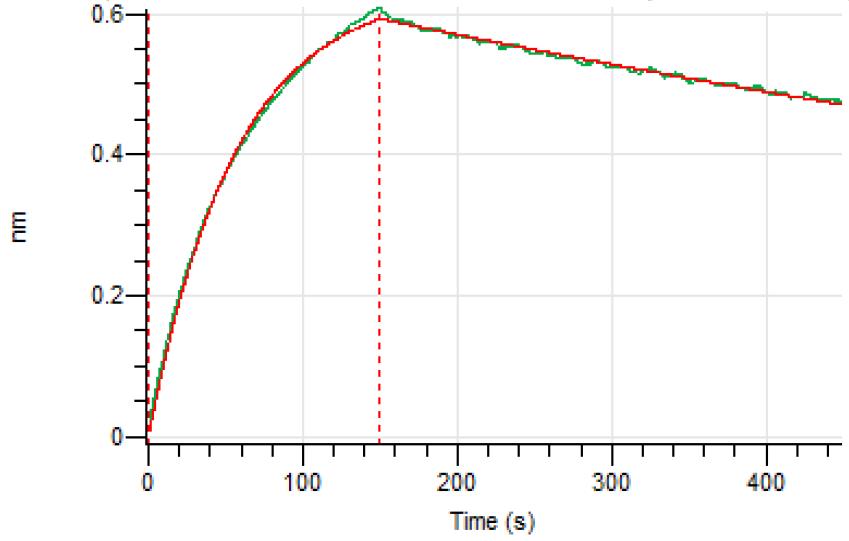 Loaded Patritumab on AHC2 biosensor, can bind HER3 Protein, Human (HEK293, His, HY-P72625) with an affinity constant of 1.804E-09 M as determined in BLI assay.


Chemical Information
-
CAS No. 1262787-83-6
-
Appearance Liquid
-
Molecular Weight 146.86 kDa
-
Color Colorless to light yellow
-
SMILES
[Patritumab]
-
Synonyms
AMG 888; U3-1287
-
Shipping
Shipping with dry ice.
-
Formulation
Please refer to the lot-specific COA for specific buffer information.
-
Storage
Please store the product under the recommended conditions in the Certificate of Analysis.


Publications (2)
-
Journal Impact Factor
-
Most Recent
-
Clin Cancer Res
ERBB3 overexpression is enriched in diverse patient populations with castration-sensitive prostate cancer and is associated with a unique AR activity signature. [Abstract]2024 Apr 15;30(8):1530-1543. PMID: 38306015
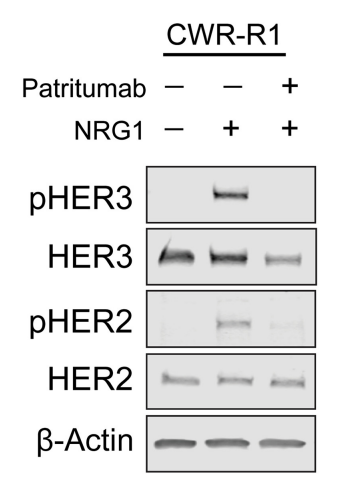
Patritumab purchased from MedChemExpress. Usage Cited in: Clin Cancer Res. 2024 Apr 15;30(8):1530-1543. [Abstract]
Patritumab (10 μM; 2 h) reduced pHER3 after NRG1 stimulation (100 ng/mL; 15 min) in CWR-R1 cells.
-


Purity & Documentation
-
Data Sheet (292 KB)
-
SDS (251 KB)
- English - EN (251 KB)
- Français - FR (251 KB)
- Deutsch - DE (251 KB)
- Norwegian - NO (251 KB)
- Español - ES (251 KB)
- Swedish - SV (251 KB)
- Italian - IT (251 KB)
- Korean - KR (251 KB)
- Portuguese - PT (251 KB)
-
Inhibitory Antibodies User Guide (603 KB)
References

Calculators
Concentration (start) × Volume (start) = Concentration (final) × Volume (final)


Patritumab Related Classifications
HY-P99275 Related Classifications
 Powered by Bioz
Keywords