



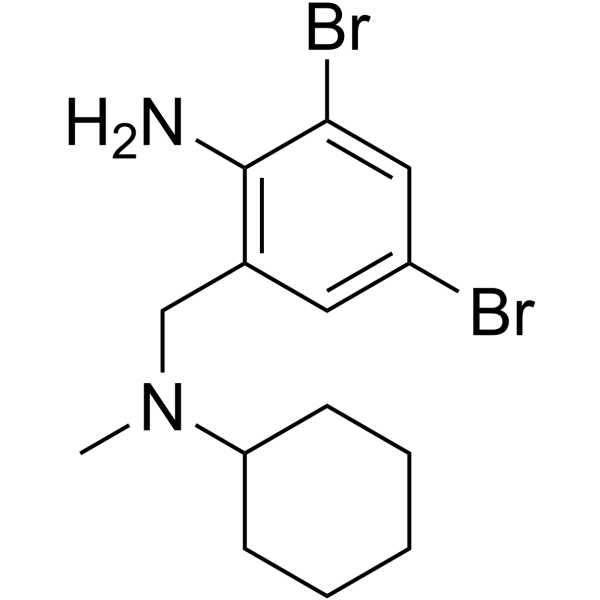
Bromhexine
Based on 4 publication(s) in Google Scholar
Bromhexine is an orally active mucolytic activator. Bromhexine acts as a TMPRSS2 inhibitor and binds hACE2, with an IC50 of 17.3 μM against Omicron pseudovirus infection, disrupting the interaction between the SARS‑CoV‑2 spike protein and hACE2. Bromhexine reduces IDO expression and kynurenine pathway activation, tissue levels of TLR-4 and NF-κB, and TNF-alpha secretion, exerts antioxidant activity, and alleviates acute pruritus. Bromhexine promotes mucin and lipid secretion in conjunctival fornix epithelial cells. Bromhexine attenuates glandular pathological damage in Sjögren's syndrome models. Bromhexine can be used in research on viral infections, pruritus, inflammation-related diseases, and respiratory diseases.
商品は「研究用試薬」です。人や動物の医療用・臨床診断用・食品用の製品ではありません。
研究用途以外に使用した場合、当社は一切の責任を負いかねます。
- CAS 番号: 3572-43-8
- 分子式: C14H20Br2N2
- 分子量:376.13
-
保管条件:Powder -20°C, 3 years ; In solvent -80°C, 6 months , -20°C, 1 month

To place orders, for customer services and technical support, please contact: MedChemExpress USA
Tel: 609-228-6898 E-mail: [email protected] [email protected]
Other In-stock Forms of Bromhexine


-
 生物活性
-
化学情報
- プロトコル
- 純度とドキュメンテーション
- 参考文献
-
 Help & FAQs




生物活性
製品説明
|
TNF-α |
IDO |
NF-κB |
TLR4 |
体外実験
Bromhexine (0.56-5 μM; 24 h) increases MUC5AC secreted by primary human conjunctival fornix epithelial cells, with a 2-fold increase at 0.56 μM and a peak level at 1.67 μM, while MUC5AC in cell lysates is also detectable by ELISA[2].
Bromhexine (0.01-500 µM; 2 h pretreatment; 48 h pseudovirus infection) inhibits Omicron pseudovirus infection in HEK-293/ACE2 cells with an IC50 of 17.3 µM[4].
Bromhexine (40 µM; 48 h infection) reduces Alpha, Beta, and Delta pseudovirus infection in HEK-293/ACE2 cells by approximately 40%[4].
Bromhexine (0.56-5 μM) increases Ki67 expression in primary human conjunctival fornix epithelial cells, increases mucin staining, and promotes the production of neutral lipid droplets[2].
Bromhexine upregulates CHML expression in primary human conjunctival fornix epithelial cells at 1.67 μM[2].
MedChemExpress (MCE) has not independently confirmed the accuracy of these methods. They are for reference only.
体内実験
Bromhexine reduces glomerular volume in Streptozotocin (HY-13753)-induced diabetic rats[1].
Bromhexine (60 mg/kg; continuously from 20 weeks of age for 10-17 weeks) significantly inhibits pathological changes in the parotid glands of the Sjögren's syndrome model NZB‑NZW‑F1 mice and improves mouse survival[3].
MedChemExpress (MCE) has not independently confirmed the accuracy of these methods. They are for reference only.
臨床実験
| NCT Number | Sponsor | Condition | Start Date |
Phase

|
|---|---|---|---|---|
| NCT01329991 | 2011-05 | PHASE1 |


化学情報
-
CAS 番号 3572-43-8
-
性状 Solid
-
分子量 376.13
-
分子式 C14H20Br2N2
-
Color White to off-white
-
SMILES
BrC1=CC(Br)=CC(CN(C)C2CCCCC2)=C1N
-
輸送条件
Room temperature in continental US; may vary elsewhere.
-
保管条件
Powder -20°C 3 years In solvent -80°C 6 months -20°C 1 month


Publications (4)
-
Journal Impact Factor
-
Most Recent
-
Biochem Pharmacol
ALOX5 Promotes Autophagy-dependent Ferroptosis by Activating the AMPK/mTOR Pathway in Melanoma. [Abstract]2023 Jun:212:115554. PMID: 37080437 -
Int Immunopharmacol
A natural product, Piperlongumine (PL), increases tumor cells sensitivity to NK cell killing. [Abstract]2021 Jul:96:107658. PMID: 33887610 -
BMJ Open Respir Res
Respiratory syncytial virus-induced SIGLEC1 upregulation inhibits macrophage autophagy and facilitates inflammatory mediator secretion. [Abstract]2026 Apr 20;13(1):e003586. PMID: 42009498 -
FEBS Lett
Bromhexine elevates REP2 expression to stimulate secretion from human primary conjunctiva fornix epithelial cells. [Abstract]2020 Jan;594(1):153-160. PMID: 31365127


純度とドキュメンテーション


参考文献

Calculators
濃度 (開始) × 体積 (開始) = 濃度 (終了) × 体積 (終了)


Bromhexine 関連分類
HY-B0372 関連分類
 Powered by Bioz
Keywords
- Bromhexine
- 3572-43-8
- Antibiotic
- Bacterial
- SARS-CoV
- TNF Receptor
- Toll-like Receptor (TLR)
- NF-κB
- Indoleamine 2,3-Dioxygenase (IDO)
- SARS coronavirus
- Tumor Necrosis Factor Receptor
- TNFR
- Nuclear factor-κB
- Nuclear factor-kappaB
- ACE2
- IDO
- Omicron
- SARS-CoV-2
- TMPRSS2
- TNF-alpha
- kynurenine pathway
- mucolytic
- secretolytic
- Inhibitor
- inhibitor
- inhibit