18 Results for "

S. aureus infection model

" in MedChemExpress (MCE) Product Catalog:
Products (18)

18 Results for "S. aureus infection model" in MCE Product Catalog:

12
12 Cited Publications
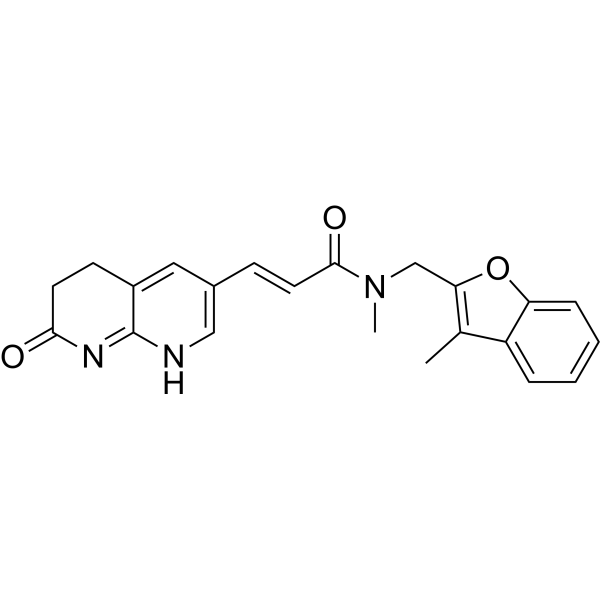
Cat. No.: HY-16911
CAS No.: 620175-39-5
Synonyms: API-1252; Debio 1452
Target:  

Bacterial Antibiotic

Research Areas:  

Infection

AFN-1252 is an orally active and selective inhibitor of FabI, an essential enzyme in fatty acid biosynthesis in Staphylococcus spp. AFN-1252 exhibits exquisite and highly selective activity against Staphylococcus spp. AFN-1252 exhibits typical MIC90 values of ⩽0.015 μg/ml against diverse clinical isolates of S. aureus. AFN-1252 is efficacious in a mouse model of septicemia providing 100% protection from an otherwise lethal peritoneal infection of S. aureus Smith .
loading...
    loading...
Cat. No.: HY-178949
Research Areas:  

Infection

MRSA antibiotic 3 (Compound C8) is a small-molecule antibiotic active against Methicillin (HY-121544)-resistant Staphylococcus aureus (MRSA), showing a MIC of 0.5 μg/mL against the standard S. aureus strain (ATCC 29213). MRSA antibiotic 3 potently inhibits the ATPase activity of S. aureus DNA gyrase with an IC50 of 0.32 μM. MRSA antibiotic 3 exhibits strong inhibitory activity against five clinical MRSA isolates, with MIC values ranging from 0.5 to 1 μg/mL. MRSA antibiotic 3 demonstrates negligible cytotoxicity at effective antibacterial concentrations and causes no hemolysis in erythrocytes even at extremely high concentrations. MRSA antibiotic 3 shows significant protective effects in both Galleria mellonella infection and murine sepsis models .
loading...
    loading...
Cat. No.: HY-175376
Target:  

Antibiotic Bacterial

Research Areas:  

Infection

QPyN16Th is an N-palmitoylated cationic thiazolidine antibiotic. QPyN16Th is selectively active against the Gram-positive bavteria E. faecalis, S. aureus and MRSA with an MIC of 1.95 μM over gram-negative bacteria. QPyN16Th can induce membrane permeabilization and depolarization and ROS production in MRSA. QPyN16Th increases the survival of zebrafish model of intramuscular MRSA infection .
loading...
    loading...
Cat. No.: HY-114622
CAS No.: 1047981-31-6
Synonyms: API-1252 tosylate; Debio 1452 tosylate
Target:  

Bacterial Antibiotic

Research Areas:  

Infection

AFN-1252 (API-1252) tosylate is an orally active and selective inhibitor of FabI, an essential enzyme in fatty acid biosynthesis in Staphylococcus spp. AFN-1252 tosylate exhibits exquisite and highly selective activity against Staphylococcus spp. AFN-1252 tosylate exhibits typical MIC90 values of 0.015 μg/ml against diverse clinical isolates of S. aureus. AFN-1252 tosylate is efficacious in a mouse model of septicemia providing 100% protection from an otherwise lethal peritoneal infection of S. aureus Smith .
loading...
    loading...
Cat. No.: HY-175723
Research Areas:  

Infection

MAO-A/B-IN-4 is an orally active MAO-A/B inhibitor, with IC50 values of 51.3 μM and 47.0 μM, respectively. MAO-A/B-IN-4 exhibits potent activity against S. aureus, MSSA, MRSA, LRSA, and LREFa. MAO-A/B-IN-4 demonstrates potent antibacterial efficacy in a mouse model of LRSA peritonitis infection. MAO-A/B-IN-4 can be used for the study of bacterial infections .
loading...
    loading...
Cat. No.: HY-111047
CAS No.: 944406-54-6
Target:  

Topoisomerase Bacterial

Research Areas:  

Infection

GSK945237 is a potent and orally active bacterial type IIA topoisomerases inhibitor. GSK945237 shows broad-spectrum activity against Gram-positive and Gram-negative bacteria (IC50 of 0.034 μg/mL against H. influenzae DNA gyrase). GSK945237 demonstrates good in vivo efficacy in a rat respiratory tract infection model. GSK945237 can be used for anti-infection research .
loading...
    loading...
Cat. No.: HY-179059
Research Areas:  

Infection

Anti-MRSA agent 40 (Compound 7-8) is a potent agent against Methicillin-resistant Staphylococcus aureus (MRSA). Anti-MRSA agent 40 exhibits significant antibacterial activity against MRSA2 and S. aureus ATCC 29213, with its MIC values being 1 μg/mL. Anti-MRSA agent 40 causes depolarization of the cell membrane, damages membrane integrity, and simultaneously increases the level of ROS within MRSA2, ultimately leading to cell lysis and death. Anti-MRSA agent 40 shows significant efficacy in the MRSA2 skin abscess model. Anti-MRSA agent 40 can be used for research on anti-MRSA infections .
loading...
    loading...
Cat. No.: HY-W587414
CAS No.: 70253-62-2
Target:  

Bacterial Antibiotic

Research Areas:  

Infection

Neospiramycin I is a macrolide antibiotic and a derivative of Spiramycin I (HY-N7141). Neospiramycin I is effective against the macrolide-sensitive KB210 strain of S. aureus, but ineffective against the macrolide-resistant KB224 strain, with minimum inhibitory concentrations (MIC) of 3.12 and greater than 100 µg/mL, respectively; it is also effective against B. cereus, B. subtilis, M. luteus, E. coli, and K. pneumoniae, with respective MIC values of 1.56, 3.12, 3.12, 0.2, 50, and 12.5 µg/mL. Neospiramycin I binds to the ribosomes of E. coli, with an inhibitory concentration 50 (IC50) of 1.2 µM. It protects mice from death in a type III S. pneumoniae infection model, with an effective dose 50 (ED50) of 399.8 mg/kg .
loading...
    loading...
Cat. No.: HY-181671
Target:  

Bacterial

Research Areas:  

Infection

Antibacterial agent 324 is an amphipathic antibacterial agent. Antibacterial agent 324 exhibits selective activity against Gram-positive bacteria, with limited activity against enterococci and weak activity against Gram-negative bacteria .
loading...
    loading...
Cat. No.: HY-184679
CAS No.: 890179-59-6
Target:  

Antibiotic Bacterial

Research Areas:  

Infection

MCZ-038 is a thiourea antibiotic with bactericidal activity. MCZ-038 exerts its effects by interfering with the lipid organization or fluidity of bacterial cell membranes . MCZ-038 can be used in studies related to drug-resistant Staphylococcus aureus infections and Vancomycin (HY-B0671)-resistant Enterococcus faecium infections .
loading...
    loading...
Cat. No.: HY-182798
Research Areas:  

Infection

Antibacterial agent 337 is an antibacterial agent. Antibacterial agent 337 specifically interacts with PG in bacterial cell membranes, triggering membrane disruption, membrane depolarization, increased permeability, cytoplasmic leakage, ROS accumulation and rapid bacterial death. Antibacterial agent 337 inhibits biofilm formation and disrupts mature biofilms. Antibacterial agent 337 exhibits potent in vivo antibacterial efficacy in a mouse model of Staphylococcus aureus skin abscess. Antibacterial agent 337 can be used in studies of Gram-positive bacterial infections, including methicillin-resistant Staphylococcus aureus infections, vancomycin-resistant Enterococcus faecalis infections and bacterial biofilm infections .
loading...
    loading...
Cat. No.: HY-179637
Research Areas:  

Infection

RNAP-σ interaction-IN-4 (Compound 3a) is an inhibitor of the RNA polymerase-sigma factor interaction (RNAP-σ) with MIC values against S. pneumoniae and S. aureus of 1 μg/mL and 2 μg/mL, respectively. RNAP-σ interaction-IN-4 exhibits strong bactericidal properties by interfering with the interaction of β′CH−σ and disrupting the transcription of bacteria. RNAP-IN-2 shows significant efficacy in sepsis models. RNAP-σ interaction-IN-4 can be used to study Gram-positive bacterial infections caused by multi-drug resistant strains .
loading...
    loading...
Cat. No.: HY-182033
CAS No.: 2761081-10-9
Target:  

Bacterial ClpP

Research Areas:  

Infection

ClpP agonist 1 is a Staphylococcus aureus ClpP (SaClpP) agonist with an EC50 of 1.44 μM, Kd values of 2.95 μM (isothermal titration calorimetry) and 18 μM (bio-layer interferometry), and a low drug resistance frequency. ClpP agonist 1 reduces bacterial load, shrinks infected area and improves histopathological outcomes in a mouse skin infection model. ClpP agonist 1 can be used for the research of Methicillin (HY-121544)-resistant Staphylococcus aureus (MRSA) skin infections .
loading...
    loading...
Cat. No.: HY-P11819
CAS No.: 3100335-76-7
SAP 2.8 peptide is an antimicrobial peptide. SAP 2.8 peptide induces bacterial membrane rupture and permeabilization, triggers an increase in intracellular ROS production, and causes bacterial death. SAP 2.8 peptide inhibits bacterial biofilm formation and disrupts established biofilms. SAP 2.8 peptide reduces bacterial load in animal models. SAP 2.8 peptide can be used for research on bacterial infections, skin and soft tissue infections, and peritonitis .
loading...
    loading...
Cat. No.: HY-168729
CAS No.: 3052804-28-8
Target:  

Bacterial

Research Areas:  

Infection

Antibacterial agent 256 (Compound C09) is an inhibitor for type I signal peptidase (SPase I). Antibacterial agent 256 inhibits gram-positive bacteria, that inhibits S. aureus ATCC 29213, E. faecium QF31, E. faecalis SF23-1 and S. suis P1/7, with MIC of 1-16 μg/mL. Antibacterial agent 256 exhibits cytotoxicity in cancer cell HEp-2 and Caco-2 with CC50 of 14.65 μg/mL and 21.93 μg/mL. Antibacterial agent 256 exhibits a hemolytic activity on mouse RBCs, with an HC50 of 13.29 μg/mL. Antibacterial agent 256 ameliorates the MRSA skin infection in mouse model .
loading...
    loading...
Cat. No.: HY-184313
Research Areas:  

Infection

Antibacterial agent 357 is an Antibacterial agent. Antibacterial agent 357 disrupts bacterial cell membranes, induces ROS accumulation, and triggers metabolic disorders. Antibacterial agent 357 exhibits antibacterial activity against MRSA, Staphylococcus aureus, and Gram-negative bacteria. Antibacterial agent 357 can be used in research related to MRSA infections, S. aureus infections, and Gram-negative bacterial infections .
loading...
    loading...
Cat. No.: HY-184584
Research Areas:  

Infection

Antibacterial agent 358 is an antibacterial agent. Antibacterial agent 358 selectively interacts with PG on bacterial cell membranes, causing membrane damage. Antibacterial agent 358 induces bacterial cell membrane depolarization, increased membrane permeability and leakage of intracellular components. Antibacterial agent 358 inhibits biofilm formation and disrupts established biofilms. Antibacterial agent 358 reduces bacterial load and alleviates tissue inflammation in a mouse skin abscess model. Antibacterial agent 358 can be used in research related to Gram-positive bacterial infections and skin abscesses .
loading...
    loading...
Cat. No.: HY-189347
CAS No.: 3096111-98-4
Target:  

Bacterial

Research Areas:  

Infection

CHNQD-01748 is an Antibacterial agent. CHNQD-01748 disrupts mature biofilms and bacterial membranes, leading to bacterial lysis. CHNQD-01748 exhibits selective antibacterial activity against S. aureus and MRSA, with negligible activity against other Gram-positive bacteria, Gram-negative bacteria, and fungi. CHNQD-01748 can be used for research on MRSA infections .
loading...
    loading...
  • 1

