



Akt
PKB; Protein kinase B
Akt/PKB (Protein kinase B), a serine/threonine protein kinase with antiapoptotic activity, is one of the major downstream targets of PtdIns(3,4,5)P3 signaling pathway. It contains a pleckstrin homology domain (PH domain) that specifically binds PtdIns(3,4,5)P3 on the plasma membrane. Akt phosphorylation and activation are directly determined by the level of PtdIns(3,4,5)P3 on the plasma membrane, which is regulated by PI3K.
Akt consists of three isoforms: PKBα/Akt1, PKBβ/Akt2 and PKBγ/Akt3. Akt isoforms have an N-terminal PH (pleckstrin homology) domain and a kinase domain, which are separated by a 39-amino-acid hinge region. Catalytically active Akt regulates the function of numerous substrates involved in cell survival, growth, proliferation, metabolism and protein synthesis.
Akt is a crucial mediator of cell survival and its deactivation is implicated in various stress-induced pathological cell death and degenerative diseases.
Akt Isoform Specific Products
All Product Categories
-
Akt Inhibitors
(1020)
View all products
-
Akt Agonists
(7)
View all products
-
Akt Activators
(301)
View all products
-
Akt Modulators
(25)
View all products
-
Akt Chemical
(1)
View all products
-
Akt Inducers
(9)
View all products
-
Akt Degraders
(11)
View all products
-
Akt Control
(1)
View all products
-
Akt Substrate
(1)
View all products
-
Akt Ligands
(6)
View all products
-
AKT Serine/Threonine Kinase 2 (AKT2) Proteins
(5)
View all products
-
AKT Serine/Threonine Kinase 3 (AKT3) Proteins
(6)
View all products
-
Akt Related Products (1489)
Related Products (1489)

-
Recombinant Proteins (11)
-
Antibodies (11)
-
Akt Isoform Comparison
-
Capivasertib-d4
 0 ImagesCat. No.: HY-15431SSynonyms: AZD5363-d4Capivasertib-d4 (AZd5363-d4) is the deuterium labeled Capivasertib (HY-15431). Capivasertib (AZD5363) is an orally active and potent pan-AKT kinase inhibitor with IC50 of 3, 7 and 7 nM for Akt1,Akt2 and Akt3, respectively.
-
Anticancer agent 235
 0 ImagesCat. No.: HY-N13063CAS No.: 2411108-21-7Anticancer agent 235 (Compound 49) is a modulator for PI3K/AKT/mTOR pathway, that promotes the generation of ROS, reduces the mitochondrial membrane potential, and thereby inhibits the proliferation of cancer cells HCT116, Caco-2, AGS and SMMC-772 with IC50 of 0.35-26.9 μM. Anticancer agent 235 arrests the cell cycle at G2/M phase, and induces apoptosis in HCT116.
-
Ishophloroglucin A
 0 ImagesCat. No.: HY-N12489CAS No.: 2263882-48-8Ishophloroglucin A is an orally active phlorotannin compound found in Ishige okamurae. Ishophloroglucin A can alleviate Dexamethasone (HY-14648)-induced muscle atrophy through muscle protein metabolism. Ishophloroglucin A can improve impaired protein synthesis (PI3K and Akt) or degradation (muscle-specific ubiquitin ligase muscle RING finger and atrogin-1). Ishophloroglucin A can be used for research of muscle atrophy-related diseases.
-
Dimethoxycurcumin-d6
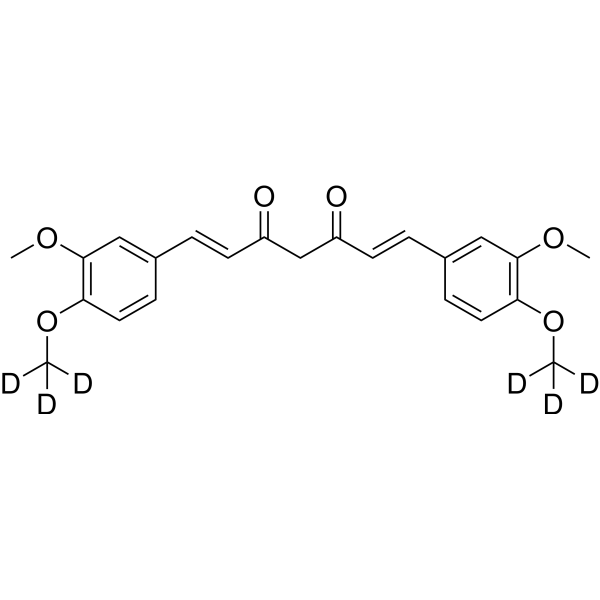 0 ImagesCat. No.: HY-100977SCAS No.: 3006902-95-7Synonyms: DiMC-d6; CHC 004-d6; Di-O-methylcurcumin-d6Dimethoxycurcumin-d6 (DiMC-d6; CHC 004-d6; Di-O-methylcurcumin-d6) is the deuterated-labeled Dimethoxycurcumin (HY-100977). Dimethoxycurcumin (DiMC) is a curcuminoid compound found in Curcuma longa. Dimethoxycurcumin is also an orally active thioredoxin reductase inhibitor (IC50 = 5.4 μM) and androgen receptor antagonist. Dimethoxycurcumin inhibits thioredoxin reductase, leading to oxidized thioredoxin accumulation, ROS production, DNA damage, glutathione depletion, mitochondrial membrane potential decrease, ATP depletion, S phase arrest, and apoptosis. Dimethoxycurcumin inhibits NF-κB, NADPH oxidase subunits, ATP synthase subunits, CDK4, cyclin-D1, FASN, ACC, and the IRS2-PI3K-Akt pathway, while activating AMPK, ERK, and JNK. Dimethoxycurcumin can be used for research on cancer, arsenic-induced hepatotoxicity, and tuberculosis.
-
5,4'-Dihydroxy-6,8-dimethoxy-7-O-rhamnosyl flavone
 0 ImagesCat. No.: HY-N12959CAS No.: 927406-46-0Synonyms: DDR5,4'-Dihydroxy-6,8-dimethoxy-7-O-rhamnosyl flavone (DDR) is an anticancer agent that can be extracted from Indigofera ovata. 5,4'-Dihydroxy-6,8-dimethoxy-7-O-rhamnosyl flavone can inhibit the PI3K/AKT and NF-кB pathways, inhibit the invasion and migration of cancer cells, and has anticancer activity.


-
Akt1-IN-7
 0 ImagesCat. No.: HY-163579CAS No.: 3034255-09-6Akt1-IN-7 (Compound 370) is an Akt1 inhibitor (IC50: <15 nM).
-
Monomethyl lithospermate
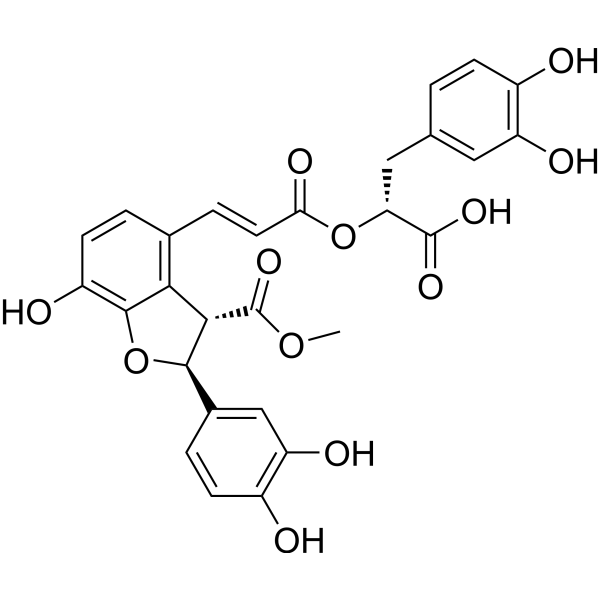 0 ImagesCat. No.: HY-N8931CAS No.: 933054-33-2Synonyms: Lithospermic acid monomethyl esterMonomethyl lithospermate activates the PI3K/AKT pathway, which plays a protective role in nerve injury. Monomethyl lithospermate can improve the survival ability of SHSY-5Y cells, inhibit the breakdown of mitochondrial membrane potential (MMOP) and inhibit cell apoptosis. Monomethyl lithospermate also reduced the level of oxidative stress in the brain tissue of rats with middle artery occlusion (MCAO) and improved nerve damage in rats with ischemic stroke (IS).
-
Histamine-13C5, 15N3
 0 ImagesCat. No.: HY-B1204S2Synonyms: Ergamine-13C5, 15N3Histamine-13C5, 15N3 (Ergamine-13C5, 15N3) is the 13C and 15N labeled isotope of Histamine (HY-B1204). Histamine is the agonist for histamine receptor and a vasodilator. Histamine is an organic nitrogen compound that participates in local immune responses, regulates intestinal physiological functions, and acts as a neurotransmitter. Histamine affects p38 MAPK/Akt signaling pathway, exhibits antitumor, antioxidant and anti-inflammatory activities. Histamine can be used in the research of acute myeloid leukemia, malignant melanoma, and renal cell carcinoma.
-
cis,trans-Germacrone
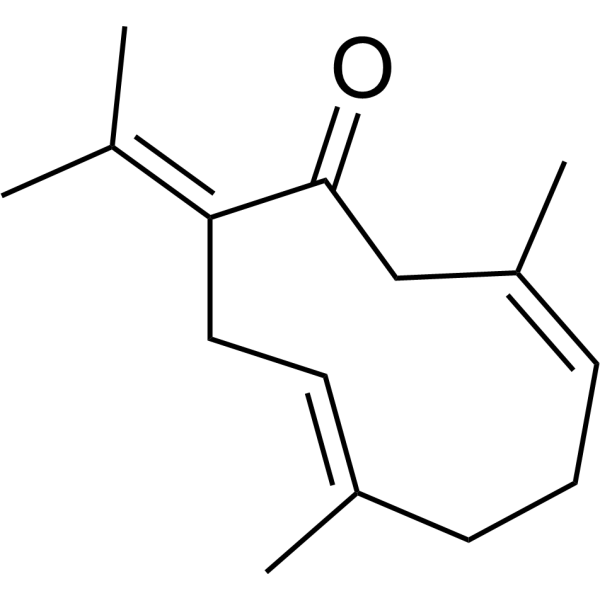 0 ImagesCat. No.: HY-145670CAS No.: 32663-51-7cis,trans-Germacrone is an isomer of Germacrone (HY-N0440) and is present in the stems and leaves of Curcuma wenyujin. Germacrone exhibits a wide range of antitumor, antioxidant, and anti-inflammatory effects. Germacrone inhibits lung cancer cell proliferation and alters Akt/MDM2/p53. Germacrone also induces cell cycle arrest at the G1/S phase. Germacrone is used in lung cancer-related research.
-
Mito-fisetin mF7
 0 ImagesCat. No.: HY-185559CAS No.: 3106880-06-9Mito-fisetin mF7 is a lipophilic derivative of Fisetin (HY-N0182). Mito-fisetin mF7 interacts with AKT and Bcl-2, limiting their stability and functionality. Mito-fisetin mF7 stimulates impairs mitochondrial function and reduces metabolic activity of cancer cells. Mito-fisetin mF7 can be used for the research of ER-positive breast cancer.
-
SS-3091
 0 ImagesCat. No.: HY-178042CAS No.: 2756257-56-2SS-3091 is a pan-KRas inhibitor active across KRasG12D, KRasG12C, KRasG12V, KRasG12S mutants, with minimal effects on non-KRas-driven cancer cells. SS-3091 binds to the KRas·ARaf interaction interface, destabilizes the complex, and attenuates KRas activity. SS-3091 suppresses phosphorylation of S6K, Akt, and ERK. SS-3091 reduces proliferation and decreases colony formation of cancer cells bearing KRasG12 mutations. SS-3091 can be used for the research of KRas-driven cancers.
-
SST0116CL1
 0 ImagesCat. No.: HY-164399CAS No.: 1799802-29-1SST0116CL1 is a HSP90 inhibitor (IC50: 0.21 μM). SST0116CL1 binds to the ATP binding pocket of Hsp90, and interferes with Hsp90 chaperone function thus resulting in client protein (EGFR, CDK4 and AKT) degradation. SST0116CL1 induces degradation of Her2 in BT-474 cell (IC50: 0.2 μM). SST0116CL1 has antiproliferative activity and inhibits tumor growth. SST0116CL1 can be used for the study of leukemia, gastric and ovarian carcinoma.
-
AKT-IN-11
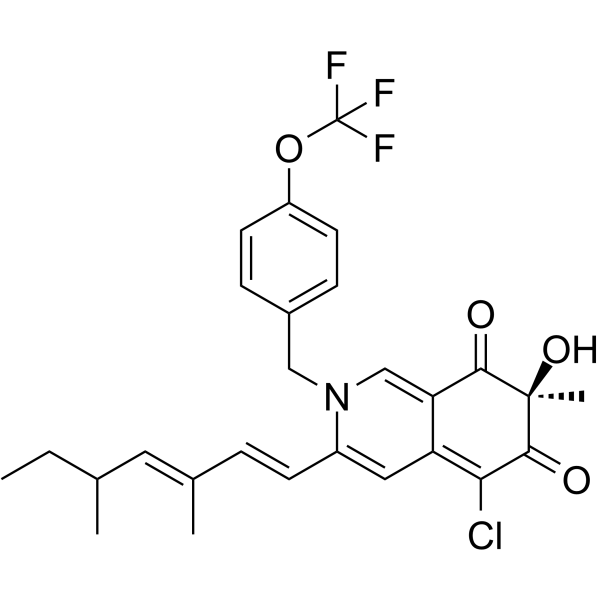 0 ImagesCat. No.: HY-144253AKT-IN-11 is one of the most effective antibacterial agents against human hepatoma BEL-7402 cell line with an IC50 value of 1.15μM.
-
Archexin sodium scrambled negative control
 0 ImagesCat. No.: HY-177616BArchexin sodium scrambled negative control is the sequence scrambled negative control of Archexin sodium.
-
AKT ligand-2
 0 ImagesCat. No.: HY-48682CAS No.: 2376139-61-4AKT ligand-2 (compound 5) is an AKT ligand. AKT ligand-2 can be combined with VHL ligand (S,R,S)-AHPC (HY-125845) through linker to synthesize PROTAC MS21 (HY-141807).
-
GTx-134
 0 ImagesCat. No.: HY-13312ACAS No.: 1008448-19-8GTx-134 is a dual insulin-like growth factor 1 receptor/insulin receptor (IGF-1R/IR) inhibitor with an IC50 values for IGF-1R and IR of 97 and 187 nM respectively. GTx-134 inhibits the autophosphorylation of IGF-1R and its downstream signaling pathway (Akt), thereby blocking the proliferation and survival signals of tumor cells. GTx-134 has broad-spectrum inhibitory activity against multiple myeloma cell lines and can induce apoptosis in sensitive cells. GTx-134 significantly inhibits tumor growth in mice with MM1.S cell transplantation. GTx-134 works in synergy with existing therapies (such as protease preparations, immunomodulators). GTx-134 can be used in high-risk myeloma research.




