



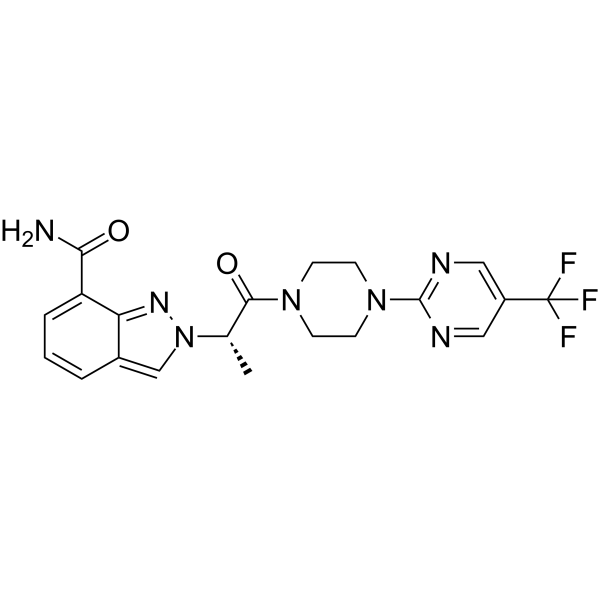
PARP7-IN-17

Based on 1 Customer Validation
PARP7-IN-17 is an orally active, selective PARP7 inhibitor with an IC50 of 4.5 nM. PARP7-IN-17 restores type I interferon signaling and induces IFN-beta and CXCL10 expression. PARP7-IN-17 promotes TBK1 and STAT1 phosphorylation. PARP7-IN-17 can be used for research on colon cancer.
For research use only. We do not sell to patients.
- Purity : 99.81%
- CAS No.: 3024030-10-9
- Formula: C20H20F3N7O2
- Molecular Weight:447.41
-
Storage:Powder -20°C, 3 years , 4°C, 2 years ; In solvent -80°C, 6 months , -20°C, 1 month

To place orders, for customer services and technical support, please contact: MedChemExpress USA
Tel: 609-228-6898 E-mail: [email protected] [email protected]


-
 Biological Activity
-
Chemical Information
-
Solvent & Solubility
- Protocols
- Purity & Documentation
- References
-
 Help & FAQs




Biological Activity
Description
IC50 & Target
[1]|
PARP7 4.5 nM (IC50) |
STAT1 |
Cellular Effect
|
Cell Line

|
Type | Value | Description | References |
|---|---|---|---|---|
| CT26 | IC50 |
16.17 μM
|
Cytotoxicity against mouse CT26 colorectal cancer cells assessed as viability reduction incubated 6 days by MTT assay.
Cytotoxicity against mouse CT26 colorectal cancer cells assessed as viability reduction incubated 6 days by MTT assay.
|
38059836 |
| CT26 | IC50 |
36.07 μM
|
Cytotoxicity against mouse CT26 colorectal cancer cells assessed as viability reduction incubated 6 days by CellTiter-Glo assay.
Cytotoxicity against mouse CT26 colorectal cancer cells assessed as viability reduction incubated 6 days by CellTiter-Glo assay.
|
38059836 |
| AML12 | IC50 |
50 μM
|
Cytotoxicity against normal mouse AML12 hepatocytes assessed as viability reduction incubated 6 days by MTT assay with IC50 greater than 50 μM.
Cytotoxicity against normal mouse AML12 hepatocytes assessed as viability reduction incubated 6 days by MTT assay with IC50 greater than 50 μM.
|
38059836 |
In Vitro
PARP7-IN-17 (1 μM) in a 371-kinase panel shows no obvious inhibitory activity at 1 μM[1].
PARP7-IN-17 in Caco-2 monolayers has high permeability and low efflux (efflux ratio 0.80)[1].
PARP7-IN-17 in CYP inhibition assays does not substantially inhibit CYP2C9, CYP2D6, or CYP3A4/5 (IC50 >30 μM)[1].
PARP7-IN-17 in cross-species liver hepatocytes is metabolically stable[1].
MedChemExpress (MCE) has not independently confirmed the accuracy of these methods. They are for reference only.
-
Cell Line:CT26 cells
-
Concentration:0.04, 0.14, 0.44 μM
-
Incubation Time:2 days (exposure)
-
Result:Increased IFN-β and CXCL10 mRNA expression relative to β-actin in a dose-dependent manner compared with blank control.
-
Cell Line:CT26 cells
-
Concentration:4.00 μM (alone); 0.14, 0.42, 1.30, 4.00 μM (with DMXAA 20 μg/mL)
-
Incubation Time:3 days (exposure)
-
Result:Promoted TBK1 phosphorylation and increased STAT1 phosphorylation in a concentration-dependent manner; total TBK1, total STAT1, and β-actin were also probed.
Parmacokinetics
In Vivo
MedChemExpress (MCE) has not independently confirmed the accuracy of these methods. They are for reference only.
-
Animal Model:Balb/c (female, 6-8 weeks)[1]
-
Dosage:6.25 mg/kg; 12.5 mg/kg; 25 mg/kg
-
Administration:i.g.; twice daily; 14 days
-
Result:Tumor growth inhibition (TGI) values were 42%, 53%, and 83% at 6.25, 12.5, and 25 mg/kg twice daily, respectively.
Tumor IFN-β mRNA expression was dose-dependently increased, and IHC showed increased IFN-β release in tumors.
Flow cytometry of tumors showed increased percentages of CD3+CD4+ and CD3+CD8+ T cells; IHC showed increased CD8+ T-cell infiltration.
-
Animal Model:Balb/c nude (female, 6-8 weeks)[1]
-
Dosage:25 mg/kg
-
Administration:i.g.; twice daily; 14 days
-
Result:No inhibitory effect on tumor growth was observed in CT26-bearing nude mice.


Chemical Information
-
CAS No. 3024030-10-9
-
Appearance Solid
-
Molecular Weight 447.41
-
Formula C20H20F3N7O2
-
Color White to off-white
-
SMILES
O=C(C1=CC=CC2=CN(N=C21)[C@@H](C)C(N3CCN(CC3)C4=NC=C(C=N4)C(F)(F)F)=O)N
-
Shipping
Room temperature in continental US; may vary elsewhere.
-
Storage
Powder -20°C 3 years 4°C 2 years In solvent -80°C 6 months -20°C 1 month


Solvent & Solubility
In Vitro:
DMSO : 50 mg/mL (111.75 mM; Need ultrasonic; Hygroscopic DMSO has a significant impact on the solubility of product, please use newly opened DMSO)
Please refer to the solubility information to select the appropriate solvent. Once prepared, please aliquot and store the solution to prevent product inactivation from repeated freeze-thaw cycles.
Storage method and period of stock solution: -80°C, 6 months; -20°C, 1 month. When stored at -80°C, please use it within 6 months. When stored at -20°C, please use it within 1 month.
Concentration (start) × Volume (start) = Concentration (final) × Volume (final)
In Vivo Dissolution Calculator
Please enter the basic information of animal experiments:
-
-
-
-
Recommended: Prepare an additional quantity of animals to account for potential losses during experiments.
Working solution concentration: 0.22 mg/mL


Purity & Documentation
-
Data Sheet (284 KB)
-
SDS (251 KB)
- English - EN (251 KB)
- Français - FR (251 KB)
- Deutsch - DE (251 KB)
- Norwegian - NO (251 KB)
- Español - ES (251 KB)
- Swedish - SV (251 KB)
- Italian - IT (251 KB)
- Korean - KR (251 KB)
- Portuguese - PT (251 KB)
-
Handling Instructions (2659 KB)
References


Complete Stock Solution Preparation Table
Please refer to the solubility information to select the appropriate solvent. Once prepared, please aliquot and store the solution to prevent product inactivation from repeated freeze-thaw cycles.
Storage method and period of stock solution: -80°C, 6 months; -20°C, 1 month. When stored at -80°C, please use it within 6 months. When stored at -20°C, please use it within 1 month.
| Optional Solvent | Concentration Solvent Mass | 1 mg | 5 mg | 10 mg | 25 mg |
|---|---|---|---|---|---|
| DMSO | 1 mM | 2.2351 mL | 11.1754 mL | 22.3509 mL | 55.8772 mL |
| 5 mM | 0.4470 mL | 2.2351 mL | 4.4702 mL | 11.1754 mL | |
| 10 mM | 0.2235 mL | 1.1175 mL | 2.2351 mL | 5.5877 mL | |
| 15 mM | 0.1490 mL | 0.7450 mL | 1.4901 mL | 3.7251 mL | |
| 20 mM | 0.1118 mL | 0.5588 mL | 1.1175 mL | 2.7939 mL | |
| 25 mM | 0.0894 mL | 0.4470 mL | 0.8940 mL | 2.2351 mL | |
| 30 mM | 0.0745 mL | 0.3725 mL | 0.7450 mL | 1.8626 mL | |
| 40 mM | 0.0559 mL | 0.2794 mL | 0.5588 mL | 1.3969 mL | |
| 50 mM | 0.0447 mL | 0.2235 mL | 0.4470 mL | 1.1175 mL | |
| 60 mM | 0.0373 mL | 0.1863 mL | 0.3725 mL | 0.9313 mL | |
| 80 mM | 0.0279 mL | 0.1397 mL | 0.2794 mL | 0.6985 mL | |
| 100 mM | 0.0224 mL | 0.1118 mL | 0.2235 mL | 0.5588 mL |


PARP7-IN-17 Related Classifications
HY-163081 Related Classifications
 Powered by Bioz
Keywords
- PARP7-IN-17
- 3024030-10-9
- PARP
- IFNAR
- CXCR
- Ser/Thr Kinase
- STAT
- poly ADP ribose polymerase
- Interferon-α/β receptor
- Interferon-alpha/beta receptor
- CXC chemokine receptors
- C-X-C motif chemokine receptors
- Protein Serine-Threonine Kinase
- ADP-ribosyltransferase
- CT26
- CXCL10
- IFN-beta
- PARP7
- STAT1
- T-cell infiltration
- TBK1
- colon carcinoma
- type I interferon signaling
- Inhibitor
- inhibitor
- inhibit