



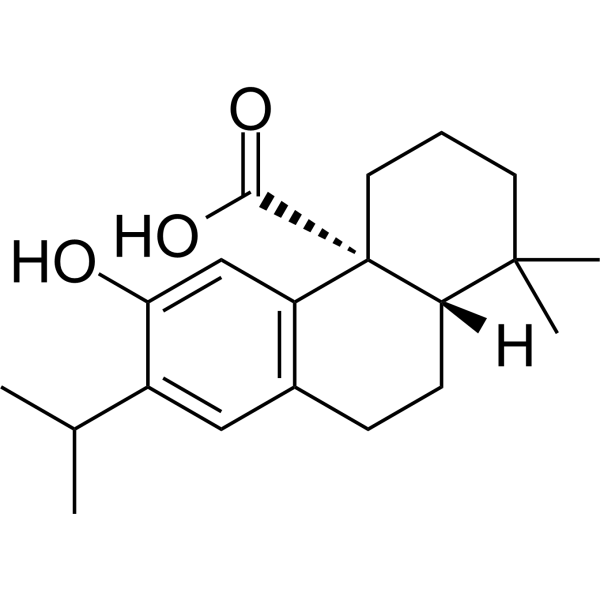
Pisiferic acid

Based on 1 Customer Validation
Pisiferic acid is a blood-brain barrier-permeable Kv1.1/Kv1.2 opener and Antibacterial agent. Pisiferic acid has no activity against KCNQ2/3, hERG, or Kv2.1. Pisiferic acid inhibits Perilipin1 and PPARγ protein expression. Pisiferic acid activates PP2C, inhibits PP2B/calcineurin, and induces Apoptosis/Caspase-3/7. Pisiferic acid inhibits macromolecule synthesis in Proteus vulgaris and inhibits DNA/lipid/peptidoglycan synthesis in Bacillus subtilis. Pisiferic acid has antibacterial effects against Proteus vulgaris, Staphylococcus aureus, and Bacillus subtilis. Pisiferic acid can be used for research on episodic ataxia type 1, Kv1.2 loss-of-function channelopathy, obesity, and acute promyelocytic leukemia.
Nos produits utilisent uniquement pour la recherche. Nous ne vendons pas aux patients.
- Pureté : 99.44%
- CAS No.: 67494-15-9
- Formule: C20H28O3
- Masse moléculaire:316.43
-
Stockage:Powder -20°C, 3 years ; In solvent -80°C, 6 months , -20°C, 1 month

To place orders, for customer services and technical support, please contact: MedChemExpress USA
Tel: 609-228-6898 E-mail: [email protected] [email protected]


-
 Activité biologique
-
Chemical Information
-
Solvant et solubilité
- Protocole
- Pureté et documentation
- Références
-
 Help & FAQs


Voir tous les produits spécifiques à Isoform Caspase
MoreVoir tous les produits spécifiques à Isoform DNA/RNA Synthesis
More

Activité biologique
Description
IC50 & Target
[4]|
PPARγ |
Caspase 3 |
Caspase-7 |
Cellular Effect
|
Cell Line

|
Type | Value | Description | References |
|---|---|---|---|---|
| HL-60 | IC50 |
35.1 μM
|
Cytotoxicity against human HL60 promyelocytic leukemia cells assessed as viability reduction after 4 days incubation by MTT assay.
Cytotoxicity against human HL60 promyelocytic leukemia cells assessed as viability reduction after 4 days incubation by MTT assay.
|
20153620 |
In Vitro
Pisiferic acid (4 days) exhibits cytotoxicity against HL60 cells with an IC50 of 35.1 µM[4].
Pisiferic acid (100 µM; 6 hours) induces condensed and fragmented nuclei in HL60 cells[4].
Pisiferic acid (50-200 µM; 0-6 h) activates caspase-3/7 in HL60 cells in a time- and dose-dependent manner, with activation occurring after more than 2 hours at 100 µM and strong activation occurring after 6 hours at 200 µM[4].
Pisiferic acid (18 h) inhibits P. vulgaris HX-19, S. aureus Terajima, and B. subtilis ATCC 6633, with MIC values of 25, 50, and 50 μg/mL, respectively[5].
Pisiferic acid inhibits lipid accumulation in differentiating 3T3-L1 adipocytes[3].
Pisiferic acid (50 μM; days 2-10) inhibits perilipin1 and PPARγ protein expression in differentiating 3T3-L1 adipocytes[3].
Pisiferic acid (12 μM; 3 min before recording) shifts EM in Xenopus oocytes expressing Kv1.1 channels[1].
Pisiferic acid (12 μM; 3 min) opens the channel in Xenopus oocytes expressing wild-type Kv1.2 by hyperpolarizing V0.5act and the resting membrane potential and slowing deactivation[2].
In Xenopus oocytes expressing heterozygous, heteromeric Kv1.1/Kv1.2 channels, Pisiferic acid (12 μM) increases current at −20 mV and hyperpolarizes V0.5act of all fourteen tested Kv1.2 LOF variants[2].
Pisiferic acid (100 µM) activates recombinant mouse GST-PP2Cα up to 1.3-fold[4].
Pisiferic acid inhibits PP2B phosphatase activity with an IC50 of 118.3 µM[4].
MedChemExpress (MCE) has not independently confirmed the accuracy of these methods. They are for reference only.
-
Cell Line:mouse 3T3-L1 adipocytes
-
Concentration:50 μM
-
Incubation Time:undifferentiated cells, day 2, day 4, day 7, day 10
-
Result:Perilipin1 expression increased from the middle to late stage (day 4-10) and was clearly reduced by the presence of 50 μM Pisiferic acid.
Also suppressed PPARγ expression in the late stage (day 7-10) of differentiation.
-
Cell Line:HL60 cells
-
Concentration:50, 100, 200 µM
-
Incubation Time:0, 1, 2, 3, 6 h
-
Result:Caspase-3/7 activation increased gradually for more than 2 h after exposure to 100 µM pisiferic acid.
Caspase-3/7 activity was also strongly activated with 200 µM pisiferic acid after 6 h of exposure.
In Vivo
MedChemExpress (MCE) has not independently confirmed the accuracy of these methods. They are for reference only.
- Research Protocol for Infectious Diseases
- RNA extraction experimental
- Western Blot
- Detection of Apoptosis
- TUNEL staining for apoptotic DNA fragmentation
- Annexin V plus membrane-impermeant dye apoptosis staining
- Apoptosis Solutions
- Research Protocol for Metabolic Diseases
- Protocol For Protein Expression And Purification


Chemical Information
-
CAS No. 67494-15-9
-
Appearance Solid
-
Masse moléculaire 316.43
-
Formule C20H28O3
-
Color White to off-white
-
SMILES
O=C([C@]12CCCC(C)(C)[C@]1([H])CCC3=C2C=C(O)C(C(C)C)=C3)O
-
Livraison
Room temperature in continental US; may vary elsewhere.
-
Stockage
Powder -20°C 3 years In solvent -80°C 6 months -20°C 1 month


Solvant et solubilité
In Vitro:
DMSO : 100 mg/mL (316.03 mM; Need ultrasonic; Hygroscopic DMSO has a significant impact on the solubility of product, please use newly opened DMSO)
Please refer to the solubility information to select the appropriate solvent. Once prepared, please aliquot and store the solution to prevent product inactivation from repeated freeze-thaw cycles.
Storage method and period of stock solution: -80°C, 6 months; -20°C, 1 month. When stored at -80°C, please use it within 6 months. When stored at -20°C, please use it within 1 month.
Please refer to the solubility information to select the appropriate solvent. Once prepared, please aliquot and store the solution to prevent product inactivation from repeated freeze-thaw cycles.
Storage method and period of stock solution: -80°C, 6 months; -20°C, 1 month. When stored at -80°C, please use it within 6 months. When stored at -20°C, please use it within 1 month.
Concentration (start) × Volume (start) = Concentration (final) × Volume (final)
In Vivo:
Select the appropriate dissolution method based on your experimental animal and administration route.
- For the following dissolution methods, please ensure to first prepare a clear stock solution using an In Vitro approach and then sequentially add co-solvents:
- To ensure reliable experimental results, the clarified stock solution can be appropriately stored based on storage conditions. As for the working solution for In Vivo experiments, it is recommended to prepare freshly and use it on the same day.
- The percentages shown for the solvents indicate their volumetric ratio in the final prepared solution. If precipitation or phase separation occurs during preparation, heat and/or sonication can be used to aid dissolution.
Add each solvent one by one: 10% DMSO 40% PEG300 5% Tween-80 45% Saline
Solubility: ≥ 2.5 mg/mL (7.90 mM); Clear solution
This protocol yields a clear solution of ≥ 2.5 mg/mL (saturation unknown).
Taking 1 mL working solution as an example, add 100 μL DMSO stock solution (25.0 mg/mL) to 400 μL PEG300, and mix evenly; then add 50 μL Tween-80 and mix evenly; then add 450 μL Saline to adjust the volume to 1 mL.
Preparation of Saline: Dissolve 0.9 g sodium chloride in ddH₂O and dilute to 100 mL to obtain a clear Saline solution.
Add each solvent one by one: 10% DMSO 90% (20% SBE-β-CD in Saline)
Solubility: ≥ 2.5 mg/mL (7.90 mM); Clear solution
This protocol yields a clear solution of ≥ 2.5 mg/mL (saturation unknown).
Taking 1 mL working solution as an example, add 100 μL DMSO stock solution (25.0 mg/mL) to 900 μL 20% SBE-β-CD in Saline, and mix evenly.
Preparation of 20% SBE-β-CD in Saline (4°C, storage for one week): 2 g SBE-β-CD powder is dissolved in 10 mL Saline, completely dissolve until clear.
In Vivo Dissolution Calculator
Please enter the basic information of animal experiments:
-
-
-
-
Recommended: Prepare an additional quantity of animals to account for potential losses during experiments.
Please enter your animal formula composition:
-
%DMSO +
Recommended: Keep the proportion of DMSO in working solution below 2% if your animal is weak.
-
%+
-
+%Tween-80 + +
-
%Saline +
The co-solvents required include: DMSO, . All of co-solvents are available by MedChemExpress (MCE). , Tween 80. All of co-solvents are available by MedChemExpress (MCE).
Working solution concentration: 0.22 mg/mL
Method for preparing stock solution: mg drug dissolved in μL DMSO. Stock solution concentration: mg/mL.
1. Take μL DMSO stock solution;
2. Add μL .
μL , mix evenly;
3. Then add μL Tween 80, mix evenly;
4. Then add μL
Please ensure that the stock solution in the first step is dissolved to a clear state, and add co-solvents in sequence. You can use ultrasonic heating (ultrasonic cleaner, recommended frequency 20-40 kHz), vortexing, etc. to assist dissolution.


Pureté et documentation
-
Fiche technique (283 KB)
-
SDS (394 KB)
- English - EN (394 KB)
- Français - FR (394 KB)
- Deutsch - DE (394 KB)
- Norwegian - NO (394 KB)
- Español - ES (394 KB)
- Swedish - SV (394 KB)
- Italian - IT (394 KB)
- Korean - KR (394 KB)
- Portuguese - PT (394 KB)
-
Instruction de manipulation (2659 KB)
Références


Complete Stock Solution Preparation Table
Please refer to the solubility information to select the appropriate solvent. Once prepared, please aliquot and store the solution to prevent product inactivation from repeated freeze-thaw cycles.
Storage method and period of stock solution: -80°C, 6 months; -20°C, 1 month. When stored at -80°C, please use it within 6 months. When stored at -20°C, please use it within 1 month.
| Optional Solvent | Concentration Solvent Mass | 1 mg | 5 mg | 10 mg | 25 mg |
|---|---|---|---|---|---|
| DMSO | 1 mM | 3.1603 mL | 15.8013 mL | 31.6026 mL | 79.0064 mL |
| 5 mM | 0.6321 mL | 3.1603 mL | 6.3205 mL | 15.8013 mL | |
| 10 mM | 0.3160 mL | 1.5801 mL | 3.1603 mL | 7.9006 mL | |
| 15 mM | 0.2107 mL | 1.0534 mL | 2.1068 mL | 5.2671 mL | |
| 20 mM | 0.1580 mL | 0.7901 mL | 1.5801 mL | 3.9503 mL | |
| 25 mM | 0.1264 mL | 0.6321 mL | 1.2641 mL | 3.1603 mL | |
| 30 mM | 0.1053 mL | 0.5267 mL | 1.0534 mL | 2.6335 mL | |
| 40 mM | 0.0790 mL | 0.3950 mL | 0.7901 mL | 1.9752 mL | |
| 50 mM | 0.0632 mL | 0.3160 mL | 0.6321 mL | 1.5801 mL | |
| 60 mM | 0.0527 mL | 0.2634 mL | 0.5267 mL | 1.3168 mL | |
| 80 mM | 0.0395 mL | 0.1975 mL | 0.3950 mL | 0.9876 mL | |
| 100 mM | 0.0316 mL | 0.1580 mL | 0.3160 mL | 0.7901 mL |


Pisiferic acid Related Classifications
HY-W354851 Related Classifications
 Powered by Bioz