



Specneuzhenide
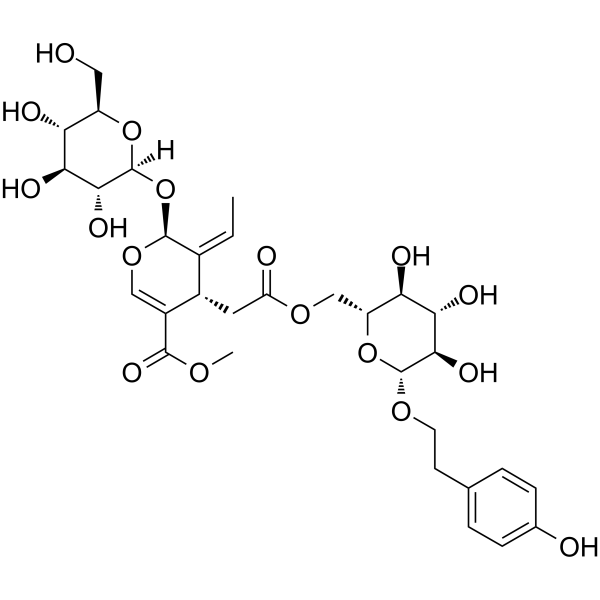
Specneuzhenide (Nuezhenide) is an orally active phenol glycoside isolated from Ligustrum sinense. Specneuzhenide exhibits anti-inflammatory, antioxidant, antifibrotic, antitumor, hypoglycemic, as well as cartilage- and kidney-protective activities. Specneuzhenide inhibits fibrosis by activating the AMPK pathway (Kd = 62 µM), alleviates inflammation and oxidative stress by regulating multiple signaling pathways (NF-κB, Wnt/β-catenin and HO-1/Nrf-2), and upregulates podocyte proteins to comprehensively protect renal function. Specneuzhenide can be used in research related to cancer, rheumatoid arthritis, pulmonary fibrosis, diabetic nephropathy and osteoarthritis.
For research use only. We do not sell to patients.
- CAS No.: 449733-84-0
- Formula: C31H42O17
- Molecular Weight:686.65
-
Storage:
4°C, protect from light
* In solvent : -80°C, 6 months; -20°C, 1 month (protect from light)

To place orders, for customer services and technical support, please contact: MedChemExpress USA
Tel: 609-228-6898 E-mail: [email protected] [email protected]


-
 Biological Activity
-
Chemical Information
-
Solvent & Solubility
- Purity & Documentation
- References
-
 Help & FAQs


All AMPK Isoforms
More

Biological Activity
Description
|
AMPK |
NFκB |
HO-1 |
IL-6 |
E-cadherin (CDH1) |
Cellular Effect
|
Cell Line

|
Type | Value | Description | References |
|---|---|---|---|---|
| HepG2 | IC50 |
>100 μM
Compound: 3
|
Anticancer activity against human HepG2 cells assessed as cell viability after 48 hrs by MTT assay
Anticancer activity against human HepG2 cells assessed as cell viability after 48 hrs by MTT assay
|
[PMID: 24974349] |
In Vitro
Specneuzhenide (Nuezhenide) (10-40 µM; 1 h pretreatment followed by 8-24 h stimulation with LPS (HY-D1056)) exerts anti-inflammatory, antioxidant and mitochondrial protective effects, inhibits NF-κB pathway activation, and blocks the nuclear translocation of p65 in RAW264.7 macrophages[3].
Specneuzhenide (5-20 µM; 48 h) inhibits the myofibroblast transdifferentiation activity in TGF-β1-stimulated mouse primary lung fibroblasts (PLFs), reduces the expression of Col-1, α-SMA, LOXL2 and PD-L1, and increases the phosphorylation of AMPK[1].
Specneuzhenide (Nuezhenide) (5-20 µM; 48 h) inhibits epithelial-mesenchymal transition in TGF-β1 (HY-P78360)-stimulated MLE-12 cells, upregulating E-cadherin expression and downregulating Vimentin and α-SMA expression[1].
MedChemExpress (MCE) has not independently confirmed the accuracy of these methods. They are for reference only.
-
Cell Line:MLE-12 cells and primary lung fibroblasts (PLFs)
-
Concentration:1, 5, 10, 15, 20 µM
-
Incubation Time:48 h
-
Result:Showed no significant cytotoxic effect on normal cell viability at the tested.
-
Cell Line:TGF-β1-stimulated MLE-12 cells and PLFs
-
Concentration:5, 10, 20 µM
-
Incubation Time:48 h
-
Result:Significantly down-regulated the protein levels of α-SMA, Vimentin, Col-1, and LOXL2, and up-regulated the protein expression of E-cadherin; simultaneously.
Increased the phosphorylation level of AMPK and decreased the protein expression of PD-L1.
-
Cell Line:TGF-β1-stimulated MLE-12 cells and PLFs
-
Concentration:5, 10, 20 µM
-
Incubation Time:48 h
-
Result:Significantly down-regulated the mRNA levels of α-SMA, Vimentin, and Col-1, and up-regulated the mRNA expression of E-cadherin.
-
Cell Line:TGF-β1-stimulated PLFs
-
Concentration:10 µM
-
Incubation Time:48 h
-
Result:Significantly reduced the fluorescence expression signal of PD-L1.
-
Cell Line:RAW264.7 macrophages
-
Concentration:10, 20, 40 µM
-
Incubation Time:24 h
-
Result:Caused no significant toxic effects on cell viability.
-
Cell Line:LPS-stimulated RAW264.7 macrophages
-
Concentration:10, 20, 40 µM
-
Incubation Time:1 h pretreatment, followed by 24 h LPS stimulation
-
Result:Reduced the secretion of pro-inflammatory cytokines (TNF-α, IL-6).
-
Cell Line:LPS-stimulated RAW264.7 macrophages
-
Concentration:10, 20, 40 µM
-
Incubation Time:1 h pretreatment, followed by 8 to 18 h LPS stimulation
-
Result:Significantly decreased the protein expression of iNOS and COX-2, and effectively inhibited the phosphorylation of IKKα/β, IκBα, and p65.
-
Cell Line:LPS-stimulated RAW264.7 macrophages
-
Concentration:40 µM
-
Incubation Time:1 h pretreatment, followed by 1 h LPS stimulation
-
Result:Effectively prevented the nuclear translocation of NF-κB p65 from the cytoplasm to the nucleus.
In Vivo
Specneuzhenide (30-60 mg/kg; p.o.; once daily; for 16 consecutive days) effectively reduces blood glucose and urinary protein, alleviates renal tissue inflammation, and protects renal podocytes in a diabetic nephropathy model of Sprague Dawley rats induced by STZ (HY-13753) combined with a high-sugar and high-fat diet[4].
Specneuzhenide (45-90 mg/kg; p.o.; once daily; for 14 consecutive days) significantly improves survival rate, attenuates pulmonary fibrosis, reduces collagen deposition and inhibits fibroblast proliferation in the bleomycin (HY-108345)-induced pulmonary fibrosis model of C57BL/6 mice[1].
MedChemExpress (MCE) has not independently confirmed the accuracy of these methods. They are for reference only.
-
Animal Model:C57BL/6 (male, 6-8 weeks old, 18-22 g, intratracheal bleomycin-induced pulmonary fibrosis)[1]
-
Dosage:45 mg/kg; 90 mg/kg
-
Administration:p.o.; once daily; for 14 days
-
Result:Reversed weight loss and decreased mortality and pulmonary index.
Alleviated pathological damage and massive collagen deposition in lung tissues, reducing the fibrosis score.
Activated AMPK and promoted PD-L1 degradation in vivo, thereby down-regulating proliferation markers (such as Mki67) and inhibiting fibroblast proliferation.
-
Animal Model:Sprague Dawley (male, 200 g)[2]
-
Dosage:5 mg/kg; 10 mg/kg; 15 mg/kg
-
Administration:p.o.; once daily; 28 days
-
Result:Increased the body weight of rats and decreased hind paw swelling volume, arthritis score, and organ indices of the spleen and thymus.
Reduced liver function parameters (SGPT, SGOT, ALP) and anti-CII IgG antibody levels in the serum.
Inhibited serum inflammatory mediators (COX-2, PGE2) and pro-inflammatory cytokines (TNF-α, IL-1β, IL-6, etc.), while increasing the levels of IL-10 and TGF-β.
Improved oxidative stress by decreasing MDA and elevating GSH, SOD, and CAT.
Significantly down-regulated the relative mRNA expression of Nrf2, HO-1, and NF-κB.
-
Animal Model:Sprague-Dawley (male, specific pathogen free, 220 g, diabetic nephropathy induced by high glucose/high fat diet + streptozotocin injection)[4]
-
Dosage:30 mg/kg; 60 mg/kg
-
Administration:p.o.; once daily; for 16 days
-
Result:Decreased blood glucose levels and 24-hour urine protein content, and increased the body weight of the model rats.
Reduced the expression levels of IL-1β, IL-6, and TNF-α in serum and renal tissues, and corrected the oxidative stress imbalance (decreased MDA, elevated SOD).
Significantly up-regulated the expression of podocyte-related proteins (Podocin and CD2AP) in renal tissues, and was confirmed by HE and PAS staining to alleviate glomerular pathological damage.


Chemical Information
-
CAS No. 449733-84-0
-
Appearance Solid
-
Molecular Weight 686.65
-
Formula C31H42O17
-
Color White to off-white
-
SMILES
C/C=C1[C@@H](C(C(OC)=O)=CO[C@H]/1O[C@@H]2O[C@@H]([C@H]([C@@H]([C@H]2O)O)O)CO)CC(OC[C@H]3O[C@H]([C@@H]([C@H]([C@@H]3O)O)O)OCCC4=CC=C(C=C4)O)=O
-
Synonyms
Nuezhenide
-
Structure Classification
-
Initial Source
-
Shipping
Room temperature in continental US; may vary elsewhere.
-
Storage
4°C, protect from light
* In solvent : -80°C, 6 months; -20°C, 1 month (protect from light)


Solvent & Solubility
In Vitro:
DMSO : ≥ 100 mg/mL (145.63 mM; Hygroscopic DMSO has a significant impact on the solubility of product, please use newly opened DMSO)
* "≥" means soluble, but saturation unknown.
Please refer to the solubility information to select the appropriate solvent. Once prepared, please aliquot and store the solution to prevent product inactivation from repeated freeze-thaw cycles.
Storage method and period of stock solution: -80°C, 6 months; -20°C, 1 month (protect from light). When stored at -80°C, please use it within 6 months. When stored at -20°C, please use it within 1 month.
Please refer to the solubility information to select the appropriate solvent. Once prepared, please aliquot and store the solution to prevent product inactivation from repeated freeze-thaw cycles.
Storage method and period of stock solution: -80°C, 6 months; -20°C, 1 month (protect from light). When stored at -80°C, please use it within 6 months. When stored at -20°C, please use it within 1 month.
Concentration (start) × Volume (start) = Concentration (final) × Volume (final)
In Vivo:
Select the appropriate dissolution method based on your experimental animal and administration route.
- For the following dissolution methods, please ensure to first prepare a clear stock solution using an In Vitro approach and then sequentially add co-solvents:
- To ensure reliable experimental results, the clarified stock solution can be appropriately stored based on storage conditions. As for the working solution for In Vivo experiments, it is recommended to prepare freshly and use it on the same day.
- The percentages shown for the solvents indicate their volumetric ratio in the final prepared solution. If precipitation or phase separation occurs during preparation, heat and/or sonication can be used to aid dissolution.
Add each solvent one by one: 10% DMSO 40% PEG300 5% Tween-80 45% Saline
Solubility: ≥ 2.5 mg/mL (3.64 mM); Clear solution
This protocol yields a clear solution of ≥ 2.5 mg/mL (saturation unknown).
Taking 1 mL working solution as an example, add 100 μL DMSO stock solution (25.0 mg/mL) to 400 μL PEG300, and mix evenly; then add 50 μL Tween-80 and mix evenly; then add 450 μL Saline to adjust the volume to 1 mL.
Preparation of Saline: Dissolve 0.9 g sodium chloride in ddH₂O and dilute to 100 mL to obtain a clear Saline solution.
Add each solvent one by one: 10% DMSO 90% (20% SBE-β-CD in Saline)
Solubility: ≥ 2.08 mg/mL (3.03 mM); Clear solution
This protocol yields a clear solution of ≥ 2.08 mg/mL (saturation unknown).
Taking 1 mL working solution as an example, add 100 μL DMSO stock solution (20.8 mg/mL) to 900 μL 20% SBE-β-CD in Saline, and mix evenly.
Preparation of 20% SBE-β-CD in Saline (4°C, storage for one week): 2 g SBE-β-CD powder is dissolved in 10 mL Saline, completely dissolve until clear.
In Vivo Dissolution Calculator
Please enter the basic information of animal experiments:
-
-
-
-
Recommended: Prepare an additional quantity of animals to account for potential losses during experiments.
Please enter your animal formula composition:
-
%DMSO +
Recommended: Keep the proportion of DMSO in working solution below 2% if your animal is weak.
-
%+
-
+%Tween-80 + +
-
%Saline +
The co-solvents required include: DMSO, . All of co-solvents are available by MedChemExpress (MCE). , Tween 80. All of co-solvents are available by MedChemExpress (MCE).
Working solution concentration: 0.22 mg/mL
Method for preparing stock solution: mg drug dissolved in μL DMSO. Stock solution concentration: mg/mL. * In solvent : -80°C, 6 months; -20°C, 1 month (protect from light)
1. Take μL DMSO stock solution;
2. Add μL .
μL , mix evenly;
3. Then add μL Tween 80, mix evenly;
4. Then add μL
Please ensure that the stock solution in the first step is dissolved to a clear state, and add co-solvents in sequence. You can use ultrasonic heating (ultrasonic cleaner, recommended frequency 20-40 kHz), vortexing, etc. to assist dissolution.


Purity & Documentation
-
Data Sheet (297 KB)
-
SDS (393 KB)
- English - EN (393 KB)
- Français - FR (393 KB)
- Deutsch - DE (393 KB)
- Norwegian - NO (393 KB)
- Español - ES (393 KB)
- Swedish - SV (393 KB)
- Italian - IT (393 KB)
- Korean - KR (393 KB)
- Portuguese - PT (393 KB)
-
Handling Instructions (2659 KB)
References
[1]. Wu Y, et al. Specneuzhenide improves bleomycin-induced pulmonary fibrosis in mice via AMPK-dependent reduction of PD-L1. Phytomedicine : international journal of phytotherapy and phytopharmacology. 2024 Jun;128:155318. [Content Brief]
[4]. Yin J, et al. Protective Effects of Specneuzhenide on Renal Injury in Rats with Diabetic Nephropathy. Open medicine (Warsaw, Poland). 2019;14:740-747. [Content Brief]


Complete Stock Solution Preparation Table
Please refer to the solubility information to select the appropriate solvent. Once prepared, please aliquot and store the solution to prevent product inactivation from repeated freeze-thaw cycles.
Storage method and period of stock solution: -80°C, 6 months; -20°C, 1 month (protect from light). When stored at -80°C, please use it within 6 months. When stored at -20°C, please use it within 1 month.
| Optional Solvent | Concentration Solvent Mass | 1 mg | 5 mg | 10 mg | 25 mg |
|---|---|---|---|---|---|
| DMSO | 1 mM | 1.4563 mL | 7.2817 mL | 14.5635 mL | 36.4086 mL |
| 5 mM | 0.2913 mL | 1.4563 mL | 2.9127 mL | 7.2817 mL | |
| 10 mM | 0.1456 mL | 0.7282 mL | 1.4563 mL | 3.6409 mL | |
| 15 mM | 0.0971 mL | 0.4854 mL | 0.9709 mL | 2.4272 mL | |
| 20 mM | 0.0728 mL | 0.3641 mL | 0.7282 mL | 1.8204 mL | |
| 25 mM | 0.0583 mL | 0.2913 mL | 0.5825 mL | 1.4563 mL | |
| 30 mM | 0.0485 mL | 0.2427 mL | 0.4854 mL | 1.2136 mL | |
| 40 mM | 0.0364 mL | 0.1820 mL | 0.3641 mL | 0.9102 mL | |
| 50 mM | 0.0291 mL | 0.1456 mL | 0.2913 mL | 0.7282 mL | |
| 60 mM | 0.0243 mL | 0.1214 mL | 0.2427 mL | 0.6068 mL | |
| 80 mM | 0.0182 mL | 0.0910 mL | 0.1820 mL | 0.4551 mL | |
| 100 mM | 0.0146 mL | 0.0728 mL | 0.1456 mL | 0.3641 mL |


Specneuzhenide Related Classifications
HY-N6075 Related Classifications
 Powered by Bioz
Keywords
- Specneuzhenide
- 449733-84-0
- Nuezhenide
- AMPK
- NF-κB
- β-catenin
- Wnt
- Heme Oxygenase (HO)
- Interleukin Related
- Reactive Oxygen Species (ROS)
- ROS Kinase
- Cadherin
- MMP
- PD-1/PD-L1
- Lysyl Oxidase
- HO-1
- Nrf2
- MLE-12 cells
- diabetic nephropathy
- rheumatoid arthritis
- primary lung fibroblasts
- RAW264.7 cells
- primary rat chondrocytes
- Inhibitor
- inhibitor
- inhibit