



Reactive Oxygen Species (ROS)
Reactive oxygen species (ROS), such as superoxide anion (O2-), hydrogen peroxide (H2O2), and hydroxyl radical (HO•), consist of radical and non-radical oxygen species formed by the partial reduction of oxygen. Cellular ROS are generated endogenously during mitochondrial oxidative metabolism as well as in cellular response to xenobiotics, cytokines, and bacterial invasion.
ROS also activates MAPK pathways by the direct inhibition of MAPK phosphatases. Through PTEN, the PI3K pathway is subject to reversible redox regulation by ROS generated by growth factor stimulation. The activation of autophagy may be a cellular defense mechanism in response to ROS.
All Product Categories
-
Reactive Oxygen Species (ROS) Inhibitors
(1091)
View all products
-
Reactive Oxygen Species (ROS) Agonists
(37)
View all products
-
Reactive Oxygen Species (ROS) Antagonists
(2)
View all products
-
Reactive Oxygen Species (ROS) Activators
(525)
View all products
-
Reactive Oxygen Species (ROS) Modulators
(22)
View all products
-
Reactive Oxygen Species (ROS) MDM2 Inhibitor
(1)
View all products
-
Reactive Oxygen Species (ROS) Inducers
(645)
View all products
-
Reactive Oxygen Species (ROS) Controls
(5)
View all products
-
Reactive Oxygen Species (ROS) Substrates
(3)
View all products
-
Reactive Oxygen Species (ROS) Related Products (2859)
Related Products (2859)

-
Antibodies (8)
-
DdBIC
 0 ImagesCat. No.: HY-180786CAS No.: 3085711-53-8DdBIC is a pyroptosis inducer. DdBIC binds to Nur77 and triggers its translocation to mitochondria, activates SDHA to deplete succinyl-CoA, disrupts heme homeostasis, induces electron leakage, and elicits mitochondrial ROS production. DdBIC induces mitochondrial ROS that oxidatively activates OMA1, promotes OPA1 cleavage and its release into the cytoplasm, activates the integrated stress response via PERK, and ultimately activates granzyme B to cleave GSDMC. DdBIC can be used for the study of melanoma.
-
MN-05
 0 ImagesCat. No.: HY-126939CAS No.: 1835197-63-1MN-05 is a dual neuroprotective and vasodilatory NMDA receptor inhibitor.MN-05 blocks calcium influx, reduces free radical production, and maintains mitochondrial membrane potential in cortical neurons exposed to glutamate.MN-05 dilates aortic rings against phenylephrine-induced contraction.MN-05 protects neurons against glutamate-induced injury in vitro.MN-05 can be used for the research of neurodegenerative diseases.
-
PARP1-IN-27
 0 ImagesCat. No.: HY-161934PARP1-IN-27 (Compound 9B) is the inhibitor for PARP1 and PARP2, with IC50 of 2.53 nM and 6.45 nM in cell SUM149PT. PARP1-IN-27 inhibits the proliferation of BRCA-mutated cancer cells SUM149PT, HCC1937 and Capan-1, with IC50 of 0.62, 1.91 and 4.26 μM respectively. PARP1-IN-27 aggravates DNA double-strand breaks, increases ROS generation, arrests cell cycle at G2/M phase, and induces apoptosis in SUM149PT.
-
ZMC2
 0 ImagesCat. No.: HY-165381CAS No.: 71555-14-1ZMC2 is a thiosemicarbazone-class metal ion chelator and zinc ionophore with a human mutant p53R175H binding Ka of 27.4 nM.ZMC2 binds Fe, Cu, Mn, Zn, and other transition metals.ZMC2 facilitates zinc transport across membranes.ZMC2 restores zinc binding to zinc-deficient p53 mutants, restoring wild-type structure and function, including site-specific DNA binding.ZMC2 generates reactive oxygen species (ROS).ZMC2 can be used for the research of cancer.
-
NecroX-2
 0 ImagesCat. No.: HY-179037CAS No.: 1120333-38-1NecroX-2 is a potent inhibitor of caspase-independent necrosis. NecroX-2 exhibits antioxidant activity by scavenging DPPH radicals and peroxynitrite. NecroX-2 inhibits t-BHP-induced mitochondrial ROS/RNS generation, and protects t-BHP and Doxorubicin (HY-15142A)-induced cell death in vitro. NecroX-2 can be used for research on neurological diseases.

-
MMP-9-IN-12
 0 ImagesCat. No.: HY-175558MMP-9-IN-12 is a matrix metalloproteinase-9 (MMP-9) inhibitor with an IC50 of 6.57 μM. MMP-9-IN-12 shows an IC50 value of 1.54 μM for HCT-116 cells. MMP-9-IN-12 induces cell apoptosis, ROS production and mitochondrial depolarization. MMP-9-IN-12 inhibits cells migration and disrupts cell cycle progression. MMP-9-IN-12 can be used for the research of colorectal cancer (CRC).
-
Carbaryl-d3
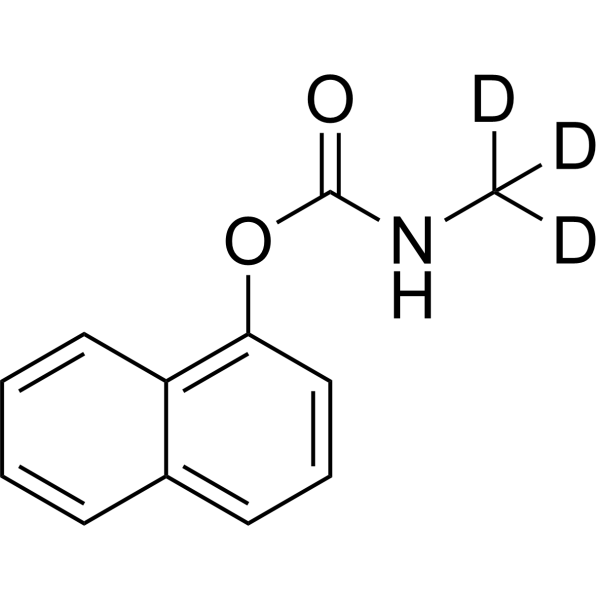 0 ImagesCat. No.: HY-B1315SCAS No.: 1433961-56-8
-
HDAC-IN-88
 0 ImagesCat. No.: HY-168962HDAC-IN-88 (Compound HJ-9) is the inhibitor for HDAC that inhibits HDAC6, HDAC1, HDAC2, HDAC8 and HDAC3 with IC50s of 0.226, 1.103, 2.308, 3.255 and 3.864 μM, respectively. HDAC-IN-88 inhibits the proliferation of cancer cell HepG2, HCT116 and MV4-11 with IC50 of 5.47, 9.78 and 0.38 μM, inhibits the migration of HCT116, arrests the cell cycle at G0/G1 phase, and induces apoptosis and autophagy in MV4-11. HDAC-IN-88 reduces ROS level and mitochondrial membrane potential. HDAC-IN-88 exhibits antimalarial activity that inhibits P. falciparum 3D7 with EC50 of 165 nM. HDAC-IN-88 also exhibits anti-angiogenic activity.
-
SB-T-101141
 0 ImagesCat. No.: HY-106159CAS No.: 186348-05-0SB-T-101141 is a novel taxane. SB-T-101141 effectively induces a noncanonical ferroptosis to overcome Paclitaxel (HY-B0015) resistance of breast cancer. SB-T-101141 facilitates the production of iron and ferrous ions and ROS. SB-T-101141 stably binds to KHSRP to inhibit the iron-dependent expression of CISD1 related to iron homeostasis. SB-T-101141 synergistically enhances the iron-dependent activation of JNK and PERK pathways via KHSRP. SB-T-101141 suppresses breast tumor growth in MCF-7(PR)/MDA-MB-231(PR) or KHSRP knock-down MCF-7 xenograft mice model.
-
Levomefolic acid-13C5
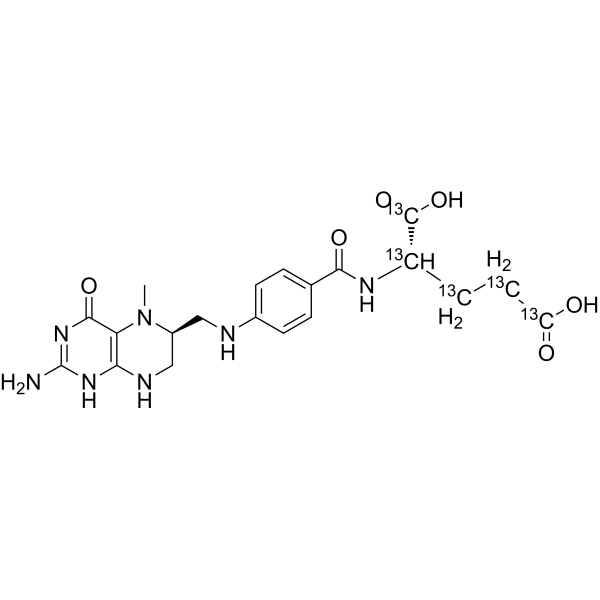 0 ImagesCat. No.: HY-14781S2CAS No.: 2687960-08-1Synonyms: L-5-MTHF-13C5Levomefolic acid-13C5 is the 13C labeled Levomefolic acid. Levomefolic acid (L-5-MTHF) is an orally active, brain-penetrant natural active form of folic acid and is one of the most widely used folic acid food supplements.
-
DPP-4-IN-3
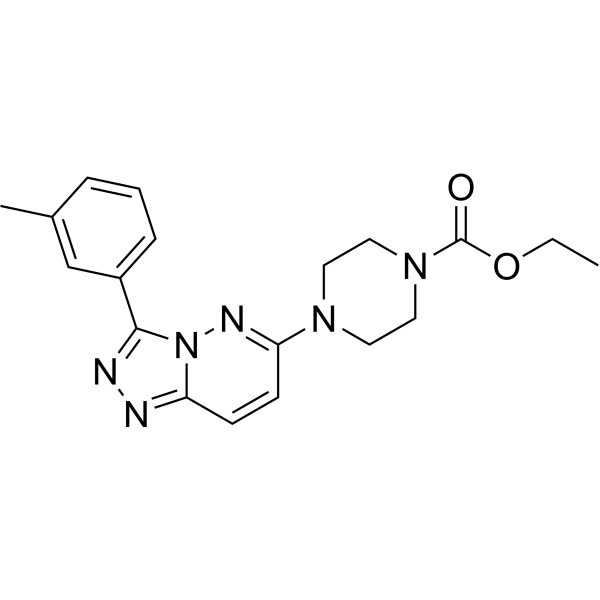 0 ImagesCat. No.: HY-146455CAS No.: 2402735-14-0DPP-4-IN-3 (Compound 5a) is a potent dipeptidyl peptidase IV (DPP-IV) inhibitor with an IC50 of 0.75 nM. DPP-4-IN-3 shows excellent antioxidant and insulinotropic activity.
-
BChE-IN-50
 0 ImagesCat. No.: HY-184658CAS No.: 3132777-83-1BChE-IN-50 is an orally active human butyrylcholinesterase (hBChE) inhibitor with an IC50 of 0.28 μM and a Ki of 0.78 μM. As a ROS inhibitor, BChE-IN-50 protects nerve cells from toxic damage induced by hydrogen peroxide and Aβ1-42, and alleviates Aβ-induced cognitive impairment in mice. BChE-IN-50 can be used for the research of Alzheimer's disease.
-
Antiproliferative agent-70
 0 ImagesCat. No.: HY-176485Antiproliferative agent-70 (compound 23) is a potent antiproliferative agent. Antiproliferative agent-70 shows antiproliferative activities and induces MMP depolarization. Antiproliferative agent-70 induces mitochondrial dysfunction. Antiproliferative agent-70 induces mitophagy and ferroptosis. Antiproliferative agent-70 increases the protein expression of PINK1, p-Parkin, p53 and p21. Antiproliferative agent-70 increases intracellular ROS levels. Antiproliferative agent-70 shows anticancer activity.
-
Hexahydrocurcumin-d6
 0 ImagesCat. No.: HY-W745860CAS No.: 2469279-20-5Hexahydrocurcumin-d6 is the deuterium labeled Hexahydrocurcumin (HY-N0929). Hexahydrocurcumin is one of the major metabolites of curcumin and a selective, orally active COX-2 inhibitor. Hexahydrocurcumin is inactive against COX-1. Hexahydrocurcumin has antioxidant, anticancer and anti-inflammatory activities.
-
PPARα agonist 4
 0 ImagesCat. No.: HY-159146PPARα agonist 4 (compound BH400) is a PPARα agonist (EC50= 1.2 μM). PPARα agonist 4 also inhibits STING (IC50: 8.1 μM). PPARα agonist 4 reduces the CoCl2-induced production of ROS and LPS-induced secretion of IL-6. The PPARα agonist 4 restores the decreased expression of PCG1α induced by LPS.
-
Ciprofloxacin lactate (Standard)
 0 ImagesCat. No.: HY-W040298RCAS No.: 97867-33-9Synonyms: Bay-09867 lactate (Standard)Ciprofloxacin (lactate) (Standard) is the analytical standard of Ciprofloxacin (lactate). This product is intended for research and analytical applications. Ciprofloxacin (Bay-09867) lactate is a potent, orally active topoisomerase IV inhibitor. Ciprofloxacin lactate induces mitochondrial DNA and nuclear DNA damage and lead to mitochondrial dysfunction, ROS production. Ciprofloxacin lactate has anti-proliferative activity and induces apoptosis. Ciprofloxacin lactate is a fluoroquinolone antibiotic, exhibiting potent antibacterial activity[4].
-
Landiolol-d8
 0 ImagesCat. No.: HY-100607SSynonyms: ONO1101-d8Landiolol-d8 (ONO1101-d8) is the deuterium labeled Landiolol (HY-100607). Landiolol (ONO1101) is a highly selective, ultra-short-acting competitive inhibitor of β1 adrenergic receptors. Landiolol specifically blocks cardiac β1 receptors, reducing heart rate and myocardial oxygen consumption. Landiolol inhibits TNF-α-induced excessive mitochondrial oxygen consumption and reactive oxygen species production in a sepsis model, alleviating renal injury. Landiolol has little effect on cardiac ion channels (such as L-type calcium current and inward rectifier potassium current) and has a weak negative inotropic effect. Landiolol can be used for perioperative tachycardia control and protection studies of sepsis-related acute kidney injury.
-
Benazepril hydrochloride (Standard)
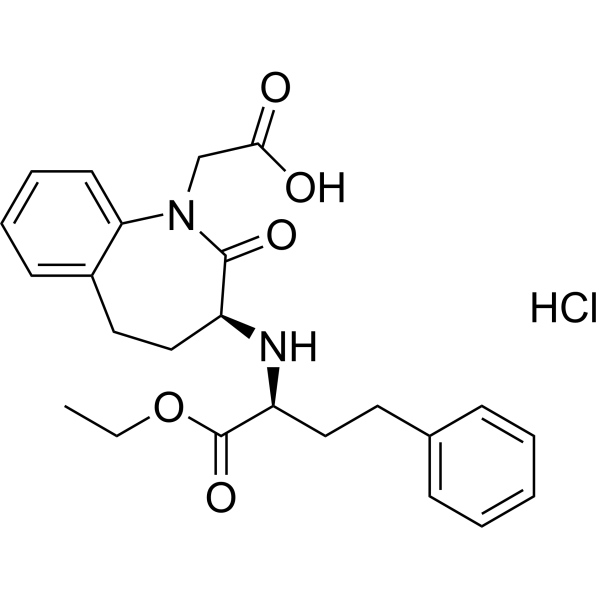 0 ImagesSynonyms: CGS14824A (Standard)Benazepril hydrochloride (Standard) is the analytical standard of Benazepril hydrochloride. This product is intended for research and analytical applications. Benazepril hydrochloride is an orally active angiotensin-converting enzyme (ACE) inhibitor to reduce angiotensin-II production. Benazepril hydrochloride inhibits oxidative stress and inhibits apoptosis by the PI3K/Akt signaling pathway. In addition, Benazepril hydrochloride improves diabetic nephropathy and decreases proteinuria. Benazepril hydrochloride can be used in the study of hypertension, heart failure and diabetic nephropathy.
-
Michelenolide
 0 ImagesCat. No.: HY-N17729CAS No.: 66392-96-9Michelenolide is an antioxidant and ferrous ion chelator. Michelenolide can be found in the stems of Michelia alba, with moderate antioxidant activity, moderate ferrous ion chelating properties.




