



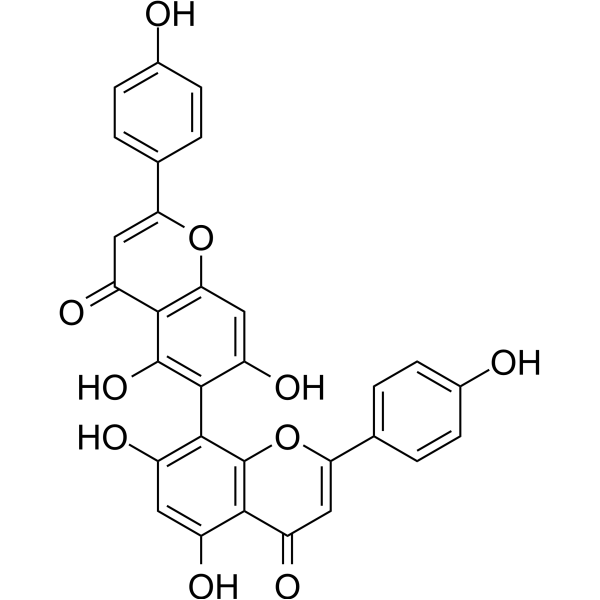
Agathisflavone

Based on 1 Customer Validation
Agathisflavone is a naturally derived biflavonoid with antioxidant, anti-inflammatory, antiviral, antiparasitic, neuroprotective, and hepatoprotective activities, and it can bind iNOS and COX‑2 to exert anti-inflammatory effects. Agathisflavone inhibits influenza virus neuraminidase and influenza virus replication. Agathisflavone modulates glial cell activation and inflammatory factor expression, inhibits glioma cell viability and migration, downregulates STAT3 /pSTAT3 signaling, and simultaneously protects neurons and promotes neurogenesis. Agathisflavone can act as a GABAA receptor agonist and also exerts effects through the ERα/ERβ estrogen receptor signaling pathway, promoting neurogenesis, upregulating retinoic acid receptors, and antagonizing glutamate-induced neuronal degeneration. Agathisflavone inhibits glial proliferation and increases SVZ GFAP‑eGFP+ neural stem cells in a mouse brain puncture injury model. Agathisflavone can be used for research on neuroinflammation, glioma, influenza virus infection, and oxidative stress-related diseases.
For research use only. We do not sell to patients.
- Purity : 99.33%
- CAS No.: 28441-98-7
- Formula: C30H18O10
- Molecular Weight:538.46
-
Storage:
4°C, protect from light, stored under nitrogen
* In solvent : -80°C, 6 months; -20°C, 1 month (protect from light, stored under nitrogen)

To place orders, for customer services and technical support, please contact: MedChemExpress USA
Tel: 609-228-6898 E-mail: [email protected] [email protected]


-
 Biological Activity
-
Chemical Information
-
Solvent & Solubility
- Protocols
- Purity & Documentation
- References
-
 Help & FAQs




Biological Activity
Description
|
STAT3 |
IL-1β |
IL-10 |
IL-6 |
ERα |
ERβ |
Cellular Effect
|
Cell Line

|
Type | Value | Description | References |
|---|---|---|---|---|
| HT-29 | IC50 |
1.5 μM
Compound: Agathisflavone
|
Antiproliferative activity against human HT-29 cells assessed as decrease in cell viability after 24 hrs by CCK8 assay
Antiproliferative activity against human HT-29 cells assessed as decrease in cell viability after 24 hrs by CCK8 assay
|
[PMID: 30108705] |
| PBMC | IC50 |
25 μM
Compound: 2
|
Cytotoxicity against uninfected PHA-stimulated human PBMC assessed as thymidine incorporation after 24 hrs by trypan blue exclusion method
Cytotoxicity against uninfected PHA-stimulated human PBMC assessed as thymidine incorporation after 24 hrs by trypan blue exclusion method
|
[PMID: 9322359] |
In Vitro
Agathisflavone (5-10 µM; 24 h) inhibits the migration of human GL-15 and rat C6 glioma cells[3].
Agathisflavone (5 µM; 24 h) downregulates miR-125b and miR-155 and upregulates IL-6 and arginase-1 mRNA in the secretome of human GL-15 glioblastoma cells[3].
Agathisflavone (FAB) (0.1-30 μM; 72 h) selectively reduces the viability of GL-15 and U373 GBM cells in a dose-dependent manner without reducing the viability of hMSCs, with 5 μM reducing GL-15 to 60.8% and 3 μM reducing U373 to 67.3%[5].
Agathisflavone (1-30 μM; 72 h) does not significantly reduce viability in direct hMSC:GL-15 and hMSC:U373 co-cultures and appears to increase cell-cell interactions[5].
Agathisflavone (1-10 μM; 72 h)-generated hMSC conditioned medium increases GL-15 viability to 116.5%[5].
Agathisflavone (3-5 μM; 72 h) inhibits the migration of GL-15 and U373 cells and increases differentiation markers in GL-15 cells[5].
Agathisflavone (3-5 μM; 72 h) decreases STAT3 expression in GL-15 and U373 cells at 5 μM and decreases pSTAT3 in GL-15 at 3 and 5 μM[5].
Agathisflavone (1 μM; 24 h) inhibits LPS-induced microglial activation markers and restores the ramified morphology of primary rat cortical glial cells; it also restores GFAP expression in LPS-stimulated primary rat cortical astrocyte-enriched cultures[2].
Agathisflavone (1 μM) decreases IL-1β mRNA and increases IL-10 mRNA in LPS-stimulated primary rat cortical glial cell cultures[2].
Agathisflavone (FAB) increases cell number and neuronal marker expression in rat primary cortical neuron/glia co-cultures and antagonizes glutamate-induced neuronal degeneration; moreover, it enhances retinoic acid-induced neurogenesis activity in mouse stem cells and pluripotent stem cells[4].
MedChemExpress (MCE) has not independently confirmed the accuracy of these methods. They are for reference only.
-
Cell Line:primary rat cortical glial
-
Concentration:0.1, 1, 10 μM
-
Incubation Time:24 h
-
Result:Did not reduce viability of primary rat cortical glial cultures.
-
Cell Line:human GL-15 glioblastoma cells and rat C6 glioma cells
-
Concentration:1, 3, 5, 10, 30 µM
-
Incubation Time:24 h
-
Result:Reduced viability of human GL-15 and rat C6 glioma cells.
-
Cell Line:human GL-15 and rat C6 glioma cell monolayers
-
Concentration:5 and 10 µM
-
Incubation Time:24 h
-
Result:Inhibited migration of human GL-15 and rat C6 glioma cells.
-
Cell Line:human GL-15 glioblastoma cells and their secretome
-
Concentration:5 µM
-
Incubation Time:24 h
-
Result:Downregulated miR-125b and miR-155 in the secretome of human GL-15 glioblastoma cells.
Upregulated IL-6 and arginase-1 mRNA in human GL-15 glioblastoma cells.
-
Cell Line:Human glioblastoma GL-15 and U373 cells and human mesenchymal stem cells (hMSC)
-
Concentration:0.1, 1, 5, 10, 30 μM (GL-15); 0.1, 1, 3, 5, 10 μM (U373); 1, 3, 5, 10, 30 μM (hMSC)
-
Incubation Time:24 h and 72 h (GL-15 and U373); 72 h (hMSC)
-
Result:Decreased viability of GL-15 and U373 GBM cells in a dose-dependent manner without reducing hMSC viability, with 5 μM reducing GL-15 to 60.8% and 3 μM reducing U373 to 67.3%.
-
Cell Line:GL-15 and U373 GBM cells; hMSC-conditioned medium
-
Concentration:5 and 10 μM (hMSC prior exposure); 1, 3, 5, 10 μM (GL-15 co-stimulation)
-
Incubation Time:72 h (hMSC prior exposure and GL-15/U373 conditioned-medium exposure)
24 h and 72 h (co-stimulation) -
Result:Conditioned medium collected from hMSCs pre‑treated with 10 μM significantly elevated viability of GL‑15 cells to 116.5 %, compared with the 97.7 % viability of control cells.
Conditioned medium yielded 98.4 % viability for U373 cells.
Simultaneous co‑exposure with the conditioned medium produced no significant viability differences at 24 h and 72 h.
-
Cell Line:GL-15 and U373 GBM cells and GL-15:hMSC coculture
-
Concentration:3, 5 μM
-
Incubation Time:72 h
-
Result:Inhibited migration of GL-15 and U373 cells, with U373 reaching 22.2% and GL-15 reaching 32.2% migratory cells at 5 μM.
-
Cell Line:GL-15 GBM cells
-
Concentration:3 μM
-
Incubation Time:72 h
-
Result:Increased differentiation markers in GL-15 cells, with β-III-tubulin-positive cells at 198.3% and GFAP-positive cells at 132.6%.
-
Cell Line:GL-15 and U373 GBM cells
-
Concentration:3, 5 μM
-
Incubation Time:72 h
-
Result:Reduced STAT3 expression in GL-15 and U373 cells at 5 μM (to 39.9% and 43.2%) and reduces pSTAT3 in GL-15 at 3 and 5 μM (to 64.32% and 15.23%).
In Vivo
MedChemExpress (MCE) has not independently confirmed the accuracy of these methods. They are for reference only.
-
Animal Model:C57/BL6 wild-type and TgN(GFAP-EGFP)GFEC-FKi (hGFAP-eGFP) transgenic (age postnatal day 8-10)[1]
-
Dosage:2 µL of 100 µM
-
Administration:i.c.v. into lateral ventricles; twice daily; 3 days (P8-P10)
-
Result:Reduced GFAP immunoreactivity at the lesion site.
Reduced Ki‑67 immunoreactivity at the lesion site.
Reduced the number of Iba1+ microglia at the lesion site by ~40 % relative to vehicle control.
Doubled the CD206+‑to‑CD16/32+ microglia ratio, without changing the individual relative densities of CD206+ and CD16/32+ microglia.
Decreased Iba1+ microglial density within perilesional sites and raised microglial process branch and branch‑junction counts; average branch length remained unaltered.
Elevated GFAP‑eGFP+ neural‑stem‑cell abundance up to 2‑fold across dorsal, lateral and horn microdomains of the SVZ.
Left DCX+ cell counts and Ki‑67+ cell counts unchanged in horn, dorsal and lateral SVZ regions.
- Research Protocol for Infectious Diseases
- RNA extraction experimental
- Mammalian live/dead viability and cytotoxicity staining
- Cell migration
- ROS/oxidative-stress fluorescent staining
- CCK-8/WST-8 Cell Proliferation Assay
- Cell differentiation
- Research Protocol for Inflammation-related Diseases
- Research Protocol for Neurological Diseases
- Cell Viability Determination by MTT Colorimetric Assay
- Cell Cytotoxicity Assay
- Research Protocol for Endocrine Diseases
- SH-SY5Y neuronal-like differentiation
- MTT Cell Proliferation Assay


Product Details
-
Structure Classification


Chemical Information
-
CAS No. 28441-98-7
-
Appearance Solid
-
Molecular Weight 538.46
-
Formula C30H18O10
-
Color Light yellow to yellow
-
SMILES
O=C1C=C(OC2=C1C(O)=CC(O)=C2C3=C(C4=C(C=C3O)OC(C5=CC=C(C=C5)O)=CC4=O)O)C6=CC=C(C=C6)O
-
Shipping
Room temperature in continental US; may vary elsewhere.
-
Storage
4°C, protect from light, stored under nitrogen
* In solvent : -80°C, 6 months; -20°C, 1 month (protect from light, stored under nitrogen)


Solvent & Solubility
In Vitro:
DMSO : 100 mg/mL (185.71 mM; Need ultrasonic; Hygroscopic DMSO has a significant impact on the solubility of product, please use newly opened DMSO)
Please refer to the solubility information to select the appropriate solvent. Once prepared, please aliquot and store the solution to prevent product inactivation from repeated freeze-thaw cycles.
Storage method and period of stock solution: -80°C, 6 months; -20°C, 1 month (protect from light, stored under nitrogen). When stored at -80°C, please use it within 6 months. When stored at -20°C, please use it within 1 month.
Concentration (start) × Volume (start) = Concentration (final) × Volume (final)
In Vivo:
Select the appropriate dissolution method based on your experimental animal and administration route.
- For the following dissolution methods, please ensure to first prepare a clear stock solution using an In Vitro approach and then sequentially add co-solvents:
- To ensure reliable experimental results, the clarified stock solution can be appropriately stored based on storage conditions. As for the working solution for In Vivo experiments, it is recommended to prepare freshly and use it on the same day.
- The percentages shown for the solvents indicate their volumetric ratio in the final prepared solution. If precipitation or phase separation occurs during preparation, heat and/or sonication can be used to aid dissolution.
Add each solvent one by one: 10% DMSO 40% PEG300 5% Tween-80 45% Saline
Solubility: ≥ 2.5 mg/mL (4.64 mM); Clear solution
This protocol yields a clear solution of ≥ 2.5 mg/mL (saturation unknown).
Taking 1 mL working solution as an example, add 100 μL DMSO stock solution (25.0 mg/mL) to 400 μL PEG300, and mix evenly; then add 50 μL Tween-80 and mix evenly; then add 450 μL Saline to adjust the volume to 1 mL.
Preparation of Saline: Dissolve 0.9 g sodium chloride in ddH₂O and dilute to 100 mL to obtain a clear Saline solution.
In Vivo Dissolution Calculator
Please enter the basic information of animal experiments:
-
-
-
-
Recommended: Prepare an additional quantity of animals to account for potential losses during experiments.
Please enter your animal formula composition:
-
%DMSO +
Recommended: Keep the proportion of DMSO in working solution below 2% if your animal is weak.
-
%+
-
+%Tween-80 + +
-
%Saline +
The co-solvents required include: DMSO, . All of co-solvents are available by MedChemExpress (MCE). , Tween 80. All of co-solvents are available by MedChemExpress (MCE).
Working solution concentration: 0.22 mg/mL
Method for preparing stock solution: mg drug dissolved in μL DMSO. Stock solution concentration: mg/mL. * In solvent : -80°C, 6 months; -20°C, 1 month (protect from light, stored under nitrogen)
1. Take μL DMSO stock solution;
2. Add μL .
μL , mix evenly;
3. Then add μL Tween 80, mix evenly;
4. Then add μL
Please ensure that the stock solution in the first step is dissolved to a clear state, and add co-solvents in sequence. You can use ultrasonic heating (ultrasonic cleaner, recommended frequency 20-40 kHz), vortexing, etc. to assist dissolution.
Purity & Documentation


References
[6]. de Freitas CS, et al. Agathisflavone, a Biflavonoid from Anacardium occidentale L., Inhibits Influenza Virus Neuraminidase. Curr Top Med Chem. 2020;20(2):111-120. [Content Brief]
[7]. Islam MT, et al. Agathisflavone: Botanical sources, therapeutic promises, and molecular docking study. IUBMB Life. 2019 Sep;71(9):1192-1200. [Content Brief]

Complete Stock Solution Preparation Table
Please refer to the solubility information to select the appropriate solvent. Once prepared, please aliquot and store the solution to prevent product inactivation from repeated freeze-thaw cycles.
Storage method and period of stock solution: -80°C, 6 months; -20°C, 1 month (protect from light, stored under nitrogen). When stored at -80°C, please use it within 6 months. When stored at -20°C, please use it within 1 month.
| Optional Solvent | Concentration Solvent Mass | 1 mg | 5 mg | 10 mg | 25 mg |
|---|---|---|---|---|---|
| DMSO | 1 mM | 1.8571 mL | 9.2857 mL | 18.5715 mL | 46.4287 mL |
| 5 mM | 0.3714 mL | 1.8571 mL | 3.7143 mL | 9.2857 mL | |
| 10 mM | 0.1857 mL | 0.9286 mL | 1.8571 mL | 4.6429 mL | |
| 15 mM | 0.1238 mL | 0.6190 mL | 1.2381 mL | 3.0952 mL | |
| 20 mM | 0.0929 mL | 0.4643 mL | 0.9286 mL | 2.3214 mL | |
| 25 mM | 0.0743 mL | 0.3714 mL | 0.7429 mL | 1.8571 mL | |
| 30 mM | 0.0619 mL | 0.3095 mL | 0.6190 mL | 1.5476 mL | |
| 40 mM | 0.0464 mL | 0.2321 mL | 0.4643 mL | 1.1607 mL | |
| 50 mM | 0.0371 mL | 0.1857 mL | 0.3714 mL | 0.9286 mL | |
| 60 mM | 0.0310 mL | 0.1548 mL | 0.3095 mL | 0.7738 mL | |
| 80 mM | 0.0232 mL | 0.1161 mL | 0.2321 mL | 0.5804 mL | |
| 100 mM | 0.0186 mL | 0.0929 mL | 0.1857 mL | 0.4643 mL |


Agathisflavone Related Classifications
HY-118383 Related Classifications
 Powered by Bioz
Keywords
- Agathisflavone
- 28441-98-7
- Parasite
- Influenza Virus
- Interleukin Related
- TGF-beta/Smad
- STAT
- GABA Receptor
- Estrogen Receptor/ERR
- IL
- Transforming growth factor beta
- Gamma-aminobutyric acid Receptor
- γ-Aminobutyric acid Receptor
- ERα
- ERβ
- GABAA
- GR
- NF-κB
- STAT3
- astrogliosis
- microgliosis
- neurogenesis
- retinoic acid receptors
- Inhibitor
- inhibitor
- inhibit