



Aspirin-d3

Based on 1 Customer Validation
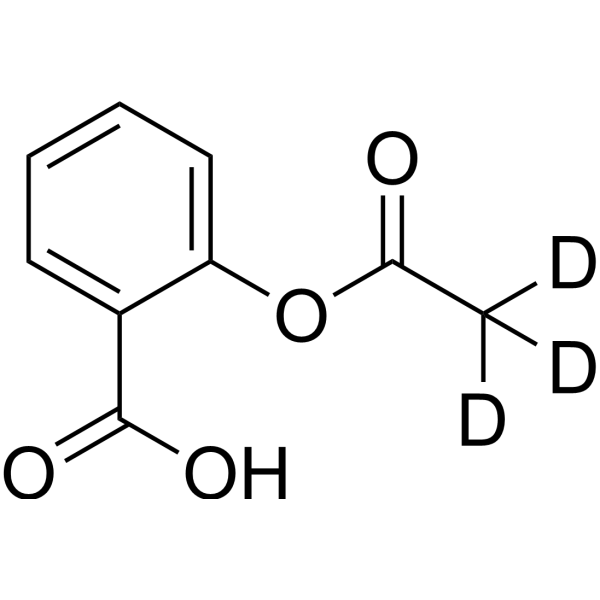
Aspirin-d3 is the deuterium labeled Aspirin (HY-14654). Aspirin (Acetylsalicylic acid) is an orally active, potent and irreversible inhibitor of cyclooxygenase COX-1 and COX-2, with IC50 values of 5 and 210 μg/mL, respectively. Aspirin induces apoptosis. Aspirin inhibits the activation of NF-κB. Aspirin also inhibits platelet prostaglandin synthetase, and can prevent coronary artery and cerebrovascular thrombosis.
For research use only. We do not sell to patients.
- Purity : 99.84%
- CAS No.: 921943-73-9
- Formula: C9H5D3O4
- Molecular Weight:183.18
-
Storage:Powder -20°C, 3 years , 4°C, 2 years ; In solvent -80°C, 6 months , -20°C, 1 month

To place orders, for customer services and technical support, please contact: MedChemExpress USA
Tel: 609-228-6898 E-mail: [email protected] [email protected]


-
 Biological Activity
-
Chemical Information
-
Solvent & Solubility
- Protocols
- Purity & Documentation
- References
-
 Help & FAQs


All Caspase Isoforms
More

Biological Activity
Description
In Vitro
Stable heavy isotopes of hydrogen, carbon, and other elements have been incorporated into drug molecules, largely as tracers for quantitation during the drug development process. Deuteration has gained attention because of its potential to affect the pharmacokinetic and metabolic profiles of drugs[1].
MedChemExpress (MCE) has not independently confirmed the accuracy of these methods. They are for reference only.
Application
1. This compound can be used as a tracer
2. This compound can be used as an internal standard for quantitative analysis by NMR, GC-MS, or LC-MS.


Chemical Information
-
CAS No. 921943-73-9
-
Unlabeled CAS 50-78-2
-
Appearance Solid
-
Molecular Weight 183.18
-
Formula C9H5D3O4
-
Color White to off-white
-
SMILES
O=C(O)C1=CC=CC=C1OC(C([2H])([2H])[2H])=O
-
Synonyms
Acetylsalicylic acid-d3; ASA-d3
-
Shipping
Room temperature in continental US; may vary elsewhere.
-
Storage
Powder -20°C 3 years 4°C 2 years In solvent -80°C 6 months -20°C 1 month


Solvent & Solubility
In Vitro:
DMSO : 100 mg/mL (545.91 mM; Need ultrasonic; Hygroscopic DMSO has a significant impact on the solubility of product, please use newly opened DMSO)
Please refer to the solubility information to select the appropriate solvent. Once prepared, please aliquot and store the solution to prevent product inactivation from repeated freeze-thaw cycles.
Storage method and period of stock solution: -80°C, 6 months; -20°C, 1 month. When stored at -80°C, please use it within 6 months. When stored at -20°C, please use it within 1 month.
Please refer to the solubility information to select the appropriate solvent. Once prepared, please aliquot and store the solution to prevent product inactivation from repeated freeze-thaw cycles.
Storage method and period of stock solution: -80°C, 6 months; -20°C, 1 month. When stored at -80°C, please use it within 6 months. When stored at -20°C, please use it within 1 month.
Concentration (start) × Volume (start) = Concentration (final) × Volume (final)


Purity & Documentation
-
Data Sheet (277 KB)
-
SDS (252 KB)
- English - EN (252 KB)
- Français - FR (252 KB)
- Deutsch - DE (252 KB)
- Norwegian - NO (252 KB)
- Español - ES (252 KB)
- Swedish - SV (252 KB)
- Italian - IT (252 KB)
- Korean - KR (252 KB)
- Portuguese - PT (252 KB)
-
Handling Instructions (2659 KB)
References
[1]. Russak EM, et al. Impact of Deuterium Substitution on the Pharmacokinetics of Pharmaceuticals. Ann Pharmacother. 2019;53(2):211-216. [Content Brief]
[2]. Mitchell JA, et al. Selectivity of nonsteroidal antiinflammatory drugs as inhibitors of constitutive and induciblecyclooxygenase. Proc Natl Acad Sci U S A. 1993 Dec 15;90(24):11693-7.;Vane JR, et al. The mechanism of action of aspirin. Thromb Res. 2003 Jun 15;110(5-6):255-8.;Wu KK, et al. Aspirin and other cyclooxygenase inhibitors: new therapeutic insights. Semin Vasc Med. 2003 May;3(2):107-12.;Kopp E, et al. Inhibition of NF-kappa B by sodium salicylate and aspirin. Science. 1994 Aug 12;265(5174):956-9.;Blanco FJ, et al. Effect of antiinflammatory drugs on COX-1 and COX-2 activity in human articular chondrocytes. J Rheumatol. 1999 Jun;26(6):1366-73. [Content Brief]


Complete Stock Solution Preparation Table
Please refer to the solubility information to select the appropriate solvent. Once prepared, please aliquot and store the solution to prevent product inactivation from repeated freeze-thaw cycles.
Storage method and period of stock solution: -80°C, 6 months; -20°C, 1 month. When stored at -80°C, please use it within 6 months. When stored at -20°C, please use it within 1 month.
| Optional Solvent | Concentration Solvent Mass | 1 mg | 5 mg | 10 mg | 25 mg |
|---|---|---|---|---|---|
| DMSO | 1 mM | 5.4591 mL | 27.2956 mL | 54.5911 mL | 136.4778 mL |
| 5 mM | 1.0918 mL | 5.4591 mL | 10.9182 mL | 27.2956 mL | |
| 10 mM | 0.5459 mL | 2.7296 mL | 5.4591 mL | 13.6478 mL | |
| 15 mM | 0.3639 mL | 1.8197 mL | 3.6394 mL | 9.0985 mL | |
| 20 mM | 0.2730 mL | 1.3648 mL | 2.7296 mL | 6.8239 mL | |
| 25 mM | 0.2184 mL | 1.0918 mL | 2.1836 mL | 5.4591 mL | |
| 30 mM | 0.1820 mL | 0.9099 mL | 1.8197 mL | 4.5493 mL | |
| 40 mM | 0.1365 mL | 0.6824 mL | 1.3648 mL | 3.4119 mL | |
| 50 mM | 0.1092 mL | 0.5459 mL | 1.0918 mL | 2.7296 mL | |
| 60 mM | 0.0910 mL | 0.4549 mL | 0.9099 mL | 2.2746 mL | |
| 80 mM | 0.0682 mL | 0.3412 mL | 0.6824 mL | 1.7060 mL | |
| 100 mM | 0.0546 mL | 0.2730 mL | 0.5459 mL | 1.3648 mL |


Aspirin-d3 Related Classifications
HY-14654S Related Classifications
 Powered by Bioz