



Cathepsin
Cathepsins are protease enzymes, categorized into multiple families. Cathepsins can be serine protease, cysteine protease, or aspartyl protease. There are about 15 classes of cathepsins in humans (Cathepsin A, B, C, D, E, F, G, H, K, L, O, S, V, W, and Z). Cathepsins are active in the low pH milieu of lysosomes and are versatile in their functions. Like other enzymes, they are vital for the normal physiological functions such as digestion, blood coagulation, bone resorption, ion channel activity, innate immunity, complement activation, apoptosis, vesicular trafficking, autophagy, angiogenesis, proliferation, and metastasis, among scores of others.
Numerous pathologies have been attributed to the dysregulated cathepsins, some of which include arthritis, periodontitis, pancreatitis, macular degeneration, muscular dystrophy, atherosclerosis, obesity, stroke, Alzheimer's disease, schizophrenia, tuberculosis, and Ebola.
Cathepsin Isoform Specific Products
All Product Categories
-
Cathepsin Inhibitors
(222)
View all products
-
Cathepsin Antagonist
(1)
View all products
-
Cathepsin Activators
(9)
View all products
-
Cathepsin Inducers
(3)
View all products
-
Cathepsin Degrader
(1)
View all products
-
Cathepsin Control
(1)
View all products
-
Cathepsin Substrates
(22)
View all products
-
Cathepsin Ligand
(1)
View all products
-
Cathepsin Proteins
(35)
View all products
-
Cathepsin B Proteins
(5)
View all products
-
Cathepsin C Proteins
(4)
View all products
-
Cathepsin D Proteins
(5)
View all products
-
Cathepsin E Proteins
(3)
View all products
-
Cathepsin K Proteins
(1)
View all products
-
Cathepsin L1 Proteins
(4)
View all products
-
Cathepsin S Proteins
(2)
View all products
-
Cathepsin Related Products (307)
Related Products (307)

-
Recombinant Proteins (35)
-
Antibodies (6)
-
Cathepsin Isoform Comparison
-
AKR1C3-IN-17
 0 ImagesCat. No.: HY-187527CAS No.: 3120497-79-9AKR1C3-IN-17 is a cathepsin B (CTSB)-activated small molecule-drug conjugate targeting AKR1C3 with an IC50 of 9 nM. AKR1C3-IN-17 is cleaved by CTSB to release the payload Gemcitabine (HY-17026). AKR1C3-IN-17 induces apoptosis and shows antitumor activity in mice. AKR1C3-IN-17 can be used for the study of hepatocellular carcinoma.
-
Leupeptin hydrochloride
 0 ImagesCat. No.: HY-183478CAS No.: 39740-82-4Leupeptin hydrochloride is a broad-spectrum protease inhibitor. By inhibiting the activation of the PTEN/PI3K/Akt/NF-κB/ERK1/2/p38 signaling pathway, Leupeptin hydrochloride significantly reduces LPS-induced NO and ROS production, mitochondrial membrane potential hyperpolarization, phagocytic activity, pro-inflammatory cytokine release, and M1 polarization in mouse peritoneal macrophages, and reverses autophagic flux impairment. It also decreases Concanavalin A (HY-P2149)-induced proliferation index of mouse splenic lymphocytes and the Th1/IL-10 and Th2/IL-10 cytokine ratios, thereby modulating innate and adaptive immune responses. Leupeptin hydrochloride inhibits blood coagulation and tumorigenesis in mouse skin. Leupeptin hydrochloride can be used in research on chronic inflammatory diseases and skin tumorigenesis.
-
CA-074 methyl ester (Standard)
 0 ImagesSynonyms: CA-074Me (Standard)CA-074 methyl ester (Standard) is the analytical standard of CA-074 methyl ester (HY-100350). This product is intended for research and analytical applications. CA-074 methyl ester is a specific inhibitor of Cathepsin B, which has potent bioactivities such as neuroprotective, anti-cancer, and anti-inflamatory effects.
-
Y-U0-S
 0 ImagesCat. No.: HY-189662Y-U0-S is a potent inhibitor of the coronavirus main protease (Mpro) and host cathepsins. The IC50 values of Y-U0-S against SARS-CoV-2 Mpro, SARS-CoV Mpro, Cathepsin B, and Cathepsin L are 0.81, 1.14, 0.86, and 21.13 μM, respectively. Y-U0-S exhibits broad-spectrum anti-coronavirus activity, with an EC50 of 0.22 μM against wild-type SARS-CoV-2. Y-U0-S forms an irreversible covalent bond with the catalytic site C145 of Mpro through its aldehyde warhead, and by optimizing multi-site occupancy of the scaffold to engage conserved residues, it effectively blocks enzyme activity and inhibits viral replication. Y-U0-S can be used for research on COVID-19.
-
Oxocarbazate
 0 ImagesCat. No.: HY-139111CAS No.: 1014405-03-8Oxocarbazate is an inhibitor of human cathepsin L with the IC50 values of 6.9 nM (human Cathepsin L,0 h) 0.4 nM ((human Cathepsin L,4 h) and 5.07 μM (human cathepsin B), respectively. Oxocarbazate blockes both SARS-CoV (IC50 = 273 nM) and Ebola virus (IC50 = 193 nM) entry into 293T cells.
-
Y-U0-R
 0 ImagesCat. No.: HY-189663Y-U0-R is a potent covalent inhibitor of coronavirus main protease (Mpro), with IC50 values of 0.22 and 0.25 μM against SARS-CoV-2 Mpro and SARS-CoV Mpro, respectively. Y-U0-R exhibits broad-spectrum anti-coronavirus activity, with an EC50 of 0.47 µM against SARS-CoV-2. Y-U0-R forms a stable hemithioacetal covalent bond with the catalytic residue C145 through its aldehyde warhead, and occupies multiple active subsites and residue networks, resulting in time-dependent irreversible inhibition of enzymatic activity. Y-U0-R can be used for research on COVID-19 and SARS-CoV-2 infection.
-
SARS-CoV-2 3CLpro-IN-38
 0 ImagesCat. No.: HY-184269SARS-CoV-2 3CLpro-IN-38 is a 3CLpro inhibitor with an IC50 of 0.34 μM against SARS-CoV-2 3CLpro and an IC50 of 0.12 μM against MERS-CoV 3CLpro. SARS-CoV-2 3CLpro-IN-38 inhibits recombinant Cathepsin L with an IC50 of 5.23 nM. SARS-CoV-2 3CLpro-IN-38 inhibits cysteine proteases essential for the replication of SARS-CoV-2 and MERS-CoV, suppresses host cysteine proteases involved in coronavirus entry, blocks viral entry, and inhibits viral replication. SARS-CoV-2 3CLpro-IN-38 can be used in the research of COVID-19.
-
S2160
 0 ImagesCat. No.: HY-118959CAS No.: 54799-93-8Synonyms: Bz-Phe-Val-Arg-pNAS2160 is a substrate of Cathepsin B that can be utilized in the calorimetric assay for the measurement of cathepsin B.
-
SQ 32602
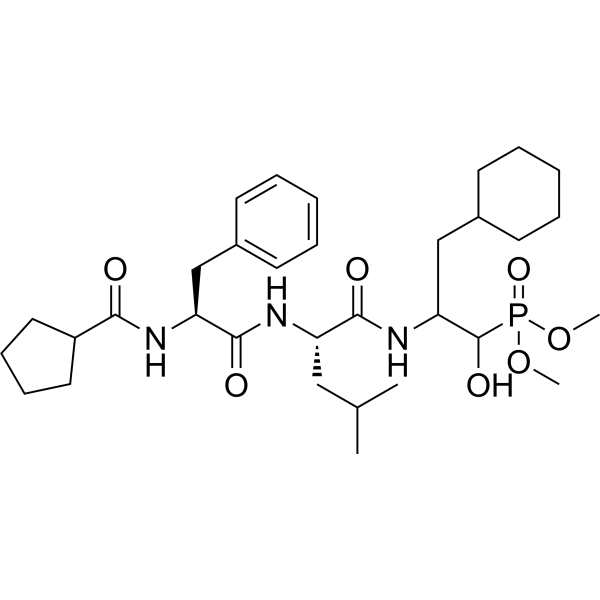 0 ImagesCat. No.: HY-124202CAS No.: 169529-81-1SQ 32602 is an inhibitor of cathepsin E, with the IC50 of 88 nM.
-
5F-203 (Standard)
 0 ImagesCat. No.: HY-124421RCAS No.: 260443-89-8Synonyms: NSC-703786 (Standard)5F-203 (Standard) (NSC-703786 (Standard)) is the analytical standard of 5F-203 (HY-124421). This product is intended for research and analytical applications. 5F-203 (NSC-703786) is an aryl hydrocarbon receptor (AhR) agonist and the active moiety of the water-soluble benzothiazole prodrug Phortress (HY-103223). 5F-203 binds to cytosolic AhR and induces CYP1A1 and CYP1B1 expression. 5F-203 activates AhR signaling to induce DNA damage, cell cycle arrest, apoptosis, caspase-3/-7 activation, lysosomal membrane permeabilization, and Cathepsin B release. 5F-203 induces CYGB and pro-apoptotic protein expression and NAG-1 mRNA/protein induction through RNA stabilization. 5F-203 is used in research related to cancers such as triple-negative breast cancer and colorectal cancer.
-
NCO 700 sulfate
 0 ImagesCat. No.: HY-106058ACAS No.: 84579-82-8NCO-700 sulfate is a dual cathepsin B and calcium-activated neutral protease (CANP) inhibitor with IC50 values of 0.8 and 46 μM, respectively. NCO-700 sulfate reduces the degradation of myocardial fibrin by inhibiting protease activity. NCO-700 sulfate also has inhibitory effects on hormone-independent tumor cells, such as prostate cancer cells, and induces apoptosis. NCO-700 sulfate can be used to study myocardial ischemia and refractory hormone-independent tumors.
-
Z-LVG-CHN2 (Standard)
 0 ImagesCat. No.: HY-108137RCAS No.: 119670-30-3Z-LVG-CHN2 (Standard) is the analytical standard of Z-LVG-CHN2 (HY-108137). This product is intended for research and analytical applications. Z-LVG-CHN2 is a cell-permeable and irreversible inhibitor of cysteine proteinase. Z-LVG-CHN2 is a tripeptide derivative and mimics part of the human cysteine proteinase-binding center. Z-LVG-CHN2 displays an inhibition on HSV whereas no significant effect on poliovirus replication. Z-LVG-CHN2 effectively blocks SARS-COV-2 replication (EC50=190 nM) via inhibition of SARS-COV-2 3CL pro protease.
-
AM4299 A
 0 ImagesCat. No.: HY-187615CAS No.: 160825-48-9AM4299 A is a thiol protease inhibitor with IC50 values of 73, 390 and 88 nM against Cathepsin B, Cathepsin L and Papain, respectively. AM4299 A shows low toxicity and favorable biosafety in mice. AM4299 A can be used in studies related to osteoporosis and parasitic diseases.
-
NC 2300
 0 ImagesCat. No.: HY-15099CAS No.: 221144-20-3Synonyms: VEL 0230NC 2300 (VEL-0230)is a selective and orally active cysteine cathepsin inhibitor with the IC50 values of 284, 34.5, and 186 nM for cathepsin B, K, and S, respectively.NC 2300 can be used for study of diseases involving bone mineral disorders.
-
K11002 hydrobromide
 0 ImagesCat. No.: HY-183387CAS No.: 1348565-08-1K11002 hydrobromide is a cysteine protease inhibitor. K11002 hydrobromide forms a covalent bond with the active site cysteine residue via Michael addition. K11002 hydrobromide inhibits the growth of Trypanosoma brucei. K11002 hydrobromide can be used in the research of African human trypanosomiasis (sleeping sickness).
-
Odanacatib (Standard)
 0 ImagesCat. No.: HY-10042RCAS No.: 603139-19-1Synonyms: MK-0822 (Standard)Odanacatib (Standard) is the analytical standard of Odanacatib (HY-10042). This product is intended for research and analytical applications. Odanacatib (MK-0822) is a potent and selective inhibitor of cathepsin K, with an IC50 of 0.2 nM for human cathepsin K.
-
TB-11
 0 ImagesTB-11 is a Cathepsin D inhibitor, with IC50s of 0.126 nM (Cathepsin D), 1.92 nM (Cathepsin E), 48.8 nM (BACE1), respectively. TB-11 can be used for tumor research.
-
EP-459
 0 ImagesCat. No.: HY-187732CAS No.: 76739-51-0EP-459 is a papain inhibitor (IC50=0.4 μg/mL) with no significant inhibitory activity against serine proteases such as trypsin, plasmin, thrombin, and urokinase. The effects of EP-459 are similar to those of E-64C (HY-100227), but differ from the functions of leupeptin and its analogs. EP-459 can serve as a titration reagent for mouse cathepsin L (precursor form/MEP) activity, covalently binding to the cysteine residue at its active site. EP-459 is also a Ca2+-dependent active site-directed inhibitor that can inactivate chicken gizzard smooth muscle calpain II, and can be acetylated to generate Ac-Ep-459, which after radiolabeling can be used to prepare [3H]Ac-Ep-459 for calpain active site labeling.
-
E-64 (Standard)
 0 ImagesCat. No.: HY-15282RCAS No.: 66701-25-5Synonyms: Proteinase inhibitor E 64 (Standard)
-
Rpi-856 C
 0 ImagesCat. No.: HY-P1982CAS No.: 157381-55-0Rpi-856 C is an Aspartic protease inhibitor, with an IC50 of 5.5 nM against HIV-1 protease, 9.2 nM against HTLV-I protease, 2.0 μM against Cathepsin D, and 4.8 μM against Pepsin. Rpi-856 C is produced by the Streptomyces strain AL-322. Rpi-856 C does not inhibit chymosin, trypsin, chymotrypsin, papain, bromelain, thermolysin, prolyl endopeptidase, carboxypeptidase A or carboxypeptidase B. Rpi-856 C can be used in the research of acquired immunodeficiency syndrome (AIDS) and related diseases, as well as HIV infection.




