



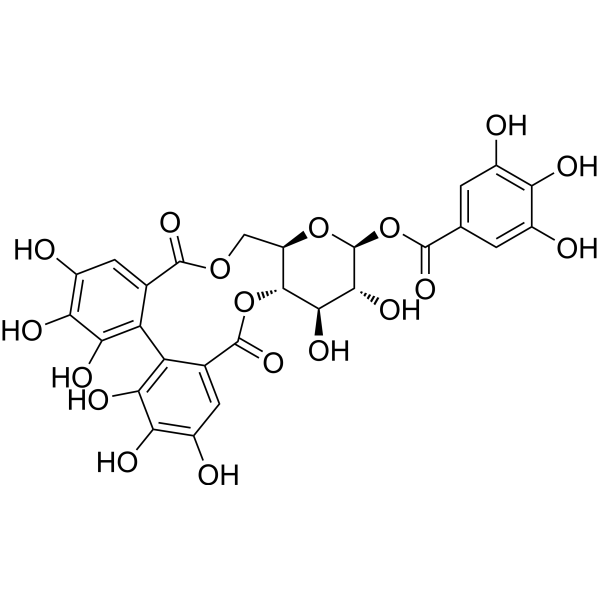
Strictinin

Based on 1 Customer Validation
Strictinin is an orally active phenolic compound. Strictinin reduces xanthine oxidase activity, uric acid production, and the activation of ERK1/2, JNK, NF-κB, and NLRP3 inflammasome components in hepatocytes treated with Xanthine (HY-W017389). Strictinin decreases elevated serum uric acid levels and enhanced xanthine oxidase activity in mice treated with potassium oxonate. Strictinin acts as a ROR1 inhibitor and exhibits anticancer activity against highly aggressive non-androgen-dependent prostate cancer. Strictinin induces cancer cell apoptosis (apoptosis), arrests cell cycle, and inhibits cancer cell migration, invasion, and epithelial-mesenchymal transition. Strictinin modulates gut microbiota, inhibits bacterial growth and biofilm formation, accelerates small intestinal transit, and blocks viral entry and replication. Strictinin can be used in research related to hyperuricemia, androgen receptor-negative non-androgen-dependent prostate cancer, triple-negative breast cancer, bacterial infections, constipation, coronavirus infections, dental caries, and infections caused by influenza A, influenza B, and human parainfluenza virus type 1.
For research use only. We do not sell to patients.
- Purity : 97.15%
- CAS No.: 517-46-4
- Formula: C27H22O18
- Molecular Weight:634.45
-
Storage:Powder -20°C, 3 years ; In solvent -80°C, 6 months , -20°C, 1 month

To place orders, for customer services and technical support, please contact: MedChemExpress USA
Tel: 609-228-6898 E-mail: [email protected] [email protected]


-
 Biological Activity
-
Chemical Information
-
Solvent & Solubility
- Protocols
- Purity & Documentation
- References
-
 Help & FAQs




Biological Activity
Description
Cellular Effect
|
Cell Line

|
Type | Value | Description | References |
|---|---|---|---|---|
| A549 | ED50 |
>10 μg/mL
Compound: 22
|
Cytotoxicity against human A549 cells by tetrazolium salt-based colorimetric assay
Cytotoxicity against human A549 cells by tetrazolium salt-based colorimetric assay
|
[PMID: 1431932] |
| HCT-8 | ED50 |
>10 μg/mL
Compound: 22
|
Cytotoxicity against human HCT8 cells by tetrazolium salt-based colorimetric assay
Cytotoxicity against human HCT8 cells by tetrazolium salt-based colorimetric assay
|
[PMID: 1431932] |
| KB | ED50 |
>10 μg/mL
Compound: 22
|
Cytotoxicity against human KB cells by tetrazolium salt-based colorimetric assay
Cytotoxicity against human KB cells by tetrazolium salt-based colorimetric assay
|
[PMID: 1431932] |
| TE-671 | ED50 |
>10 μg/mL
Compound: 22
|
Cytotoxicity against human TE671 cells by tetrazolium salt-based colorimetric assay
Cytotoxicity against human TE671 cells by tetrazolium salt-based colorimetric assay
|
[PMID: 1431932] |
In Vitro
Strictinin (50-500 μM; 24 h) exhibits cytotoxicity against AML12 mouse hepatocytes only at the concentration of 500 μM[1].
Strictinin (100-250 μM; 4-24 h) inhibits XOD activity and uric acid (UA) production in Xanthine (HY-W017389)-treated AML12 mouse hepatocytes, and suppresses IL-1β expression in these cells[1].
Strictinin (250 μM; 6 h) inhibits the activation of ERK1/2, JNK, NF-κB, and components of the NLRP3 inflammasome (NLRP3, ASC, caspase-1, cleaved caspase-1) in Xanthine-induced AML12 mouse hepatocytes[1].
Strictinin (31.25-1000 μM; 72 h) potently inhibits the viability of PC3 cells with an IC50 of 277.2 μmol/L, whereas its toxicity toward normal RWPE-1 cells is much lower (IC50 = 658.5 μmol/L)[2].
Strictinin (250 μM; 24-72 h) induces significant apoptosis in PC3 cells, reduces the number of viable cells, increases the populations of total apoptotic and dead cells, and triggers caspase 3/7-mediated apoptosis[2].
Strictinin (250 μM; 24-48 h) inhibits the expression of ROR1 in PC3 and DU145 cells, blocks the downstream PI3K-AKT-GSK3β pro-survival signaling pathway, and suppresses the expression of EMT markers Twist1, Snail and MMP9 in the cells[2].
Strictinin (125-250 μM; 24 h) inhibits migration and invasion of PC3 cells[2].
Strictinin (250 μM; 48-72 h) induces S-phase cell cycle arrest in PC3 cells[2].
Strictinin (125-1000 μg/mL; 24-72 h) reduces the viability of MDA-MB-231 and BT-549 triple-negative breast cancer (TNBC) cells in a dose-dependent manner, and its cytotoxicity depends on the expression of ROR1[3].
Strictinin (62.5-125 μg/mL; 24 h) inhibits the activity of the PI3K/AKT pathway in MDA-MB-231 and BT-549 triple-negative breast cancer (TNBC) cells[3].
Strictinin (125 μg/mL; 3-24 h) time-dependently inhibits the phosphorylation of AKT and GSK3β, reduces XIAP levels, inhibits Bad phosphorylation, and induces caspase-9 cleavage in MDA-MB-231 and BT-549 triple-negative breast cancer (TNBC) cells[3].
Strictinin (125-250 μg/mL) dose-dependently induces apoptosis in MDA-MB-231 and BT-549 triple-negative breast cancer (TNBC) cells[3].
Strictinin (62.5-125 μg/mL; 3-12 h post-wounding) inhibits the migration and invasion of MDA-MB-231 and BT-549 triple-negative breast cancer (TNBC) cells[3].
Strictinin inhibits the growth of *Cutibacterium acnes* (MIC = 250 μM) and *Staphylococcus epidermidis* (MIC = 2000 μM)[4].
Strictinin (4-100 µM) inhibits MHV plaque formation in mouse L cells in a concentration-dependent manner. Under the condition of full co-treatment, 100 µM Strictinin completely blocks plaque formation, while 20 µM reduces the plaque formation rate to <25% of that in the control group[5].
Strictinin (100 µM; administered during infection, harvested at 12 and 24 hpi) completely abrogates the expression of viral nucleocapsid protein in MHV-infected mouse L cells[5].
Strictinin (20-500 μM; 24 h) dose-dependently inhibits biofilm formation by Streptococcus mutans and Streptococcus sobrinus[6].
Strictinin (0.01-75 μM; 72 h) exhibits cytotoxicity against MDCK cells, with a CC50 of 5 μM after 72 h[7].
When added simultaneously with viral inoculation, Strictinin (2-8 μM; 1 h inoculation + 48 h incubation) inhibits the replication of influenza B virus in MDCK cells[7].
Strictinin (5-20 μM; 1 h inoculation + 48 h incubation) inhibits replication of human parainfluenza virus type 1 in LLC-MK2 cells in vitro in a dose-dependent manner when added concurrently with viral inoculation[7].
Strictinin (1-10 μM; 1 h) inhibits A/WSN/33 (H1N1) influenza A virus-induced semi-fusion in COS-7 cells at concentrations of 1 and 10 μM[7].
MedChemExpress (MCE) has not independently confirmed the accuracy of these methods. They are for reference only.
-
Cell Line:AML12 mouse hepatocytes
-
Concentration:50 μM; 100 μM; 250 μM; 500 μM
-
Incubation Time:24 h
-
Result:Did not significantly reduce cell viability at 50, 100, or 250 μM.
Caused a statistically significant reduction in cell viability at 500 μM.
-
Cell Line:xanthine-treated AML12 mouse hepatocytes
-
Concentration:250 μM (co-treated with 100 μM Xanthine)
-
Incubation Time:6/24 h
-
Result:Inhibited xanthine-induced activation of ERK1/2, JNK, and NF-κB.
Reduced xanthine-induced upregulation of NLRP3, ASC, caspase-1, and cleaved caspase-1 protein expressions.
Significantly decreased the expression of cleaved IL-1β, particularly in xanthine-treated cells.
-
Cell Line:PC3 (androgen-receptor negative androgen-independent prostate cancer) cells, RWPE-1 (normal prostatic epithelial) cells
-
Concentration:31.25, 62.5, 125, 250, 500, 1000 μM
-
Incubation Time:72 h
-
Result:Exhibited selective cytotoxicity, with an IC50 of 277.2 μmol/L in PC3 cells.
Showed 2.4-fold lower IC50 in PC3 cells than the IC50 of 658.5 μmol/L in RWPE-1 cells.
-
Cell Line:PC3 androgen-receptor negative androgen-independent prostate cancer cells
-
Concentration:250 μM
-
Incubation Time:72 h
-
Result:Led to a significant decrease in live PC3 cells.
Caused significant increases in early apoptotic, late apoptotic, dead, and total apoptotic cell populations compared to vehicle control.
Showed a shift from live cells to apoptotic/dead cells in representative flow cytometry profiles.
Increased the percentage of apoptotic and dead PC3 cells in a time-dependent manner.
Showed a greater effect after 48 h compared to 24 h and vehicle control, as indicated by elevated caspase 3/7 activity.
-
Cell Line:PC3 androgen-receptor negative androgen-independent prostate cancer cells
-
Concentration:250 μmol/L
-
Incubation Time:24 h; 48 h
-
Result:Reduced ROR1 protein expression, with greater reduction after 48 h than 24 h.
Decreased the ratios of p-AKT/AKT and p-GSK3β/GSK3β.
Indicated inhibition of ROR1-mediated PI3K-AKT-GSK3β pro-survival signaling.\nReduced the expression of Twist1, Snail, and MMP9 in PC3 cells.
Showed greater reductions in Twist1, Snail, and MMP9 expression after 48 h compared to 24 h.
-
Cell Line:PC3 androgen-receptor negative androgen-independent prostate cancer cells, RWPE-1 normal prostatic epithelial cells
-
Concentration:125, 250 μmol/L
-
Incubation Time:24 h
-
Result:Reduced percent wound healed in PC3 cells in a concentration-dependent manner.
Caused a significant reduction in percent wound healed in PC3 cells at 250 μmol/L compared to control.
Did not significantly change percent wound healed in RWPE-1 cells compared to control.
-
Cell Line:PC3 androgen-receptor negative androgen-independent prostate cancer cells, RWPE-1 normal prostatic epithelial cells
-
Concentration:250 μmol/L
-
Incubation Time:24 h
-
Result:Significantly reduced the percentage area covered by invaded PC3 cells compared to control.
Did not significantly change invasion in RWPE-1 cells compared to control.
-
Cell Line:PC3 androgen-receptor negative androgen-independent prostate cancer cells, RWPE-1 normal prostatic epithelial cells
-
Concentration:125 μmol/L; 250 μmol/L
-
Incubation Time:24 h (125 μmol/L; 250 μmol/L PC3); 48 h (250 μmol/L PC3); 72 h (250 μmol/L RWPE-1)
-
Result:Caused an S-phase cell cycle arrest in PC3 cells, with a ~5% increase in S-phase cells after 48 h of 250 μmol/L treatment compared to control.
Caused a ~2% increase in S-phase cells in RWPE-1 cells after 250 μmol/L treatment for 72 h compared to control.
In Vivo
Strictinin (0.25-0.5 g/kg; p.o.; single administration) exerts a dose-dependent laxative effect in rats by accelerating small intestinal transit, without altering food intake, inducing diarrhea, or promoting gastric emptying[4].
MedChemExpress (MCE) has not independently confirmed the accuracy of these methods. They are for reference only.
-
Animal Model:ICR (8-week-old male; hyperuricemia induced by oral gavage of potassium oxonate)[1]
-
Dosage:400 mg/kg; 700 mg/kg; 1000 mg/kg
-
Administration:p.o.; single weekly; 7 days
-
Result:Significantly reduced elevated liver xanthine oxidase activity and serum uric acid level induced by potassium oxonate.
Prevented slight renal tubular dilation damage observed in potassium oxonate-treated mice.
Significantly elevated proportions of Clostridium thermosuccinogenes, Marvinbryantia formatexigens, and Ruminococcus lactaris in gut microbiota.
Significantly reduced proportions of Clostridium aldenense, Clostridium cellulovorans, Clostridium lavalense, Clostridium saccharolyticum, Clostridium symbiosum, Ruminococcus gauvreauii, Roseburia faecis, and Ruminococcus gnavus in gut microbiota compared to potassium oxonate-only treated mice.
Caused no significant liver damage in treated groups.
-
Animal Model:Sprague-Dawley (male, 200-250 g)[4]
-
Dosage:0.25 g/kg; 0.5 g/kg
-
Administration:p.o.; single dose
-
Result:Increased feces weight significantly relative to controls at 6 hs post-administration (0.25 g/kg dose).
Increased feces weight significantly relative to controls at 6, 12, and 24 h post-administration, with a stronger effect at the higher dose (0.5 g/kg dose).
Showed no significant change in gastric emptying percentage relative to controls (0.5 g/kg dose).
Accelerated small intestinal transit percentage significantly relative to controls (0.5 g/kg dose).
Caused no significant differences in food intake or fecal water content relative to controls.
- Scratch/Wound-Healing Migration Assay
- Annexin V plus membrane-impermeant dye apoptosis staining
- BrdU Incorporation Assay
- Cell migration
- Neural Crest/Neuronal Cell Migration Explant Assay
- Research Protocol for Microbiome Analysis
- Protocol for Cell Cycle
- Research Protocol for Inflammation-related Diseases
- Breast Cancer Modeling
- Detection of Apoptosis
- TUNEL staining for apoptotic DNA fragmentation
- Flow cytometric DNA-content cell-cycle staining
- Zigmond Chamber Chemotaxis Assay
- Research Protocol for Endocrine Diseases
- Under-Agarose Cell Migration Assay
- Aerobic Bacterial Batch Culture on Broth/Agar
- Transwell/Boyden Chamber Migration Assay
- Apoptosis Solutions
- 3D Collagen/Hydrogel Matrix Migration Assay
- Cell invasion
- Cell-Exclusion Zone Migration Assay
- Dunn/Insall Chamber Chemotaxis Assay
- Fungal Biofilm Culture
- Pyroptosis Solutions


Chemical Information
-
CAS No. 517-46-4
-
Appearance Solid
-
Molecular Weight 634.45
-
Formula C27H22O18
-
Color White to off-white
-
SMILES
O[C@H]1[C@H](OC(C2=CC(O)=C(O)C(O)=C2)=O)O[C@H](COC3=O)[C@@H](OC(C4=CC(O)=C(O)C(O)=C4C5=C(O)C(O)=C(O)C=C53)=O)[C@@H]1O
-
Structure Classification
-
Initial Source
-
Shipping
Room temperature in continental US; may vary elsewhere.
-
Storage
Powder -20°C 3 years In solvent -80°C 6 months -20°C 1 month


Solvent & Solubility
In Vitro:
H2O : 50 mg/mL (78.81 mM; Need ultrasonic)
Please refer to the solubility information to select the appropriate solvent. Once prepared, please aliquot and store the solution to prevent product inactivation from repeated freeze-thaw cycles.
Storage method and period of stock solution: -80°C, 6 months; -20°C, 1 month. When stored at -80°C, please use it within 6 months. When stored at -20°C, please use it within 1 month.
* Note: If you choose water as the stock solution, please dilute it to the working solution, then filter and sterilize it with a 0.22 μm filter before use.
Please refer to the solubility information to select the appropriate solvent. Once prepared, please aliquot and store the solution to prevent product inactivation from repeated freeze-thaw cycles.
Storage method and period of stock solution: -80°C, 6 months; -20°C, 1 month. When stored at -80°C, please use it within 6 months. When stored at -20°C, please use it within 1 month.
* Note: If you choose water as the stock solution, please dilute it to the working solution, then filter and sterilize it with a 0.22 μm filter before use.
Concentration (start) × Volume (start) = Concentration (final) × Volume (final)


Purity & Documentation
-
Data Sheet (296 KB)
-
SDS (252 KB)
- English - EN (252 KB)
- Français - FR (252 KB)
- Deutsch - DE (252 KB)
- Norwegian - NO (252 KB)
- Español - ES (252 KB)
- Swedish - SV (252 KB)
- Italian - IT (252 KB)
- Korean - KR (252 KB)
- Portuguese - PT (252 KB)
-
Handling Instructions (2659 KB)
References
[1]. Huang KC, et al. Alleviation of Hyperuricemia by Strictinin in AML12 Mouse Hepatocytes Treated with Xanthine and in Mice Treated with Potassium Oxonate. Biology (Basel). 2023;12(2):329. Published 2023 Feb 17. [Content Brief]
[2]. Sivaganesh V, et al. Receptor tyrosine kinase-like orphan receptor 1 inhibitor strictinin exhibits anti-cancer properties against highly aggressive androgen-independent prostate cancer. Explor Target Antitumor Ther. 2023;4(6):1188-1209. [Content Brief]
[3]. Fultang N, et al. Strictinin, a novel ROR1-inhibitor, represses triple negative breast cancer survival and migration via modulation of PI3K/AKT/GSK3ß activity. PLoS One. 2019;14(5):e0217789. Published 2019 May 31. [Content Brief]
[4]. Hsieh SK, et al. Antibacterial and laxative activities of strictinin isolated from Pu'er tea (Camellia sinensis). J Food Drug Anal. 2016;24(4):722-729. [Content Brief]
[5]. Tu EC, et al. Strictinin, a Major Ingredient in Yunnan Kucha Tea Possessing Inhibitory Activity on the Infection of Mouse Hepatitis Virus to Mouse L Cells. Molecules. 2023;28(3):1080. Published 2023 Jan 21. [Content Brief]
[6]. Liao MH, et al. Pu'er tea rich in strictinin and catechins prevents biofilm formation of two cariogenic bacteria, Streptococcus mutans and Streptococcus sobrinus. J Dent Sci. 2021 Oct;16(4):1331-1334. [Content Brief]
[7]. Saha RK, et al. Antiviral effect of strictinin on influenza virus replication. Antiviral Res. 2010;88(1):10-18. [Content Brief]


Complete Stock Solution Preparation Table
Please refer to the solubility information to select the appropriate solvent. Once prepared, please aliquot and store the solution to prevent product inactivation from repeated freeze-thaw cycles.
Storage method and period of stock solution: -80°C, 6 months; -20°C, 1 month. When stored at -80°C, please use it within 6 months. When stored at -20°C, please use it within 1 month.
| Optional Solvent | Concentration Solvent Mass | 1 mg | 5 mg | 10 mg | 25 mg |
|---|---|---|---|---|---|
| H2O | 1 mM | 1.5762 mL | 7.8808 mL | 15.7617 mL | 39.4042 mL |
| 5 mM | 0.3152 mL | 1.5762 mL | 3.1523 mL | 7.8808 mL | |
| 10 mM | 0.1576 mL | 0.7881 mL | 1.5762 mL | 3.9404 mL | |
| 15 mM | 0.1051 mL | 0.5254 mL | 1.0508 mL | 2.6269 mL | |
| 20 mM | 0.0788 mL | 0.3940 mL | 0.7881 mL | 1.9702 mL | |
| 25 mM | 0.0630 mL | 0.3152 mL | 0.6305 mL | 1.5762 mL | |
| 30 mM | 0.0525 mL | 0.2627 mL | 0.5254 mL | 1.3135 mL | |
| 40 mM | 0.0394 mL | 0.1970 mL | 0.3940 mL | 0.9851 mL | |
| 50 mM | 0.0315 mL | 0.1576 mL | 0.3152 mL | 0.7881 mL | |
| 60 mM | 0.0263 mL | 0.1313 mL | 0.2627 mL | 0.6567 mL |
* Note: If you choose water as the stock solution, please dilute it to the working solution, then filter and sterilize it with a 0.22 μm filter before use.


Strictinin Related Classifications
HY-135319 Related Classifications
 Powered by Bioz
Keywords
- Strictinin
- 517-46-4
- Bacterial
- Antibiotic
- ERK
- JNK
- NF-κB
- ROR
- Apoptosis
- Caspase
- GSK-3
- Akt
- PI3K
- NLRP3 inflammasome
- MDA-MB-231 triple negative breast cancer cells
- ROR1
- Streptococcus mutans
- PI3K-AKT-GSK3β signaling
- PC3 androgen-receptor negative androgen-independent prostate cancer cells
- AML12 mouse hepatocytes
- influenza A virus
- xanthine oxidase
- Propionibacterium acnes
- phenolic compound
- ICR mice
- Sprague-Dawley rat
- Inhibitor
- inhibitor
- inhibit