



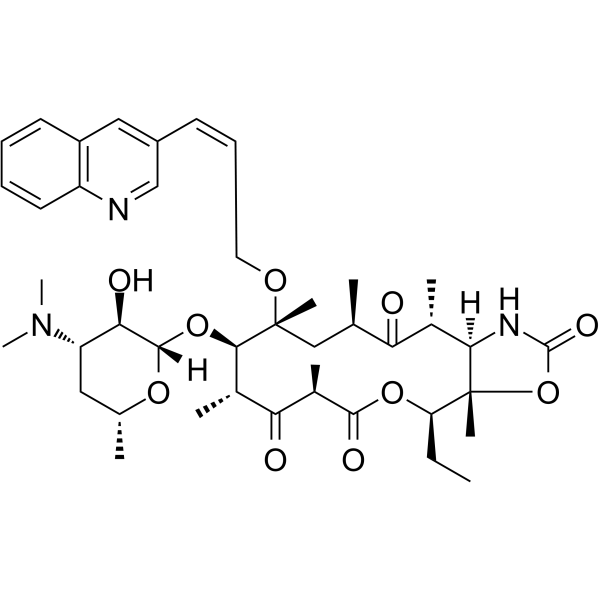
Cethromycin
Based on 2 publication(s) in Google Scholar
Cethromycin (ABT-773; Abbott-195773) is an orally effective ketolide antibiotic with broad-spectrum antibacterial activity. Cethromycin binds to domains II/V of the 23S rRNA of the 50S subunit, inhibiting bacterial protein synthesis. Cethromycin can accumulate in lung tissue, alveolar macrophages, epithelial lining fluid, and human polymorphonuclear leukocytes. Cethromycin exhibits potent in vitro activity against a variety of respiratory pathogens, including Mycoplasma pneumoniae. Cethromycin exhibits significant intracellular and pulmonary enrichment and anti-inflammatory effects against mycoplasma pneumonia in mouse models, improving airway obstruction and airway hyperresponsiveness. Cethromycin disrupts the apicoplast and reduces liver-stage parasite burden during the liver stage of Plasmodium berghei. Cethromycin can be used in research related to pneumonia, Staphylococcus aureus infection, gonorrhea, and malaria.
For research use only. We do not sell to patients.
- Purity : 96.19%
- CAS No.: 205110-48-1
- Formula: C42H59N3O10
- Molecular Weight:765.93
-
Storage:Powder -20°C, 3 years ; In solvent -80°C, 6 months , -20°C, 1 month

To place orders, for customer services and technical support, please contact: MedChemExpress USA
Tel: 609-228-6898 E-mail: [email protected] [email protected]


-
 Biological Activity
-
Chemical Information
-
Solvent & Solubility
- Protocols
- Purity & Documentation
- References
-
 Help & FAQs


Publications Citing Use of MedChemExpress (MCE) Cethromycin
MoreAll Antibiotic Isoforms
MoreAll Parasite Isoforms
More

Biological Activity
Description
In Vitro
Cethromycin exhibits significant in vitro activity against Neisseria gonorrhoeae[1].
Cethromycin exhibits potent in vitro activity against Borrelia burgdorferi, with MIC90/MBC90 of 0.0019/0.125 µg/mL[1].
Cethromycin (4-16 × MIC) selected resistant mutants at a significantly lower frequency than erythromycin in S. pneumoniae, S. aureus , and S. pyogenes [1].
Cethromycin resistance is associated with specific erm genes and the MLSB phenotype in S. aureus, where ermA MRSA and ermB/ermC MSSA show higher resistance rates, and the cMLSB phenotype exhibits higher resistance than iMLSB in both MRSA and MSSA[7].
Cethromycin (20 µM; 48 h) disrupts plastid development in the liver stage of P. berghei in Hepa-1-6 hepatocytes, resulting in parasites with a single malformed plastid[8].
Cethromycin (10 μg/mL; 3 h) was released in large amounts from preloaded THP-1 promonocytes, with approximately 90% excreted within the first 30 min[4].
MedChemExpress (MCE) has not independently confirmed the accuracy of these methods. They are for reference only.
-
Cell Line:Hepa-1-6 hepatocytes
-
Concentration:20 µM
-
Incubation Time:48 h
-
Result:Resulted in parasites with predominately no observed apicoplasts.
Noted that parasites had single dysmorphic apicoplasts.
Indicated almost normal parasite development nearly indistinguishable from control activity.
Parmacokinetics
| Species | Dose | Route | MRT | CL | T1/2 | AUC | Cmax | Tmax |
|---|---|---|---|---|---|---|---|---|
| Mice[10] | 25 mg/kg | p.o. | 5.5 h | 0.0420 L/h | 3.1 h | 592.5 mg·h/L | / | / |
| Mice[10] | 50 mg/kg | p.o. | 18.2 h | 0.0160 L/h | 13.5 h | 3070 mg·h/L | / | / |
| Mice[10] | 100 mg/kg | p.o. | 25 h | 0.0094 L/h | 17.6 h | 10600 mg·h/L | / | / |
| Mice[10] | 200 mg/kg | p.o. | 52.8 h | 0.0067 L/h | 37.2 h | 29800 mg·h/L | / | / |
| Mice[6] | 12.5 mg/kg | p.o. | / | / | 5.4 h | 14.4 μg·h/mL | 0.86 μg/mL | 2.0 h |
| Mice[6] | 25 mg/kg | p.o. | / | / | 6.7 h | 40.7 μg·h/mL | 1.77 μg/mL | 2.2 h |
| Mice[6] | 50 mg/kg | p.o. | / | / | 15.9 h | 130.3 μg·h/mL | 3.63 μg/mL | 2.6 h |
| Mice[6] | 100 mg/kg | p.o. | / | / | 38.1 h | 474.8 μg·h/mL | 7.40 μg/mL | 2.8 h |
| Mice[6] | 200 mg/kg | p.o. | / | / | 67.7 h | 1,520.0 μg·h/mL | 14.59 μg/mL | 2.2 h |
In Vivo
MedChemExpress (MCE) has not independently confirmed the accuracy of these methods. They are for reference only.
-
Animal Model:C57BL/6 (6 weeks old, 20-22 g, female)[3]
-
Dosage:12 mg/kg ; 50 mg/kg
-
Administration:p.o.; single dose
-
Result:Inhibited parasite load by 16% at 12 mg/kg.
Reduced parasite load by 60% at 50 mg/kg.
Achieved greater than 99% inhibition when combined with primaquine at 15 mg/kg.
Resulted in a 4-fold drop in relative fluorescent units compared to Primaquine alone.
-
Animal Model:BALB/c (female, 6-7 weeks old)[8]
-
Dosage:15 mg/kg (single dose on day 1); 30 mg/kg (single dose on day 1); 45 mg/kg (single dose on day 0); 45 mg/kg (single dose on day 1); 60 mg/kg (single dose on day 0); 60 mg/kg (single dose on day 1); 120 mg/kg (single dose on day 1); 20 mg/kg (three separate doses on days -1, 0, and 1); 120 mg/kg (doses on days 0 and 1)
-
Administration:p.o.; single dose or multiple doses
-
Result:Resulted in 1/3 mice patent with an average day to patency of 8 at 45 mg/kg dosed on day 0.
Resulted in 0/3 mice patent at 60 mg/kg dosed on day 0.
Resulted in 5/12 patent mice with an average day to patency of 8 at 15 mg/kg dosed on day 1.
Resulted in 1/9 patent mice with an average day to patency of 10 at 30 mg/kg dosed on day 1.
Resulted in 0/3 patent mice with delayed patency at 45 mg/kg dosed on day 1.
Resulted in 1/9 patent mice with patency delayed to 13 days at 60 mg/kg dosed on day 1.
Resulted in 0/3 patent mice at 120 mg/kg dosed on day 1.
Resulted in 0/3 patent mice when administered at 20 mg/kg on days -1, 0, and 1.
Resulted in 0/3 patent mice when administered at 120 mg/kg on days 0 and 1.
Resulted in 0/9 patent mice treated with a single oral 60 mg/kg dose 24 hours after sporozoite injection in a separate 3,000 sporozoite tail vein injection model.
-
Animal Model:BALB/cj (female, at least 6 weeks old, approximately 20 g)[8]
-
Dosage:60 mg/kg
-
Administration:p.o.; daily for 6 or 7 days
-
Result:Resulted in partial cure (2/3 mice) with 6 days of treatment.
Resulted in cure of all mice with 7 days of treatment.
-
Animal Model:BALB/c (female, 2-month-old)[9]
-
Dosage:25 mg/kg
-
Administration:s.c.; once daily; 10 days
-
Result:Reduced M. pneumoniae culture titers significantly on days 7 and 10.
Reduced histopathologic score significantly on days 4, 7, and 10.
Reduced 7 of 10 BAL cytokines measured (TNF-α, IFN-γ, IL-1β, IL-8, IL-12, MCP-1, and MIP-1α) significantly on day 4.
Reduced airway obstruction (baseline P_enh) significantly on days 4 and 10.
Reduced airway hyperreactivity (post-methacholine P_enh) significantly on day 4.
Clinical Trial
| NCT Number | Sponsor | Condition | Start Date |
Phase

|
|---|---|---|---|---|
| NCT01329991 | Plexxikon| | 2011-05 | PHASE1 |


Chemical Information
-
CAS No. 205110-48-1
-
Appearance Solid
-
Molecular Weight 765.93
-
Formula C42H59N3O10
-
Color White to off-white
-
SMILES
O[C@H]1[C@@](O[C@@H]([C@@](OC/C=C\C2=CC(C=CC=C3)=C3N=C2)(C)C[C@@H](C)C4=O)[C@@H](C)C([C@@H](C)C(O[C@H](CC)[C@](OC(N5)=O)(C)[C@@]5([H])[C@H]4C)=O)=O)([H])O[C@H](C)C[C@@H]1N(C)C
-
Synonyms
ABT-773; Abbott-195773; A-195773
-
Shipping
Room temperature in continental US; may vary elsewhere.
-
Storage
Powder -20°C 3 years In solvent -80°C 6 months -20°C 1 month


Publications (2)
-
Journal Impact Factor
-
Most Recent
-
BMC Microbiol
The antimicrobial activity of cethromycin against Staphylococcus aureus and compared with erythromycin and telithromycin. [Abstract]2023 Apr 20;23(1):109. PMID: 37081393 -


Solvent & Solubility
In Vitro:
DMSO : 100 mg/mL (130.56 mM; Need ultrasonic; Hygroscopic DMSO has a significant impact on the solubility of product, please use newly opened DMSO)
Please refer to the solubility information to select the appropriate solvent. Once prepared, please aliquot and store the solution to prevent product inactivation from repeated freeze-thaw cycles.
Storage method and period of stock solution: -80°C, 6 months; -20°C, 1 month. When stored at -80°C, please use it within 6 months. When stored at -20°C, please use it within 1 month.
Concentration (start) × Volume (start) = Concentration (final) × Volume (final)


Purity & Documentation
-
Data Sheet (306 KB)
-
SDS (252 KB)
- English - EN (252 KB)
- Français - FR (252 KB)
- Deutsch - DE (252 KB)
- Norwegian - NO (252 KB)
- Español - ES (252 KB)
- Swedish - SV (252 KB)
- Italian - IT (252 KB)
- Korean - KR (252 KB)
- Portuguese - PT (252 KB)
-
Handling Instructions (2659 KB)
References


Complete Stock Solution Preparation Table
Please refer to the solubility information to select the appropriate solvent. Once prepared, please aliquot and store the solution to prevent product inactivation from repeated freeze-thaw cycles.
Storage method and period of stock solution: -80°C, 6 months; -20°C, 1 month. When stored at -80°C, please use it within 6 months. When stored at -20°C, please use it within 1 month.
| Optional Solvent | Concentration Solvent Mass | 1 mg | 5 mg | 10 mg | 25 mg |
|---|---|---|---|---|---|
| DMSO | 1 mM | 1.3056 mL | 6.5280 mL | 13.0560 mL | 32.6401 mL |
| 5 mM | 0.2611 mL | 1.3056 mL | 2.6112 mL | 6.5280 mL | |
| 10 mM | 0.1306 mL | 0.6528 mL | 1.3056 mL | 3.2640 mL | |
| 15 mM | 0.0870 mL | 0.4352 mL | 0.8704 mL | 2.1760 mL | |
| 20 mM | 0.0653 mL | 0.3264 mL | 0.6528 mL | 1.6320 mL | |
| 25 mM | 0.0522 mL | 0.2611 mL | 0.5222 mL | 1.3056 mL | |
| 30 mM | 0.0435 mL | 0.2176 mL | 0.4352 mL | 1.0880 mL | |
| 40 mM | 0.0326 mL | 0.1632 mL | 0.3264 mL | 0.8160 mL | |
| 50 mM | 0.0261 mL | 0.1306 mL | 0.2611 mL | 0.6528 mL | |
| 60 mM | 0.0218 mL | 0.1088 mL | 0.2176 mL | 0.5440 mL | |
| 80 mM | 0.0163 mL | 0.0816 mL | 0.1632 mL | 0.4080 mL | |
| 100 mM | 0.0131 mL | 0.0653 mL | 0.1306 mL | 0.3264 mL |


Cethromycin Related Classifications
HY-19655 Related Classifications
 Powered by Bioz
Keywords
- Cethromycin
- 205110-48-1
- ABT-773
- Abbott-195773
- A-195773
- ABT773
- ABT 773
- Abbott195773
- Abbott 195773
- Abbott-195773
- A195773
- A 195773
- A-195773
- Antibiotic
- Bacterial
- Parasite
- TNF Receptor
- IFNAR
- Interleukin Related
- Staphylococcus aureus
- Mycoplasma pneumoniae
- human polymorphonuclear leukocytes
- Streptococcus pneumoniae
- 50S ribosomal subunit
- Plasmodium berghei
- 23S rRNA domain II
- Mycobacterium avium complex
- Haemophilus influenzae
- Hepa1-6 cells
- Inhibitor
- inhibitor
- inhibit