



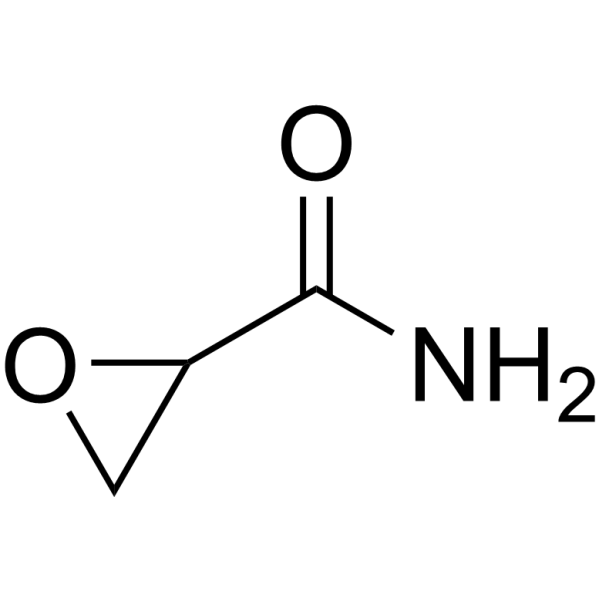
Glycidamide
Based on 1 publication(s) in Google Scholar
Glycidamide (Oxiranecarboxamide) is the genotoxic metabolite of acrylamide. Glycidamide covalently binds to adenine and guanine bases to form thermally labile depurinating Glycidamide-DNA adducts, which block polymerase progression and are promutagenic, producing mutational signatures of A-to-G transitions and G-to-C/G-to-T transversions. Glycidamide induces hprt mutations, DNA damage, micronucleus formation, cytogenetic damage, impaired proliferation kinetics, cytotoxicity, apoptosis, and regulation of apoptosis gene expression. Glycidamide can be used in cancer research.
Nur für Forschungszwecke. Wir verkaufen nicht an Patienten.
- Reinheit : 97.93%
- CAS. Nr.: 5694-00-8
- Formel: C3H5NO2
- Molecular Weight:87.08
-
Speicherung:
-20°C, stored under nitrogen
* In solvent : -80°C, 6 months; -20°C, 1 month (stored under nitrogen)

To place orders, for customer services and technical support, please contact: MedChemExpress USA
Tel: 609-228-6898 E-mail: [email protected] [email protected]


-
 Biologische Aktivität
-
Chemical Information
-
Lösungsmittel & Löslichkeit
- Protokoll
- Reinheit & Dokumentation
- Verweise
-
 Help & FAQs




Biologische Aktivität
Beschreibung
|
DNA |
Caspase 3 |
Bax |
Bcl-2 |
p53 |
In Vitro
Glycidamide (1 μM-0.5 mM; 24 h) reduces viable TM4 Sertoli cells and increases early apoptosis, apoptosis, and necrosis[5].
Glycidamide (1 μM-0.5 mM; 24 h) upregulates caspase3, Bax, and p53 mRNA and downregulates Bcl-2 mRNA in TM3 Leydig cells[5].
Glycidamide (1 μM-0.5 mM; 24 h) increases Bax and p53 mRNA and decreases Bcl-2 mRNA in TM4 Sertoli cells[5].
Glycidamide (1 μM-0.5 mM; 24 h) increases MDA levels in TM3 Leydig cells at both tested concentrations[5].
Glycidamide (1 μM-0.5 mM; 24 h) induces H2O2 production in TM3 Leydig cells at 0.5 mM and 1 μM-0.5 mM[5].
Glycidamide (0.25-2 mM; 24 h) induces micronucleus formation and impairs proliferation kinetics in MCF10A cells[1].
Glycidamide forms the major N7-guanine adduct linearly from 1 µM to 1 mM in MCF10A cells, and forms the minor N3-adenine adduct at concentrations of 250 µM and above[1].
Glycidamide (1-2 mM; co-treated with 10 µM KU55933 for 24 h) cytotoxicity is enhanced in MCF10A cells by KU55933 (HY-12016) inhibition of ATM[1].
Glycidamide (400-2000 μM) dose-dependently reduces V79 cell viability starting from 800 μM, and at 2000 μM reduces viability by 50%[2].
Glycidamide (100-3000 μM; 1-4 h) induces concentration-dependent DNA damage in human blood lymphocytes starting from 300 μM[2].
Glycidamide (50 nM-10 mM; 4 h exposure) is cytotoxic to Big Blue mouse embryonic fibroblasts only at millimolar concentrations, with time- and dose-dependent loss of viability[4].
Glycidamide (5-500 μM; exposure for 4 h) induces dose-dependent DNA adducts in exon 5 of TP53 in normal human bronchial epithelial cells[4].
Glycidamide (1 μM-0.5 mM; 24 h) reduces TM3 Leydig cell viability at the high concentrations tested[5].
Glycidamide (1 μM-0.5 mM; 24 h) increases LDH activity in TM3 Leydig cells at both tested concentrations[5].
MedChemExpress (MCE) has not independently confirmed the accuracy of these methods. They are for reference only.
-
Cell Line:MCF10A human mammary epithelial cells
-
Concentration:0.1, 0.25, 0.5, 1, 2, 3, and 4 mM
-
Incubation Time:24 h
-
Result:A linear dose-dependent decrease in MCF10A cell viability was produced.
Viability was decreased at 0.5 mM and higher, and was <7% at 3 and 4 mM.
The calculated IC50 was 1.56 mM.
-
Cell Line:mouse TM3 Leydig cells
-
Concentration:1 μM, 0.5 mM
-
Incubation Time:24 h
-
Result:LDH activity increased at both 0.5 mM and 1 μM.
-
Cell Line:mouse TM3 Leydig cells
-
Concentration:1 μM, 0.5 mM
-
Incubation Time:24 h
-
Result:At 1 μM, viable cells were 77.9%, early apoptosis was 21.5%, apoptosis was 0.6%, and necrosis was 0.0%.
At 0.5 mM, viable cells were 58.2%, early apoptosis was 35.7%, apoptosis was 5.6%, and necrosis was 0.5%.
-
Cell Line:mouse TM4 Sertoli cells
-
Concentration:1 μM, 0.5 mM
-
Incubation Time:24 h
-
Result:At 1 μM, viable cells were 83.9%, early apoptosis was 13.9%, apoptosis was 2.1%, and necrosis was 0.1%.
At 0.5 mM, viable cells were 76.6%, early apoptosis was 19.1%, apoptosis was 3.0%, and necrosis was 1.3%.
-
Cell Line:mouse TM3 Leydig cells
-
Concentration:1 μM, 0.5 mM
-
Incubation Time:24 h
-
Result:At 1 μM, caspase3 was 2.1-fold, Bcl-2 was 0.5-fold, Bax was 2.2-fold, and p53 was 1.4-fold vs control.
At 0.5 mM, caspase3 was 3.6-fold, Bcl-2 was 0.2-fold, Bax was 4.6-fold, and p53 was 4.9-fold vs control.
-
Cell Line:mouse TM4 Sertoli cells
-
Concentration:1 μM, 0.5 mM
-
Incubation Time:24 h
-
Result:At 1 μM, caspase3 was 0.7-fold, Bcl-2 was 0.5-fold, Bax was 1.3-fold, and p53 was 1.3-fold vs control.
At 0.5 mM, caspase3 was 1.7-fold, Bcl-2 was 0.4-fold, Bax was 1.4-fold, and p53 was 1.4-fold vs control.
In Vivo
Glycidamide (61 mg/kg; i.p.; single dose) produces N7-GA-Gua DNA adduct levels that are 160-560% of those with equimolar acrylamide across tissues in rats[3].
MedChemExpress (MCE) has not independently confirmed the accuracy of these methods. They are for reference only.
-
Animal Model:B6C3F1 (male and female, 27-28 days of age; males 16.5 g, females 14.3 g)[3]
-
Dosage:61 mg/kg
-
Administration:i.p.; single dose
-
Result:N7-GA-Gua and N3-GA-Ade DNA adducts were produced in all tissues examined and in circulating leukocytes.
N7-GA-Gua adduct levels in mouse tissues were 1700-2500 per 108 nucleotides, except for the testes, which were markedly lower.
N3-GA-Ade adduct levels were consistently approximately 75-fold lower than N7-GA-Gua levels.
-
Animal Model:Fischer 344 (male and female, 75-120 days of age; males 577 g, females 302 g)[3]
-
Dosage:61 mg/kg
-
Administration:i.p.; single dose
-
Result:N7-GA-Gua and N3-GA-Ade DNA adducts were produced in all tissues examined and in leukocytes.
Relative to equimolar acrylamide dosing, N7-GA-Gua DNA adduct levels were 160-560% of those observed with acrylamide across tissues in male and female rats; high variability was observed in testes and male leukocytes.
- RT-PCR
- RNA extraction experimental
- Detection of Apoptosis
- TUNEL staining for apoptotic DNA fragmentation
- Cell Cytotoxicity Assay
- Mammalian live/dead viability and cytotoxicity staining
- Annexin V plus membrane-impermeant dye apoptosis staining
- Apoptosis Solutions
- Genotoxicity/Mutagenicity Study
- Real Time qPCR (Q-PCR)
- Cell Viability Determination by MTT Colorimetric Assay


Chemical Information
-
CAS. Nr. 5694-00-8
-
Appearance Solid
-
Molecular Weight 87.08
-
Formel C3H5NO2
-
Color White to off-white
-
SMILES
O=C(N)C1OC1
-
Synonyms
Oxiranecarboxamide; 2,3-Epoxypropanamide
-
Versand
Room temperature in continental US; may vary elsewhere.
-
Speicherung
-20°C, stored under nitrogen
* In solvent : -80°C, 6 months; -20°C, 1 month (stored under nitrogen)


Publications (1)
-
Journal Impact Factor
-
Most Recent
-
Int J Mol Sci
2025 Apr 26;26(9):4129. PMID: 40362368


Lösungsmittel & Löslichkeit
In Vitro:
DMSO : 125 mg/mL (1435.46 mM; Need ultrasonic; Hygroscopic DMSO has a significant impact on the solubility of product, please use newly opened DMSO)
Please refer to the solubility information to select the appropriate solvent. Once prepared, please aliquot and store the solution to prevent product inactivation from repeated freeze-thaw cycles.
Storage method and period of stock solution: -80°C, 6 months; -20°C, 1 month (stored under nitrogen). When stored at -80°C, please use it within 6 months. When stored at -20°C, please use it within 1 month.
Konzentration (Stammlösung) × Volumen (Stammlösung) = Konzentration (Ziellösung) × Volumen (Ziellösung)
In Vivo Dissolution Calculator
Please enter the basic information of animal experiments:
-
-
-
-
Recommended: Prepare an additional quantity of animals to account for potential losses during experiments.
Working solution concentration: 0.22 mg/mL


Reinheit & Dokumentation


Verweise

Complete Stock Solution Preparation Table
Please refer to the solubility information to select the appropriate solvent. Once prepared, please aliquot and store the solution to prevent product inactivation from repeated freeze-thaw cycles.
Storage method and period of stock solution: -80°C, 6 months; -20°C, 1 month (stored under nitrogen). When stored at -80°C, please use it within 6 months. When stored at -20°C, please use it within 1 month.
| Optional Solvent | Concentration Solvent Mass | 1 mg | 5 mg | 10 mg | 25 mg |
|---|---|---|---|---|---|
| DMSO | 1 mM | 11.4837 mL | 57.4185 mL | 114.8369 mL | 287.0923 mL |
| 5 mM | 2.2967 mL | 11.4837 mL | 22.9674 mL | 57.4185 mL | |
| 10 mM | 1.1484 mL | 5.7418 mL | 11.4837 mL | 28.7092 mL | |
| 15 mM | 0.7656 mL | 3.8279 mL | 7.6558 mL | 19.1395 mL | |
| 20 mM | 0.5742 mL | 2.8709 mL | 5.7418 mL | 14.3546 mL | |
| 25 mM | 0.4593 mL | 2.2967 mL | 4.5935 mL | 11.4837 mL | |
| 30 mM | 0.3828 mL | 1.9139 mL | 3.8279 mL | 9.5697 mL | |
| 40 mM | 0.2871 mL | 1.4355 mL | 2.8709 mL | 7.1773 mL | |
| 50 mM | 0.2297 mL | 1.1484 mL | 2.2967 mL | 5.7418 mL | |
| 60 mM | 0.1914 mL | 0.9570 mL | 1.9139 mL | 4.7849 mL | |
| 80 mM | 0.1435 mL | 0.7177 mL | 1.4355 mL | 3.5887 mL | |
| 100 mM | 0.1148 mL | 0.5742 mL | 1.1484 mL | 2.8709 mL |


Glycidamide Related Classifications
HY-119329 Related Classifications
 Powered by Bioz