



Ecabet

Based on 1 Customer Validation
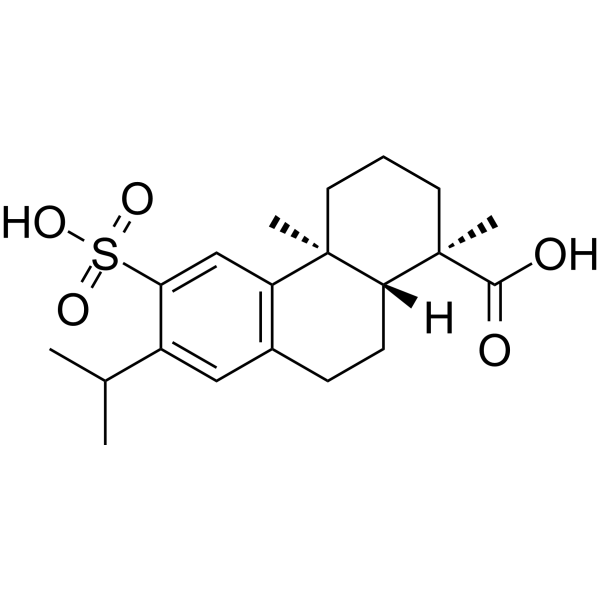
Ecabet (TA-2711 (free acid)) is a locally acting anti-ulcer compound. Ecabet irreversibly inhibits H. pylori urease, binds and precipitates pepsin (HY-P1635) and pepsinogen, and inhibits gastric juice proteolysis as well as pepsin-mediated mucolysis; it blocks the TLR4 signaling pathway activated by H. pylori lipopolysaccharide, reducing downstream superoxide production. Ecabet binds to gastric mucin to enhance mucus viscosity and strengthen the mucus barrier, promotes mucin synthesis and secretion, upregulates endogenous prostaglandins, activates capsaicin (HY-10448)-sensitive sensory nerves and the nitric oxide system, and induces ERK1/2-dependent COX‑2 and TGF‑α expression. Ecabet can be used in research related to H. pylori infection, reflux esophagitis, ulcerative colitis, and ulcerative proctosigmoiditis.
商品は「研究用試薬」です。人や動物の医療用・臨床診断用・食品用の製品ではありません。
研究用途以外に使用した場合、当社は一切の責任を負いかねます。
- 純度 : 98.51%
- CAS 番号: 33159-27-2
- 分子式: C20H28O5S
- 分子量:380.50
-
保管条件:Powder -20°C, 3 years , 4°C, 2 years ; In solvent -80°C, 6 months , -20°C, 1 month

To place orders, for customer services and technical support, please contact: MedChemExpress USA
Tel: 609-228-6898 E-mail: [email protected] [email protected]


-
 生物活性
-
化学情報
-
溶剤 & 溶解度
- プロトコル
- 純度とドキュメンテーション
- 参考文献
-
 Help & FAQs




生物活性
製品説明
|
COX-2 |
TLR4 |
体外実験
Ecabet (10 mg/mL), after acid precipitation, removes H. pylori LPS endotoxin activity in the supernatant to < 0.4 EU/mL[2].
Ecabet (2 mg/mL or higher concentration) forms higher-molecular-weight complexes with H. pylori LPS, which appear as slower migration in non-denaturing gel electrophoresis[2].
Ecabet (0.5-2 mg/mL; 10 min) inhibits urea-dependent survival of H. pylori NCTC 11637 at pH 3.0 in a concentration-dependent manner[3].
Ecabet (1-4 mg/mL; 5 min) inhibits crude H. pylori urease in a pH-dependent, time-dependent, and irreversible manner, with an IC50 of 2.2 mg/mL against NCTC 11637 at pH 5.0 and > 16 mg/mL at pH 8.0[3].
Ecabet (5 min) inhibits intact H. pylori NCTC 11637 urease at pH 5.0 with an IC50 of 3.8 mg/mL[3].
Ecabet (10 mg/mL) prevents H. pylori LPS-induced Nox1 and Noxo1 mRNA expression in guinea pig gastric mucosal cells[2].
Ecabet (5 mg/mL; incubated at 37°C for 30 min) inhibits pepsin activity in human gastric juice, with residual activity of 36.9% in stimulated samples at pH 1.6 and 21.7% at pH 5.0[4].
Ecabet (5 mg/mL; incubated at 37°C for 30 min) inhibits human pepsin isoenzymes, with pepsin 1 being the most strongly inhibited (66% inhibition at pH 5.0; 100% inhibition at pH 1.6), followed by pepsin 3 and 5[4].
Ecabet (0.5-10 mg/mL; incubated at 37°C for 3 h) interacts with porcine gastric mucin to increase viscosity, producing a 28.8% synergistic effect at pH 5.0 and a 19.8% synergistic effect at pH 1.6 at 5 mg/mL[4].
Ecabet (2.5 mg/mL; 5-60 min) activates ERK1/2 MAPK in IEC-6 cells and mildly activates IkB-α[5].
Ecabet (2.5 mg/mL; 24 h) increases PGE2 production to 32.3 pg/mL after 24 h of exposure in IEC-6 cells[5].
Ecabet (1.0-2.5 mg/mL; 24 h) does not significantly increase epithelial migration in scratched IEC-6 monolayers without added H2O2 after 24 h of exposure[5].
MedChemExpress (MCE) has not independently confirmed the accuracy of these methods. They are for reference only.
-
Cell Line:rat IEC-6 intestinal epithelial cells
-
Concentration:2.5 mg/mL
-
Incubation Time:5, 15, 30, 60 min
-
Result:ERK1/2 MAPK phosphorylation was clearly detected at 15 min.
Slight IkB-α phosphorylation was detected at 15 and 30 min.
-
Cell Line:rat IEC-6 intestinal epithelial cells
-
Concentration:2.5 mg/mL
-
Incubation Time:1, 2 h
-
Result:TGF-α and COX-2 mRNAs were not expressed before stimulation and both were induced after stimulation.
TGF-β1 mRNA was expressed before stimulation and was not enhanced.
The MEK inhibitor completely suppressed TGF-α and COX-2 mRNA induction.
The NF-kB inhibitor suppressed TGF-α mRNA induction but only slightly suppressed COX-2 mRNA induction.
-
Cell Line:rat IEC-6 intestinal epithelial cells
-
Concentration:2.5 mg/mL
-
Incubation Time:24 h
-
Result:PGE2 concentration was 32.3 pg/mL 24 h after stimulation, compared with 7.03 pg/mL without stimulation.
-
Cell Line:rat IEC-6 intestinal epithelial cells
-
Concentration:1.0, 2.5, 5.0 mg/mL
-
Incubation Time:24 h
-
Result:The number of migrated cells into the wound area was not significantly increased at 1.0 or 2.5 mg/mL compared with no stimulation.
-
Cell Line:rat IEC-6 intestinal epithelial cells
-
Concentration:1.0, 2.5 mg/mL
-
Incubation Time:24 h
-
Result:After 24-h culture with 20 µM H2O2, apoptotic IEC-6 cell numbers were lower with 1.0 mg/mL or 2.5 mg/mL than with H2O2 alone.
-
Cell Line:rat IEC-6 intestinal epithelial cells
-
Concentration:1.0, 2.5, 5.0 mg/mL
-
Incubation Time:24 h
-
Result:Compared with 20 µM H2O2 alone, the number of migrated cells into a wound area was enhanced by 38.2%, 51.1%, and 17.7% with 1.0, 2.5, and 5.0 mg/mL, respectively.
-
Cell Line:rat IEC-6 intestinal epithelial cells
-
Concentration:2.5 mg/mL
-
Incubation Time:24 h; BrdU labeling 30 min
-
Result:The number of BrdU-positive cells migrating into the wound area was increased 1.56 times by coculture compared with culturing with 20 µM H2O2 alone.
-
Cell Line:rat IEC-6 intestinal epithelial cells
-
Concentration:2.5 mg/mL
-
Incubation Time:24 h
-
Result:The number of migrated cells was decreased by coculture with the COX-2 inhibitor or MEK inhibitor compared with 20 µM H2O2 plus 2.5 mg/mL.
Coculture with the TGF-α neutralizing antibody or NF-kB inhibitor did not modulate the number of migrated cells.
-
Cell Line:rat IEC-6 intestinal epithelial cells
-
Concentration:2.5 mg/mL
-
Incubation Time:24 h
-
Result:The number of apoptotic cells was increased by coculture with the COX-2 inhibitor, NF-kB inhibitor, or MEK inhibitor compared with 20 µM H2O2 plus 2.5 mg/mL.
Coculture with the TGF-α neutralizing antibody did not modulate the number of apoptotic cells.
臨床実験
| NCT Number | Sponsor | Condition | Start Date |
Phase

|
|---|---|---|---|---|
| NCT01329991 | 2011-05 | PHASE1 |


化学情報
-
CAS 番号 33159-27-2
-
性状 Solid
-
分子量 380.50
-
分子式 C20H28O5S
-
Color White to off-white
-
SMILES
O=C([C@]1(C)CCC[C@]2(C)C3=C(CC[C@@]12[H])C=C(C(C)C)C(S(=O)(O)=O)=C3)O
-
別名
TA-2711 free acid
-
輸送条件
Room temperature in continental US; may vary elsewhere.
-
保管条件
Powder -20°C 3 years 4°C 2 years In solvent -80°C 6 months -20°C 1 month


溶剤 & 溶解度
体外:
DMSO : 100 mg/mL (262.81 mM; Need ultrasonic; Hygroscopic DMSO has a significant impact on the solubility of product, please use newly opened DMSO)
Please refer to the solubility information to select the appropriate solvent. Once prepared, please aliquot and store the solution to prevent product inactivation from repeated freeze-thaw cycles.
Storage method and period of stock solution: -80°C, 6 months; -20°C, 1 month. When stored at -80°C, please use it within 6 months. When stored at -20°C, please use it within 1 month.
濃度 (開始) × 体積 (開始) = 濃度 (終了) × 体積 (終了)
体内:
Select the appropriate dissolution method based on your experimental animal and administration route.
- For the following dissolution methods, please ensure to first prepare a clear stock solution using an In Vitro approach and then sequentially add co-solvents:
- To ensure reliable experimental results, the clarified stock solution can be appropriately stored based on storage conditions. As for the working solution for In Vivo experiments, it is recommended to prepare freshly and use it on the same day.
- The percentages shown for the solvents indicate their volumetric ratio in the final prepared solution. If precipitation or phase separation occurs during preparation, heat and/or sonication can be used to aid dissolution.
Add each solvent one by one: 10% DMSO 40% PEG300 5% Tween-80 45% Saline
Solubility: ≥ 2.5 mg/mL (6.57 mM); Clear solution
This protocol yields a clear solution of ≥ 2.5 mg/mL (saturation unknown).
Taking 1 mL working solution as an example, add 100 μL DMSO stock solution (25.0 mg/mL) to 400 μL PEG300, and mix evenly; then add 50 μL Tween-80 and mix evenly; then add 450 μL Saline to adjust the volume to 1 mL.
Preparation of Saline: Dissolve 0.9 g sodium chloride in ddH₂O and dilute to 100 mL to obtain a clear Saline solution.
Add each solvent one by one: 10% DMSO 90% (20% SBE-β-CD in Saline)
Solubility: ≥ 2.5 mg/mL (6.57 mM); Clear solution
This protocol yields a clear solution of ≥ 2.5 mg/mL (saturation unknown).
Taking 1 mL working solution as an example, add 100 μL DMSO stock solution (25.0 mg/mL) to 900 μL 20% SBE-β-CD in Saline, and mix evenly.
Preparation of 20% SBE-β-CD in Saline (4°C, storage for one week): 2 g SBE-β-CD powder is dissolved in 10 mL Saline, completely dissolve until clear.
In Vivo Dissolution Calculator
Please enter the basic information of animal experiments:
-
-
-
-
Recommended: Prepare an additional quantity of animals to account for potential losses during experiments.
Please enter your animal formula composition:
-
%DMSO +
Recommended: Keep the proportion of DMSO in working solution below 2% if your animal is weak.
-
%+
-
+%Tween-80 + +
-
%Saline +
The co-solvents required include: DMSO, . All of co-solvents are available by MedChemExpress (MCE). , Tween 80. All of co-solvents are available by MedChemExpress (MCE).
Working solution concentration: 0.22 mg/mL
Method for preparing stock solution: mg drug dissolved in μL DMSO. Stock solution concentration: mg/mL.
1. Take μL DMSO stock solution;
2. Add μL .
μL , mix evenly;
3. Then add μL Tween 80, mix evenly;
4. Then add μL
Please ensure that the stock solution in the first step is dissolved to a clear state, and add co-solvents in sequence. You can use ultrasonic heating (ultrasonic cleaner, recommended frequency 20-40 kHz), vortexing, etc. to assist dissolution.


純度とドキュメンテーション


参考文献

Complete Stock Solution Preparation Table
Please refer to the solubility information to select the appropriate solvent. Once prepared, please aliquot and store the solution to prevent product inactivation from repeated freeze-thaw cycles.
Storage method and period of stock solution: -80°C, 6 months; -20°C, 1 month. When stored at -80°C, please use it within 6 months. When stored at -20°C, please use it within 1 month.
| Optional Solvent | Concentration Solvent Mass | 1 mg | 5 mg | 10 mg | 25 mg |
|---|---|---|---|---|---|
| DMSO | 1 mM | 2.6281 mL | 13.1406 mL | 26.2812 mL | 65.7030 mL |
| 5 mM | 0.5256 mL | 2.6281 mL | 5.2562 mL | 13.1406 mL | |
| 10 mM | 0.2628 mL | 1.3141 mL | 2.6281 mL | 6.5703 mL | |
| 15 mM | 0.1752 mL | 0.8760 mL | 1.7521 mL | 4.3802 mL | |
| 20 mM | 0.1314 mL | 0.6570 mL | 1.3141 mL | 3.2852 mL | |
| 25 mM | 0.1051 mL | 0.5256 mL | 1.0512 mL | 2.6281 mL | |
| 30 mM | 0.0876 mL | 0.4380 mL | 0.8760 mL | 2.1901 mL | |
| 40 mM | 0.0657 mL | 0.3285 mL | 0.6570 mL | 1.6426 mL | |
| 50 mM | 0.0526 mL | 0.2628 mL | 0.5256 mL | 1.3141 mL | |
| 60 mM | 0.0438 mL | 0.2190 mL | 0.4380 mL | 1.0951 mL | |
| 80 mM | 0.0329 mL | 0.1643 mL | 0.3285 mL | 0.8213 mL | |
| 100 mM | 0.0263 mL | 0.1314 mL | 0.2628 mL | 0.6570 mL |


Ecabet 関連分類
HY-B0691 関連分類
 Powered by Bioz
Keywords