



TX-1123
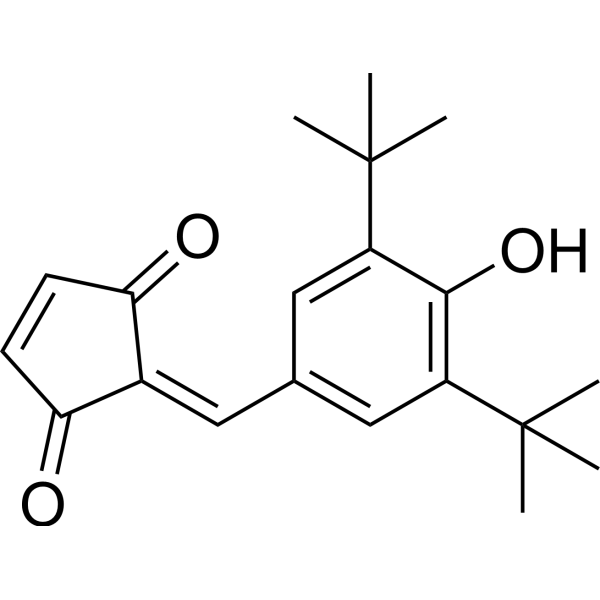
TX-1123 is a potent protein tyrosine kinase (PTK) inhibitor for Src, eEF2-K, and PKA, and EGFR-K/PKC. TX-1123 is a cyclo-oxygenase (COX) inhibitor with IC50 values of 1.16 μM and 15.7 μM for COX2 and COX1, respectively. TX-1123 has low mitochondrial toxicity. TX-1123 can be used in research of cancer.
연구목적의 판매만을 진행합니다. 환자를 대상으로 한 판매는 하지 않습니다.
- CAS No.: 157397-06-3
- 화학식: C20H24O3
- 분자량:312.40
-
보관:
Please store the product under the recommended conditions in the Certificate of Analysis.

To place orders, for customer services and technical support, please contact: MedChemExpress USA
Tel: 609-228-6898 E-mail: [email protected] [email protected]


-
 Biological Activity
-
Chemical Information
- 순도&문서
- References
-
 Help & FAQs


All EGFR Isoforms
More

Biological Activity
제품 설명
IC50 & Target
[2]|
COX-2 1.16 nM (IC50) |
COX-1 15.7 μM (IC50) |
In Vitro
TX-1123 (NIH3T3 cells) inhibits Src-K, eEF2-K, PKA, PKC, EGFR-k with IC50 values of 2.2, 3.2, 9.6, 320, and 320 μM, respectively[1].
TX-1123 (mitochondrial suspension) has a weaker mitochondrial toxicity and ATP-synthesis inhibitory activities with an IC50 value of 5 μM[1].
TX-1123 (0-1000 μM; 48 h) has antitumor activity with IC50 values of 3.66, 39, and 57 μM for HepG2, HCT116, and Rat hepatocytes, respectively[1].
MedChemExpress (MCE) has not independently confirmed the accuracy of these methods. They are for reference only. .
-
Cell Line:HepG2, HCT116, and Rat hepatocytes
-
Concentration:0-1000 μM
-
Incubation Time:48 hours
-
Result:Inhibited tumor cell growth in a dose-dependent manner.


Chemical Information
-
CAS No. 157397-06-3
-
분자량 312.40
-
화학식 C20H24O3
-
SMILES
O=C1/C(C(C=C1)=O)=C\C2=CC(C(C)(C)C)=C(O)C(C(C)(C)C)=C2
-
선적
Room temperature in continental US; may vary elsewhere.
-
보관
Please store the product under the recommended conditions in the Certificate of Analysis.


순도&문서
References
[1]. Hori H, et, al. TX-1123: an antitumor 2-hydroxyarylidene-4-cyclopentene-1,3-dione as a protein tyrosine kinase inhibitor having low mitochondrial toxicity. Bioorg Med Chem. 2002 Oct;10(10):3257-65. [Content Brief]
[2]. Ohkura K, et, al. Interactive Analysis of TX-1123 with Cyclo-oxygenase: Design of COX2 Selective TX Analogs. Anticancer Res. 2017 Jul;37(7):3849-3854. [Content Brief]

Calculators
Concentration (start) × Volume (start) = Concentration (final) × Volume (final)


TX-1123 Related Classifications
HY-121828 Related Classifications
 Powered by Bioz