



Tools for SARS-CoV-2 Research — The Battle against COVID-19 has just Begun
2020-03-23
COVID-19 Treatments: Antiviral and Anti-inflammation
- Antiviral
- Anti-inflammation
- Antiviral Natural Products
- COVID-19 Related Compound Libraries
The pandemic outbreak of coronavirus disease 2019 (COVID-19) has spread all over the world and has been a great threat to humans for absence of specific effective anti-viral treatments. It is urgent to identify effective, safe, and available treatment strategy for COVID-19.
As COVID-19 is a viral infectious disease with major symptoms of fever and pneumonia, antiviral and anti-inflammation related supportive therapies are important treatments for severe cases.
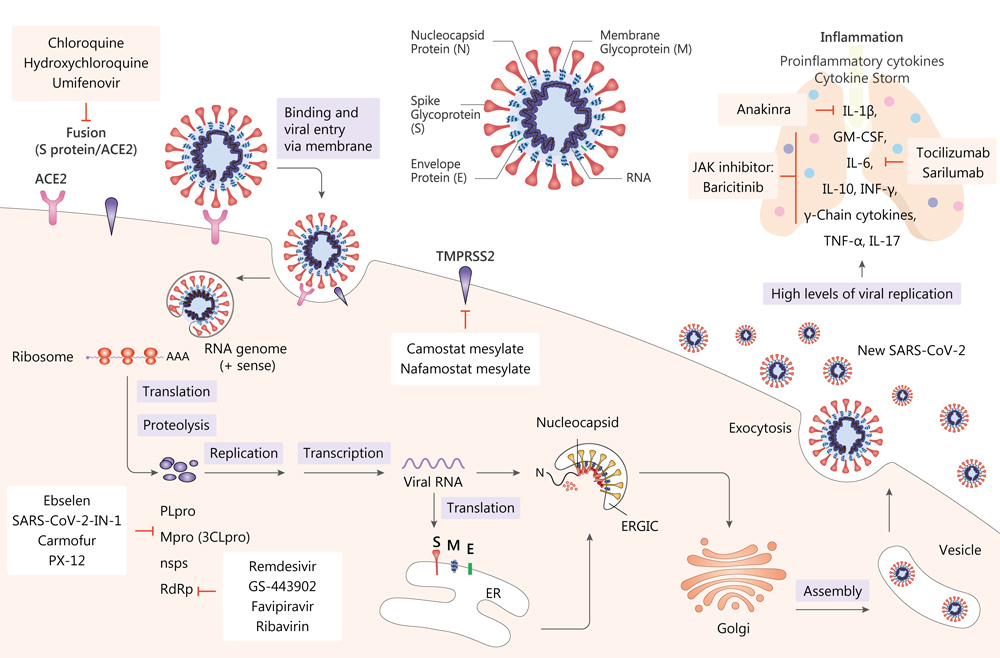
Schematic of SARS-CoV-2 infection[1-3]
COVID-19 in caused by severe acute respiratory syndrome coronavirus 2(SARS-CoV-2). SARS-CoV-2 belongs to coronavirus (CoV) who have four main structural proteins: spike (S), membrane (M), envelope (E), and nucleocapsid (N) proteins.
After primed by a protease called TMPRSS2 (transmembrane protease, serine 2), the S protein mediates the CoV entry into host cells by attaching to a cellular receptor named ACE2, followed by fusion between virus and host cell membranes. Genome replication and subgenomic RNA transcription after entry carry on with the participation of many nonstructural proteins such as Mpro (main protease or 3CLpro), PLpro (papain-like protease) and RdRp (RNA-dependent RNA polymerase). Then the structural proteins are translated, assembled into mature virions, and released via vesicles by exocytosis.
What’s worth mentioning, the vast release of cytokines (such as IL-1β, GM-CSF, IL-6, IL-10) by the immune system in response to severe infection of SARS-CoV-2 called cytokine storm contributes largely to the mortality of COVID-19.
Antiviral
All the proteins and subcellular structures participated in the life cycle of CoVs are promising targets for treatment of disease caused by CoVs. It is inspiring that numbers of promising agents with potential of antiviral have been reported to deal with COVID-19.
| Group | Compound | Mechanism of action |
|---|---|---|
| Inhibitors of viral protein synthesis |
Lopinavir[4] Ritonavir[4] |
Protease inhibitor. |
|
Inhibitors of viral RNA polymerase/RNA synthesis |
Remdesivir[5] GS-443902[6] GS-443902 trisodium[6] Favipiravir[7] Ribavirin[8] |
Nucleoside analogue, prodrug, RdRp inhibitor. |
| Inhibitors of viral entry |
Chloroquine[5] Chloroquine phosphate[5] Hydroxychloroquine sulfate[5] |
Increasing endosomal pH required for virus/cell fusion, as well as interfering with the glycosylation of ACE2. |
|
Camostat mesylate[9] Nafamostat mesylate[10] |
Inhibiting Sprotein priming and S protein-driven cell entry of SARS-CoV-2 mediating by TMPRSS2. | |
| Umifenovir hydrochloride[11] | Might inhibit the fusion process. | |
| Inhibitors of Mpro |
Ebselen[12] Carmofur[12] PX-12[12] SARS-CoV-2-IN-1[13] |
Binding with Mpro of SARS-CoV-2. |
| Inhibitor of viral proteins trafficking | Ivermectin[14] | Inhibit importin α/β-mediated nuclear transport, which in turn blocks the nuclear trafficking of viral proteins. |
| Enhance antiviral immune response |
Nitazoxanide[15] Interferon-beta 1[16] |
Regulates inflammation pathways. |
Remdesivir and Nucleoside Analogues
Remdesivir is an adenosine analogue, which incorporates into nascent viral RNA chains and function as inhibitor of RdRp. Remdesivir has been reported to inhibit numbers of RNA viruses (including SARS-CoV, MERS-CoV and SARS-CoV-2) infection in cultured cells and showed effects for treating COVID-19 in clinical. Except for remdesivir, its metabolites and several nucleoside analogues are also reported to have the antiviral ability.
| Condition | Compound | Mechanism | Status |
|---|---|---|---|
|
Anticancer Nucleoside & Nucleotide Analogues |
Gemcitabine | Targets DNA polymerase | Approved |
| 5-Azacytidine | Traps DNA methyltransferase | Approved | |
| Cytarabine | Targets DNA polymerase | Approved | |
|
Antiviral Nucleoside & Nucleotide Analogues |
Remdesivir[5] GS-443902[6] GS-443902 trisodium[5] Remdesivir nucleoside monophosphate |
Remdesivir and its metabolites, inhibitors of RdRp. | Phase III |
| Favipiravir | Targets RNA-dependent RNA polymerase (RdRp) | Approved | |
| Tenofovir | Targets nucleotide reverse transcriptase | Approved | |
| Asunaprevir | Targets NS3 protease | Approved | |
|
Antibacterial Nucleoside & Nucleotide Analogues |
Linezolid | Inhibits bacterial protein synthesis | Approved |
| Nitrofurantoin | Inhibits bacterial DNA, RNA and protein synthesis | Approved | |
| Isoniazid | Acts on the mycobacterial cell wall | Approved |
Chloroquine and Its Family Members
Chloroquine is a widely-used anti-malarial and autoimmune disease drug, has recently been reported as a potential broad spectrum antiviral drug. Chloroquine is known to block virus infection by inhibiting the fusion of virus and host cell by increasing endosomal pH and interfering the function of ACE2. Chloroquine and hydroxychloroquine are proposed to be used to treat COVID-19 in clinical trials.
- Subfamily Members
- Relationship
- Mechanism of Action
- Clinical Status and Indication
| Chloroquine | Representative Drug |
Autophagy, RNA-dependent RNA polymerase, TLR |
Approved: Malaria, Tumor, Rheumatoid Arthritis, COVID-19, etc Preclinical Research: Chikungunya Virus |
| Didesethyl Chloroquine |
Major Metabolite of Chloroquine |
Autophagy, RNA-dependent RNA polymerase |
Preclinical Research: Malaria, Chikungunya Virus |
| Hydroxychloroquine |
Less Toxic Metabolite of Chloroquine |
Autophagy, RNA-dependent RNA polymerase, TLR |
Approved: Malaria, Tumor, Rheumatoid Arthritis, COVID-19, etc Preclinical Research: Chikungunya Virus |
| Cletoquine |
Major Active Metabolite of Hydroxychloroquine |
Autophagy, RNA-dependent RNA polymerase |
Preclinical Research: Chikungunya Virus, Antirheumatic |
| Ferroquine | Chloroquine Analog | Autophagy, Ferroptosis |
Phase II: Malaria Preclinical Research: Tumor, Virus |
| Desmethyl Ferroquine |
Major Metabolite of Ferroquine |
Autophagy, RNA-dependent RNA polymerase |
Preclinical Research: Malaria, Virus |
|
SARS-CoV-IN 1 SARS-CoV-IN 2 SARS-CoV-IN 3 |
Derivative of Ferroquine | Preclinical Research: Malaria, SARS-CoV |
| Primaquine | Chloroquine Analog | ROS | Approved: Malaria, HIV |
| Mefloquine | Chloroquine Analog | Heme polymerase |
Approved: Malaria Preclinical Research: Osteoporosis |
| Amodiaquine | Chloroquine Analog | Heme polymerase |
Approved: Malaria Preclinical Research: Ebola Virus |
| N-Desethyl amodiaquine |
Major Active Metabolite of Amodiaquine |
Preclinical Research: Malaria |
Anti-inflammation
Current management for COVID-19 is supportive therapy as there is still no effective cure.
Respiratory failure from acute respiratory distress syndrome (ARDS) is reported to be the leading cause of mortality of COVID-19. The primary cause of ARDS is cytokine storm characterized by excessive and uncontrolled release of pro-inflammatory cytokines (such as IL-6, IL-1, IL-17, IL-2, GM-CSF) after infection. So anti-inflammation are the most important supportive therapy for patients with severe COVID-19.
Therapeutic options for anti-inflammation in patients with COVID-19 include steroids, selective cytokine blockade, JAK inhibition, and intravenous immunoglobulin.
| Compound | Mechanism of action |
|---|---|
| Methylprednisolone[17] | Glucocorticoids suppress cytokine storm manifestations in patients with COVID-19. |
| Dexamethasone[18] | A glucocorticoid receptor agonist and the first drug save lives by one-third among patients critically ill with COVID-19. |
| Anakinra[19] | An interleukin-1 receptor (IL-1R) antagonist may be beneficial for treating severe COVID-19 patients. |
|
Tocilizumab[20] Sarilumab[21] |
Recombinant human IL-6 monoclonal antibody thus blocking IL-6 signaling and its mediated inflammatory response, as a therapeutic option against COVID-19. |
| Baricitinib[22] | A dual inhibitor of JAK and AAK1 (AP2-associated protein kinase 1, a regulator ofendocytosis) as the possible candidate for treatment of COVID-19 because of its relative safety and high affinity. |
|
Chloroquine Hydroxychloroquine[5] |
CQ and HCQ can regulate immune system by affecting cell signaling and production of pro-inflammatory cytokines. |
| Melatonin[23] | Plays a role of adjuvant medication in the regulation of immune system, inflammation and oxidation stress. |
Antiviral Natural Products
Many natural products have broad-spectrum antiviral effects by inhibiting various steps in viral infection and replication. Natural products can also function as immunomodulators, suppressing inflammatory reaction. Some of them are reported to have the potential of inhibiting coronavirus and may be promising candidate agents for COVID-19. Take emodin as an example, it has been shown to inhibit the interaction of SARS-CoV S protein with its receptor ACE2[24].
COVID-19 Related Compound Libraries
It is urgent to develop drugs to treat COVID-19 quickly. The drug repurposing using visual screening technology in clinical and approved compounds can greatly shorten timeline and improve the efficiency of the development of anti-COVID-19 drugs.
As mentioned above, the reported candidate drugs for COVID-19 include agents targeting viruses (such as HIV and SARS-CoV) and inflammation. It indicates that all the antiviral, anti-infection and anti-inflammation related chemicals may have the potential to be effective in treatment of COVID-19.
| Compound library | Description |
|---|---|
|
Anti-COVID-19 Compound Library |
Chemicals with potential anti-COVID-19 activity targeted 3CL protease, Spike protein, NSP15, RdRp, PLpro and ACE2 collected by visual screening in Drug Repurposing Compound Library (HY-L035). |
| Anti-Virus Compound Library | Compound library containing all kinds of molecules with anti-virus activity. |
| Anti-Infection Compound Library | Antiviral, antibacterial, antifungal and antiparasitic compound library. |
|
Immunology/Inflammation Compound Library |
Antiviral, antibacterial, antifungal and antiparasitic compound library. |
Anti-infection:
References:
 LinkedIn
 Researchgate
 Instagram
 X
X Facebook
 WhatsApp
 Reddit
 Mail
Mail