12 Results for "

mouse wound infection model

" in MedChemExpress (MCE) Product Catalog:
Products (12)

12 Results for "mouse wound infection model" in MCE Product Catalog:

1
1 Cited Publications
Cat. No.: HY-148775B
Purity:  ≥95.0%
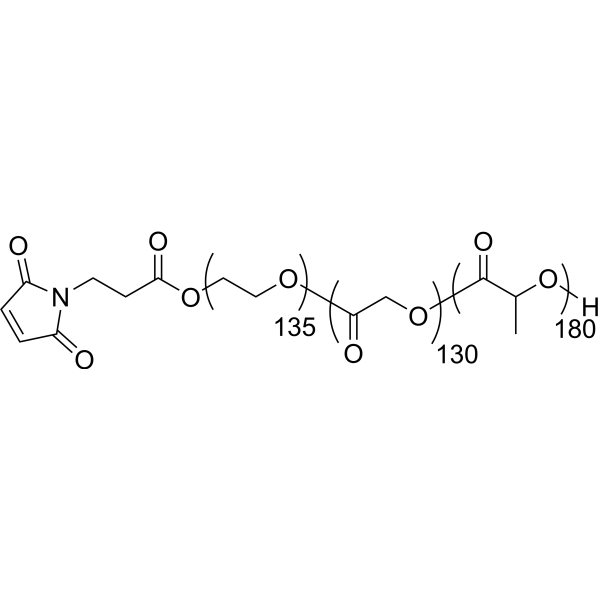
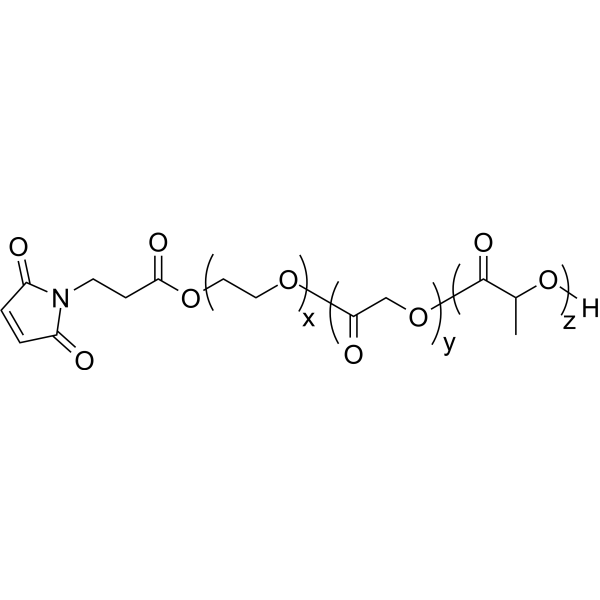
PLGA-PEG-MAL (20KDA-5.0KDA, LA:GA RATIO 40:60) is a biodegradable amphipathic polymeric nanocarrier of poly (lactic-co-glycolic acid)-block-poly (ethylene glycol) (PLGA-PEG-Mal) that allows covalent modification of functional molecules. PLGA-PEG-MAL (20KDA-5.0KDA, LA:GA RATIO 40:60) modified with Angiopep-2 can cross the blood-brain barrier and exhibits targeting selectivity for glioblastoma cells. PLGA-PEG-MAL (20KDA-5.0KDA, LA:GA RATIO 40:60) can capture tumor-derived protein antigens, and exerts immunomodulatory effects when conjugated with anti-OX40 antibody; when used in combination with A2-CL/Dbait nanoparticles and radiotherapy, it prolongs survival time and reduces tumor volume in glioblastoma mouse models. PLGA-PEG-MAL (20KDA-5.0KDA, LA:GA RATIO 40:60) can be used for studies related to bacterial wound infections and glioblastoma .
loading...
    loading...
Cat. No.: HY-148775A
CAS No.: 743423-15-6
MPEG-PLGA (21500-26500) is a biodegradable amphipathic polymeric nanocarrier of poly (lactic-co-glycolic acid)-block-poly (ethylene glycol) (PLGA-PEG-Mal) that allows covalent modification of functional molecules. MPEG-PLGA (21500-26500) modified with Angiopep-2 can cross the blood-brain barrier and exhibits targeting selectivity for glioblastoma cells. MPEG-PLGA (21500-26500) can capture tumor-derived protein antigens, and exerts immunomodulatory effects when conjugated with anti-OX40 antibody; when used in combination with A2-CL/Dbait nanoparticles and radiotherapy, it prolongs survival time and reduces tumor volume in glioblastoma mouse models. MPEG-PLGA (21500-26500) can be used for studies related to bacterial wound infections and glioblastoma .
loading...
    loading...
Cat. No.: HY-148775
Purity:  ≥95.0%
PLGA-PEG-MAL (60kDa-3.4kDa, LA:GA ratio 75:25) is a biodegradable amphipathic polymeric nanocarrier of poly (lactic-co-glycolic acid)-block-poly (ethylene glycol) (PLGA-PEG-Mal) that allows covalent modification of functional molecules. PLGA-PEG-MAL (60kDa-3.4kDa, LA:GA ratio 75:25) modified with Angiopep-2 can cross the blood-brain barrier and exhibits targeting selectivity for glioblastoma cells. PLGA-PEG-MAL (60kDa-3.4kDa, LA:GA ratio 75:25) can capture tumor-derived protein antigens, and exerts immunomodulatory effects when conjugated with anti-OX40 antibody; when used in combination with A2-CL/Dbait nanoparticles and radiotherapy, it prolongs survival time and reduces tumor volume in glioblastoma mouse models. PLGA-PEG-MAL (60kDa-3.4kDa, LA:GA ratio 75:25) can be used for studies related to bacterial wound infections and glioblastoma .
loading...
    loading...
Cat. No.: HY-162818
Research Areas:  

Infection

Antibacterial agent 237 (compound Ru-8) is a bacteriostatic agent for Staphylococcus aureus, with MIC of 0.78-1.56 μg/mL. Antibacterial agent 237 destroys bacterial cell membranes, changes their permeability, and induces bacteria to produce Reactive Oxygen Species, leading to bacterial death without causing drug resistance. Antibacterial agent 237 has low hemolytic toxicity to rabbit red blood cells and Raw 264.7 cells, and has significant antibacterial effects against Staphylococcus aureus in mouse skin wound infection models and Bacillus major larvae infection models .
loading...
    loading...
Cat. No.: HY-173270
Target:  

Bacterial

Research Areas:  

Infection

Antibacterial synergist 3 is a dual-acting inhibitor of biofilm (IC50 of PAO1: 0.40 μM and IC50 of PA14: 1.45 μM). Antibacterial synergist 3 reduces virulence production by inhibiting the quorum sensing (QS) system and induces iron deficiency in P. aeruginosa PAO1. Antibacterial synergist 3 enhances the efficacy of Tobramycin (HY-B0441) and Ciprofloxacin (HY-B0356) in a mouse wound infection model. Antibacterial synergist 3 can be used for the research of P. aeruginosa infections .
loading...
    loading...
Cat. No.: HY-163984
CAS No.: 2899202-97-0
Target:  

Bacterial

Research Areas:  

Infection

Antibacterial agent 240 (compound 62-7c) is an antibacterial agent that can target multidrug-resistant (MDR) MRSA strains. Antibacterial agent 240 showed high biosafety and potent anti-infection activity in mouse pneumonia and mouse wound models of MRSA infection .
loading...
    loading...
Cat. No.: HY-175254
Target:  

Bacterial

Research Areas:  

Infection

Antibiofilm agent-17 is a dual-action biofilm inhibitor against Pseudomonas aeruginosa (IC50 = 0.33 μM). Antibiofilm agent-17 inhibits biofilm growth by reducing quorum sensing-mediated virulence production and iron ion acquisition. Antibiofilm agent-17 exhibits synergistic antimicrobial effects in a mouse wound infection model. Antibiofilm agent-17 can be used in research on combating Pseudomonas aeruginosa infections .
loading...
    loading...
Cat. No.: HY-168204
Target:  

Bacterial Fungal

Research Areas:  

Infection

3-Acetyl-28-N–(3–guanidinobutoxy)-oleanolic acid (compound J1) is a potent antimicrobial agent. 3-Acetyl-28-N–(3–guanidinobutoxy)-oleanolic acid shows anti-gram-positive bacteria and fungi activity. 3-Acetyl-28-N–(3–guanidinobutoxy)-oleanolic acid can be used as antibiotic adjuvants. 3-Acetyl-28-N–(3–guanidinobutoxy)-oleanolic disrupts the bacterial cell membrane, inserts into the DNA, and binds to DNA gyrase. 3-Acetyl-28-N–(3–guanidinobutoxy)-oleanolic reduces microbial count in a mouse MRSA skin infection model and accelerates wound healing .
loading...
    loading...
Cat. No.: HY-184201
CAS No.: 3123310-71-1
Research Areas:  

Infection

Anti-MRSA agent 44 is a potent anti-methicillin-resistant Staphylococcus aureus (MRSA) agent. Anti-MRSA agent 44 exihibits antibiofilm activity against MRSA. Anti-MRSA agent 44 reduces bacterial counts and biofilm burdens, accelerates wound healing, lowers inflammatory cytokine levels in mouse models. Anti-MRSA agent 44 can be used for the research of MRSA skin wound infection and MRSA catheter-associated biofilm infection .
loading...
    loading...
Cat. No.: HY-P11607
Target:  

Bacterial

Research Areas:  

Infection

CyLip-10 is a microbial-derived cyclic-lipid antimicrobial peptide. CyLip-10 has broad-spectrum antimicrobial efficacy, low hemolytic activity, and excellent stability. CyLip-10 can disrupt membrane integrity, inhibit biofilm formation and induce membrane permeabilization and bacterial cell death. CyLip-10 reduces bacterial load, promotes wound healing, and alleviates inflammatory responses in a mouse Methicillin (HY-121544)-resistant Staphylococcus aureus skin wound infection model. CyLip-10 can be used for the bacterial infection .
loading...
    loading...
Cat. No.: HY-182056
Target:  

Bacterial

Research Areas:  

Infection

Antibacterial agent 331 is an antibacterial agent with anti-biofilm activity. Antibacterial agent 331 exhibits activity against a variety of Gram-positive and Gram-negative bacteria. Antibacterial agent 331 eliminates MRSE 62 and promotes the repair of infected wounds in mouse models. Antibacterial agent 331 can be used for research on infections .
loading...
    loading...
Cat. No.: HY-183361
Target:  

Bacterial Elastase

Research Areas:  

Infection

Antibiofilm agent-22 is an FpvA receptor-targeting antibacterial agent. Antibiofilm agent-22 chelates iron, disrupts las, pqs, and rhl pathways, reduces elastase, pyocyanin, and rhamnolipid production, and induces bacterial iron starvation. Antibiofilm agent-22 can be used for the research of Pseudomonas aeruginosa infection .
loading...
    loading...
  • 1

