1. Search Result
Search Result
Pathways Recommended: Anti-infection
Results for "

mouth infection

" in MedChemExpress (MCE) Product Catalog:

14

Inhibitors & Agonists

1

Biochemical Assay Reagents

1

Peptides

2

Natural
Products

1

Isotope-Labeled Compounds

Cat. No. Nombre del producto Target Áreas de investigación Chemical Structure
  • HY-B1597

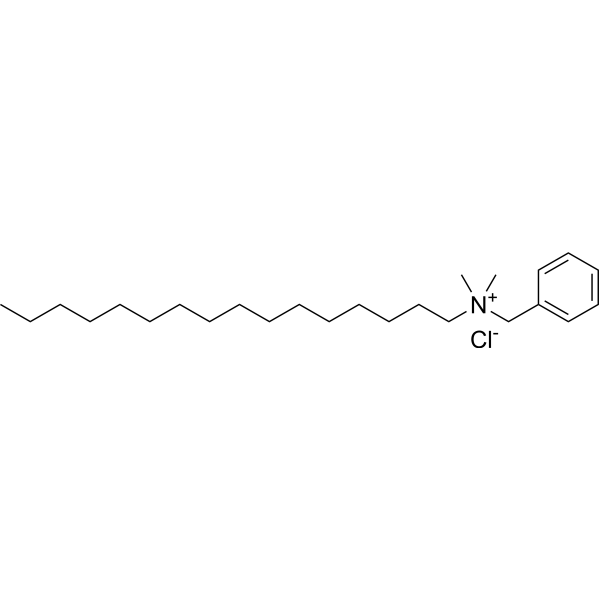
    Benzyldimethylhexadecylammonium chloride

    Bacterial Infection Inflammation/Immunology
    Cetalkonium chloride is an ammonium antiseptic agent used in many topical agents for infections of mouth, throat and eye. Cetalkonium chloride acts as anti-inflammatory amphiphilic agent. Cetalkonium chloride is a cationic surfactant, that improves the precorneal residence time and bioavailability of drugs. Cetalkonium chloride interacts with the negative charges on the bacterial cell membrane, disrupts the integrity of the cell membrane, causes leakage of cell contents and ultimately leading to bacterial death .
    Cetalkonium chloride
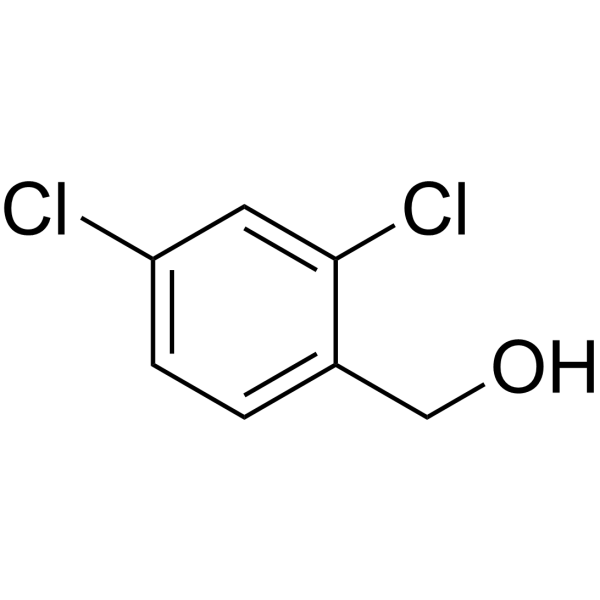
  • HY-W039454

    Environmental Pollutants Bacterial SARS-CoV Infection
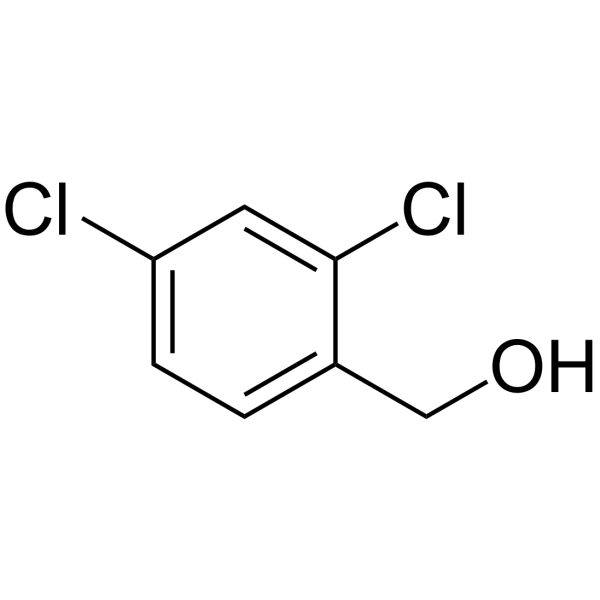
    2,4-Dichlorobenzyl alcohol is an orally active mild antiseptic, with a broad spectrum for bacterial and virus associated with mouth and throat infections. 2,4-Dichlorobenzyl alcohol exhibits prenatal developmental toxicity.2,4-Dichlorobenzyl alcohol can be used in the study of SARS-CoV .
    2,4-Dichlorobenzyl alcohol
  • HY-N0857
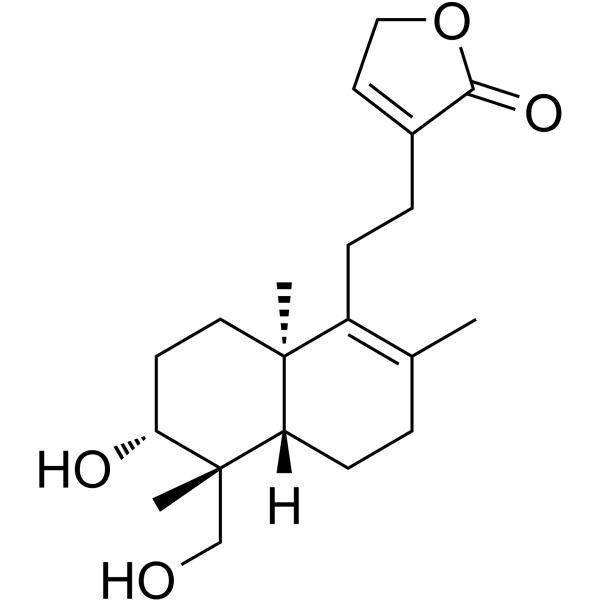
    Deoxyandrographolide
    1 Publications Verification

    GLUT HDAC Virus Protease PI3K AMPK Akt Histone Demethylase MDM-2/p53 IFNAR Reactive Oxygen Species (ROS) Infection Metabolic Disease Inflammation/Immunology
    Deoxyandrographolide is an orally active lactone found in the Andrographis paniculata Nees. Deoxyandrographolide shows a KD of 38.4 μM of HDAC1. Deoxyandrographolide enhances GLUT4 plasma membrane translocation, activates PI3K and AMPK-dependent signaling pathways, suppresses fasting blood glucose, serum insulin, triglycerides, and LDL-cholesterol levels. Deoxyandrographolide enhances HDAC1 expression via inhibited ubiquitination degradation, represses H3K4me3, improves chromosome stability, and restrains aging biomarkers p16, p21, γH2A.X, p53 and ROS production. Deoxyandrographolide interacts with Foot-and-Mouth Disease Virus 3Cpro active site, inhibits protease and IFN-antagonist activity, derepresses ISG expression, and inhibits viral replication. Deoxyandrographolide can be used for the researches of type 2 diabetes mellitus, vascular senescence and virus infection .
    Deoxyandrographolide
  • HY-W145481A

    Carob galactomannan

    Sirtuin Inflammation/Immunology
    D-Galacto-D-mannan (Carob galactomannan) is an orally active Dectin-2 agonist. D-Galacto-D-mannan exerts antioxidant activity against hydroxyl radical generation. D-Galacto-D-mannan activates Dectin-2 to trigger downstream signaling pathways, promote the expression of immunoregulatory molecules, coordinate innate and adaptive immune responses, and inhibit excessive inflammatory responses by upregulating the expression of Sirtuin 1. When used as a vaccine adjuvant, D-Galacto-D-mannan induces cellular and humoral immune responses, promotes IFNγ secretion, increases antibody levels and virus neutralization titers, and elevates the levels of immunoglobulin G and A. D-Galacto-D-mannan can serve as an adjuvant for foot-and-mouth disease vaccines, enhance the vaccine-mediated ability of hosts to defend against viral infection in mice, and reduce local side effects at the inoculation site in pigs. D-Galacto-D-mannan can be used in the research of inflammatory and immune diseases, such as foot-and-mouth disease .
    D-Galacto-D-mannan
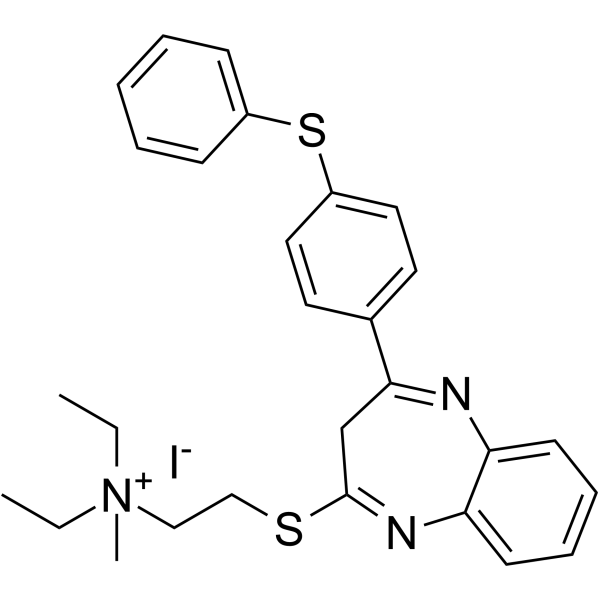
  • HY-131554

    Bacterial Antibiotic Infection
    Tibezonium iodide, an oropharyngeal disinfectant, has antibacterial activity for the prevention of mouth infections .
    Tibezonium iodide
  • HY-W039454R

    Reference Standards Bacterial SARS-CoV Infection
    2,4-Dichlorobenzyl alcohol (Standard) is the analytical standard of 2,4-Dichlorobenzyl alcohol (HY-W039454). This product is intended for research and analytical applications. 2,4-Dichlorobenzyl alcohol is an orally active mild antiseptic, with a broad spectrum for bacterial and virus associated with mouth and throat infections. 2,4-Dichlorobenzyl alcohol exhibits prenatal developmental toxicity.2,4-Dichlorobenzyl alcohol can be used in the study of SARS-CoV .
    2,4-Dichlorobenzyl alcohol (Standard)
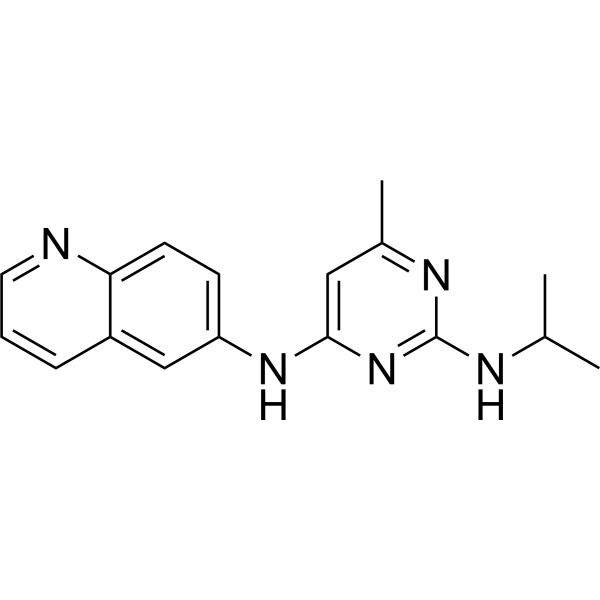
  • HY-174814

    Enterovirus Infection
    Jun15716 is an Enterovirus (EVs) 2C protein (EVs 2C) inhibitor with Kis of 15.9, 44.2 and 17.8 μM for EV-D68, EV-A71 and CVB3, respectively. Jun15716 has a potent antiviral activity against EV-D68 US/MO/14-18947 and CVB3 Nancy cells (EC50s of 1.0 and 0.7 μM, respectively). Jun15716 can be used for viral infections research, such as meningitis, hand, foot and mouth disease (HFMD) and viral myocarditis .
    Jun15716
  • HY-174815

    Enterovirus Infection
    Jun15799 is an Enterovirus (EVs) 2C protein (EVs 2C) inhibitor with Kis of 0.8, 21.1 and 3.0 μM for EV-D68, EV-A71 and CVB3, respectively. Jun15799 has a significant antiviral activity against EV-D68 US/MO/14-18947, EV-A71 Tainan/4643/1998 and CVB3 Nancy cells (EC50s of 0.3, 11.4 and 0.3 μM, respectively). Jun15799 can be used for viral infections research, such as meningitis, hand, foot and mouth disease (HFMD) and viral myocarditis .
    Jun15799
  • HY-B1597R

    Benzyldimethylhexadecylammonium chloride (Standard)

    Reference Standards Bacterial Infection Inflammation/Immunology
    Cetalkonium (chloride) (Standard) is the analytical standard of Cetalkonium (chloride). This product is intended for research and analytical applications. Cetalkonium chloride is an ammonium antiseptic agent used in many topical agents for infections of mouth, throat and eye. Cetalkonium chloride acts as anti-inflammatory amphiphilic agent. Cetalkonium chloride is a cationic surfactant, that improves the precorneal residence time and bioavailability of drugs. Cetalkonium chloride interacts with the negative charges on the bacterial cell membrane, disrupts the integrity of the cell membrane, causes leakage of cell contents and ultimately leading to bacterial death .
    Cetalkonium chloride (Standard)
  • HY-P2015A

    BCH 069 hydrochloride

    HIV Infection Inflammation/Immunology
    Diacetylsplenopentin (BCH 069) hydrochloride is an antiviral agent, and protects guinea pigs from foot-and-mouth disease (FMD) infection. Berlopentin has immunostimulatory properties .
    Diacetylsplenopentin hydrochloride
  • HY-P2015

    BCH 069

    HIV Infection Inflammation/Immunology
    Diacetylsplenopentine (BCH 069) is an antiviral agent, and protects guinea pigs from foot-and-mouth disease (FMD) infection. Berlopentin has immunostimulatory properties .
    Diacetylsplenopentine
  • HY-157082

    Enterovirus Infection
    ZHSI-1 is an EV71 (Enterovirus 71) inhibitor that inhibits EV71/CVA16 replication and virus-induced pyroptosis associated with viral pathogenesis. ZHSI-1 effectively prevents EV71 infection in neonatal and young mice in animal models. ZHSI-1 can be used to study viral infections such as hand, foot and mouth disease (HFMD) .
    ZHSI-1
  • HY-W724344

    Benzyldimethylhexadecylammonium-d5 chloride

    Isotope-Labeled Compounds Bacterial Infection Inflammation/Immunology
    Cetalkonium-d5 chloride (Benzyldimethylhexadecylammonium-d5 chloride) is the deuterium labeled Cetalkonium chloride (HY-B1597). Cetalkonium chloride is an ammonium antiseptic agent used in many topical agents for infections of mouth, throat and eye. Cetalkonium chloride acts as anti-inflammatory amphiphilic agent. Cetalkonium chloride is a cationic surfactant, that improves the precorneal residence time and bioavailability of drugs. Cetalkonium chloride interacts with the negative charges on the bacterial cell membrane, disrupts the integrity of the cell membrane, causes leakage of cell contents and ultimately leading to bacterial death .
    Cetalkonium-d5 chloride
  • HY-N9907

    Bacterial Infection
    7,3′-Dihydroxy-8,4′-dimethoxyisoflavone is an isoflavone Antibacterial agent. 7,3′-Dihydroxy-8,4′-dimethoxyisoflavone is isolated from the stems of S. parviflorus. 7,3′-Dihydroxy-8,4′-dimethoxyisoflavone exhibits weak antibacterial activity against Gram-positive and Gram-negative bacterial strains. 7,3′-Dihydroxy-8,4′-dimethoxyisoflavone can be used in the research of bacterial infections .
    7,3′-Dihydroxy-8,4′-dimethoxyisoflavone

Consulta en línea

Your information is safe with us. * Required Fields.

Saludo


Country or Region *

Nombre del solicitante *


Nombre de la Organizaciòn *

Department *


Direcciòn del E-mail *


Nombre del producto *

Cat. No.


Requested quantity *

Número de teléfono *


Observaciones

Consulta en línea

Inquiry Information

Nombre del producto:
Cat. No.:
Cantidad:
MCE Japan Authorized Agent:

