



PARP
poly ADP ribose polymerase
PARP is a family of proteins involved in a number of cellular processes involving mainly DNA repair and programmed cell death. The PARP family comprises 17 members. They have all very different structures and functions in the cell. PARP1, PARP2, VPARP (PARP4), Tankyrase-1 and -2 (PARP-5a or TNKS, and PARP-5b or TNKS2) have a confirmed PARP activity. Others include PARP3, PARP6, TIPARP (or PARP7), PARP8, PARP9, PARP10, PARP11, PARP12, PARP14, PARP15, and PARP16. PARP is found in the cell’s nucleus. The main role is to detect and signal single-strand DNA breaks (SSB) to the enzymatic machinery involved in the SSB repair.
PARP Isoform Specific Products
-
PARP
(307)
View all products
-
PARP1
(219)
View all products
-
PARP2
(85)
View all products
-
PARP3
(23)
View all products
-
PARP4
(11)
View all products
-
TNKS1/
PARP5A (41)View all products
-
TNKS2/
PARP5B (38)View all products
-
PARP7
(25)
View all products
-
PARP10
(20)
View all products
-
PARP14
(17)
View all products
-
PARP15
(14)
View all products
-
PARP12
(4)
View all products
-
PARP16
(3)
View all products
All Product Categories
-
PARP Inhibitors
(467)
View all products
-
PARP Agonists
(4)
View all products
-
PARP Activators
(116)
View all products
-
PARP Modulators
(13)
View all products
-
PARP Inducers
(20)
View all products
-
PARP Degraders
(25)
View all products
-
PARP Substrate
(1)
View all products
-
PARP Ligands
(4)
View all products
-
PARP Related Products (710)
Related Products (710)

-
Antibodies (11)
-
PARP Isoform Comparison
-
ARTD10/PARP10-IN-2
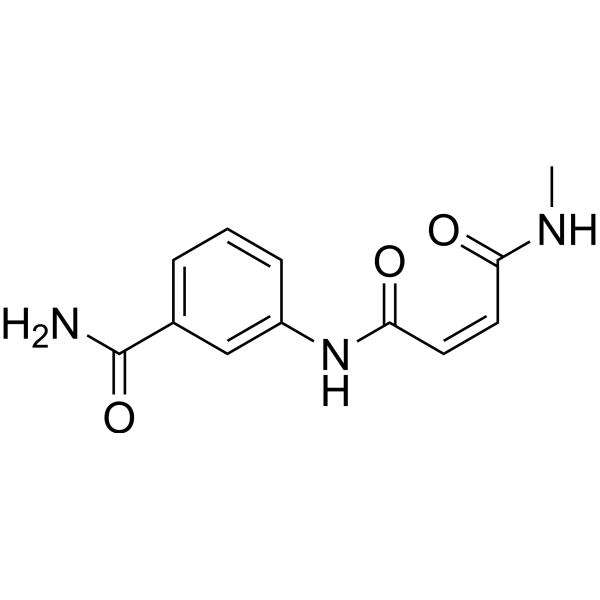 0 ImagesCat. No.: HY-148710CAS No.: 1708103-69-8ARTD10/PARP10-IN-2 (compound 19) is a potent and non-selective PARP inhibitor, targeting to mono-ADP-ribosyltransferases ARTD10/PARP10 and poly(ADP-ribose) polymerase-1 ARTD1/PARP1 with IC50s of 2.0 μM, and 9.7 μM, respectively.
-
ZINC000081009201
 0 ImagesCat. No.: HY-174836CAS No.: 1424500-13-9ZINC000081009201 is a potent poly(ADP-ribose) polymerase 1 (PARP1) inhibitor with an IC50 value of 1.4767 μM. ZINC000081009201 is promising for research of triple-negative breast cancer (TNBC).
-
YCH3971
 0 ImagesCat. No.: HY-181664YCH3971 is a PARP1 inhibitor with a PARP1 IC50 of 7.52 nM and a PARP1 EC50 of 67.75 nM. YCH3971 inhibits the proliferation of BRCA-deficient tumor cells. YCH3971 induces DNA damage, G2/M phase arrest, and caspase-mediated Apoptosis in triple-negative breast cancer cells. YCH3971 can be used for the research of BRCA-deficient tumors.
-
Bax activator-2
 0 ImagesCat. No.: HY-182349CAS No.: 3034297-25-8Bax activator-2 is a pro-apoptotic agent targeting BAX, with an IC50 of 0.30 μM against human BAX. Bax activator-2 binds to the trigger site of BAX and induces its conformational change. Bax activator-2 induces mitochondrial depolarization, cytochrome c release, cleavage of caspase-3/9 and PARP, thereby initiating apoptosis. Bax activator-2 exhibits cytotoxicity against a variety of cancer cell lines. Bax activator-2 can be used in research related to acute myeloid leukemia and solid tumors.
-
PARP7-IN-18
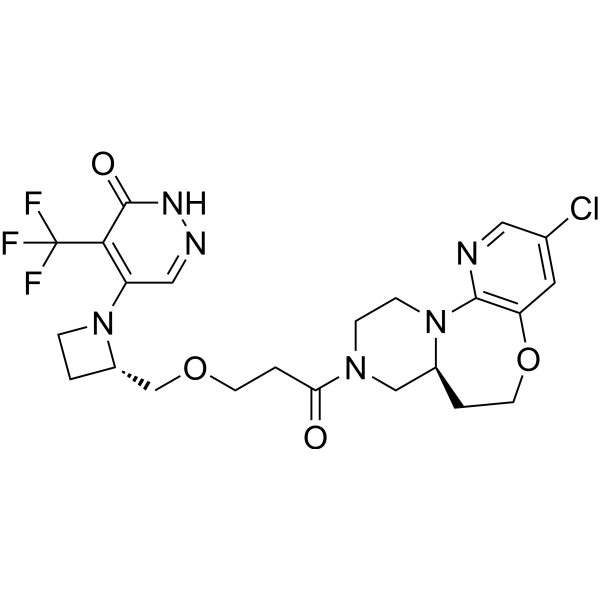 0 ImagesCat. No.: HY-162172CAS No.: 2819999-00-1PARP7-IN-18 is a potent, highly selective, and orally active PARP7 inhibitor with an IC50 of 0.11 nM. PARP7-IN-18 exhibits >1000-fold selectivity over other PARP family members. PARP7-IN-18 inhibits NCI-H1373 lung cancer cell proliferation with an IC50 of 2.5 nM and promotes IFN-β expression. PARP7-IN-18 exhibits favorable pharmacokinetic properties and can be used in research on PARP7-sensitive tumors, such as lung cancer.

-
VEGFR/PARP-IN-1
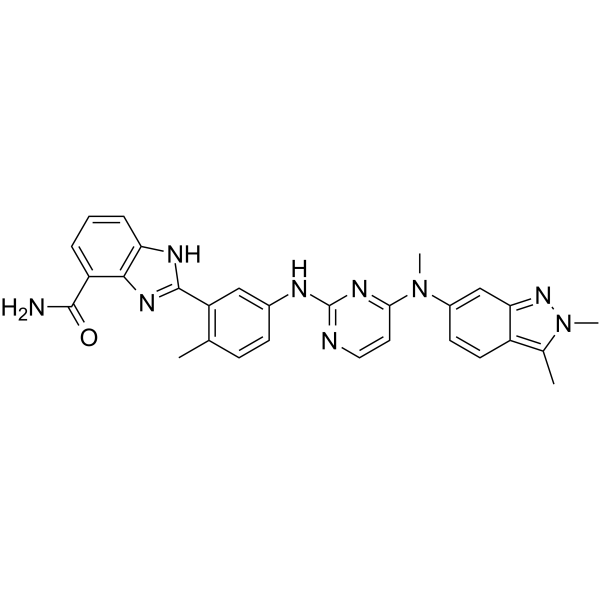 0 ImagesCat. No.: HY-155965CAS No.: 3010256-54-6VEGFR/PARP-IN-1 (Compound 14b) is a VEGFR/PARP dual inhibitor (IC50s: 191 nM and 60.9 nM respectively). VEGFR/PARP-IN-1 inhibits DNA damage repair, induces cell apoptosis, and arrests cell in the G2/M phase. VEGFR/PARP-IN-1 has good antiproliferative efficacy against BRCA wild-type breast cancer cells (IC50: 4.1 and 3.5 μM for MDA-MB-231 and MCF-7 cells). VEGFR/PARP-IN-1 is an antitumor and anti-metastasis agent.
-
NU 1085
 0 ImagesCat. No.: HY-14206CAS No.: 188106-83-4NU 1085 is a potent poly(ADP-ribose) polymerase (PARP) inhibitor with a Ki of 6 nM. NU 1085 shows strong cytotoxicity to cancer cells (LC50 = 83-94 μM) and can enhance the anticancer effect of Temozolomide (HY-17364). NU 1085 can be used for the research of cancer, such as lung cancer.
-
Picolinamide (Standard)
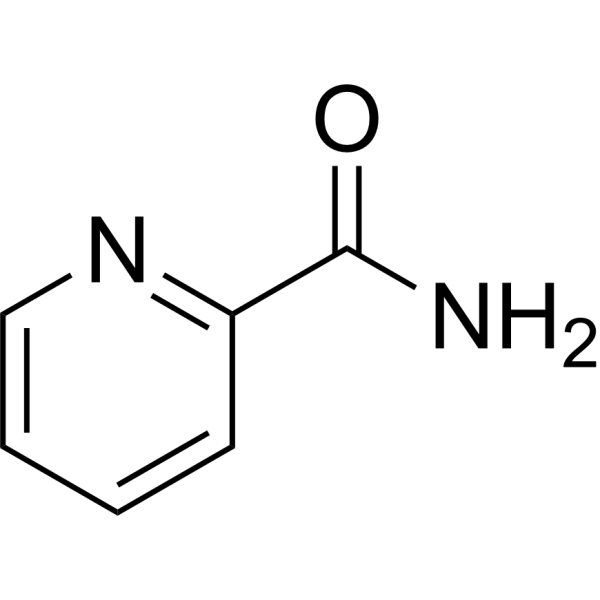 0 ImagesSynonyms: 2-Picolinamide (Standard)Picolinamide (Standard) is the analytical standard of Picolinamide. This product is intended for research and analytical applications. Picolinamide (2-Picolinamide) is an inhibitor of Poly(ADP-ribose) synthetase of nuclei from rat pancreatic islet cells.

-
Tiparp Rat Pre-designed siRNA Set A
 0 ImagesCat. No.: HY-RS14548
Tiparp Rat Pre-designed siRNA Set A contains three designed siRNAs for Tiparp gene (Rat), as well as a negative control, a positive control, and a FAM-labeled negative control.
-
Swerchirin
 0 ImagesSwerchirin is an orally active, plant-derived xanthone that acts as an inhibitor of the Raf/MEK/ERK signaling pathway. Swerchirin downregulates the expression of phosphorylated MEK and phosphorylated ERK, induces mitochondrial apoptosis and cell cycle arrest, regulates Bcl-2 family proteins, triggers cytochrome c release, activates caspases, and drives PARP cleavage. Swerchirin reduces blood glucose levels in rat models under fasting, fed, glucose-loaded conditions, and following treatment with Tolbutamide (HY-B0401). Swerchirin can be used in research related to ovarian cancer, liver injury, and diabetes.
-
PARP1-IN-50
 0 ImagesCat. No.: HY-179614CAS No.: 2255341-36-5PARP1-IN-50 is a selective and orally active PARP-1 inhibitor with an IC50 of 64.98 nM. PARP1-IN-50 can inhibit PAR formation and induce DNA double strand breaks, thereby causing DNA damage. PARP1-IN-50 can induce G2/M phase arrest and cancer cells apoptosis. PARP1-IN-50 demonstrates significant antiproliferative activity against various cancer cells. PARP1-IN-50 can be used for the research of cancer, such as breast cancer.
-
ADP-ribose/PARP-IN-1
 0 ImagesCat. No.: HY-174447CAS No.: 3047557-92-3ADP-ribose/PARP-IN-1 (Compound Ex.16) is a conjugated compound. ADP-ribose/PARP-IN-1 contains disease targeting moieties, PARP inhibitor moieties, cleavable linkers, chelators. ADP-ribose/PARP-IN-1 targets specific targets through the disease targeting moiety and selectively delivers PARP inhibitors to tumor cells. The cleavable linker of ADP-ribose/PARP-IN-1 releases the PARP inhibitor under appropriate conditions, inhibiting PARP to prevent DNA damage repair, while the radionuclide carried by the chelator exerts a killing effect. ADP-ribose/PARP-IN-1 can be used in the research of prostate cancer.
-
Tubulin polymerization-IN-68
 0 ImagesCat. No.: HY-163983CAS No.: 2924156-96-5Tubulin polymerization-IN-68 (compound 32) is a tubulin inhibitor that can inhibit tubulin polymerization and destroy the cellular microtubule network. Tubulin polymerization-IN-68 can upregulate the expression of PARP-1 and caspase-3 and induce cell apoptosis, and has anticancer activity. Tubulin polymerization-IN-68 can effectively inhibit HepG2 (IC50=93 nM) and significantly inhibit the growth of HepG2 xenograft tumors in nude mice by oral administration.
-
Olaparib-d4-2
 0 ImagesCat. No.: HY-10162S4Synonyms: AZD2281-d4-2; KU0059436-d4-2; MK-7339-d4-2Olaparib-d4-2 is the deuterium labeled Olaparib (HY-10162). Olaparib (AZD2281; KU0059436) is a potent and orally active PARP inhibitor with IC50s of 5 and 1 nM for PARP1 and PARP2, respectively. Olaparib is an autophagy and mitophagy activator. Olaparib cannot cross the intact blood-brain barrier (BBB).
-
LT-626
 0 ImagesCat. No.: HY-148302CAS No.: 1207456-03-8LT-626 is a potent PARP inhibitor with an IC50 of 1.60 nM. LT-626 inhibits cellular PAR synthesis with an EC50 of 17.9 nM and shows enhanced cytotoxicity in colorectal cancer cells harboring MRE11 mutations. LT-626 exhibits synergistic effects with Cisplatin (HY-17394), Oxaliplatin (HY-17371), and SN-38 (HY-13704) in colorectal cancer cells. LT-626 can be used for colorectal research.
-
TNKS-2-IN-4
 0 ImagesCat. No.: HY-167762CAS No.: 1613436-03-5TNKS-2-IN-4 (Compound 17) is a selective TNKS-2 inhibitor with an IC50 of 19 nM. TNKS-2-IN-4 exhibits anticancer activity against colorectal cancer.
-
Quinidine-13C, d2 hydrochloride
 0 ImagesCat. No.: HY-B1751S1Quinidine-13C, d2 hydrochloride is the 13C, d2 labeled Quinidine hydrochloride (HY-W115674). Quinidine hydrochloride is an orally active antiarrhythmic agent. Quinidine hydrochloride reduces the expression level of P-gp, inhibits P-gp-mediated efflux, increases the intracellular accumulation of P-gp substrates, induces PARP cleavage and Caspase-3 activation, and elevates the proportion of Apoptotic cells at the sub-G1 phase. Quinidine hydrochloride exerts sustained block and open-channel block effects on IK(f). Quinidine hydrochloride alters the urinary metabolic ratio of Amphetamine, modulates the Pentylenetetrazol-induced seizure threshold, and regulates the anticonvulsant effect of Dextromethorphan. Quinidine hydrochloride can be used in studies related to uterine sarcoma and seizures.




