



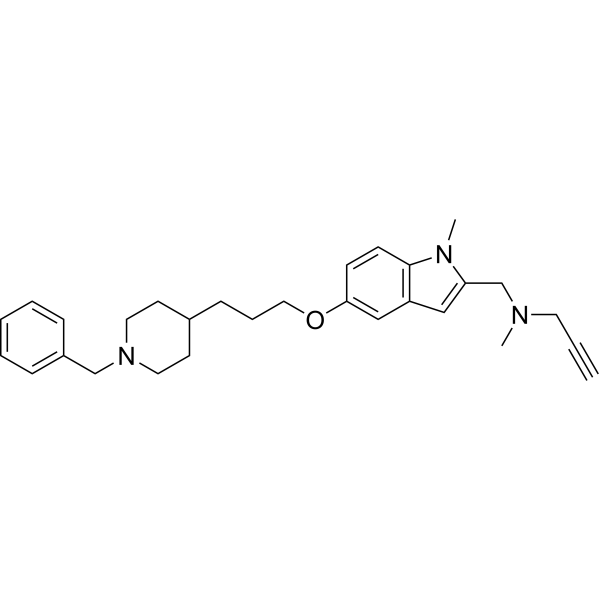
ASS234

Based on 1 Customer Validation
ASS234 is a selective MAO A inhibitor (hMAO A IC50 5.44 nM, hMAO B IC50 177 nM, hAChE IC50 0.81 μM and hBChE IC50 1.82 μM). ASS234 reduces HMT activity and exhibits antioxidant, anti-Apoptotic, anti-inflammatory, and neuroprotective effects, activates Wnt, induces PPARd expression, reduces Amyloid, elevates monoamines, and improves cognition. ASS234 can be used in research on Alzheimer's disease and vascular dementia.
연구목적의 판매만을 진행합니다. 환자를 대상으로 한 판매는 하지 않습니다.
- Purity : 99.6%
- CAS No.: 1334106-34-1
- 화학식: C29H37N3O
- 분자량:443.62
-
보관:Powder -20°C, 3 years , 4°C, 2 years ; In solvent -80°C, 6 months , -20°C, 1 month

To place orders, for customer services and technical support, please contact: MedChemExpress USA
Tel: 609-228-6898 E-mail: [email protected] [email protected]


-
 Biological Activity
-
Chemical Information
- Protocol
- 순도&문서
- References
-
 Help & FAQs




Biological Activity
제품 설명
IC50 & Target
[2]|
hMAO-A 5.44 nM (IC50) |
hMAO-B 177 nM (IC50) |
hAChE 0.81 μM (IC50) |
hBCHE 1.82 μM (IC50) |
Cellular Effect
|
Cell Line

|
Type | Value | Description | References |
|---|---|---|---|---|
| HEK293 | IC50 |
0.38 μM
Compound: 5
|
Inhibition of cerebral human recombinant AchE expressed in HEK293 cells using acetylthiocholine iodide as substrate preincubated for 10 mins measured after 15 mins of substrate addition by Ellman's method
Inhibition of cerebral human recombinant AchE expressed in HEK293 cells using acetylthiocholine iodide as substrate preincubated for 10 mins measured after 15 mins of substrate addition by Ellman's method
|
[PMID: 22023459] |
| HEK293 | IC50 |
3.3 μM
Compound: II, ASS234
|
Inhibition of recombinant human BuChE expressed in HEK293 cells preincubated for 15 mins
Inhibition of recombinant human BuChE expressed in HEK293 cells preincubated for 15 mins
|
[PMID: 25418133] |
| HEK293 | IC50 |
3.4 μM
Compound: II, ASS234
|
Inhibition of recombinant human AChE expressed in HEK293 cells preincubated for 15 mins
Inhibition of recombinant human AChE expressed in HEK293 cells preincubated for 15 mins
|
[PMID: 25418133] |
In Vitro
ASS234 (5-10 µM; 60 min pre-incubation) reduces Aβ1-42-induced nuclear condensation in SH-SY5Y cells to 31.7% (at 10 µM)[3].
ASS234 (5-10 µM; 60 min pre-incubation) attenuates Aβ1-42-induced caspase-3/PARP and caspase-9 activation in SH-SY5Y cells, but does not prevent caspase-8 cleavage[3].
ASS234 (5-10 µM; 60 min preincubation) prevents Aβ1-42-induced depletion of catalase and SOD-1 in SH-SY5Y cells, with the strongest protective effect on SOD-1 at 10 µM[3].
ASS234 (10 µM) prevents Aβ1-42 fibril formation and promotes the formation of 6-8 nm protofibril/annular structures, while reducing Aβ1-40 fibrils and causing them to aggregate into clusters[3].
ASS234 (5-10 µM) reduces Aβ1-42 fibrils and oligomers while increasing monomer-to-trimer forms[3].
ASS234 (100 µM) completely blocks AChE-dependent Aβ1-42 and Aβ1-40 aggregation[3].
ASS234 (100 µM) converts AChE-promoted Aβ1-42 and Aβ1-40 fibrils into shorter fibrils and amorphous aggregates[3].
ASS234 (IC50 = 5.44 nM for hMAO A) inhibits hAChE, hBuChE, hMAO A, and hMAO B in cell-free assays[2].
ASS234 (Ki 0.4 µM) binds to MAO A with a reversible Ki value of 0.4 µM and irreversibly inactivates MAO A/B, forming a covalent flavin N5 adduct in hMAO B[2].
ASS234 (5 µM; 24 h) increases the expression of Wnt2b, Wnt5a, Wnt6, and PPARδ genes in SH-SY5Y cells[2].
ASS234 (100-300 µM) reduces the viability of HepG2 cells in a concentration-dependent manner, with lower toxicity at high concentrations[2].
ASS234 (100 µg/mL; 240 min) shows high predicted BBB permeability in the PAMPA-BBB assay, with a Pe of 10.3 × 10⁻⁶ cm/s[3].
ASS234 (serial dilution; pre-incubation at 37 °C for 30 min; reaction for 30 min) inhibits human recombinant AChE and BuChE with IC50 values of 0.81 μM and 1.82 μM, respectively[4].
ASS234 (1 mM tyramine; 30 min incubation) is a potent MAO A-selective inhibitor, with IC50 values of 5.44 nM and 0.17 nM against purified MAO A and membrane-bound MAO A, respectively[4].
ASS234 (at various concentrations) reversibly inhibits human MAO A with competitive Ki values, with a Ki value of 0.20 μM for the purified enzyme and a Ki value of 0.053 μM for the membrane-bound enzyme[4].
ASS234 (100 nM-1 μM; 0-20 min; 30 °C) irreversibly inactivates human MAO A, with kinact/KI = 61 × 103 min−1 M−1 for the purified enzyme and kinact/KI = 3000 × 103 min−1 M−1 for the membrane-bound enzyme[4].
ASS234 binds completely to MAO A and MAO B, increasing the mass of both enzymes by +446 Da[4].
MedChemExpress (MCE) has not independently confirmed the accuracy of these methods. They are for reference only.
-
Cell Line:SH-SY5Y human neuroblastoma cells
-
Concentration:5 and 10 µM (ASS234); 40 µM (Aβ1-42)
-
Incubation Time:60 min pre-incubation; 24 h
-
Result:Aβ1-42 exposure increased LDH activity to 258%.
Pre-incubation reduced LDH activity dose-dependently to 97.9% at 10 µM.
Phase contrast images showed shrunken cell bodies after Aβ1-42 exposure, visibly reduced under the assayed conditions.
-
Cell Line:SH-SY5Y human neuroblastoma cells
-
Concentration:5 and 10 µM (ASS234); 40 µM (Aβ1-42); 0.5 µg/mL (Hoechst 33258)
-
Incubation Time:60 min pre-incubation; 24 h; 30 min staining
-
Result:Aβ1-42 exposure increased condensed nuclei to 49.7%.
Pre-incubation produced a concentration-dependent decrease in condensed or fragmented nuclei, with the highest reduction at 10 µM (31.7%).
-
Cell Line:SH-SY5Y human neuroblastoma cells
-
Concentration:5 and 10 µM (ASS234); 40 µM (Aβ1-42)
-
Incubation Time:60 min pre-incubation; 24 h; 16 h at 4°C (primary antibodies)
-
Result:Aβ1-42 exposure induced the cleaved caspase-3 p19 fragment and PARP proteolysis (85 kDa).
Pre-incubation (5 and 10 µM) reduced caspase-3 cleavage and attenuated PARP fragmentation.
Aβ1-42 exposure induced active caspase-9 p35, which was reduced at 5 and 10 µM.
The pro-form of caspase-8 decreased after Aβ1-42 exposure, and caspase-8 cleavage was not prevented.
Cleaved caspase-12 was not observed.\nAβ1-42 exposure reduced catalase expression by 19.1% and SOD-1 expression by 84.7%.
Pre-incubation (5 and 10 µM) completely prevented the Aβ1-42-induced reduction of catalase at both concentrations.
For SOD-1, a dose-dependent increase was produced, with the highest protection at 10 µM.
-
Cell Line:SH-SY5Y human neuroblastoma cells
-
Concentration:5 μM
-
Incubation Time:24 h
-
Result:Wnt2b, Wnt5a, and Wnt6 gene expression was significantly increased.
PPARd gene expression was also significantly increased.
In Vivo
ASS234 (5 mg/kg; s.c.; once daily; 5 consecutive days starting 1 day after BCCAO) attenuates BCCAO-induced cognitive impairment, preserving working memory and latency while reference memory recovers by the second retest in male Wistar rats with vascular dementia[1].
ASS234 (5 days) inhibits brain MAO A and raises serotonin and catecholamine levels in a rat vascular dementia model[2].
ASS234 (0.62 mg/kg-0.12 mM/kg) reverses Scopolamine (HY-N0296)-induced cognitive impairment and improves recognition performance[2].
MedChemExpress (MCE) has not independently confirmed the accuracy of these methods. They are for reference only.
-
Animal Model:Wistar (male, 180-250 g)[1]
-
Dosage:5 mg/kg
-
Administration:s.c.; once daily; 5 consecutive days
-
Result:MAO-A activity was 0 pmol/min/mg protein in the rest of brain and 52.86 pmol/min/mg protein in hypothalamus.
MAO-B activity was 408.88 pmol/min/mg protein in the rest of brain and 531.36 pmol/min/mg protein in hypothalamus.
HMT activity was 43.39 pmol/min/mg protein in the rest of brain and 40.07 pmol/min/mg protein in hypothalamus, with a small decrease in hypothalamic HMT.
Serotonin concentration in the rest of brain was 3.20 nmol/g wet wt, with no change in hypothalamic serotonin.
Dopamine concentration was 10.31 nmol/g wet wt, and noradrenaline concentration was 6.77 nmol/g wet wt.
Histamine concentration increased by 30% in hypothalamus and 20% in the rest of brain.
Cerebral AChE activity was not significantly changed; striatal AChE activity was 0.392 µmol/min/mg protein.
Reduced food and water consumption by 30% (to 6.63 g/100 g body weight and 9.82 mL/100 g body weight, respectively) and urine output by 17% (to 8.06 mL/24 hr).
-
Animal Model:Wistar (male, 180-250 g)[1]
-
Dosage:5 mg/kg
-
Administration:s.c.; once daily; 5 consecutive days starting 1 day after BCCAO
-
Result:BCCAO rats maintained latency at a level comparable to the 7th training day.
Run time increased by only 35% during R1-R2.
Working memory ratio was maintained at 56.67 in R1 and 63.69 in R2, compared with 58.95 on training day 7.
Reference memory ratio was 41.39 in R1 versus 54.14 on training day 7, and recovered to approximately 53.81 in R2.
BCCAO rats performed better in holeboard tests than untreated BCCAO rats.
-
Animal Model:APPswe/PS1ΔE9 transgenic[2]
-
Dosage:0.62 mg/kg
-
Administration:daily; 16 weeks
-
Result:Produced an apparent reduction in neuritic plaque number in the cerebral cortex and hippocampus compared with vehicle-treated mice.
Cortical plaque deposition significantly decreased in tg mice compared with tg controls.
Hippocampal Aβ plaque load also decreased, although statistical significance was not reached.
GFAP and iba-1 immunostaining significantly decreased in the cortex compared with controls.


Chemical Information
-
CAS No. 1334106-34-1
-
Appearance Solid
-
분자량 443.62
-
화학식 C29H37N3O
-
Color White to off-white
-
SMILES
C#CCN(C)CC1=CC2=C(C=CC(OCCCC3CCN(CC3)CC4=CC=CC=C4)=C2)N1C
-
선적
Room temperature in continental US; may vary elsewhere.
-
보관
Powder -20°C 3 years 4°C 2 years In solvent -80°C 6 months -20°C 1 month


순도&문서


References

Calculators
Concentration (start) × Volume (start) = Concentration (final) × Volume (final)


ASS234 Related Classifications
HY-121072 Related Classifications
 Powered by Bioz
Keywords
- ASS234
- 1334106-34-1
- ASS 234
- ASS-234
- Monoamine Oxidase
- Cholinesterase (ChE)
- Histone Methyltransferase
- Apoptosis
- Wnt
- PPAR
- Amyloid-β
- MAO
- Peroxisome proliferator-activated receptors
- β-amyloid peptide
- Aβ
- Abeta
- AChE
- Alzheimer's disease
- BChE
- MAO A
- MAO B
- PPARδ
- Wnt signaling
- amyloid aggregation
- cholinesterase
- vascular dementia
- Inhibitor
- inhibitor
- inhibit