12 Results for "

murine bacterial infection model

" in MedChemExpress (MCE) Product Catalog:
Products (12)

12 Results for "murine bacterial infection model" in MCE Product Catalog:

Cat. No.: HY-P11430
CAS No.: 290360-66-6
Research Areas:  

Infection

UBI (31-38) is a Ubiquicidin-derived octapeptide and anti-bacterial agent. UBI (31-38) selectively interacts with anionic phospholipid membranes and restricts lipid lateral motion. UBI (31-38) induces anionic vesicle aggregation via electrostatic repulsion screening, and undergoes conformational changes in membrane-mimicking environments. UBI (31-38) can be used for the research of infection imaging probes .
loading...
    loading...
Cat. No.: HY-P5545
Target:  

Bacterial

Research Areas:  

Infection

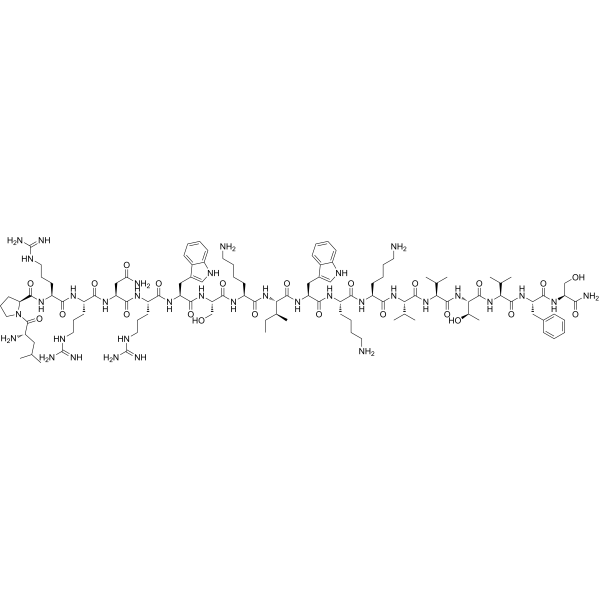
Lynronne-1 is an antimicrobial peptide. Lynronne-1 is active against Gram-positive bacterials, including MDR strains (MIC: 8-32 μg/mL for methicillin-resistant MRSA strains). Lynronne-1 reduces the bacterial load in MRSA infected wound murine model. Lynronne-1 is also effective against P. aeruginosa infection .
loading...
    loading...
Cat. No.: HY-174985
Target:  

Bacterial

Research Areas:  

Infection

Anti-MRSA agent 32 (Compound 26) is an orally active and selective SaClpP (Staphylococcus aureus ClpP protease) activator with an EC50 value of 0.98 μM. Anti-MRSA agent 32 activates SaClpP to abnormally degrade bacterial proteins, inhibiting the proliferation of Staphylococcus aureus. Anti-MRSA agent 32 promotes wound healing in a murine skin infection model. Anti-MRSA agent 32 is promising for research of infectious diseases such as methicillin-resistant Staphylococcus aureus (MRSA) infections .
loading...
    loading...
Cat. No.: HY-175295A
Research Areas:  

Infection

Anti-MRSA agent 33 iodide is an anti-Methicillin (HY-121544)-resistant Staphylococcus aureus (MRSA) agent, with MIC values of 2-4 μg/mL. Anti-MRSA agent 33 iodide demonstrates effective biofilm eradication and minimal cytotoxicity toward mammalian cells. Anti-MRSA agent 33 iodide specifically binds to phosphatidylglycerol (PG) on bacterial membranes, leading to membrane disruption, excessive production of ROS, and metabolic collapse, ultimately resulting in bacterial cell death. Anti-MRSA agent 33 iodide reduces bacterial load in a murine skin infection model .
loading...
    loading...
Cat. No.: HY-173472
CAS No.: 2876921-34-3
Research Areas:  

Infection

MBL-IN-5 is a metallo-β-lactamase (MBL) inhibitor. MBL-IN-5 inhibits three clinically relevant B1 subfamily MBLs (NDM-1, VIM-1, and IMP-1) with IC50s of 0.05  nM, 14  nM and 21 nM respectively. MBL-IN-5 remarkably enhances carbapenems’ effectiveness against MBL-producing clinical strains and significantly reduces the bacterial load in a neutropenic murine thigh infection model combined with the IPM antibiotic .
loading...
    loading...
Cat. No.: HY-186103
CAS No.: 1204401-08-0
Glycolipid C34, α-GalCer (HY-102022) analog, is a CD1d-binding glycolipid antinfection agent. Glycolipid C34 mediates invariant natural killer T cell activation and increases the secretion of IFN-γ and IL-4. Glycolipid C34 promotes clearance of bacterial infections in murine models and enhances protective immunity against viral infections. Glycolipid C34 can be used for the research of bacterial infection, viral infection .
loading...
    loading...
Cat. No.: HY-182027
CAS No.: 3031427-16-1
Antibacterial agent 330 is an antibacterial agent. Antibacterial agent 330 triggers ROS accumulation, forms DNA supramolecular complex by intercalation to block DNA replication and inhibits LDH to
disturb metabolism, and further prompts bacterial cell rupture to induce the leakage of intracellular content, ultimately causing bacterial death. Antibacterial agent 330 displays antibacterial activity and promotes wound healing in both G. Mellonella larval and murine wound infection models. Antibacterial agent 330 can be used for the research of bacterial infections .
loading...
    loading...
Cat. No.: HY-182417
CAS No.: 351372-19-5
Target:  

Bacterial Topoisomerase

Research Areas:  

Infection

PD 0305970 is an orally active bacterial gyrase and topoisomerase inhibitor. PD 0305970 shows exceptional activity against gram-positive and fastidious organisms and more modest activity against gram-negative species. PD 0305970 shows low spontaneous resistance frequencies. PD 0305970 shows antibacterial efficacy in murine streptococcal sepsis and pneumococcal pneumonia models. PD 0305970 can be used for the research of bacterial infection .
loading...
    loading...
Cat. No.: HY-181671
Target:  

Bacterial

Research Areas:  

Infection

Antibacterial agent 324 is an amphipathic antibacterial agent. Antibacterial agent 324 exhibits selective activity against Gram-positive bacteria, with limited activity against enterococci and weak activity against Gram-negative bacteria .
loading...
    loading...
Cat. No.: HY-182798
Research Areas:  

Infection

Antibacterial agent 337 is an antibacterial agent. Antibacterial agent 337 specifically interacts with PG in bacterial cell membranes, triggering membrane disruption, membrane depolarization, increased permeability, cytoplasmic leakage, ROS accumulation and rapid bacterial death. Antibacterial agent 337 inhibits biofilm formation and disrupts mature biofilms. Antibacterial agent 337 exhibits potent in vivo antibacterial efficacy in a mouse model of Staphylococcus aureus skin abscess. Antibacterial agent 337 can be used in studies of Gram-positive bacterial infections, including methicillin-resistant Staphylococcus aureus infections, vancomycin-resistant Enterococcus faecalis infections and bacterial biofilm infections .
loading...
    loading...
Cat. No.: HY-184584
Research Areas:  

Infection

Antibacterial agent 358 is an antibacterial agent. Antibacterial agent 358 selectively interacts with PG on bacterial cell membranes, causing membrane damage. Antibacterial agent 358 induces bacterial cell membrane depolarization, increased membrane permeability and leakage of intracellular components. Antibacterial agent 358 inhibits biofilm formation and disrupts established biofilms. Antibacterial agent 358 reduces bacterial load and alleviates tissue inflammation in a mouse skin abscess model. Antibacterial agent 358 can be used in research related to Gram-positive bacterial infections and skin abscesses .
loading...
    loading...
Cat. No.: HY-184325
Target:  

Bacterial IKK

Research Areas:  

Infection

NDM-622 is a Colistin (HY-113678) adjuvant. NDM-622 weakly inhibits IKKβ with an IC50 of 20.40 μM. NDM-622 reduces the minimum inhibitory concentration of colistin against colistin-highly-resistant Acinetobacter baumannii and Klebsiella pneumoniae. NDM-622 decreases bacterial colony-forming units in a mouse peritonitis model infected with colistin-highly-resistant Klebsiella pneumoniae. NDM-622 does not modify bacterial lipid A, induce reactive oxygen species production, or increase bacterial membrane permeability. NDM-622 can be used in the research of extensively drug-resistant Gram-negative bacterial infections, colistin-resistant Acinetobacter baumannii infections, and Klebsiella pneumoniae infections .
loading...
    loading...
  • 1

