



Caspase
Caspase is a family of cysteine proteases that play essential roles in apoptosis (programmed cell death), necrosis, and inflammation. There are two types of apoptotic caspases: initiator (apical) caspases and effector (executioner) caspases. Initiator caspases (e.g., CASP2, CASP8, CASP9, and CASP10) cleave inactive pro-forms of effector caspases, thereby activating them. Effector caspases (e.g., CASP3, CASP6, CASP7) in turn cleave other protein substrates within the cell, to trigger the apoptotic process. The initiation of this cascade reaction is regulated by caspase inhibitors. CASP4 and CASP5, which are overexpressed in some cases of vitiligo and associated autoimmune diseases caused by NALP1 variants, are not currently classified as initiator or effector in MeSH, because they are inflammatory enzymes that, in concert with CASP1, are involved in T-cell maturation.
Caspase Isoform Specific Products
-
Caspase 1
(81)
View all products
-
Caspase 2
(11)
View all products
-
Caspase 3
(563)
View all products
-
Caspase 4
(11)
View all products
-
Caspase 5
(5)
View all products
-
Caspase 6
(12)
View all products
-
Caspase 7
(110)
View all products
-
Caspase 8
(113)
View all products
-
Caspase 9
(197)
View all products
-
Caspase 10
(6)
View all products
-
Caspase 12
(3)
View all products
-
Caspase
(600)
View all products
-
Caspase 11
(2)
View all products
-
Caspase-13
(1)
View all products
All Product Categories
-
Caspase Inhibitors
(448)
View all products
-
Caspase Agonists
(41)
View all products
-
Caspase Activators
(646)
View all products
-
Caspase Modulators
(48)
View all products
-
Caspase Chemicals
(4)
View all products
-
Caspase MDM2 Inhibitor
(1)
View all products
-
Caspase Inducers
(49)
View all products
-
Caspase Degrader
(1)
View all products
-
Caspase Control
(1)
View all products
-
Caspase Substrates
(4)
View all products
-
Caspase Proteins
(10)
View all products
-
Caspase-1 Proteins
(3)
View all products
-
Caspase-3 Proteins
(3)
View all products
-
Caspase 7 Proteins
(1)
View all products
-
Caspase-8 Proteins
(1)
View all products
-
Caspase-10 Proteins
(1)
View all products
-
Caspase Related Products (1424)
Related Products (1424)

-
Recombinant Proteins (10)
-
Antibodies (35)
-
Caspase Signaling Pathway
-
Caspase Isoform Comparison
-
NEURL1B-IN-1
 0 ImagesCat. No.: HY-182008CAS No.: 3068938-30-4NEURL1B-IN-1 is a molecular glue-like NEURL1B degrader with a Kd value of 46.2 nM. NEURL1B-IN-1 binds to Arg422 within the NHR2 domain of NEURL1B, triggers its autoubiquitination and proteasomal degradation, disrupts its interaction with DLL1, and attenuates the Notch signaling pathway. NEURL1B-IN-1 induces cell cycle arrest and apoptosis, and inhibits migration of hepatocellular carcinoma cells. NEURL1B-IN-1 is applicable to research related to hepatocellular carcinoma.

-
Clausenidin
 0 ImagesCat. No.: HY-N16771CAS No.: 28384-44-3Clausenidin is a selective inhibitor targeting apoptosis-related pathways, including the mitochondrial pathway and death receptor pathway, and vascular endothelial growth factor (VEGF). Clausenidin induces mitochondrial membrane depolarization by activating caspase-3, caspase-8 and caspase-9, upregulating the pro-apoptotic protein Bax and downregulating the anti-apoptotic protein Bcl-2. Clausenidin also inhibits VEGF expression and blocks angiogenesis, exerting anti-tumor activity. Clausenidin has inhibitory effects against Mycobacterium tuberculosis (MIC=200 μg/mL). Clausenidin can induce apoptosis in liver cancer cells, arrest the cell cycle in the G2/M phase, and inhibit tumor angiogenesis. Clausenidin can be used in the research of malignant tumors such as liver cancer.
-
Pim-1 kinase-IN-14
 0 ImagesCat. No.: HY-178133Pim-1 kinase-IN-14 is a PIM-1 kinase inhibitor with an IC50 value of 94 nM. Pim-1 kinase-IN-14 shows broad-spectrum and high-efficiency anticancer activity against multiple human cancer cell lines, including liver cancer (HepG-2), colon cancer (Caco-2), myeloid leukemia (NFS-60), and prostate cancer (PC-3) cells. Pim-1 kinase-IN-14exerts its anticancer effects by inducing apoptosis and activating caspase 3/7. Pim-1 kinase-IN-14 can be used for the study of cancers associated with PIM-1 kinase overexpression.
-
2-Hexadecanol
 0 Images2-Hexadecanol is a fatty acid based compound. 2-Hexadecanol can be isolated from marine organism Sea pen. 2-Hexadecanol induces Apoptosis, elevates the expression of caspase-3 and caspase-8. 2-Hexadecanol exhibits anticancer activity against breast cancer and cervical cancer.
-
Porphyra 334
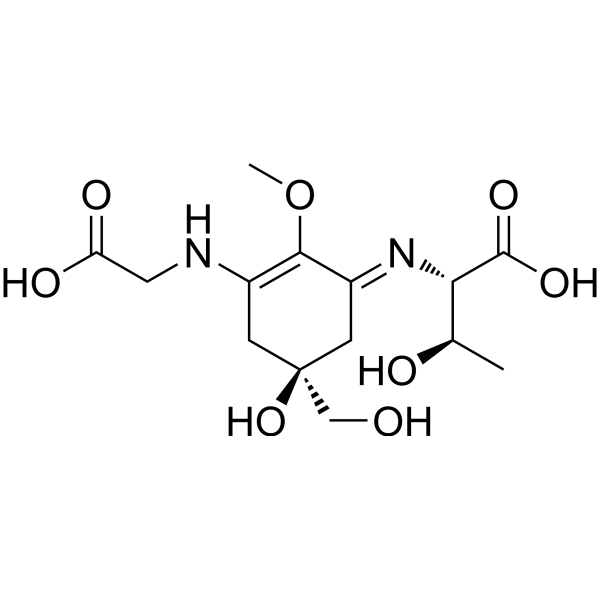 0 ImagesPorphyra 334 is a carnosine-like amino acid and a natural photoprotective agent and antioxidant. Porphyra-334 exerts its photoprotective effects by scavenging ROS, inhibiting the expression and activity of MMP-1/8, and promoting the synthesis of collagen and elastin. Porphyra 334 effectively inhibits linoleic acid oxidation induced by alkyl radicals (AAPH) and singlet oxygen. Porphyra 334 has anti-obesity potential by inhibiting the expression of PPARγ2 and C/EBPα. Porphyra 334 protects cells against UV-induced DNA damage and apoptosis by inhibiting the activation of caspase-3.
-
Bfl-1-IN-7
 0 ImagesCat. No.: HY-180941Bfl-1-IN-7 is an orally active and selective Bfl-1 inhibitor with an IC50 value of 0.015 μM. Bfl-1-IN-7 activates caspase 3/7, and when combined with the Mcl-1 inhibitor AZD5991 (HY-101533), it reduces the viability of lymphoma cells. Bfl-1-IN-7 can be used in lymphoma-related studies.
-
HDAC8-IN-14
 0 ImagesCat. No.: HY-178380HDAC8-IN-14, a curcuminoid derivative, is a selective HDAC8 inhibitor with a Ki of 9 nM. HDAC8-IN-14 induces the production of reactive oxygen species (ROS), disrupts mitochondrial membrane potential, and promotes apoptosis. HDAC8-IN-14 can significantly promote the accumulation of cells in the sub-G0/G1 phase, consistent with apoptotic or necrotic cell death. HDAC8-IN-14 induces upregulation of cytochrome c, cleaved caspase-3, and the pro-apoptotic protein Bak while leaving the anti-apoptotic Bcl-2 levels unaltered. HDAC8-IN-14 can be used for the study of leukemia.
-
Dicatenarin
 0 ImagesDicatenarin is a caspase‑3 activator with growth‑inhibitory activity against human cancer cells. Dicatenarin increases caspase‑3 activity, induces intracellular ROS generation, and activates the mitochondrial‑mediated apoptotic pathway. Dicatenarin exerts growth‑inhibitory effects against a panel of human cancer cell lines. Dicatenarin can be used in research on pancreatic cancer, lung cancer, colon cancer, breast cancer, prostate cancer, and ovarian cancer.
-
YN14 (mixture of diastereomers)
 0 ImagesCat. No.: HY-155356ACAS No.: 3053689-54-3YN14 mixture of diastereomers is a diastereomer mixture of YN14 (HY-155356). YN14 is a KRASG12C PROTAC degrader that recruits E3 ubiquitin ligase to induce the polyubiquitination and proteasomal degradation of KRASG12C. YN14 induces tumor cell apoptosis, cell cycle arrest, and cell migration inhibition. YN14 exhibits in vivo antitumor proliferative activity in tumor cell xenograft nude mice. YN14 can be used in cancer-related research.
-
VEGFR-2-IN-93
 0 ImagesCat. No.: HY-189396VEGFR-2-IN-93 is a VEGFR-2 inhibitor with an IC50 of 1.79 μM. VEGFR-2-IN-93 exhibits cytotoxicity against multiple cancer cell lines and inhibits cancer cell migration. VEGFR-2-IN-93 induces G0/G1 phase arrest and apoptosis through upregulation of Bax, downregulation of Bcl-2, and activation of Caspase-3/Caspase-8. VEGFR-2-IN-93 demonstrates favorable biosafety. VEGFR-2-IN-93 can be used for research related to breast cancer, hepatocellular carcinoma, and colorectal cancer.
-
Ac-AAVALLPAVLLALLAP-YVAD-CHO
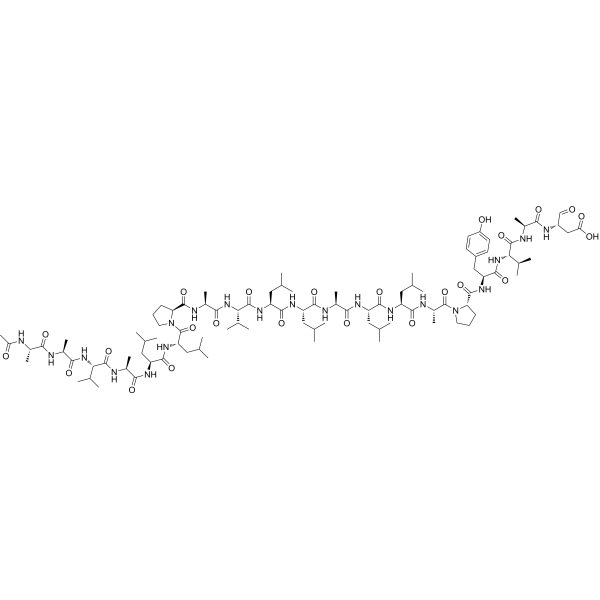 0 ImagesCat. No.: HY-P5938CAS No.: 201608-12-0Ac-AAVALLPAVLLALLAP-YVAD-CHO is a cell-permeable caspase-1 inhibitor that has antitumor activity.
-
Microtubule destabilizing agent-3
 0 ImagesCat. No.: HY-179695Microtubule destabilizing agent-3, a B32B3 (HY-12240) analog, is a microtubule destabilizing agent. Microtubule destabilizing agent-3 exerts its antimyeloma phenotypes by destabilizing microtubules and promoting mitotic arrest, leading to cell death. Microtubule destabilizing agent-3 induces G2/M phase arrest and caspase-dependent apoptosis. Microtubule destabilizing agent-3 can be used for the research of multiple myeloma.
-
CASP7 Human Pre-designed siRNA Set A
 0 ImagesCat. No.: HY-RS01962
CASP7 Human Pre-designed siRNA Set A contains three designed siRNAs for CASP7 gene (Human), as well as a negative control, a positive control, and a FAM-labeled negative control.
-
Cystamine-d8 dihydrochloride
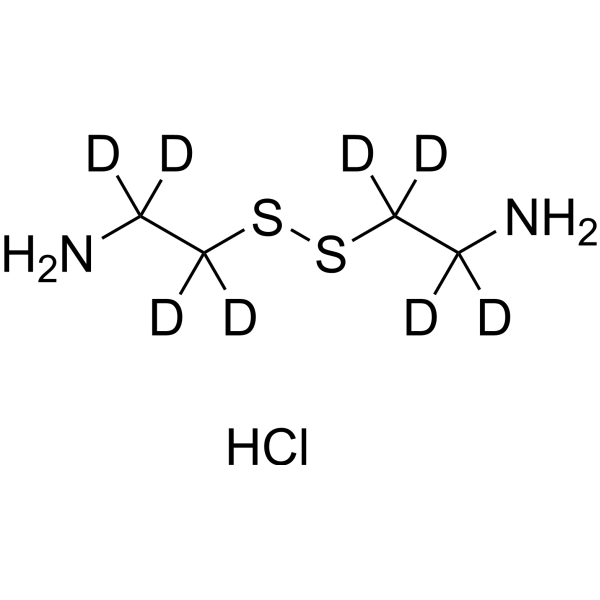 0 ImagesCat. No.: HY-W020050SCAS No.: 2712126-51-5Cystamine-d8 (dihydrochloride) is the deuterium labeled Cystamine (dihydrochloride). Cystamine (dihydrochloride) is the disulfide form of the free thiol, cysteamine. Cystamine is an orally active transglutaminase (Tgase) inhibitor. Cystamine also has inhibition activity for caspase-3 with an IC50 value of 23.6 μM. Cystamine can be used for the research of severals diseases including Huntington's disease (HD).
-
HDAC3 degrader-2
 0 ImagesCat. No.: HY-182051CAS No.: 3110847-73-6HDAC3 degrader-2 is a selective HDAC3 degrader. HDAC3 degrader-2 inhibits the activation of the NLRP3 inflammasome by degrading HDAC3, thereby reducing the maturation of IL-1β and caspase-1. HDAC3 degrader-2 exhibits anti-inflammatory activity. HDAC3 degrader-2 can be used in research related to endotoxin shock, colitis and gouty arthritis.
-
Apoptosis inducer 30
 0 ImagesCat. No.: HY-168589Apoptosis inducer 30 (Compound 15a) is an anticancer agent. Apoptosis inducer 30 induces MCF-7 cells apoptosis through mitochondrial pathway. Apoptosis inducer 30 induces intracellular reactive oxygen species levels and decreases mitochondrial membrane potential, and blocks the cell cycle in the G0/G1 phase. Apoptosis inducer 30 inhibits cell growth, with an IC50 value of 0.32 μM against MCF-7 cells, and inhibits tumor growth in a mouse model of breast cancer.
-
Isosilybin B (Standard)
 0 ImagesCat. No.: HY-N7045RCAS No.: 142796-22-3Isosilybin B (Standard) is the analytical standard of Isosilybin B (HY-N7045). This product is intended for research and analytical applications. Isosilybin B is a flavonolignan. Isosilybin B can be isolated from Silybum marianum. Isosilybin B can regulate cell cycle-related proteins (e.g., reduce cyclins (D3, D1, A, E), Cdk4, Cdk2, Cdc25A), and activate Caspases (Caspase-9 and Caspase-3). Isosilybin B can promote Apoptosis, reduce androgen receptor (AR) and PSA. Isosilybin B has anticancer activity against prostate cancer.
-
MAHS-4
 0 ImagesCat. No.: HY-187514MAHS-4 is an inhibitor of thymidylate synthase (TS) and dihydrofolate reductase (DHFR), with IC50 values of 1.918 μM and 83.53 μM, respectively. MAHS-4 inhibits thymidylate biosynthesis, reduces tetrahydrofolate pool maintenance, and interferes with extracellular matrix remodeling. MAHS-4 induces G2/M phase cell cycle arrest, activates endogenous caspase-dependent apoptosis, decreases MMP protein levels, inhibits cell migration, increases intracellular NO levels, and promotes autophagy activity. MAHS-4 is applicable for cancer-related research.
-
MMP-9-IN-14
 0 ImagesCat. No.: HY-181272MMP-9-IN-14 is a MMP-9 inhibitor (IC50 = 34.46 μM). MMP-9-IN-14 induces G1-phase cell cycle arrest and caspase-dependent apoptosis in cancer cells. MMP-9-IN-14 promotes the accumulation of phosphorylated γH2AX. MMP-9-IN-14 inhibits the migration and invasion of cancer cells, and downregulates the expressions of MMP-2, MMP-9 and hTERT in cancer cells. MMP-9-IN-14 inhibits tumor growth and angiogenic spread in animal models. MMP-9-IN-14 can be used for the research of cancers such as lung adenocarcinoma, cervical cancer and colorectal cancer.




