



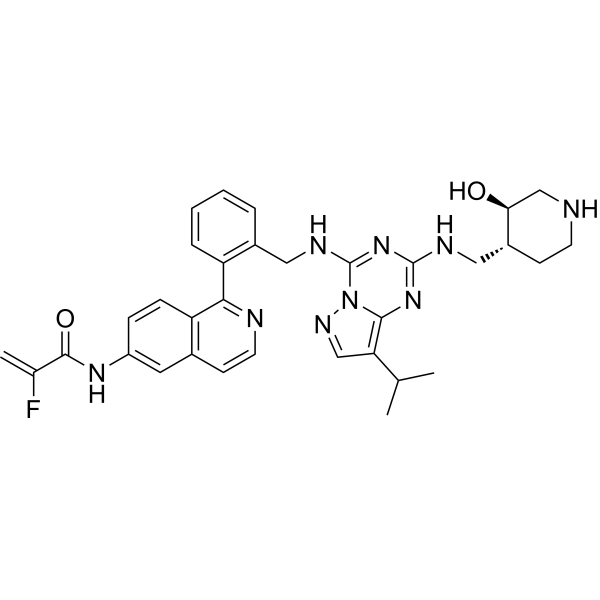
Q901
Q901 (CDK7-IN-21) is a selective covalent ATP-competitive CDK7 inhibitor with an IC50 value of 10 nM against human CDK7. Q901 inhibits MYC/E2F-dependent oncogenic transcription, the RNAPII transition from initiation to elongation, and DNA damage repair, stabilizes TOP1-DNA protein crosslinks, and induces DNA damage. Q901 sensitizes tumors to topoisomerase I inhibitors and TOP1 inhibitor-based antibody-drug conjugates. Q901 shows additive or synergistic tumor growth inhibition in solid tumor models in combination with PARP inhibitors, SERDs, ER PROTAC degraders, or anti-PD-1 antibodies. Q901 can be used for research on cancers such as ovarian cancer and lung cancer.
Para uso exclusivo en investigación. No vendemos a pacientes.
- No. CAS: 2766124-39-2
- Fòrmula: C33H36FN9O2
- Peso molecular:609.70
-
Almacenamiento:Powder -20°C, 3 years , 4°C, 2 years ; In solvent -80°C, 6 months , -20°C, 1 month

To place orders, for customer services and technical support, please contact: MedChemExpress USA
Tel: 609-228-6898 E-mail: [email protected] [email protected]
Other In-stock Forms of Q901


-
 Actividad biológica
-
Chemical Information
-
Solvente y solubilidad
- Protocolo
- Pureza y Documentación
- Referencias
-
 Help & FAQs


Ver todos los productos específicos de isoformas DNA/RNA Synthesis
MoreVer todos los productos específicos de isoformas Topoisomerase
More

Actividad biológica
Descripciòn
|
CDK7 10 nM (IC50) |
Top1 |
In Vitro
Q901 (72-120 h) potently inhibits MCF-7 proliferation, with IC50 values of 95, 16, and 5 nM at 72, 96, and 120 h, respectively[3].
Q901 (100 nM; 1-24 h) reduces promoter-proximal RNAPII and traps CDK7 at promoters in MCF-7 cells[3].
Q901 (100 nM; 1-24 h) decreases promoter occupancy of MYC and E2F1 and reduces E2F1 expression in MCF-7 cells[3].
Q901 (100 nM; 4-24 h) impairs enhancer activity in MCF-7 cells but has no strong preferential effect on super-enhancer targets[3].
Q901 (10-1000 nM; 24-72 h) induces DNA damage and increases γH2AX expression in MCF-7 cells[3].
Q901 (100 nM; 30 min-24 h) stabilizes TOP1-DPC and inhibits DDR gene expression in MCF-7 cells[3].
Q901 (72 h) enhances the antiproliferative activity of Topotecan (TPT) (HY-13768) in H82, DMS53, and H446 SCLC cells[3].
Q901 (72 h) sensitizes HCT116 cells to T-DXd (HY-138298A) in vitro, with an IC50 of 8.4 nM for Q901[3].
Q901 (72 h) enhances the antiproliferative activity of Sacituzumab govitecan (SG) (HY-132254) in H292 cells, with an IC50 of 12 nM for Q901[3].
Q901 (100 μM; 72 h) inhibits the viability of H82, A2780, and MCF7 cells within 72 h in a dilution series starting at 100 μM[4].
MedChemExpress (MCE) has not independently confirmed the accuracy of these methods. They are for reference only.
-
Cell Line:MCF-7 cells
-
Concentration:10, 100, 1000 nM
-
Incubation Time:24, 48, 72 h
-
Result:Increased γH2AX levels over time in a dose-dependent manner.
Pronounced P-H2AX induction was observed at 48 h with 1000 nM and at 72 h with 1000 nM.
-
Cell Line:A2780 cells
-
Concentration:6 nM
-
Incubation Time:4 h (exposure); washout at 0, 4, 24, and 48 h
-
Result:Free CDK7 levels were analyzed by immunoblotting at 0, 4, 24, and 48 h after washout.
CDK7 engagement was observed.
In Vivo
MedChemExpress (MCE) has not independently confirmed the accuracy of these methods. They are for reference only.
-
Animal Model:BALB/c nude[3]
-
Dosage:10 mg/kg
-
Administration:i.p.; once daily
-
Result:On day 28, 81% tumor growth inhibition was achieved; 102% tumor growth inhibition was achieved in the T-DXd-containing arm.
Tumors resumed growth by ∼11 days after dosing ended, whereas the T-DXd-containing arm maintained tumor suppression throughout the study.
-
Animal Model:BALB/c nude[3]
-
Dosage:10 mg/kg
-
Administration:i.p.; once daily
-
Result:By day 28, 80% tumor growth inhibition was achieved; 90% tumor growth inhibition was achieved in the SG-containing arm.
Sustained tumor growth inhibition was maintained throughout the study period, with slightly higher efficacy in the SG-containing arm.
-
Animal Model:BALB/c nude[3]
-
Dosage:3 mg/kg
-
Administration:i.p.; once daily
-
Result:By day 28, 61% tumor growth inhibition was achieved; 92% tumor growth inhibition was achieved in the SG-containing arm.
Sustained tumor growth inhibition was maintained throughout the study period.


Chemical Information
-
No. CAS 2766124-39-2
-
Appearance Solid
-
Peso molecular 609.70
-
Fòrmula C33H36FN9O2
-
Color White to off-white
-
SMILES
C=C(F)C(NC(C=C1)=CC2=C1C(C(C=CC=C3)=C3CNC(N4N=C5)=NC(NC[C@@H]6[C@H](CNCC6)O)=NC4=C5C(C)C)=NC=C2)=O
-
Synonyms
CDK7-IN-21
-
Envío
Room temperature in continental US; may vary elsewhere.
-
Almacenamiento
Powder -20°C 3 years 4°C 2 years In solvent -80°C 6 months -20°C 1 month


Solvente y solubilidad
In Vitro:
DMSO : 100 mg/mL (164.02 mM; Need ultrasonic; Hygroscopic DMSO has a significant impact on the solubility of product, please use newly opened DMSO)
Please refer to the solubility information to select the appropriate solvent. Once prepared, please aliquot and store the solution to prevent product inactivation from repeated freeze-thaw cycles.
Storage method and period of stock solution: -80°C, 6 months; -20°C, 1 month. When stored at -80°C, please use it within 6 months. When stored at -20°C, please use it within 1 month.
Concentration (start) × Volume (start) = Concentration (final) × Volume (final)
In Vivo:
Select the appropriate dissolution method based on your experimental animal and administration route.
- For the following dissolution methods, please ensure to first prepare a clear stock solution using an In Vitro approach and then sequentially add co-solvents:
- To ensure reliable experimental results, the clarified stock solution can be appropriately stored based on storage conditions. As for the working solution for In Vivo experiments, it is recommended to prepare freshly and use it on the same day.
- The percentages shown for the solvents indicate their volumetric ratio in the final prepared solution. If precipitation or phase separation occurs during preparation, heat and/or sonication can be used to aid dissolution.
Add each solvent one by one: 10% DMSO 40% PEG300 5% Tween-80 45% Saline
Solubility: 2.5 mg/mL (4.10 mM); Clear solution; Need ultrasonic
This protocol yields a clear solution of 2.5 mg/mL.
Taking 1 mL working solution as an example, add 100 μL DMSO stock solution (25.0 mg/mL) to 400 μL PEG300, and mix evenly; then add 50 μL Tween-80 and mix evenly; then add 450 μL Saline to adjust the volume to 1 mL.
Preparation of Saline: Dissolve 0.9 g sodium chloride in ddH₂O and dilute to 100 mL to obtain a clear Saline solution.
Add each solvent one by one: 10% DMSO 90% (20% SBE-β-CD in Saline)
Solubility: 2.5 mg/mL (4.10 mM); Clear solution; Need ultrasonic
This protocol yields a clear solution of 2.5 mg/mL.
Taking 1 mL working solution as an example, add 100 μL DMSO stock solution (25.0 mg/mL) to 900 μL 20% SBE-β-CD in Saline, and mix evenly.
Preparation of 20% SBE-β-CD in Saline (4°C, storage for one week): 2 g SBE-β-CD powder is dissolved in 10 mL Saline, completely dissolve until clear.
In Vivo Dissolution Calculator
Please enter the basic information of animal experiments:
-
-
-
-
Recommended: Prepare an additional quantity of animals to account for potential losses during experiments.
Please enter your animal formula composition:
-
%DMSO +
Recommended: Keep the proportion of DMSO in working solution below 2% if your animal is weak.
-
%+
-
+%Tween-80 + +
-
%Saline +
The co-solvents required include: DMSO, . All of co-solvents are available by MedChemExpress (MCE). , Tween 80. All of co-solvents are available by MedChemExpress (MCE).
Working solution concentration: 0.22 mg/mL
Method for preparing stock solution: mg drug dissolved in μL DMSO. Stock solution concentration: mg/mL.
1. Take μL DMSO stock solution;
2. Add μL .
μL , mix evenly;
3. Then add μL Tween 80, mix evenly;
4. Then add μL
Please ensure that the stock solution in the first step is dissolved to a clear state, and add co-solvents in sequence. You can use ultrasonic heating (ultrasonic cleaner, recommended frequency 20-40 kHz), vortexing, etc. to assist dissolution.


Pureza y Documentación
-
Ficha de datos (290 KB)
-
SDS (254 KB)
- English - EN (254 KB)
- Français - FR (254 KB)
- Deutsch - DE (254 KB)
- Norwegian - NO (254 KB)
- Español - ES (254 KB)
- Swedish - SV (254 KB)
- Italian - IT (254 KB)
- Korean - KR (254 KB)
- Portuguese - PT (254 KB)
-
Instrucciones de manejo (2659 KB)
Referencias


Complete Stock Solution Preparation Table
Please refer to the solubility information to select the appropriate solvent. Once prepared, please aliquot and store the solution to prevent product inactivation from repeated freeze-thaw cycles.
Storage method and period of stock solution: -80°C, 6 months; -20°C, 1 month. When stored at -80°C, please use it within 6 months. When stored at -20°C, please use it within 1 month.
| Optional Solvent | Concentration Solvent Mass | 1 mg | 5 mg | 10 mg | 25 mg |
|---|---|---|---|---|---|
| DMSO | 1 mM | 1.6402 mL | 8.2008 mL | 16.4015 mL | 41.0038 mL |
| 5 mM | 0.3280 mL | 1.6402 mL | 3.2803 mL | 8.2008 mL | |
| 10 mM | 0.1640 mL | 0.8201 mL | 1.6402 mL | 4.1004 mL | |
| 15 mM | 0.1093 mL | 0.5467 mL | 1.0934 mL | 2.7336 mL | |
| 20 mM | 0.0820 mL | 0.4100 mL | 0.8201 mL | 2.0502 mL | |
| 25 mM | 0.0656 mL | 0.3280 mL | 0.6561 mL | 1.6402 mL | |
| 30 mM | 0.0547 mL | 0.2734 mL | 0.5467 mL | 1.3668 mL | |
| 40 mM | 0.0410 mL | 0.2050 mL | 0.4100 mL | 1.0251 mL | |
| 50 mM | 0.0328 mL | 0.1640 mL | 0.3280 mL | 0.8201 mL | |
| 60 mM | 0.0273 mL | 0.1367 mL | 0.2734 mL | 0.6834 mL | |
| 80 mM | 0.0205 mL | 0.1025 mL | 0.2050 mL | 0.5125 mL | |
| 100 mM | 0.0164 mL | 0.0820 mL | 0.1640 mL | 0.4100 mL |


Q901 Related Classifications
HY-153278 Related Classifications
 Powered by Bioz