



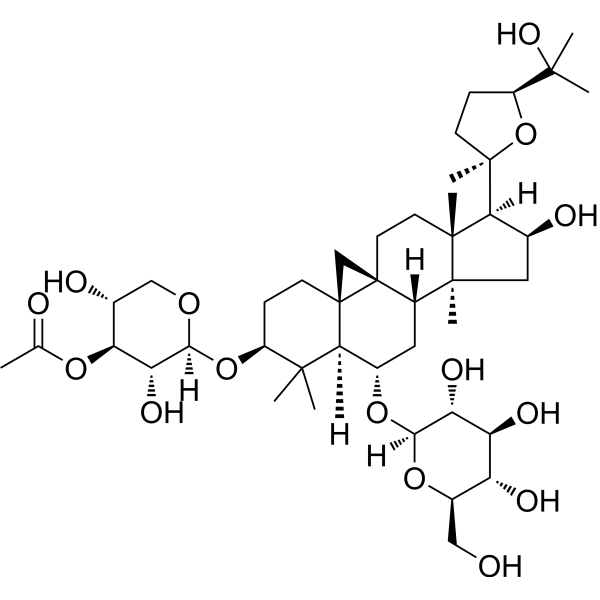
Isoastragaloside II

Based on 1 Customer Validation
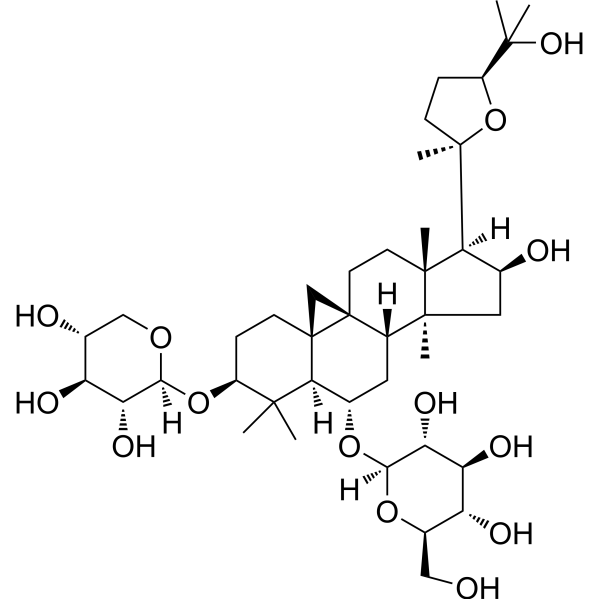
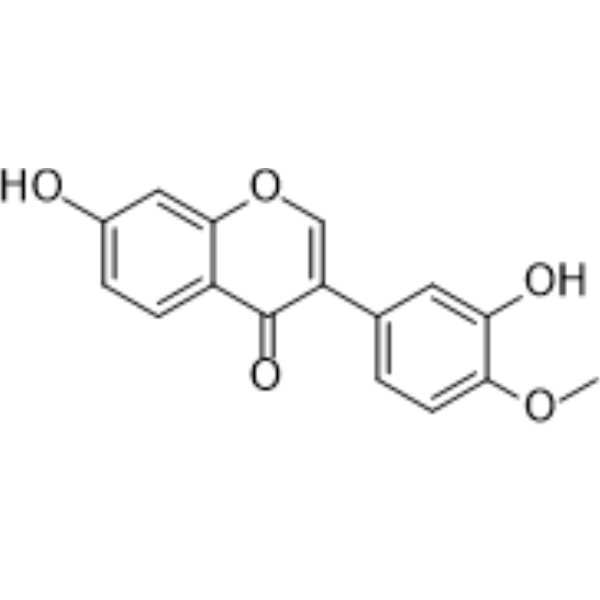
Isoastragaloside II (Astrasieversianin VII) is an orally active astragaloside that can be isolated and extracted from the roots of Astragalus membranaceus. Isoastragaloside II possesses anti-inflammatory, anti-atherosclerotic, lipid-lowering, and liver fibrosis-improving activities. Isoastragaloside II inhibits foam cell formation and inflammation in atherosclerosis by downregulating macrophage cholesterol uptake and esterification genes and upregulating hydrolysis and efflux genes (reducing IL-1β, IL-6, and TNF-α levels), and in cholestatic liver disease it synergistically activates hepatic PPAR-α and FXR signaling pathways via a gut microbiota-dependent pathway, thereby restoring bile acid homeostasis and alleviating liver injury and fibrosis. Isoastragaloside II can be used for research on atherosclerosis and cholestatic liver disease.
商品は「研究用試薬」です。人や動物の医療用・臨床診断用・食品用の製品ではありません。
研究用途以外に使用した場合、当社は一切の責任を負いかねます。
- 純度 : 99.83%
- CAS 番号: 86764-11-6
- 分子式: C43H70O15
- 分子量:827.01
-
保管条件:Powder -20°C, 3 years , 4°C, 2 years ; In solvent -80°C, 6 months , -20°C, 1 month

To place orders, for customer services and technical support, please contact: MedChemExpress USA
Tel: 609-228-6898 E-mail: [email protected] [email protected]


-
 生物活性
-
化学情報
-
溶剤 & 溶解度
- プロトコル
- 純度とドキュメンテーション
- 参考文献
-
 Help & FAQs




生物活性
製品説明
|
PPARα |
IL-1β |
IL-6 |
TNF-α |
体外実験
Isoastragaloside II (20-40 µM; 24 h) decreases the expression of Cd36, Msr1, and Acat1 and increases the expression of Abca1, Abcg1, and Nceh1 in ox-LDL-stimulated RAW 264.7 macrophages, shifting cholesterol handling toward efflux and hydrolysis[1].
Isoastragaloside II (40 μM; 3-7 days) shows no statistically significant promotion of cellular ALP activity in the preliminary screening experiment of alkaline phosphatase (ALP) activity in MC3T3-E1 cells cultured in osteogenic differentiation medium (OBM)[4].
MedChemExpress (MCE) has not independently confirmed the accuracy of these methods. They are for reference only.
-
Cell Line:RAW 264.7 macrophage foam cells
-
Concentration:20 and 40 µM; 50 µg/mL (ox-LDL)
-
Incubation Time:24 h
-
Result:Suppressed Cd36 and Msr1 expression at 20 and 40 µM with similar effects at both doses.
Upregulated Abca1 and Abcg1 expression, with 40 µM producing the greatest increase.
Reduced Acat1 expression, with 40 µM exerting stronger inhibition than 20 µM.
Upregulated Nceh1 expression in a dose-dependent manner.
-
Cell Line:RAW 264.7 macrophage foam cells
-
Concentration:20 and 40 µM; 50 µg/mL (ox-LDL)
-
Incubation Time:24 h
-
Result:Reduced IL-1β, IL-6, and TNF-α levels at 20 and 40 µM, with 40 µM generally restoring levels toward or below basal levels.
-
Cell Line:LCA-stimulated HepG2 cells
-
Concentration:100 μM (LCA); 80 μM (Isoastragaloside II); 10 μM (Z-guggulsterone); 10 μM (GW6471)
-
Incubation Time:1 h (inhibitor pre-incubation); 1 h (Isoastragaloside II); 24 h (total culture)
-
Result:LCA induction significantly downregulated FXR and BSEP, as well as PPAR-α and ACOX2.
Restored expression of FXR, BSEP, PPAR-α, and ACOX2 at 80 μM.
The restorative effect on PPAR-α and ACOX2 was abolished by GW6471, whereas the effect on FXR and BSEP was abrogated by Z-guggulsterone.
体内実験
Isoastragaloside II (25-50 mg/kg; p.o. once daily; 4 weeks) attenuates 0.1% DDC diet-induced cholestatic liver injury, ductular reaction, fibrosis, inflammation, and hepatic bile acid accumulation in mice, while activating the PPAR-α and FXR signaling pathways[2].
MedChemExpress (MCE) has not independently confirmed the accuracy of these methods. They are for reference only.
-
Animal Model:ApoE-/- (male; 6 weeks old; 20 g)[1]
-
Dosage:5 mg/kg
-
Administration:i.p.; five times per week; 12 weeks
-
Result:Compared with WD alone, reduced aortic Oil Red O-positive lipid deposition, reduced relative atherosclerotic lesion area in the aortic root, and reduced plaque collagen-positive area.
Lowered serum TC, TG, and LDL-C, and also lowered serum HDL-C, relative to WD.
Serum ALT and AST were reduced relative to WD.
Serum TNF-α, IL-6, M-CSF, MCP-1, and IL-12 were reduced relative to WD; serum IL-1β, IL-4, and IL-10 did not differ among the three groups.
Reduced F4/80-positive macrophage staining and α-SMA fluorescence intensity in the aortic root relative to WD.
Body weight trajectories and cumulative weight gain were comparable among groups.
-
Animal Model:C57BL/6J (male, 8 weeks old, 18-20 g)[3]
-
Dosage:25 mg/kg; 50 mg/kg
-
Administration:p.o.; once daily; 4 weeks
-
Result:High dose reduced DDC-induced liver weight and liver-to-body weight ratio; low dose did not reduce these parameters.
High dose reduced serum ALT, AST, ALP, TBiL, DBiL, IBiL, and TBA; low dose did not affect ALT or AST.
Both doses attenuated H&E features of cholestatic injury, including intrabiliary porphyrin crystal deposition, periportal inflammation, and ductular proliferation, and reduced periductal fibrosis by SR staining; hepatic hydroxyproline was effectively reversed by high-dose administration and OCA.
Reduced CK7 and CK19 immunopositivity and protein expression and reversed DDC-induced increases in Ck7, Ck19, Pcna, and Mki67 mRNA.
Reduced α-SMA immunopositivity and IF signal, reduced α-SMA and COL1A1 protein, and reversed DDC-induced increases in Acta2, Col1a1, Tgfb1, and Col4a1 mRNA.
Reduced F4/80+ macrophage infiltration, TNF-α IF signal, TNF-α and IL-6 protein, and Tnf, Il6, and Cxcl2 mRNA.
Transcriptomic analysis of high-dose versus model showed 380 upregulated and 561 downregulated DEGs, with KEGG enrichment in PPAR signaling pathway and bile secretion, GO enrichment in fatty acid/lipid metabolic process and peroxisomal reticulum, normalization of PPAR pathway genes by heatmap, and GSEA enrichment in bile acid biosynthesis, bile acid and bile salt metabolism, fatty acid metabolic process, and PPAR signaling; model-enriched collagen trimer and ECM gene sets were reversed.
Hepatic BA profiling showed reduced α-TMCA, TLCA, TDCA, THCA, G-HDCA, 7-12-DKLCA, β-MCA, HCA, CA, HDCA, and 7-KLCA, and reversed DDC-induced increases in unconjugated, conjugated, primary, and secondary BAs.
Restored FXR protein and MRP2, BSEP, and SHP protein, attenuated CYP7A1 protein and IF signal, reversed Fxr, Mrp2, Bsep, and Shp mRNA downregulation, and attenuated Cyp7a1 mRNA upregulation.
Restored PPAR-α IF signal and PPAR-α, ACOX2, and CPT1A protein, with corresponding reversal of Ppara, Acox2, and Cpt1a mRNA changes.
16S rRNA analysis showed increased Chao1, ACE, and observed species indices, reduced Lachnospiraceae_NK4A136_group, increased Bacteroides, and enriched Rikenellaceae_RC9_gut_group, Lachnoclostridium, Eubacterium_eligens_group, and Parabacteroides.
-
Animal Model:C57BL/6J (male, 8 weeks old, 18-20 g)[3]
-
Dosage:50 mg/kg
-
Administration:p.o.; once daily; from day 8 to end of the 3-week study
-
Result:In the group without antibiotic, DDC-induced increases in liver weight and liver-to-body weight ratio were attenuated; in the antibiotic group, these parameters were not improved.
Serum ALT and AST were reduced in the group without antibiotic; no improvement was observed in the antibiotic group.
Serum ALP, TBIL, DBIL, and IBIL were reduced more prominently in the no-antibiotic condition, whereas the antibiotic group showed only a modest reduction comparable to antibiotics alone.
Spleen weight and spleen-to-body weight ratio did not differ among groups.
Without antibiotic, DDC-induced bile duct proliferation, inflammatory infiltration, focal necrosis, and periductal fibrosis improved; the antibiotic group showed no such improvement.
- Fibrosis/Collagen Morphometry
- Phagocytosis Functional Assay
- Collagen: Sirius Red Staining
- Connective Tissue: Masson's Trichrome/Collagen Trichrome Staining
- Research Protocol for Microbiome Analysis
- Research Protocol for Cardiovascular Diseases
- Research Protocol for Inflammation-related Diseases
- Liver Histomorphometry
- Pyroptosis Solutions


Product Details
-
Structure Classification


化学情報
-
CAS 番号 86764-11-6
-
性状 Solid
-
分子量 827.01
-
分子式 C43H70O15
-
Color White to off-white
-
SMILES
C[C@]([C@@]1(CC2)C)(C[C@H](O)[C@]1([H])[C@@]3(O[C@H](C(C)(O)C)CC3)C)[C@@](C[C@H](O[C@]([C@@H]([C@@H](O)[C@@H]4O)O)([H])O[C@@H]4CO)[C@@]5([H])C6(C)C)([H])[C@@]72[C@]5(CC[C@@H]6O[C@@](OC[C@@H](O)[C@@H]8OC(C)=O)([H])[C@@H]8O)C7
-
別名
Astrasieversianin-VII
-
輸送条件
Room temperature in continental US; may vary elsewhere.
-
保管条件
Powder -20°C 3 years 4°C 2 years In solvent -80°C 6 months -20°C 1 month


溶剤 & 溶解度
体外:
DMSO : 50 mg/mL (60.46 mM; Need ultrasonic; Hygroscopic DMSO has a significant impact on the solubility of product, please use newly opened DMSO)
Please refer to the solubility information to select the appropriate solvent. Once prepared, please aliquot and store the solution to prevent product inactivation from repeated freeze-thaw cycles.
Storage method and period of stock solution: -80°C, 6 months; -20°C, 1 month. When stored at -80°C, please use it within 6 months. When stored at -20°C, please use it within 1 month.
濃度 (開始) × 体積 (開始) = 濃度 (終了) × 体積 (終了)
体内:
Select the appropriate dissolution method based on your experimental animal and administration route.
- For the following dissolution methods, please ensure to first prepare a clear stock solution using an In Vitro approach and then sequentially add co-solvents:
- To ensure reliable experimental results, the clarified stock solution can be appropriately stored based on storage conditions. As for the working solution for In Vivo experiments, it is recommended to prepare freshly and use it on the same day.
- The percentages shown for the solvents indicate their volumetric ratio in the final prepared solution. If precipitation or phase separation occurs during preparation, heat and/or sonication can be used to aid dissolution.
Add each solvent one by one: 10% DMSO 40% PEG300 5% Tween-80 45% Saline
Solubility: ≥ 2.5 mg/mL (3.02 mM); Clear solution
This protocol yields a clear solution of ≥ 2.5 mg/mL (saturation unknown).
Taking 1 mL working solution as an example, add 100 μL DMSO stock solution (25.0 mg/mL) to 400 μL PEG300, and mix evenly; then add 50 μL Tween-80 and mix evenly; then add 450 μL Saline to adjust the volume to 1 mL.
Preparation of Saline: Dissolve 0.9 g sodium chloride in ddH₂O and dilute to 100 mL to obtain a clear Saline solution.
Add each solvent one by one: 10% DMSO 90% (20% SBE-β-CD in Saline)
Solubility: ≥ 2.5 mg/mL (3.02 mM); Clear solution
This protocol yields a clear solution of ≥ 2.5 mg/mL (saturation unknown).
Taking 1 mL working solution as an example, add 100 μL DMSO stock solution (25.0 mg/mL) to 900 μL 20% SBE-β-CD in Saline, and mix evenly.
Preparation of 20% SBE-β-CD in Saline (4°C, storage for one week): 2 g SBE-β-CD powder is dissolved in 10 mL Saline, completely dissolve until clear.
In Vivo Dissolution Calculator
Please enter the basic information of animal experiments:
-
-
-
-
Recommended: Prepare an additional quantity of animals to account for potential losses during experiments.
Please enter your animal formula composition:
-
%DMSO +
Recommended: Keep the proportion of DMSO in working solution below 2% if your animal is weak.
-
%+
-
+%Tween-80 + +
-
%Saline +
The co-solvents required include: DMSO, . All of co-solvents are available by MedChemExpress (MCE). , Tween 80. All of co-solvents are available by MedChemExpress (MCE).
Working solution concentration: 0.22 mg/mL
Method for preparing stock solution: mg drug dissolved in μL DMSO. Stock solution concentration: mg/mL.
1. Take μL DMSO stock solution;
2. Add μL .
μL , mix evenly;
3. Then add μL Tween 80, mix evenly;
4. Then add μL
Please ensure that the stock solution in the first step is dissolved to a clear state, and add co-solvents in sequence. You can use ultrasonic heating (ultrasonic cleaner, recommended frequency 20-40 kHz), vortexing, etc. to assist dissolution.
純度とドキュメンテーション


参考文献

Complete Stock Solution Preparation Table
Please refer to the solubility information to select the appropriate solvent. Once prepared, please aliquot and store the solution to prevent product inactivation from repeated freeze-thaw cycles.
Storage method and period of stock solution: -80°C, 6 months; -20°C, 1 month. When stored at -80°C, please use it within 6 months. When stored at -20°C, please use it within 1 month.
| Optional Solvent | Concentration Solvent Mass | 1 mg | 5 mg | 10 mg | 25 mg |
|---|---|---|---|---|---|
| DMSO | 1 mM | 1.2092 mL | 6.0459 mL | 12.0918 mL | 30.2294 mL |
| 5 mM | 0.2418 mL | 1.2092 mL | 2.4184 mL | 6.0459 mL | |
| 10 mM | 0.1209 mL | 0.6046 mL | 1.2092 mL | 3.0229 mL | |
| 15 mM | 0.0806 mL | 0.4031 mL | 0.8061 mL | 2.0153 mL | |
| 20 mM | 0.0605 mL | 0.3023 mL | 0.6046 mL | 1.5115 mL | |
| 25 mM | 0.0484 mL | 0.2418 mL | 0.4837 mL | 1.2092 mL | |
| 30 mM | 0.0403 mL | 0.2015 mL | 0.4031 mL | 1.0076 mL | |
| 40 mM | 0.0302 mL | 0.1511 mL | 0.3023 mL | 0.7557 mL | |
| 50 mM | 0.0242 mL | 0.1209 mL | 0.2418 mL | 0.6046 mL | |
| 60 mM | 0.0202 mL | 0.1008 mL | 0.2015 mL | 0.5038 mL |


Isoastragaloside II 関連分類
HY-N0888 関連分類
 Powered by Bioz
Keywords
- Isoastragaloside II
- 86764-11-6
- Astrasieversianin-VII
- Endogenous Metabolite
- PPAR
- FXR
- Interleukin Related
- TNF Receptor
- Peroxisome proliferator-activated receptors
- NR1H4
- IL
- Tumor Necrosis Factor Receptor
- TNFR
- ABCA1
- ABCG1
- CD36
- MSR1
- PPAR-alpha
- atherosclerosis
- cholestatic liver disease
- cholesterol transport
- scavenger receptor
- Inhibitor
- inhibitor
- inhibit