



Dehydrotumulosic acid

Based on 1 Customer Validation
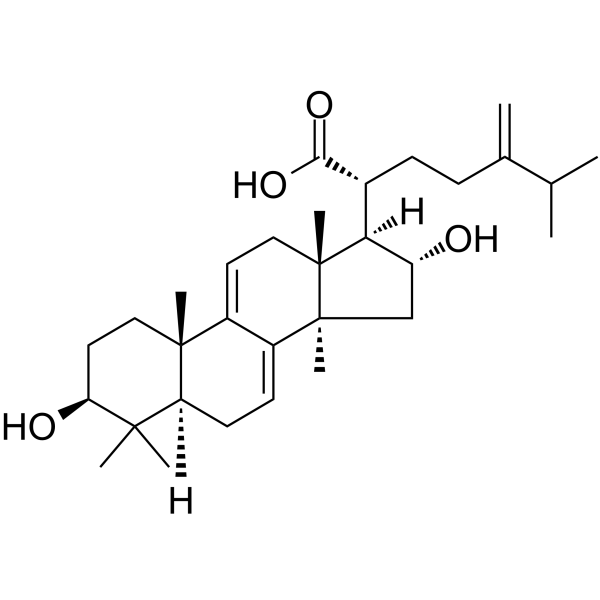
Dehydrotumulosic acid is a natural triterpenoid compound isolated from Poria cocos. Dehydrotumulosic acid inhibits Naja naja phospholipase A2 with IC50 values of 0.8 mM and 0.845 mM, and blocks phospholipid hydrolysis. Dehydrotumulosic acid restores GR phosphorylation, inhibits MEK/ERK signaling and pro-inflammatory cytokines, and exhibits glucocorticoid-independent anti-inflammatory activity in edema and chronic inflammation models. Dehydrotumulosic acid inhibits early replication of CVB3 after cell entry, reducing viral RNA, protein synthesis, and progeny virus particles. Dehydrotumulosic acid can be used in research on viral infections, dermatitis, osteoporosis, and cancer.
For research use only. We do not sell to patients.
- Purity : 99.06%
- CAS No.: 6754-16-1
- Formula: C31H48O4
- Molecular Weight:484.71
-
Storage:
4°C, sealed storage, away from moisture and light
* In solvent : -80°C, 6 months; -20°C, 1 month (sealed storage, away from moisture and light)

To place orders, for customer services and technical support, please contact: MedChemExpress USA
Tel: 609-228-6898 E-mail: [email protected] [email protected]


-
 Biological Activity
-
Chemical Information
-
Solvent & Solubility
- Protocols
- Purity & Documentation
- References
-
 Help & FAQs


-
HY-N0371
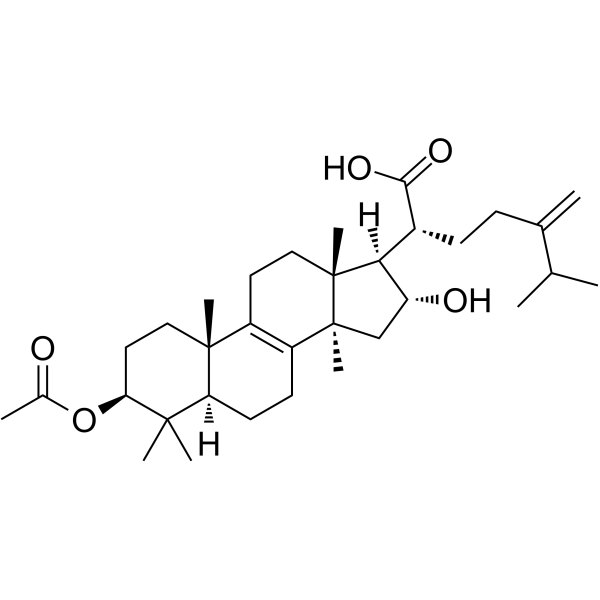
Pachymic acidTriterpenoid Compound -
HY-N0523
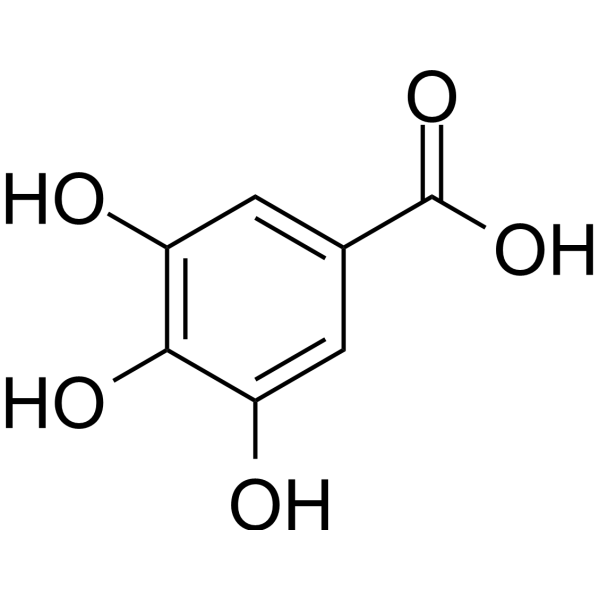
Gallic acidBioactive Polyhydroxyphenolic Compound -
HY-N0256
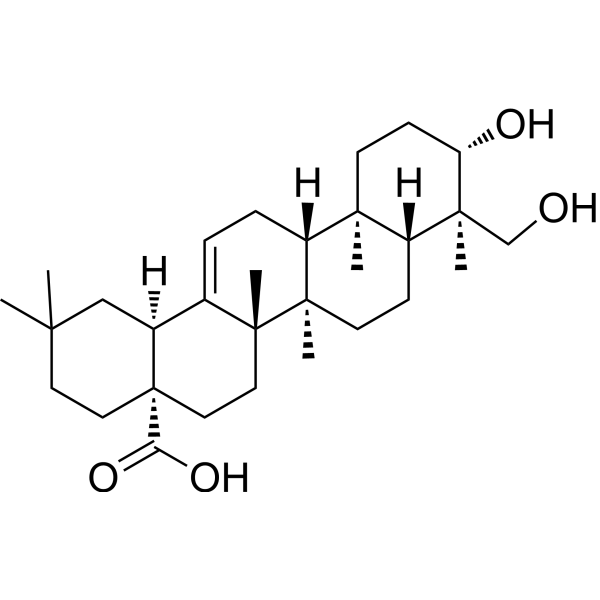
HederageninCOX Inhibitor -
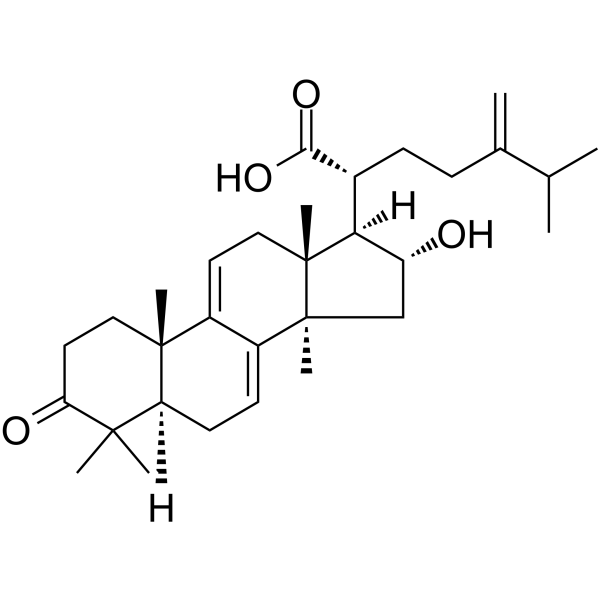
HY-N2993
Polyporenic acid CApoptosis Inducer -
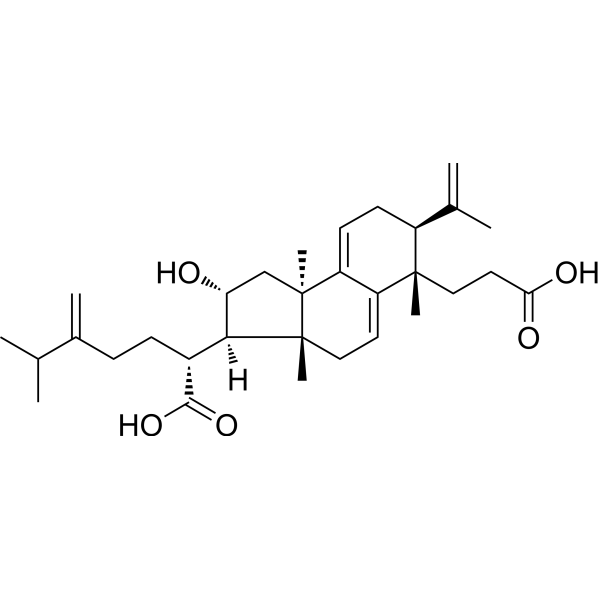
HY-N2995
Poricoic acid ANatural Product -
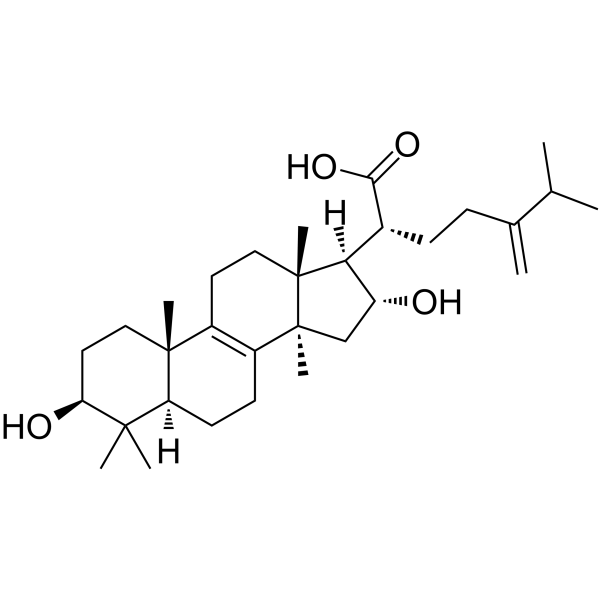
HY-N9366
Tumulosic acidKLK5 Protease Inhibitor -
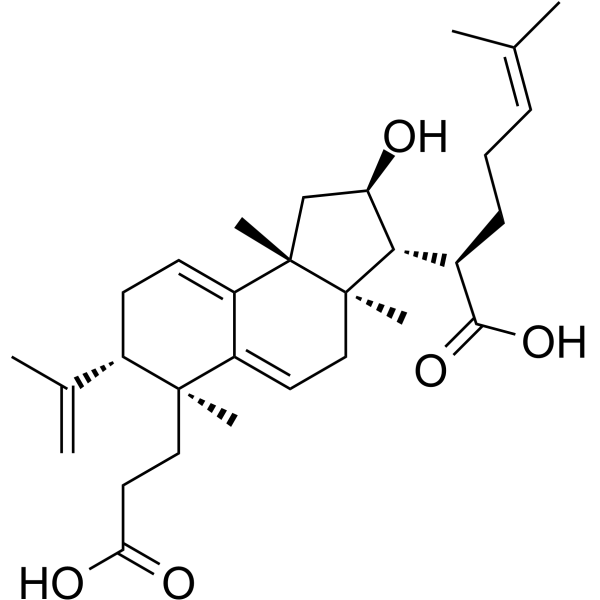
HY-N4124
Poricoic acid BTriterpenoid Compound -
HY-N2163
Mudanpioside CPDI Inhibitor -
HY-N2991
Dehydropachymic acidAutophagy Inducer -

HY-N2499R
Dehydrotumulosic acid (Standard)Reference Standard


Biological Activity
Description
|
VP1 |
β-Actin |
C-Raf |
MEK1 |
MEK2 |
ERK1 |
ERK2 |
PLA2 |
p-GR |
Cellular Effect
|
Cell Line

|
Type | Value | Description | References |
|---|---|---|---|---|
| CCRF-CEM | IC50 |
>40 μM
Compound: 10
|
Antiproliferative activity against human CCRF-CEM cells after 72 hrs by MTT assay
Antiproliferative activity against human CCRF-CEM cells after 72 hrs by MTT assay
|
[PMID: 27808511] |
| HL-60 | IC50 |
>40 μM
Compound: 10
|
Antiproliferative activity against human HL60 cells after 72 hrs by MTT assay
Antiproliferative activity against human HL60 cells after 72 hrs by MTT assay
|
[PMID: 27808511] |
| K562 | IC50 |
>40 μM
Compound: 10
|
Antiproliferative activity against human K562 cells after 72 hrs by MTT assay
Antiproliferative activity against human K562 cells after 72 hrs by MTT assay
|
[PMID: 27808511] |
| MOLT-4 | IC50 |
>40 μM
Compound: 10
|
Antiproliferative activity against human MOLT4 cells after 72 hrs by MTT assay
Antiproliferative activity against human MOLT4 cells after 72 hrs by MTT assay
|
[PMID: 27808511] |
In Vitro
Dehydrotumulosic acid reverses CVB3-induced gene expression changes enriched in MAPK and inflammatory pathways in Vero cells[1].
Dehydrotumulosic acid (12.5-50 μM; 12-24 h post-infection) inhibits CVB3-induced IL-6 and TNF-α mRNA in Vero cells at 12 h post-infection and maintains the inhibition of IL-6 at 24 h post-infection[1].
Dehydrotumulosic acid (3.125-50 μM; 72 h) reduces CVB3 plaque area but does not reduce plaque number in Vero cells[1].
Dehydrotumulosic acid (20-50 μM; 16 h) reduces CVB3 VP1 protein expression in Vero cells[1].
Dehydrotumulosic acid (20-50 μM; 16 h) inhibits CVB3-induced MEK/ERK phosphorylation and VP1 expression in Vero cells[1].
Dehydrotumulosic acid (20-50 μM; 16 h) restores GR phosphorylation in CVB3-infected Vero cells[1].
Dehydrotumulosic acid (50 μM) mainly inhibits the early post-entry stage of CVB3 replication in Vero cells[1].
Dehydrotumulosic acid (12.5-50 μM; 12-24 h post-infection) maintains Vero cell morphology at 24 h after CVB3 infection[1].
Dehydrotumulosic acid (10-100 µM; 4 days of M-CSF/RANKL-induced differentiation) inhibits RANKL-induced osteoclast differentiation in BMMs, reducing TRAP activity by 15-86% at 10-100 µM[3].
Dehydrotumulosic acid inhibits Naja naja snake venom PLA2 in a cell-free polarographic assay with an IC50 of 0.845 mM[4].
MedChemExpress (MCE) has not independently confirmed the accuracy of these methods. They are for reference only.
-
Cell Line:CVB3-infected Vero cells
-
Concentration:20, 50 μM
-
Incubation Time:16 h
-
Result:Dose-dependently reduced CVB3 VP4 mRNA.
CVB3 infection increased IL-1β, IL-6, and TNF-α mRNA; dose-dependently reduced these cytokines, with higher concentrations reaching near-baseline levels.
-
Cell Line:CVB3-infected Vero cells
-
Concentration:20, 50 μM
-
Incubation Time:16 h
-
Result:Reduced the CVB3 infection-induced increase in VP1/β-actin levels in a dose-dependent manner.
Inhibited the CVB3 infection-enhanced phosphorylation of c-Raf, MEK1/2, and ERK1/2, as well as the expression of VP1, in a dose-dependent manner.
Restored and increased the levels of p-GR, which had been reduced by CVB3 infection.
In Vivo
Dehydrotumulosic acid (50 mg/kg; subcutaneous injection; single dose) strongly inhibits Serotonin (HY-B1473A)-induced paw edema in mice, and this effect is not blocked by Progesterone (HY-N0437), Actinomycin D (HY-17559), or Cycloheximide (HY-12320)[2].
MedChemExpress (MCE) has not independently confirmed the accuracy of these methods. They are for reference only.
-
Animal Model:Swiss (female, 25-30 g)[2]
-
Dosage:0.5 mg/ear
-
Administration:topical; twice daily; 4 days; last day morning only
-
Result:Ear weight increase ΔW was 16.4 with 71% inhibition.
MPO activity was 475 mOD with 66% inhibition.
Histology showed residual focal inflammatory lesions in the dermis with diffuse fibrosis, epithelial hyperplasia and hypertrophy in the inflamed area; the cellular inflammatory ratio was 1:3 (macrophage-lymphocyte), epithelial thickness was 4.3 cells, and mastocytes were 11.7 in the dermis.
-
Animal Model:Swiss (female, 25-30 g)[2]
-
Dosage:0.5 mg/ear
-
Administration:topical; once; 16 h before induction of ear edema
-
Result:Produced 49% edema inhibition.
-
Animal Model:Swiss (female, 25-30 g)[2]
-
Dosage:50 mg/kg
-
Administration:s.c.; once
-
Result:Alone, ΔV was 17 with 76% inhibition.
With Progesterone, ΔV was 15 with 79% inhibition.
With Actinomycin D, ΔV was 17 with 76% inhibition.
With Cycloheximide, ΔV was 18 with 75% inhibition.
- Kinase activity and phosphorylation assays
- Western Blot
- LPS-Induced Endotoxemia/Systemic Inflammation
- Cotton Pellet Granuloma
- Research Protocol for Endocrine Diseases
- Carrageenan-Induced Paw Edema
- TPA/Croton Oil Ear Edema and Dermatitis
- Protocol for Kinase activity and phosphorylation assays
- Research Protocol for Inflammation-related Diseases


Product Details
-
Structure Classification
-
Initial Source


Chemical Information
-
CAS No. 6754-16-1
-
Appearance Solid
-
Molecular Weight 484.71
-
Formula C31H48O4
-
Color White to off-white
-
SMILES
C[C@]12[C@@]([C@]([C@H](C(O)=O)CCC(C(C)C)=C)([H])[C@H](O)C1)(CC=C3C2=CC[C@]4([H])[C@@]3(CC[C@H](O)C4(C)C)C)C
-
Shipping
Room temperature in continental US; may vary elsewhere.
-
Storage
4°C, sealed storage, away from moisture and light
* In solvent : -80°C, 6 months; -20°C, 1 month (sealed storage, away from moisture and light)


Solvent & Solubility
In Vitro:
DMSO : 33.33 mg/mL (68.76 mM; Need ultrasonic; Hygroscopic DMSO has a significant impact on the solubility of product, please use newly opened DMSO)
Please refer to the solubility information to select the appropriate solvent. Once prepared, please aliquot and store the solution to prevent product inactivation from repeated freeze-thaw cycles.
Storage method and period of stock solution: -80°C, 6 months; -20°C, 1 month (sealed storage, away from moisture and light). When stored at -80°C, please use it within 6 months. When stored at -20°C, please use it within 1 month.
Concentration (start) × Volume (start) = Concentration (final) × Volume (final)
In Vivo Dissolution Calculator
Please enter the basic information of animal experiments:
-
-
-
-
Recommended: Prepare an additional quantity of animals to account for potential losses during experiments.
Working solution concentration: 0.22 mg/mL
Purity & Documentation


References
[1]. Li J, et al. Dehydrotumulosic acid: a potential glucocorticoid receptor agonist with anti-coxsackievirus activity. Phytomedicine : international journal of phytotherapy and phytopharmacology. 2025 Oct;146:157107. [Content Brief]
[5]. Ukiya M, et al. Inhibition of tumor-promoting effects by poricoic acids G and H and other lanostane-type triterpenes and cytotoxic activity of poricoic acids A and G from Poria cocos. Journal of natural products. 2002 Apr;65(4):462-5. [Content Brief]

Complete Stock Solution Preparation Table
Please refer to the solubility information to select the appropriate solvent. Once prepared, please aliquot and store the solution to prevent product inactivation from repeated freeze-thaw cycles.
Storage method and period of stock solution: -80°C, 6 months; -20°C, 1 month (sealed storage, away from moisture and light). When stored at -80°C, please use it within 6 months. When stored at -20°C, please use it within 1 month.
| Optional Solvent | Concentration Solvent Mass | 1 mg | 5 mg | 10 mg | 25 mg |
|---|---|---|---|---|---|
| DMSO | 1 mM | 2.0631 mL | 10.3154 mL | 20.6309 mL | 51.5772 mL |
| 5 mM | 0.4126 mL | 2.0631 mL | 4.1262 mL | 10.3154 mL | |
| 10 mM | 0.2063 mL | 1.0315 mL | 2.0631 mL | 5.1577 mL | |
| 15 mM | 0.1375 mL | 0.6877 mL | 1.3754 mL | 3.4385 mL | |
| 20 mM | 0.1032 mL | 0.5158 mL | 1.0315 mL | 2.5789 mL | |
| 25 mM | 0.0825 mL | 0.4126 mL | 0.8252 mL | 2.0631 mL | |
| 30 mM | 0.0688 mL | 0.3438 mL | 0.6877 mL | 1.7192 mL | |
| 40 mM | 0.0516 mL | 0.2579 mL | 0.5158 mL | 1.2894 mL | |
| 50 mM | 0.0413 mL | 0.2063 mL | 0.4126 mL | 1.0315 mL | |
| 60 mM | 0.0344 mL | 0.1719 mL | 0.3438 mL | 0.8596 mL |


Dehydrotumulosic acid Related Classifications
HY-N2499 Related Classifications
 Powered by Bioz
Keywords
- Dehydrotumulosic acid
- 6754-16-1
- Endogenous Metabolite
- Phospholipase
- Glutathione Reductase (GR)
- Enterovirus
- Actin
- Raf
- MEK
- ERK
- DNA/RNA Synthesis
- Glutathione Reductase
- Rhinovirus
- HRV
- HRVs
- HEV
- HEVs
- Raf kinases
- Mitogen-activated protein kinase kinase
- MAPKK
- MAP2K
- Extracellular signal regulated kinases
- MAPK/ERK signaling
- RANKL
- coxsackievirus infection
- dermatitis
- glucocorticoid receptor
- osteoblast differentiation
- osteoclast differentiation
- osteoporosis
- phospholipase A2
- proinflammatory cytokines
- Inhibitor
- inhibitor
- inhibit