



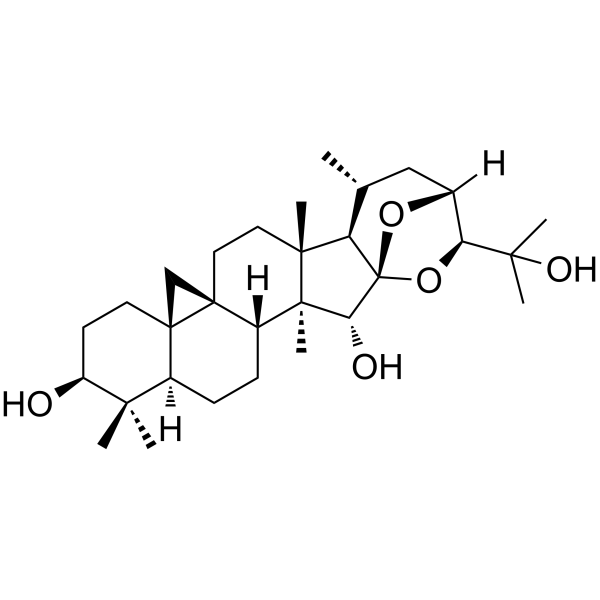
Cimigenol
Based on 1 publication(s) in Google Scholar
Cimigenol is a cycloartane-type triterpene found in Cimicifuga foetida that exhibits antitumor activity. Cimigenol inhibits Epstein-Barr virus early antigen activation and mouse skin tumor promotion. Cimigenol induces apoptosis and autophagy in HT-29 colon cancer cells. Cimigenol promotes the cleavage/activation of caspase-8 and caspase-3, proteolytic cleavage of PARP, and LC3 lipidation/autophagosome association. Cimigenol delays papilloma formation and reduces papilloma incidence and multiplicity in DMBA/TPA-treated mice. Cimigenol can be used in research related to cancer and viral infection.
연구목적의 판매만을 진행합니다. 환자를 대상으로 한 판매는 하지 않습니다.
- Purity : 99.79%
- CAS No.: 3779-59-7
- 화학식: C30H48O5
- 분자량:488.70
-
보관:
4°C, protect from light
* In solvent : -80°C, 6 months; -20°C, 1 month (protect from light)

To place orders, for customer services and technical support, please contact: MedChemExpress USA
Tel: 609-228-6898 E-mail: [email protected] [email protected]


-
 Biological Activity
-
Chemical Information
-
용액&용해도
- Protocol
- 순도&문서
- References
-
 Help & FAQs




Biological Activity
제품 설명
IC50 & Target
[2]|
Caspase 3 |
Caspase 8 |
Cellular Effect
|
Cell Line

|
Type | Value | Description | References |
|---|---|---|---|---|
| HT-29 | IC50 |
8.84 μM
|
Antiproliferative activity against human colon cancer HT-29 cells assessed as viability reduction incubated 72 hrs by MTT assay.
Antiproliferative activity against human colon cancer HT-29 cells assessed as viability reduction incubated 72 hrs by MTT assay.
|
28260002 |
In Vitro
MedChemExpress (MCE) has not independently confirmed the accuracy of these methods. They are for reference only.
-
Cell Line:HT-29 cells
-
Concentration:0.1, 1, 5, 10, 50 µM
-
Incubation Time:72 h
-
Result:Suppressed HT-29 cell growth in a concentration-dependent manner; IC50 = 8.84 µM.
-
Cell Line:HT-29 cells
-
Concentration:1, 5, 10 µM
-
Incubation Time:24, 48, and 72 h
-
Result:Increased the percentage of cells in sub-G1 and G2/M phases in a concentration- and time-dependent manner.
-
Cell Line:HT-29 cells
-
Concentration:1, 5, 10 µM
-
Incubation Time:48 h
-
Result:Induced apoptosis in HT-29 cells, with 11.6% late apoptotic cells at 10 µM after 48 h.
-
Cell Line:HT-29 cells
-
Concentration:1, 5, 10 µM
-
Incubation Time:24 and 48 h
-
Result:Increased cleaved caspase-8 and cleaved caspase-3 protein levels and degraded full-length PARP to cleaved PARP in a concentration- and time-dependent manner.\nLC3 underwent conversion from LC3-I to LC3-II in HT-29 cells.
-
Cell Line:HT-29 cells
-
Concentration:1, 5, 10 µM
-
Incubation Time:24, 48, and 72 h (AVo formation); 24 and 48 h (LC3)
-
Result:Induced autophagy in HT-29 cells, manifested as an increase in acidic vesicular organelles; it promoted GFP-LC3 puncta formation in HT-29 cells.
-
Cell Line:HT-29 cells
-
Concentration:1, 5, 10 µM (Cimigenol; 48 h); 1 nM (Baf-A1; 1 h pretreatment)
-
Incubation Time:48 h (Cimigenol); 1 h pretreatment (Baf-A1)
-
Result:Combination with Baf-A1 increased the cleaved form of PARP compared with cells without Baf-A1.
In Vivo
MedChemExpress (MCE) has not independently confirmed the accuracy of these methods. They are for reference only.
-
Animal Model:ICR (female, 6 weeks old, were initiated with topical DMBA, followed by twice‑weekly TPA promotion)[1]
-
Dosage:85 nmol per application
-
Administration:topical; 1 h before each TPA application; twice weekly; 20 weeks
-
Result:At 10 weeks of promotion, mice had 1 papilloma per mouse, and papilloma-bearing mice were 27% of the positive control.
At 20 weeks, mice had 4.3 papillomas per mouse (53% of the control group), and papilloma-bearing mice were 93% of the positive control.
- Research Protocol for Infectious Diseases
- Detection of Apoptosis
- TUNEL staining for apoptotic DNA fragmentation
- Annexin V plus membrane-impermeant dye apoptosis staining
- Autophagy
- Apoptosis Solutions
- Lysosome and acidic-vesicle live-cell staining
- Subcutaneous Cell-Line-Derived Xenograft
- Macroautophagy Solutions


Product Details
-
Structure Classification
-
Initial Source


Chemical Information
-
CAS No. 3779-59-7
-
Appearance Solid
-
분자량 488.70
-
화학식 C30H48O5
-
Color White to off-white
-
SMILES
CC1(C)[C@@H](O)CC[C@]2(C3)[C@]43CC[C@]5(C)[C@@H]([C@H](C)C[C@]6([H])[C@H]7C(C)(O)C)[C@@](O7)(O6)[C@H](O)[C@](C)5[C@]4([H])CC[C@@]12[H]
-
선적
Room temperature in continental US; may vary elsewhere.
-
보관
4°C, protect from light
* In solvent : -80°C, 6 months; -20°C, 1 month (protect from light)


Publications (1)
-
Journal Impact Factor
-
Most Recent
-
Clin Proteomics
Multi-omics analyses, cell experiments, and network pharmacology tools identified key proteins and candidate drugs for alopecia areata treatment. [Abstract]2025 May 29;22(1):22. PMID: 40442619


용액&용해도
In Vitro:
DMSO : 100 mg/mL (204.62 mM; Need ultrasonic; Hygroscopic DMSO has a significant impact on the solubility of product, please use newly opened DMSO)
Please refer to the solubility information to select the appropriate solvent. Once prepared, please aliquot and store the solution to prevent product inactivation from repeated freeze-thaw cycles.
Storage method and period of stock solution: -80°C, 6 months; -20°C, 1 month (protect from light). When stored at -80°C, please use it within 6 months. When stored at -20°C, please use it within 1 month.
Concentration (start) × Volume (start) = Concentration (final) × Volume (final)
In Vivo:
Select the appropriate dissolution method based on your experimental animal and administration route.
- For the following dissolution methods, please ensure to first prepare a clear stock solution using an In Vitro approach and then sequentially add co-solvents:
- To ensure reliable experimental results, the clarified stock solution can be appropriately stored based on storage conditions. As for the working solution for In Vivo experiments, it is recommended to prepare freshly and use it on the same day.
- The percentages shown for the solvents indicate their volumetric ratio in the final prepared solution. If precipitation or phase separation occurs during preparation, heat and/or sonication can be used to aid dissolution.
In Vivo Dissolution Calculator
Please enter the basic information of animal experiments:
-
-
-
-
Recommended: Prepare an additional quantity of animals to account for potential losses during experiments.
Please enter your animal formula composition:
-
%DMSO +
Recommended: Keep the proportion of DMSO in working solution below 2% if your animal is weak.
-
%+
-
+%Tween-80 + +
-
%Saline +
The co-solvents required include: DMSO, . All of co-solvents are available by MedChemExpress (MCE). , Tween 80. All of co-solvents are available by MedChemExpress (MCE).
Working solution concentration: 0.22 mg/mL
Method for preparing stock solution: mg drug dissolved in μL DMSO. Stock solution concentration: mg/mL. * In solvent : -80°C, 6 months; -20°C, 1 month (protect from light)
1. Take μL DMSO stock solution;
2. Add μL .
μL , mix evenly;
3. Then add μL Tween 80, mix evenly;
4. Then add μL
Please ensure that the stock solution in the first step is dissolved to a clear state, and add co-solvents in sequence. You can use ultrasonic heating (ultrasonic cleaner, recommended frequency 20-40 kHz), vortexing, etc. to assist dissolution.
순도&문서


References

Complete Stock Solution Preparation Table
Please refer to the solubility information to select the appropriate solvent. Once prepared, please aliquot and store the solution to prevent product inactivation from repeated freeze-thaw cycles.
Storage method and period of stock solution: -80°C, 6 months; -20°C, 1 month (protect from light). When stored at -80°C, please use it within 6 months. When stored at -20°C, please use it within 1 month.
| Optional Solvent | Concentration Solvent Mass | 1 mg | 5 mg | 10 mg | 25 mg |
|---|---|---|---|---|---|
| DMSO | 1 mM | 2.0462 mL | 10.2312 mL | 20.4625 mL | 51.1561 mL |
| 5 mM | 0.4092 mL | 2.0462 mL | 4.0925 mL | 10.2312 mL | |
| 10 mM | 0.2046 mL | 1.0231 mL | 2.0462 mL | 5.1156 mL | |
| 15 mM | 0.1364 mL | 0.6821 mL | 1.3642 mL | 3.4104 mL | |
| 20 mM | 0.1023 mL | 0.5116 mL | 1.0231 mL | 2.5578 mL | |
| 25 mM | 0.0818 mL | 0.4092 mL | 0.8185 mL | 2.0462 mL | |
| 30 mM | 0.0682 mL | 0.3410 mL | 0.6821 mL | 1.7052 mL | |
| 40 mM | 0.0512 mL | 0.2558 mL | 0.5116 mL | 1.2789 mL | |
| 50 mM | 0.0409 mL | 0.2046 mL | 0.4092 mL | 1.0231 mL | |
| 60 mM | 0.0341 mL | 0.1705 mL | 0.3410 mL | 0.8526 mL | |
| 80 mM | 0.0256 mL | 0.1279 mL | 0.2558 mL | 0.6395 mL | |
| 100 mM | 0.0205 mL | 0.1023 mL | 0.2046 mL | 0.5116 mL |


Cimigenol Related Classifications
HY-N6988 Related Classifications
 Powered by Bioz
Keywords
- Cimigenol
- 3779-59-7
- EBV
- Caspase
- PARP
- Atg8/LC3
- Apoptosis
- Autophagy
- Epstein-Barr Virus
- poly ADP ribose polymerase
- Autophagy-related 8
- AKT1
- DMBA/TPA
- Epstein-Barr virus early antigen activation
- G2/M-phase arrest
- HT-29 cells
- LC3 lipidation
- PARP proteolytic cleavage
- Raji cells
- anti-inflammatory
- apoptosis
- autophagosome association
- autophagy
- breast cancer
- caspase-3
- caspase-8
- cell cycle arrest
- colon cancer
- growth inhibition
- mouse skin papillomas
- papilloma formation
- sub-G1 accumulation
- tumor promotion
- Inhibitor
- inhibitor
- inhibit