8 Results for "

bacillus cereus infection

" in MedChemExpress (MCE) Product Catalog:
Products (8)

8 Results for "bacillus cereus infection" in MCE Product Catalog:

Cat. No.: HY-W094710
CAS No.: 126-96-5
Synonyms: Sodium hydrogen diacetate
Research Areas:  

Infection

Sodium diacetate (Sodium hydrogen diacetate) is a multifunctional biochemical reagent with antibacterial (bacteria) and antifungal (fungi) activities. Sodium diacetate exerts its antimicrobial effect mainly by effectively penetrating the cell walls of microorganisms and interfering with enzyme interactions. Sodium diacetate inhibits the growth and survival of fungi such as Botrytis cinerea, as well as bacteria such as Listeria and Escherichia coli. Sodium diacetate inhibits the growth of endothelial cells. Sodium diacetate can be used in the synthesis of food preservatives, flavoring agents and pH control additives .
loading...
    loading...
Cat. No.: HY-N13668
CAS No.: 468757-69-9
Rhodomyrtone is an antibiotic that can be found in the leaves of Rhodomyrtus tomentosa. Rhodomyrtone kills Gram-positive bacterial cells without causing bacteriolysis. Rhodomyrtone exhibits activity against a variety of Gram-positive bacteria, including Bacillus cereus, Bacillus subtilis, Enterococcus faecalis, Staphylococcus epidermidis, Streptococcus gordonii, Streptococcus pneumoniae, Streptococcus pyogenes and Streptococcus salivarius. Rhodomyrtone is applicable to studies related to bacterial infections .
loading...
    loading...
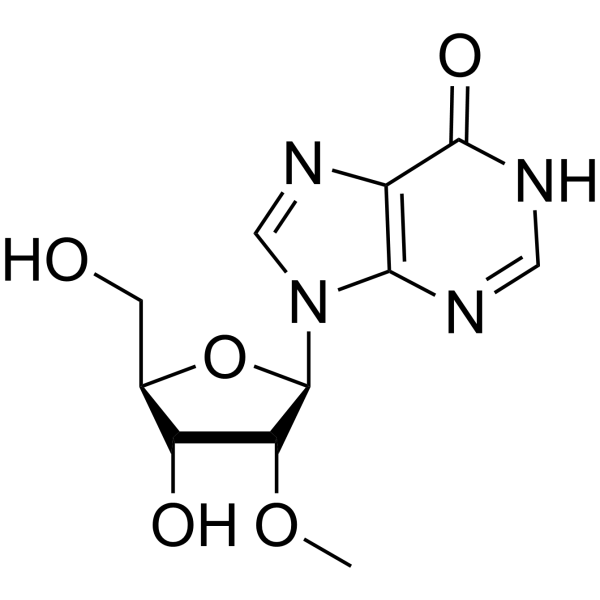
Cat. No.: HY-W013289
CAS No.: 3881-21-8
2'-O-Methylinosine is a derivative of 2'-O-Methyladenosine. 2'-O-Methylinosine can be formed by chemical deamination of unmethylated 2'-O-Methyladenosine (HY-W011552). 2'-O-Methylinosine does not induce spore germination in Bacillus cereus. 2'-O-Methylinosine can be used in studies on diabetic nephropathy and HIV infection .
loading...
    loading...
Cat. No.: HY-N19789
CAS No.: 106940-77-6
Gleinadiene is a coumarin that can be isolated from the extracts of leaves of Murraya paniculata. Gleinadiene exhibits weak antimicrobial activity against the gram-positive bacterium Bacillus cereus. Gleinadiene can be used for the research of bacterial infection .
loading...
    loading...
Cat. No.: HY-N12230
CAS No.: 1418291-70-9
Penicolinate B is a picolinic acid derivative that can be isolated from Penicillium sp. Penicolinate B exhibits antimalarial activity (IC50: 1.40 μg/mL), antitubercular activity (MIC: 25.0 μg/mL), activity against Bacillus cereus (IC50: 25.0 μg/mL), and activity against Candida albicans (IC50: 1.45 μg/mL). Penicolinate B also has certain cytotoxicity against cancer cells such as MCF-7, KB, and NCI-H187. Penicolinate B can be used in research on malaria, tuberculosis, bacterial/fungal infections and tumors .
loading...
    loading...
Cat. No.: HY-162818
Research Areas:  

Infection

Antibacterial agent 237 (compound Ru-8) is a bacteriostatic agent for Staphylococcus aureus, with MIC of 0.78-1.56 μg/mL. Antibacterial agent 237 destroys bacterial cell membranes, changes their permeability, and induces bacteria to produce Reactive Oxygen Species, leading to bacterial death without causing drug resistance. Antibacterial agent 237 has low hemolytic toxicity to rabbit red blood cells and Raw 264.7 cells, and has significant antibacterial effects against Staphylococcus aureus in mouse skin wound infection models and Bacillus major larvae infection models .
loading...
    loading...
Cat. No.: HY-N13838
CAS No.: 22518-03-2
8,9-Dehydro-7,9-diisobutyryloxythymol is a Thymol (HY-N6810) derivative, as well as an antibacterial agent. 8,9-Dehydro-7,9-diisobutyryloxythymol can be found in the aerial parts of Ageratina adenophora, with selective activity against Gram-positive bacterial strains including Bacillus cereus. 8,9-Dehydro-7,9-diisobutyryloxythymol does not exhibit detectable in vitro cytotoxic activity against human cancer cell lines. 8,9-Dehydro-7,9-diisobutyryloxythymol can be used for the research of bacterial infection .
loading...
    loading...
Cat. No.: HY-115442
CAS No.: 106359-61-9
Target:  

HDAC Bacterial

Research Areas:  

Infection Cancer

NHNB is a selective HDAC8 inhibitor (IC50 = 66.0 μM) and Peptidoglycan N-acetylglucosamine (GlcNAc) deacetylases (PGNGdacs) inhibitor. NHNB shows antibacterial and bactericidal activity against B. anthracis and B. cereus. NHNB can be used for the research of acute myeloid leukemia, Bacillus anthracis infection, and Bacillus cereus infection .
loading...
    loading...

