



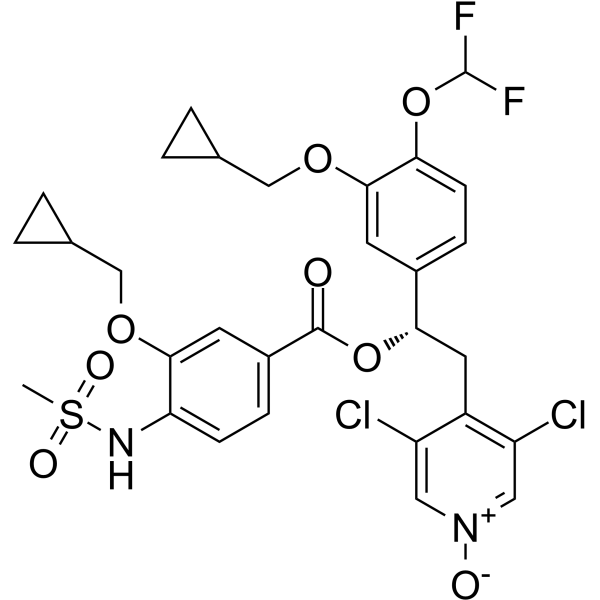
Tanimilast
Based on 1 Customer Validation
Tanimilast (CHF-6001) is an orally active and selective phosphodiesterase 4 inhibitor (IC50=0.026 nM) with robust anti-inflammatory activity and suitable for topical pulmonary administration. Tanimilast increases cellular cAMP levels, and inhibits NF-κB signaling pathway. Tanimilast is used for the research of obstructive lung diseases.
For research use only. We do not sell to patients.
- Purity : 99.71%
- CAS No.: 1239278-59-1
- Formula: C30H30Cl2F2N2O8S
- Molecular Weight:687.54
-
Storage:Powder -20°C, 3 years , 4°C, 2 years ; In solvent -80°C, 6 months , -20°C, 1 month

To place orders, for customer services and technical support, please contact: MedChemExpress USA
Tel: 609-228-6898 E-mail: [email protected] [email protected]


-
 Biological Activity
-
Chemical Information
-
Solvent & Solubility
- Protocols
- Purity & Documentation
- References
-
 Help & FAQs




Biological Activity
Description
IC50 & Target
[1]|
PDE4 0.026 nM (IC50) |
Cellular Effect
|
Cell Line

|
Type | Value | Description | References |
|---|---|---|---|---|
| U-937 | IC50 |
0.04 nM
Compound: (S)-32a
|
Inhibition of PDE4 isolated from human U937 cells assessed as reduction in cAMP level by LANCE assay
Inhibition of PDE4 isolated from human U937 cells assessed as reduction in cAMP level by LANCE assay
|
[PMID: 24400806] |
In Vitro
Tanimilast (0.1 nM-0.1 μM, 24 h) increases the expression of CCR7 protein; inhibits the production of cytokines such as TNF-α, IL-1β, IL-6, IL-12, and IL-23; reduces the production of chemokines such as CXCL8, CCL3, CXCL10, and CCL19, IC50s in LPS (HY-D1056)-stimulated human monocyte-derived dendritic cells are 0.5, 4.6, 2.8, 1.7, 9.3, 7.2, 1.2, 1.8 and 0.8 nM, respectively[2].
MedChemExpress (MCE) has not independently confirmed the accuracy of these methods. They are for reference only.
-
Cell Line:Human monocyte-derived dendritic cells
-
Concentration:0.1 nM-0.1 μM
-
Incubation Time:24 h
-
Result:Inhibited the expression of TNF-α and CXCL8.
In Vivo
MedChemExpress (MCE) has not independently confirmed the accuracy of these methods. They are for reference only.
-
Animal Model:LPS (HY-D1056)-induced acute pulmonary inflammation in mouse models[3]
-
Dosage:100-600 µg/kg
-
Administration:dry powder inhalation, single dose
-
Result:Reduced the number of white blood cells (WBC) and neutrophils in bronchoalveolar lavage fluid (BALF).
Reduced the concentrations of proinflammatory cytokines, such as TNF-α, G-CSF, IL-1β, and RANTES in BALF.
Clinical Trial
| NCT Number | Sponsor | Condition | Start Date |
Phase
|
|---|---|---|---|---|
| NCT01329991 | 2011-05 | PHASE1 |


Chemical Information
-
CAS No. 1239278-59-1
-
Appearance Solid
-
Molecular Weight 687.54
-
Formula C30H30Cl2F2N2O8S
-
Color White to off-white
-
SMILES
O=C(O[C@H](C1=CC=C(OC(F)F)C(OCC2CC2)=C1)CC3=C(Cl)C=[N+]([O-])C=C3Cl)C4=CC=C(NS(=O)(C)=O)C(OCC5CC5)=C4
-
Synonyms
CHF-6001
-
Shipping
Room temperature in continental US; may vary elsewhere.
-
Storage
Powder -20°C 3 years 4°C 2 years In solvent -80°C 6 months -20°C 1 month


Solvent & Solubility
In Vitro:
DMSO : 200 mg/mL (290.89 mM; Need ultrasonic and warming; Hygroscopic DMSO has a significant impact on the solubility of product, please use newly opened DMSO)
Please refer to the solubility information to select the appropriate solvent. Once prepared, please aliquot and store the solution to prevent product inactivation from repeated freeze-thaw cycles.
Storage method and period of stock solution: -80°C, 6 months; -20°C, 1 month. When stored at -80°C, please use it within 6 months. When stored at -20°C, please use it within 1 month.
Please refer to the solubility information to select the appropriate solvent. Once prepared, please aliquot and store the solution to prevent product inactivation from repeated freeze-thaw cycles.
Storage method and period of stock solution: -80°C, 6 months; -20°C, 1 month. When stored at -80°C, please use it within 6 months. When stored at -20°C, please use it within 1 month.
Concentration (start) × Volume (start) = Concentration (final) × Volume (final)


Purity & Documentation
-
Data Sheet (282 KB)
-
SDS (394 KB)
- English - EN (394 KB)
- Français - FR (394 KB)
- Deutsch - DE (394 KB)
- Norwegian - NO (394 KB)
- Español - ES (394 KB)
- Swedish - SV (394 KB)
- Italian - IT (394 KB)
- Korean - KR (394 KB)
- Portuguese - PT (394 KB)
-
Handling Instructions (2659 KB)
References
[1]. Moretto N, et al., CHF6001 I: a novel highly potent and selective phosphodiesterase 4 inhibitor with robust anti-inflammatory activity and suitable for topical pulmonary administration. J Pharmacol Exp Ther. 2015 Mar;352(3):559-67. [Content Brief]
[2]. Gianello V, et al., The PDE4 inhibitor CHF6001 modulates pro-inflammatory cytokines, chemokines and Th1- and Th17-polarizing cytokines in human dendritic cells. Biochem Pharmacol. 2019 May;163:371-380. [Content Brief]
[3]. Stellari FF, et al., CHF6001 Inhibits NF-κB Activation and Neutrophilic Recruitment in LPS-Induced Lung Inflammation in Mice. Front Pharmacol. 2019 Nov 12;10:1337. [Content Brief]


Complete Stock Solution Preparation Table
Please refer to the solubility information to select the appropriate solvent. Once prepared, please aliquot and store the solution to prevent product inactivation from repeated freeze-thaw cycles.
Storage method and period of stock solution: -80°C, 6 months; -20°C, 1 month. When stored at -80°C, please use it within 6 months. When stored at -20°C, please use it within 1 month.
| Optional Solvent | Concentration Solvent Mass | 1 mg | 5 mg | 10 mg | 25 mg |
|---|---|---|---|---|---|
| DMSO | 1 mM | 1.4545 mL | 7.2723 mL | 14.5446 mL | 36.3615 mL |
| 5 mM | 0.2909 mL | 1.4545 mL | 2.9089 mL | 7.2723 mL | |
| 10 mM | 0.1454 mL | 0.7272 mL | 1.4545 mL | 3.6362 mL | |
| 15 mM | 0.0970 mL | 0.4848 mL | 0.9696 mL | 2.4241 mL | |
| 20 mM | 0.0727 mL | 0.3636 mL | 0.7272 mL | 1.8181 mL | |
| 25 mM | 0.0582 mL | 0.2909 mL | 0.5818 mL | 1.4545 mL | |
| 30 mM | 0.0485 mL | 0.2424 mL | 0.4848 mL | 1.2121 mL | |
| 40 mM | 0.0364 mL | 0.1818 mL | 0.3636 mL | 0.9090 mL | |
| 50 mM | 0.0291 mL | 0.1454 mL | 0.2909 mL | 0.7272 mL | |
| 60 mM | 0.0242 mL | 0.1212 mL | 0.2424 mL | 0.6060 mL | |
| 80 mM | 0.0182 mL | 0.0909 mL | 0.1818 mL | 0.4545 mL | |
| 100 mM | 0.0145 mL | 0.0727 mL | 0.1454 mL | 0.3636 mL |


Tanimilast Related Classifications
HY-19929 Related Classifications
 Powered by Bioz