



CDK
Cyclin dependent kinase
CDKs (Cyclin-dependent kinases) are serine-threonine kinases first discovered for their role in regulating the cell cycle. They are also involved in regulating transcription, mRNA processing, and the differentiation of nerve cells. CDKs are relatively small proteins, with molecular weights ranging from 34 to 40 kDa, and contain little more than the kinase domain. In fact, yeast cells can proliferate normally when their CDK gene has been replaced with the homologous human gene. By definition, a CDK binds a regulatory protein called a cyclin. Without cyclin, CDK has little kinase activity; only the cyclin-CDK complex is an active kinase.
There are around 20 Cyclin-dependent kinases (CDK1-20) known till date. CDK1, 4 and 5 are involved in cell cycle, and CDK 7, 8, 9 and 11 are associated with transcription.
CDK levels remain relatively constant throughout the cell cycle and most regulation is post-translational. Most knowledge of CDK structure and function is based on CDKs of S. pombe (Cdc2), S. cerevisia (CDC28), and vertebrates (CDC2 and CDK2). The four major mechanisms of CDK regulation are cyclin binding, CAK phosphorylation, regulatory inhibitory phosphorylation, and binding of CDK inhibitory subunits (CKIs).
CDK Isoform Specific Products
-
CDK
(486)
View all products
-
CDK1
(198)
View all products
-
CDK2
(316)
View all products
-
CDK3
(28)
View all products
-
CDK4
(236)
View all products
-
CDK5
(98)
View all products
-
CDK6
(179)
View all products
-
CDK7
(119)
View all products
-
CDK8
(57)
View all products
-
CDK9
(206)
View all products
-
CDK11
(9)
View all products
-
CDK12
(54)
View all products
-
CDK13
(28)
View all products
-
CDK14
(6)
View all products
-
CDK16
(8)
View all products
-
CDK19
(25)
View all products
-
CDC
(21)
View all products
-
CLK
(31)
View all products
-
Pho85
(1)
View all products
-
CDK10
(1)
View all products
-
CDK15
(1)
View all products
-
CDK17
(2)
View all products
-
CDK18
(1)
View all products
-
CDK20
(1)
View all products
-
PITSLRE
(1)
View all products
All Product Categories
-
CDK Inhibitors
(1088)
View all products
-
CDK Agonists
(3)
View all products
-
CDK Antagonists
(2)
View all products
-
CDK Activators
(18)
View all products
-
CDK Modulators
(15)
View all products
-
CDK Degraders
(95)
View all products
-
CDK Controls
(4)
View all products
-
CDK Substrate
(1)
View all products
-
CDK Ligands
(16)
View all products
-
Cyclin-Dependent Kinases (CDKs) Proteins
(80)
View all products
-
Cyclin Dependent Kinase 1 (CDK1) Proteins
(9)
View all products
-
Cyclin-Dependent Kinase 2 (CDK2) Proteins
(12)
View all products
-
Cyclin-Dependent Kinase 3 (CDK3) Proteins
(6)
View all products
-
Cyclin-Dependent Kinase 4 (CDK4) Proteins
(4)
View all products
-
Cyclin-Dependent Kinase 5 (CDK5) Proteins
(5)
View all products
-
Cyclin-Dependent Kinase 6 (CDK6) Proteins
(6)
View all products
-
Cyclin-Dependent Kinase 7 (CDK7) Proteins
(4)
View all products
-
CDK Related Products (1364)
Related Products (1364)

-
Recombinant Proteins (82)
-
Antibodies (42)
-
CDK Isoform Comparison

-
Isosilybin B (Standard)
 0 ImagesCat. No.: HY-N7045RCAS No.: 142796-22-3Isosilybin B (Standard) is the analytical standard of Isosilybin B (HY-N7045). This product is intended for research and analytical applications. Isosilybin B is a flavonolignan. Isosilybin B can be isolated from Silybum marianum. Isosilybin B can regulate cell cycle-related proteins (e.g., reduce cyclins (D3, D1, A, E), Cdk4, Cdk2, Cdc25A), and activate Caspases (Caspase-9 and Caspase-3). Isosilybin B can promote Apoptosis, reduce androgen receptor (AR) and PSA. Isosilybin B has anticancer activity against prostate cancer.
-
CDK17/CycY Recombinant Human Active Protein Kinase
 0 ImagesCat. No.: HY-E70665CDK17 is highly expressed in terminally differentiated neurons, particularly those found in hippocampal regions and olfactory bulbs. CDK17/CycY Recombinant Human Active Protein Kinase is an ortholog of CDK17.
-
Anticancer agent 300
 0 ImagesCat. No.: HY-181131CAS No.: 1310059-06-3Anticancer agent 300 (compound P14) is a CCND1, CDK4, CDK6, and CCNE1 modulator, with anti-proliferative, cell-cycle modulatory, senescence-inducing, and apoptosis-inducing activity. Anticancer agent 300 can be used for the research of ER+/HER2− breast cancer and BRAF-mutant melanoma.

-
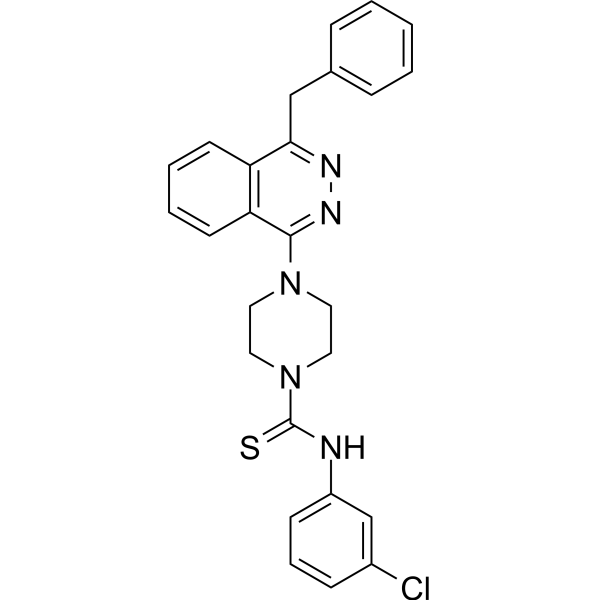
HER4/HER2-IN-1
 0 ImagesCat. No.: HY-178119HER4/HER2-IN-1 (Compound 4b) is a HER4/HER2 inhibitor. HER4/HER2-IN-1 inhibits the proliferation of HER2-positive cells. HER4/HER2-IN-1 reduces the total expression level of HER2 in A431 cells, while the phosphorylated HER2 (p-HER2) does not decrease. HER4/HER2-IN-1 lowers the level of cell cycle protein D1 (cyclin D1) and stimulates the cleavage of PARP. HER4/HER2-IN-1 can be used for the study of cancer, such as breast cancer.
-
BRD4/AKT-IN-1
 0 ImagesCat. No.: HY-183273CAS No.: 3087270-50-3BRD4/AKT-IN-1 is a BRD4/AKT inhibitor with BRD4 IC50 66.12 nM and AKT1 IC50 143.81 nM. BRD4/AKT-IN-1 blocks BRD4-mediated c-Myc transcriptional regulation, modulates AKT1 signaling, decouples AKT phosphorylation from pro-survival effectors. BRD4/AKT-IN-1 induces G0/G1 cell cycle arrest via downregulated phosphorylated RB, cyclin E1, CDK2. BRD4/AKT-IN-1 elevates LC3B levels to promote autophagy. BRD4/AKT-IN-1 promotes apoptosis in cancer cells. BRD4/AKT-IN-1 can be used for the research of metastatic castration-resistant prostate cancer.
-
Amantadine in Methanol (Standard)
 0 ImagesCat. No.: HY-B0402R1CAS No.: 768-94-5Synonyms: 1-Adamantanamine in Methanol (Standard); 1-Aminoadamantane in Methanol (Standard)Amantadine in Methanol (Standard) is the solution of Amantadine (Standard). This product is intended for research and analytical applications. Amantadine (1-Adamantanamine) is an orally avtive and potent antiviral agent with activity against influenza A viruses. Amantadine inhibits several ion channels such as NMDA and M2, and also inhibits Coronavirus ion channels. Amantadine also has anti-orthopoxvirus and anticancer activity. Amantadine can be used for Parkinson's disease, postoperative cognitive dysfunction (POCD) and COVID-19 research[4].

-
PROTAC CDK2-pRb degrader-1
 0 ImagesCat. No.: HY-186132CAS No.: 3030276-48-0PROTAC CDK2-pRb degrader-1 is an orally active PROTAC-class degrader of CDK2. PROTAC CDK2-pRb degrader-1 effectively inhibits the phosphorylation of retinoblastoma protein (Rb) at serine residues 807/811 by inducing ubiquitination and proteasomal degradation of CDK2. PROTAC CDK2-pRb degrader-1 exhibits significant activity against human cells (with EC50 values of 12 nM and 125 nM, respectively). In xenograft models, PROTAC CDK2-pRb degrader-1 effectively inhibits tumor growth and induces tumor stasis, making it suitable for research related to CCNE1-amplified cancers (such as ovarian cancer, gastric cancer, and breast cancer).
-
CDK9 ligand-Linker Conjugate 1
 0 ImagesCat. No.: HY-108375CAS No.: 2118356-95-7CDK9 ligand-Linker Conjugate 1 is a compound formed by conjugation of a selective CDK9 ligand and a PROTAC linker. CDK9 ligand-Linker Conjugate 1 can be further coupled with an E3 ubiquitin ligase ligand to synthesize CDK9 PROTAC (HY-103628). CDK9 ligand-Linker Conjugate 1 is applicable to the research of CDK9-related disease states.

-
SST0116CL1 free base
 0 ImagesCat. No.: HY-164399ACAS No.: 1202920-93-1SST0116CL1 free base is a HSP90 inhibitor (IC50: 0.21 μM). SST0116CL1 free base binds to the ATP binding pocket of Hsp90, and interferes with Hsp90 chaperone function thus resulting in client protein (EGFR, CDK4 and AKT) degradation. SST0116CL1 free base induces degradation of Her2 in BT-474 cell (IC50: 0.2 μM). SST0116CL1 free base has antiproliferative activity and inhibits tumor growth. SST0116CL1 free base has antiproliferative activity and inhibits tumor growth. SST0116CL1 free base can be used for the study of leukemia, gastric and ovarian carcinoma.
-
CDK8/19-IN-2
 0 ImagesCat. No.: HY-158377CAS No.: 3024381-54-9CDK8/19-IN-2 (compound 12) is an orally active and potent cyclin-dependent kinase 8/19 (CDK8 and CDK19) inhibitor, with IC50 values of 2.08 and 2.49 nM, respectively. CDK8/19-IN-2 can be used for acute myeloid leukemia (AML), breast cancer, and lymphoma research.
-
JNJ-7706621 (Standard)
 0 ImagesCat. No.: HY-10329RCAS No.: 443797-96-4JNJ-7706621 (Standard) is the analytical standard of JNJ-7706621 (HY-10329). This product is intended for research and analytical applications. JNJ-7706621 is a potent aurora kinase inhibitor, and also inhibits CDK1 and CDK2, with IC50s of 9 nM, 3 nM, 11 nM, and 15 nM for CDK1, CDK2, aurora-A and aurora-B, respectively.

-
Tyrphostin AG17
 0 ImagesCat. No.: HY-183456CAS No.: 71308-35-5Tyrphostin AG17 is an orally active CDK2 inhibitor and EGFR tyrosine kinase antagonist. Tyrphostin AG17 reduces the levels of p21 and p16. Tyrphostin AG17 induces G1 phase cell cycle arrest, Apoptosis, mitochondrial dysfunction, decreased ATP levels, and inhibits DNA, RNA and protein synthesis, adipogenesis, and lipid synthesis. Tyrphostin AG17 inhibits fat accumulation, white adipose tissue hypertrophy, and alterations of glycogen and lipid inclusions in hepatocytes in obese mice without changing their serum biochemical parameters. Tyrphostin AG17 exhibits anticancer effects. Tyrphostin AG17 can be used in research related to immunoblastic lymphoma, leukemia, ovarian cancer, glioblastoma, colon cancer, breast cancer, melanoma, obesity and hepatic steatosis.
-
ZSQ836
 0 ImagesCat. No.: HY-164553CAS No.: 2634811-35-9ZSQ836 is an orally active dual covalent inhibitor of CDK12/CDK13, with an EC50 value of 32 nM against CDK12. ZSQ836 can induce apoptosis and exhibit anticancer activity in vivo. ZSQ836 can be used in the study of ovarian cancer.
-
Samuraciclib hydrochloride (Standard)
 0 ImagesCat. No.: HY-103712ARCAS No.: 1805789-54-1Synonyms: CT7001 hydrochloride (Standard); ICEC0942 hydrochloride (Standard)Samuraciclib hydrochloride (Standard) is the analytical standard of Samuraciclib hydrochloride (HY-103712A). This product is intended for research and analytical applications. Samuraciclib hydrochloride (CT7001 hydrochloride) is a potent, selective, ATP-competitive and orally active CDK7 inhibitor, with an IC50 of 41 nM. Samuraciclib hydrochloride displays 45-, 15-, 230- and 30-fold selectivity over CDK1, CDK2 (IC50 of 578 nM), CDK5 and CDK9, respectively. Samuraciclib hydrochloride inhibits the growth of breast cancer cell lines with GI50 values between 0.2-0.3 µM. Samuraciclib hydrochloride has anti-tumor effects.




