



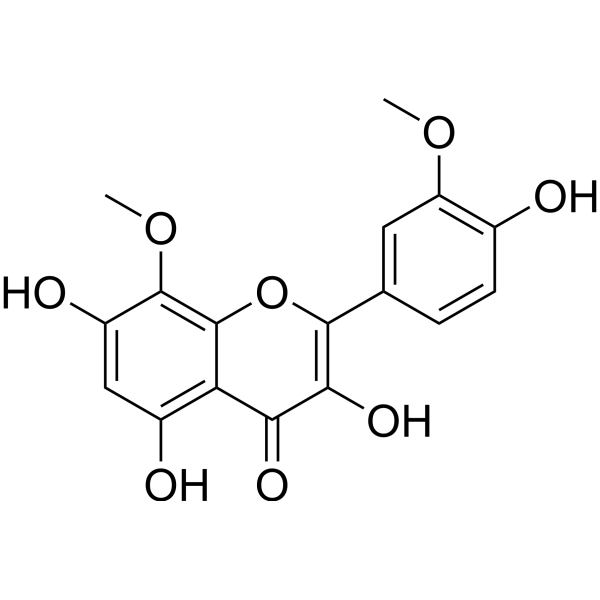
Limocitrin

Based on 1 Customer Validation
Limocitrin is a flavonol glycoside. Limocitrin inhibits AKT phosphorylation and JNK phosphorylation, upregulates p38 phosphorylation, and inhibits ERK1/2 phosphorylation, thereby blocking MAPK signaling. Limocitrin induces Apoptosis through the mitochondrial pathway, death receptor-mediated signaling, Caspase activation, and G2/M cell cycle arrest. Limocitrin possesses anti-inflammatory and anticancer properties. Limocitrin can be used for research on oral squamous cell carcinoma and chronic myeloid leukemia.
Nos produits utilisent uniquement pour la recherche. Nous ne vendons pas aux patients.
- Pureté : 99.58%
- CAS No.: 489-33-8
- Formule: C17H14O8
- Masse moléculaire:346.29
-
Stockage:
-20°C, protect from light
* In solvent : -80°C, 6 months; -20°C, 1 month (protect from light)

To place orders, for customer services and technical support, please contact: MedChemExpress USA
Tel: 609-228-6898 E-mail: [email protected] [email protected]


-
 Activité biologique
-
Chemical Information
- Protocole
- Pureté et documentation
- Références
-
 Help & FAQs


Voir tous les produits spécifiques à Isoform Caspase
More

Activité biologique
Description
IC50 & Target
[1]|
ERK1 |
ERK2 |
Cellular Effect
|
Cell Line

|
Type | Value | Description | References |
|---|---|---|---|---|
| Monocyte | IC50 |
67 μM
Compound: Limocitrin
|
Inhibition of TNFalpha expression in LPS-stimulated human monocytes treated 30 mins before LPS challenge measured after 14 hrs by ELISA
Inhibition of TNFalpha expression in LPS-stimulated human monocytes treated 30 mins before LPS challenge measured after 14 hrs by ELISA
|
[PMID: 10096854] |
In Vitro
Limocitrin (0-40 µM; 24 h) exerts a strong antiproliferative effect on SCC-9 and SCC-47 oral cancer cells by reducing colony formation[1].
Limocitrin (5-20 μM; 72 h) enhances the cytotoxicity of KHYG-1 cells against K562 cells[2].
Limocitrin (0-40 µM; 24 h) induces apoptosis in SCC-9 and SCC-47 oral cancer cells by modulating the expression of Bcl-2 family proteins and death receptor-related proteins[1].
Limocitrin (5-20 μM; 24 h) increases the protein expression of cytolytic effector molecules perforin, granzyme A and B, and granulysin in KHYG-1 cells[2].
Limocitrin (5-20 μM; 24 h) dose-dependently increases CREB phosphorylation and histone H3 acetylation in KHYG-1 cells[2].
Limocitrin (5-20 μM; 24 h) dose-dependently increases mitochondrial membrane depolarization in K562 cells co-cultured with KHYG-1 cells[2].
MedChemExpress (MCE) has not independently confirmed the accuracy of these methods. They are for reference only.
-
Cell Line:SCC-9 and SCC-47
-
Concentration:0, 10, 20, 40 µM
-
Incubation Time:24, 48, and 72 h
-
Result:Inhibited the viability of SCC-9 and SCC-47 cells in a concentration-dependent and time-dependent manner.
Found the effective dose to inhibit SCC-9 to be 40 µM at 48 h and 72 h treatment.
Inhibited only 40% of SCC-47 cell viability at 40 µM until 72 h treatment.
Showed a better cell inhibitory effect on SCC-9 cells than SCC-47 cells.
-
Cell Line:SCC-47 and SCC-9
-
Concentration:0, 10, 20, 40 µM
-
Incubation Time:24 h
-
Result:Dramatically reduced the number of colonies in SCC-9 and SCC-47 oral cancer cells in a concentration-dependent manner.
-
Cell Line:SCC-9 and SCC-47
-
Concentration:0, 10, 20, 40 µM
-
Incubation Time:24 h
-
Result:Increased the expression of pro-apoptotic proteins Bax and Bak and decreased the expression of anti-apoptotic proteins Bcl-xL and Bcl-2.
Increased the expression of Fas, DcR2, DcR3, and DR5 compared with the control group.
Slightly increased Fas and DR5 expression in both cancer cell lines.
Greatly increased DcR3 in SCC-9 cells.
Significantly increased DcR2 expression more than DcR3 expression in SCC-47 cells.\nDecreased Cyclin E1 and E2 expression and increased p21 expression in a dose-dependent manner.
Potently downregulated CDK2, CDK4, and CDK6 expression levels.\nResulted in dose-dependent inhibition of XIAP, cIAP-1, and pHSP-27 protein expression in SCC-9 and SCC-47 cells.
-
Cell Line:SCC-9 and SCC-47
-
Concentration:0, 10, 20, 40 µM
-
Incubation Time:24 h
-
Result:Significantly enhanced the apoptosis rates of SCC-9 and SCC-47 cells.
-
Cell Line:KHYG-1
-
Concentration:5-20 μM
-
Incubation Time:24 h
-
Result:Significantly increased the protein expressions of perforin, granzymes A and B, and granulysin.\nSignificantly and dose-dependently elevated the expression of phosphorylated CREB.
Significantly increased the expression of acetyl-histone H3.
- Kinase activity and phosphorylation assays
- Western Blot
- Detection of Apoptosis
- TUNEL staining for apoptotic DNA fragmentation
- Flow cytometric DNA-content cell-cycle staining
- Annexin V plus membrane-impermeant dye apoptosis staining
- BrdU Incorporation Assay
- Apoptosis Solutions
- Protocol for Cell Cycle
- Protocol for Kinase activity and phosphorylation assays
- Research Protocol for Inflammation-related Diseases


Chemical Information
-
CAS No. 489-33-8
-
Appearance Solid
-
Masse moléculaire 346.29
-
Formule C17H14O8
-
Color Light yellow to yellow
-
SMILES
O=C1C(O)=C(OC2=C(C(O)=CC(O)=C12)OC)C3=CC(OC)=C(C=C3)O
-
Structure Classification
-
Initial Source
-
Livraison
Room temperature in continental US; may vary elsewhere.
-
Stockage
-20°C, protect from light
* In solvent : -80°C, 6 months; -20°C, 1 month (protect from light)


Pureté et documentation
-
Fiche technique (289 KB)
-
SDS (252 KB)
- English - EN (252 KB)
- Français - FR (252 KB)
- Deutsch - DE (252 KB)
- Norwegian - NO (252 KB)
- Español - ES (252 KB)
- Swedish - SV (252 KB)
- Italian - IT (252 KB)
- Korean - KR (252 KB)
- Portuguese - PT (252 KB)
-
Instruction de manipulation (2659 KB)
Références

Calculators
Concentration (start) × Volume (start) = Concentration (final) × Volume (final)


Limocitrin Related Classifications
HY-119539 Related Classifications
 Powered by Bioz