



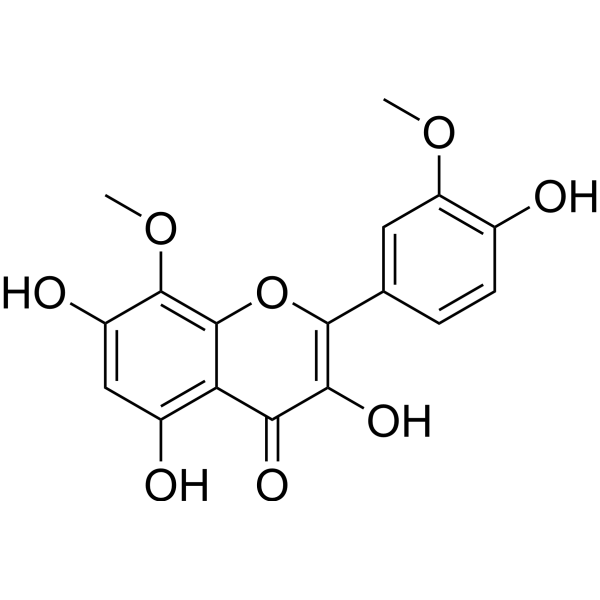
Limocitrin

Based on 1 Customer Validation
Limocitrin is a flavonol glycoside. Limocitrin inhibits AKT phosphorylation and JNK phosphorylation, upregulates p38 phosphorylation, and inhibits ERK1/2 phosphorylation, thereby blocking MAPK signaling. Limocitrin induces Apoptosis through the mitochondrial pathway, death receptor-mediated signaling, Caspase activation, and G2/M cell cycle arrest. Limocitrin possesses anti-inflammatory and anticancer properties. Limocitrin can be used for research on oral squamous cell carcinoma and chronic myeloid leukemia.
연구목적의 판매만을 진행합니다. 환자를 대상으로 한 판매는 하지 않습니다.
- Purity : 99.58%
- CAS No.: 489-33-8
- 화학식: C17H14O8
- 분자량:346.29
-
보관:
-20°C, protect from light
* In solvent : -80°C, 6 months; -20°C, 1 month (protect from light)

To place orders, for customer services and technical support, please contact: MedChemExpress USA
Tel: 609-228-6898 E-mail: [email protected] [email protected]


-
 Biological Activity
-
Chemical Information
- Protocol
- 순도&문서
- References
-
 Help & FAQs


All Caspase Isoforms
More

Biological Activity
제품 설명
IC50 & Target
[1]|
ERK1 |
ERK2 |
Cellular Effect
|
Cell Line

|
Type | Value | Description | References |
|---|---|---|---|---|
| Monocyte | IC50 |
67 μM
Compound: Limocitrin
|
Inhibition of TNFalpha expression in LPS-stimulated human monocytes treated 30 mins before LPS challenge measured after 14 hrs by ELISA
Inhibition of TNFalpha expression in LPS-stimulated human monocytes treated 30 mins before LPS challenge measured after 14 hrs by ELISA
|
[PMID: 10096854] |
In Vitro
Limocitrin (0-40 µM; 24 h) exerts a strong antiproliferative effect on SCC-9 and SCC-47 oral cancer cells by reducing colony formation[1].
Limocitrin (5-20 μM; 72 h) enhances the cytotoxicity of KHYG-1 cells against K562 cells[2].
Limocitrin (0-40 µM; 24 h) induces apoptosis in SCC-9 and SCC-47 oral cancer cells by modulating the expression of Bcl-2 family proteins and death receptor-related proteins[1].
Limocitrin (5-20 μM; 24 h) increases the protein expression of cytolytic effector molecules perforin, granzyme A and B, and granulysin in KHYG-1 cells[2].
Limocitrin (5-20 μM; 24 h) dose-dependently increases CREB phosphorylation and histone H3 acetylation in KHYG-1 cells[2].
Limocitrin (5-20 μM; 24 h) dose-dependently increases mitochondrial membrane depolarization in K562 cells co-cultured with KHYG-1 cells[2].
MedChemExpress (MCE) has not independently confirmed the accuracy of these methods. They are for reference only.
-
Cell Line:SCC-9 and SCC-47
-
Concentration:0, 10, 20, 40 µM
-
Incubation Time:24, 48, and 72 h
-
Result:Inhibited the viability of SCC-9 and SCC-47 cells in a concentration-dependent and time-dependent manner.
Found the effective dose to inhibit SCC-9 to be 40 µM at 48 h and 72 h treatment.
Inhibited only 40% of SCC-47 cell viability at 40 µM until 72 h treatment.
Showed a better cell inhibitory effect on SCC-9 cells than SCC-47 cells.
-
Cell Line:SCC-47 and SCC-9
-
Concentration:0, 10, 20, 40 µM
-
Incubation Time:24 h
-
Result:Dramatically reduced the number of colonies in SCC-9 and SCC-47 oral cancer cells in a concentration-dependent manner.
-
Cell Line:SCC-9 and SCC-47
-
Concentration:0, 10, 20, 40 µM
-
Incubation Time:24 h
-
Result:Increased the expression of pro-apoptotic proteins Bax and Bak and decreased the expression of anti-apoptotic proteins Bcl-xL and Bcl-2.
Increased the expression of Fas, DcR2, DcR3, and DR5 compared with the control group.
Slightly increased Fas and DR5 expression in both cancer cell lines.
Greatly increased DcR3 in SCC-9 cells.
Significantly increased DcR2 expression more than DcR3 expression in SCC-47 cells.\nDecreased Cyclin E1 and E2 expression and increased p21 expression in a dose-dependent manner.
Potently downregulated CDK2, CDK4, and CDK6 expression levels.\nResulted in dose-dependent inhibition of XIAP, cIAP-1, and pHSP-27 protein expression in SCC-9 and SCC-47 cells.
-
Cell Line:SCC-9 and SCC-47
-
Concentration:0, 10, 20, 40 µM
-
Incubation Time:24 h
-
Result:Significantly enhanced the apoptosis rates of SCC-9 and SCC-47 cells.
-
Cell Line:KHYG-1
-
Concentration:5-20 μM
-
Incubation Time:24 h
-
Result:Significantly increased the protein expressions of perforin, granzymes A and B, and granulysin.\nSignificantly and dose-dependently elevated the expression of phosphorylated CREB.
Significantly increased the expression of acetyl-histone H3.
- Kinase activity and phosphorylation assays
- Western Blot
- Detection of Apoptosis
- TUNEL staining for apoptotic DNA fragmentation
- Flow cytometric DNA-content cell-cycle staining
- Annexin V plus membrane-impermeant dye apoptosis staining
- BrdU Incorporation Assay
- Apoptosis Solutions
- Protocol for Cell Cycle
- Protocol for Kinase activity and phosphorylation assays
- Research Protocol for Inflammation-related Diseases


Chemical Information
-
CAS No. 489-33-8
-
Appearance Solid
-
분자량 346.29
-
화학식 C17H14O8
-
Color Light yellow to yellow
-
SMILES
O=C1C(O)=C(OC2=C(C(O)=CC(O)=C12)OC)C3=CC(OC)=C(C=C3)O
-
Structure Classification
-
Initial Source
-
선적
Room temperature in continental US; may vary elsewhere.
-
보관
-20°C, protect from light
* In solvent : -80°C, 6 months; -20°C, 1 month (protect from light)


순도&문서
-
Data Sheet (289 KB)
-
SDS (252 KB)
- English - EN (252 KB)
- Français - FR (252 KB)
- Deutsch - DE (252 KB)
- Norwegian - NO (252 KB)
- Español - ES (252 KB)
- Swedish - SV (252 KB)
- Italian - IT (252 KB)
- Korean - KR (252 KB)
- Portuguese - PT (252 KB)
-
Handling Instructions (2659 KB)
References

Calculators
Concentration (start) × Volume (start) = Concentration (final) × Volume (final)


Limocitrin Related Classifications
HY-119539 Related Classifications
 Powered by Bioz