



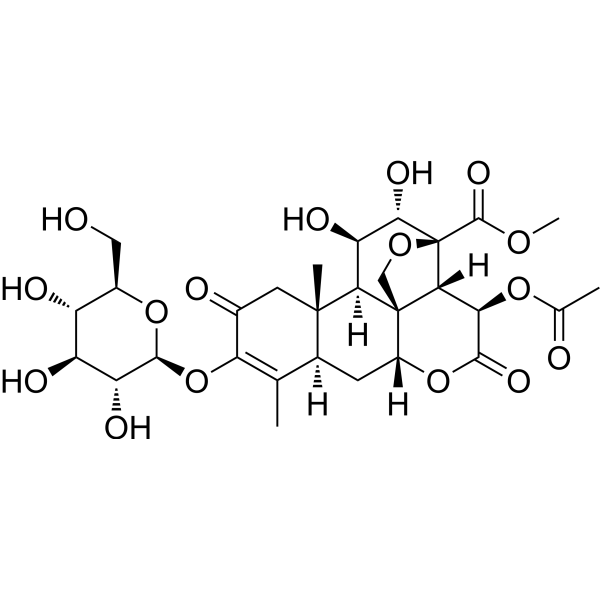
Yadanziolide A

Based on 1 Customer Validation
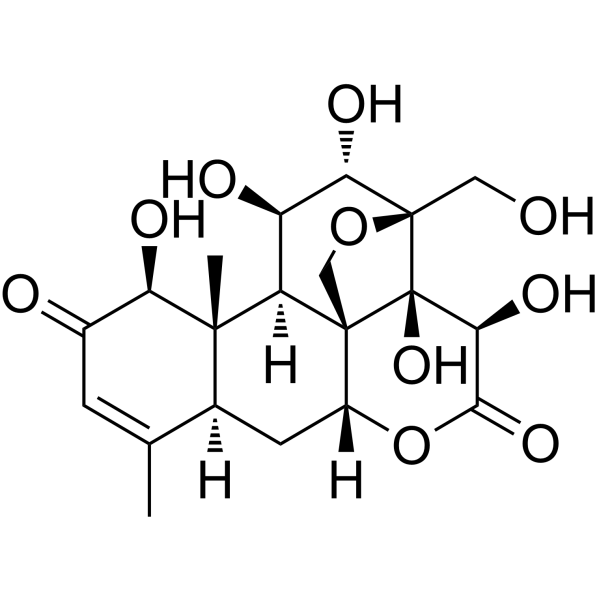
Yadanziolide A is an antiviral, antimalarial, and anticancer agent. Yadanziolide A can be isolated from Brucea javanica. Yadanziolide A inhibits STAT3 phosphorylation/activation and JAK2 phosphorylation, induces Apoptosis, and reduces TNF-alpha levels. Yadanziolide A exhibits antiplasmodial activity against Chloroquine (HY-17589A)-resistant Plasmodium falciparum. Yadanziolide A has nematocidal activity against Dipogasteridae larvae. Yadanziolide A has anti-TMV and anti-HIV-1 activities. Yadanziolide A can be used for research on hepatocellular carcinoma and type 2 diabetes.
For research use only. We do not sell to patients.
- Purity : 99.85%
- CAS No.: 95258-14-3
- Formula: C20H26O10
- Molecular Weight:426.41
-
Storage:Powder -20°C, 3 years , 4°C, 2 years ; In solvent -80°C, 6 months , -20°C, 1 month

To place orders, for customer services and technical support, please contact: MedChemExpress USA
Tel: 609-228-6898 E-mail: [email protected] [email protected]


-
 Biological Activity
-
Chemical Information
-
Solvent & Solubility
- Protocols
- Purity & Documentation
- References
-
 Help & FAQs





Biological Activity
Description
|
HIV-1 |
STAT3 |
JAK2 |
Cellular Effect
|
Cell Line

|
Type | Value | Description | References |
|---|---|---|---|---|
| HepG2 | IC50 |
300 nM
|
Cytotoxicity against human HepG2 hepatocellular carcinoma cells assessed as viability reduction incubated 24 hrs by CCK-8 assay.
Cytotoxicity against human HepG2 hepatocellular carcinoma cells assessed as viability reduction incubated 24 hrs by CCK-8 assay.
|
39056720 |
| Huh-7 | IC50 |
362 nM
|
Cytotoxicity against human Huh-7 hepatocellular carcinoma cells assessed as viability reduction incubated 24 hrs by CCK-8 assay.
Cytotoxicity against human Huh-7 hepatocellular carcinoma cells assessed as viability reduction incubated 24 hrs by CCK-8 assay.
|
39056720 |
| L02 | IC50 |
768 nM
|
Cytotoxicity against human HL-7702 normal liver cells assessed as viability reduction incubated 24 hrs by CCK-8 assay.
Cytotoxicity against human HL-7702 normal liver cells assessed as viability reduction incubated 24 hrs by CCK-8 assay.
|
39056720 |
In Vitro
Yadanziolide A (0.1-1 µM; 24 h) inhibits scratch-wound migration of HepG2 and LM-3 cells in a concentration-dependent manner within 24 h[3].
Yadanziolide A (0.1-1 µM) reduces Transwell migration and invasion of HepG2 and LM-3 cells[3].
Yadanziolide A (0.1-1 µM; 24 h) induces nuclear chromatin changes and apoptotic body formation in HepG2 and LM3 cells[3].
Yadanziolide A (0.1-1 µM) increases cleaved Caspase-3 and Caspase-8 in LM-3 and HepG2 cells and modulates Bcl-2/Bax[3].
Yadanziolide A (4 h) exhibits nematicidal activity against third-stage larvae of Diplogastridae, with an MLC of 1.6 mM[8].
MedChemExpress (MCE) has not independently confirmed the accuracy of these methods. They are for reference only.
-
Cell Line:HepG2, Huh-7, LM-3 hepatocellular carcinoma cells and HL-7702 normal liver cells
-
Concentration:0-10,000 nM
-
Incubation Time:24 h
-
Result:Dose-dependently reduced cell viability.
No significant proliferation inhibition was observed at 30 nM and 100 nM in HepG2 and Huh-7 cells; LM-3 showed approximately 20% inhibition at 100 nM.
IC50 values were 300 nM for HepG2, 362 nM for Huh-7, 171 nM for LM-3, and 768 nM for HL-7702.
-
Cell Line:LM-3 and HepG2 hepatocellular carcinoma cells
-
Concentration:0.1, 0.3, 1 µM
-
Incubation Time:24 h
-
Result:Higher concentrations increased early and late apoptotic cell populations in both cell lines.
At 1 µM, LM-3 cells showed more late apoptotic cells (18.4%) than early apoptotic cells (11.9%); HepG2 cells showed more early apoptotic cells (20.4%) than late apoptotic cells (14.6%).
In Vivo
MedChemExpress (MCE) has not independently confirmed the accuracy of these methods. They are for reference only.
-
Animal Model:C57BL/6 (male)[3]
-
Dosage:2 mg/kg (tumor growth); 2 mg/kg (serum biomarker cohorts)
-
Administration:i.p.; once daily for 14 days; once every two days for two weeks (serum biomarker cohorts)
-
Result:Suppressed tumor growth compared with the PBS control group.
Tumor/liver weight was lower than in the PBS control group.
H&E staining showed reduced liver tumor lesions.
Serum AST and ALT were lower than in controls.
Serum TNF-α and IL-6 were reduced.
Phosphorylated STAT3 was reduced in liver tumor tissues.
Phosphorylated JAK2 was also reduced in liver tumor tissue.
- Kinase activity and phosphorylation assays
- Research Protocol for Infectious Diseases
- Western Blot
- Detection of Apoptosis
- TUNEL staining for apoptotic DNA fragmentation
- Annexin V plus membrane-impermeant dye apoptosis staining
- Apoptosis Solutions
- Protocol for Kinase activity and phosphorylation assays
- Liver Cancer Modeling
- Research Protocol for Metabolic Diseases


Product Details
-
Structure Classification
-
Initial Source


Chemical Information
-
CAS No. 95258-14-3
-
Appearance Solid
-
Molecular Weight 426.41
-
Formula C20H26O10
-
Color White to off-white
-
SMILES
O[C@@]1([C@H]2O)[C@@]34[C@@]([C@@H](O)[C@H](O)[C@]1(OC4)CO)([H])[C@]([C@@](C(C)=CC5=O)([H])C[C@@]3([H])OC2=O)([C@@H]5O)C
-
Shipping
Room temperature in continental US; may vary elsewhere.
-
Storage
Powder -20°C 3 years 4°C 2 years In solvent -80°C 6 months -20°C 1 month


Solvent & Solubility
In Vitro:
DMSO : 100 mg/mL (234.52 mM; Need ultrasonic; Hygroscopic DMSO has a significant impact on the solubility of product, please use newly opened DMSO)
Please refer to the solubility information to select the appropriate solvent. Once prepared, please aliquot and store the solution to prevent product inactivation from repeated freeze-thaw cycles.
Storage method and period of stock solution: -80°C, 6 months; -20°C, 1 month. When stored at -80°C, please use it within 6 months. When stored at -20°C, please use it within 1 month.
Concentration (start) × Volume (start) = Concentration (final) × Volume (final)
In Vivo:
Select the appropriate dissolution method based on your experimental animal and administration route.
- For the following dissolution methods, please ensure to first prepare a clear stock solution using an In Vitro approach and then sequentially add co-solvents:
- To ensure reliable experimental results, the clarified stock solution can be appropriately stored based on storage conditions. As for the working solution for In Vivo experiments, it is recommended to prepare freshly and use it on the same day.
- The percentages shown for the solvents indicate their volumetric ratio in the final prepared solution. If precipitation or phase separation occurs during preparation, heat and/or sonication can be used to aid dissolution.
Add each solvent one by one: 10% DMSO 40% PEG300 5% Tween-80 45% Saline
Solubility: ≥ 2.5 mg/mL (5.86 mM); Clear solution
This protocol yields a clear solution of ≥ 2.5 mg/mL (saturation unknown).
Taking 1 mL working solution as an example, add 100 μL DMSO stock solution (25.0 mg/mL) to 400 μL PEG300, and mix evenly; then add 50 μL Tween-80 and mix evenly; then add 450 μL Saline to adjust the volume to 1 mL.
Preparation of Saline: Dissolve 0.9 g sodium chloride in ddH₂O and dilute to 100 mL to obtain a clear Saline solution.
Add each solvent one by one: 10% DMSO 90% (20% SBE-β-CD in Saline)
Solubility: ≥ 2.5 mg/mL (5.86 mM); Clear solution
This protocol yields a clear solution of ≥ 2.5 mg/mL (saturation unknown).
Taking 1 mL working solution as an example, add 100 μL DMSO stock solution (25.0 mg/mL) to 900 μL 20% SBE-β-CD in Saline, and mix evenly.
Preparation of 20% SBE-β-CD in Saline (4°C, storage for one week): 2 g SBE-β-CD powder is dissolved in 10 mL Saline, completely dissolve until clear.
In Vivo Dissolution Calculator
Please enter the basic information of animal experiments:
-
-
-
-
Recommended: Prepare an additional quantity of animals to account for potential losses during experiments.
Please enter your animal formula composition:
-
%DMSO +
Recommended: Keep the proportion of DMSO in working solution below 2% if your animal is weak.
-
%+
-
+%Tween-80 + +
-
%Saline +
The co-solvents required include: DMSO, . All of co-solvents are available by MedChemExpress (MCE). , Tween 80. All of co-solvents are available by MedChemExpress (MCE).
Working solution concentration: 0.22 mg/mL
Method for preparing stock solution: mg drug dissolved in μL DMSO. Stock solution concentration: mg/mL.
1. Take μL DMSO stock solution;
2. Add μL .
μL , mix evenly;
3. Then add μL Tween 80, mix evenly;
4. Then add μL
Please ensure that the stock solution in the first step is dissolved to a clear state, and add co-solvents in sequence. You can use ultrasonic heating (ultrasonic cleaner, recommended frequency 20-40 kHz), vortexing, etc. to assist dissolution.
Purity & Documentation


References
[1]. Yan XH, et al. Anti-tobacco mosaic virus (TMV) Quassinoids from Brucea javanica (L.) Merr. Journal of agricultural and food chemistry. 2010 Feb 10;58(3):1572-7. [Content Brief]
[2]. Bawn S. Studies on antitrypanosomal activity of medicinal plants (Doctoral dissertation, et al.
[7]. Anderson MM. Cytotoxic and antimalarial natural products. University of London, et al.

Complete Stock Solution Preparation Table
Please refer to the solubility information to select the appropriate solvent. Once prepared, please aliquot and store the solution to prevent product inactivation from repeated freeze-thaw cycles.
Storage method and period of stock solution: -80°C, 6 months; -20°C, 1 month. When stored at -80°C, please use it within 6 months. When stored at -20°C, please use it within 1 month.
| Optional Solvent | Concentration Solvent Mass | 1 mg | 5 mg | 10 mg | 25 mg |
|---|---|---|---|---|---|
| DMSO | 1 mM | 2.3452 mL | 11.7258 mL | 23.4516 mL | 58.6290 mL |
| 5 mM | 0.4690 mL | 2.3452 mL | 4.6903 mL | 11.7258 mL | |
| 10 mM | 0.2345 mL | 1.1726 mL | 2.3452 mL | 5.8629 mL | |
| 15 mM | 0.1563 mL | 0.7817 mL | 1.5634 mL | 3.9086 mL | |
| 20 mM | 0.1173 mL | 0.5863 mL | 1.1726 mL | 2.9315 mL | |
| 25 mM | 0.0938 mL | 0.4690 mL | 0.9381 mL | 2.3452 mL | |
| 30 mM | 0.0782 mL | 0.3909 mL | 0.7817 mL | 1.9543 mL | |
| 40 mM | 0.0586 mL | 0.2931 mL | 0.5863 mL | 1.4657 mL | |
| 50 mM | 0.0469 mL | 0.2345 mL | 0.4690 mL | 1.1726 mL | |
| 60 mM | 0.0391 mL | 0.1954 mL | 0.3909 mL | 0.9772 mL | |
| 80 mM | 0.0293 mL | 0.1466 mL | 0.2931 mL | 0.7329 mL | |
| 100 mM | 0.0235 mL | 0.1173 mL | 0.2345 mL | 0.5863 mL |


Yadanziolide A Related Classifications
HY-N4210 Related Classifications
 Powered by Bioz
Keywords
- Yadanziolide A
- 95258-14-3
- TMV
- STAT
- JAK
- Apoptosis
- TNF Receptor
- Parasite
- HIV
- Tobacco mosaic virus
- Janus kinase
- Tumor Necrosis Factor Receptor
- TNFR
- Human immunodeficiency virus
- HIV-1
- JAK2
- Plasmodium falciparum
- STAT3
- apoptosis
- cell invasion
- cell migration
- hepatocellular carcinoma
- tobacco mosaic virus
- tumor cell proliferation
- Inhibitor
- inhibitor
- inhibit