



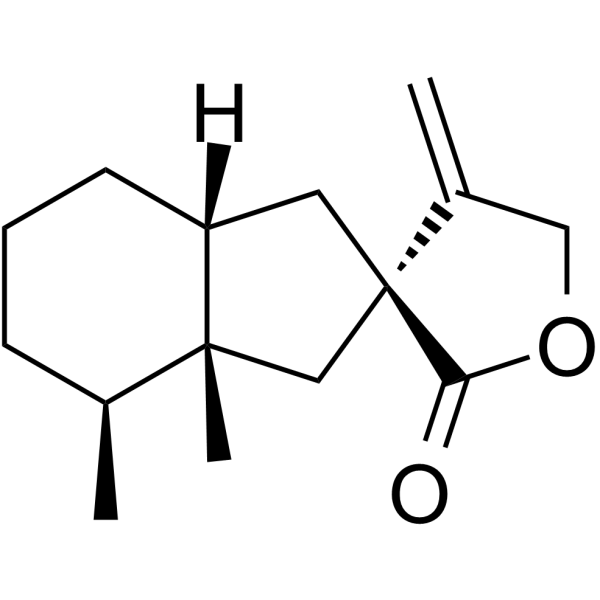
Bakkenolide A

Based on 1 Customer Validation
Bakkenolide A is an anticancer agent. Bakkenolide A reduces the viability of leukemia cells, inhibits cell colony formation and invasion, and downregulates the expression of HDAC3 in cells. Bakkenolide A downregulates the expression of pro-inflammatory cytokines including TNF-α, interleukins such as IL-1β, TGF-β1 and IFN-γ, as well as the expression of PI3K, PDK and PKC in leukemia cells. Bakkenolide A downregulates activated Akt, GSK and Bad, while upregulates Cyto-c, cleaved Caspase3 and cleaved Caspase7, induces apoptosis (apoptosis) in leukemia cells and thereby inhibits inflammatory responses in leukemia cells. Bakkenolide A significantly slows the growth of subcutaneous leukemia tumors in nude mice. Bakkenolide A is applicable to leukemia-related research.
Nur für Forschungszwecke. Wir verkaufen nicht an Patienten.
- Reinheit : 99.99%
- CAS. Nr.: 19906-72-0
- Formel: C15H22O2
- Molecular Weight:234.33
-
Speicherung:
4°C, protect from light
* In solvent : -80°C, 6 months; -20°C, 1 month (protect from light)

To place orders, for customer services and technical support, please contact: MedChemExpress USA
Tel: 609-228-6898 E-mail: [email protected] [email protected]


-
 Biologische Aktivität
-
Chemical Information
-
Lösungsmittel & Löslichkeit
- Protokoll
- Reinheit & Dokumentation
- Verweise
-
 Help & FAQs


Alle TNF Receptor Isoform-spezifische Produkte anzeigen
MoreAlle Caspase Isoform-spezifische Produkte anzeigen
More

Biologische Aktivität
Beschreibung
In Vitro
Bakkenolide A (50-250 μM; 8-80 h) reduces the viability of human leukemia K562 cells, inhibits cell colony formation and invasion, and downregulates the mRNA and protein expression of HDAC3 in cells[1].
Bakkenolide A (200 μM; 48 h) significantly downregulates the expression of proinflammatory cytokines TNF-α, IL-1β, IL-18, IL-6, IL-8, IL-2, TGF-β1, IFN-γ and IL-17, as well as the expression of PI3K, PDK and PKC, in human leukemia K562 cells[1].
Bakkenolide A (200 μM; 48 h) induces apoptosis in human leukemia K562 cells by downregulating activated Akt, GSK and Bad, while upregulating cytochrome c (Cyto-c), cleaved Caspase3 and cleaved Caspase7[1].
MedChemExpress (MCE) has not independently confirmed the accuracy of these methods. They are for reference only.
-
Cell Line:human leukemia K562 cells
-
Concentration:50, 100,
150, 200 and 250 mM (48 h viability assay); 200 μM (time-dependent viability assay) -
Incubation Time:48 h (50, 100, 150, 250 μM); 8, 16, 24, 32, 40, 48, 56, 64, 72 and 80 h (200 μM)
-
Result:Reduced K562 cell viability in a time-dependent manner at 200 μM, with significant inhibition observed at 48 h and later time points.
Reduced K562 cell viability at 50, 100, 150, 200, and 250 μM for 48 h, with the most stable and effective inhibition seen at 200 μM.
-
Cell Line:human leukemia K562 cells
-
Concentration:200 μM
-
Incubation Time:48 h
-
Result:Significantly reduced HDAC3 mRNA expression in K562 cells to levels similar to those seen in HDAC3-knockdown K562 cells.
-
Cell Line:human leukemia K562 cells
-
Concentration:200 μM
-
Incubation Time:48 h
-
Result:Significantly reduced the invasive capacity of K562 cells, with relative invasion rates reduced to levels similar to those seen in HDAC3-knockdown K562 cells.
-
Cell Line:human leukemia K562 cells
-
Concentration:200 μM
-
Incubation Time:48 h
-
Result:Significantly reduced protein expression of TNF-α, IL-1β, and IL-18 in K562 cells.
-
Cell Line:human leukemia K562 cells
-
Concentration:200 μM
-
Incubation Time:48 h
-
Result:Significantly reduced PI3K expression in K562 cells.
-
Cell Line:human leukemia K562 cells
-
Concentration:200 μM
-
Incubation Time:48 h
-
Result:Significantly accelerated apoptosis in K562 cells via flow cytometry.
Reduced activated (phosphorylated) Akt, GSK, and Bad protein expression in K562 cells.
Increased Cyto-c, cleaved Caspase3, and cleaved Caspase7 protein expression in K562 cells.
In Vivo
MedChemExpress (MCE) has not independently confirmed the accuracy of these methods. They are for reference only.
-
Animal Model:Balb/c nude mice[1]
-
Dosage:200 μM pre-treatment of K562 cells (5 x 10⁶ per mouse)
-
Administration:s.c., single administration
-
Result:Significantly slowed the growth of subcutaneous leukemia tumors in Balb/c nude mice, reduced HDAC3 expression levels in tumor tissues, increased caspase3 levels, and decreased the final tumor weight of mice after sacrifice.
- RNA extraction experimental
- Annexin V plus membrane-impermeant dye apoptosis staining
- Research Protocol for Inflammation-related Diseases
- Colony Formation (Clonogenic) Assay
- Cell Viability Determination by MTT Colorimetric Assay
- How to Select the Route of Administration for Mammals
- Detection of Apoptosis
- TUNEL staining for apoptotic DNA fragmentation
- LPS-Induced Endotoxemia/Systemic Inflammation
- Apoptosis Solutions
- Cell invasion
- Soft Agar Colony Formation Assay
- Pyroptosis Solutions


Chemical Information
-
CAS. Nr. 19906-72-0
-
Appearance Solid
-
Molecular Weight 234.33
-
Formel C15H22O2
-
Color White to off-white
-
SMILES
O=C([C@@]12C[C@@]3([H])CCC[C@H](C)[C@@]3(C)C2)OCC1=C
-
Structure Classification
-
Versand
Room temperature in continental US; may vary elsewhere.
-
Speicherung
4°C, protect from light
* In solvent : -80°C, 6 months; -20°C, 1 month (protect from light)


Lösungsmittel & Löslichkeit
In Vitro:
DMSO : 50 mg/mL (213.37 mM; Need ultrasonic; Hygroscopic DMSO has a significant impact on the solubility of product, please use newly opened DMSO)
Please refer to the solubility information to select the appropriate solvent. Once prepared, please aliquot and store the solution to prevent product inactivation from repeated freeze-thaw cycles.
Storage method and period of stock solution: -80°C, 6 months; -20°C, 1 month (protect from light). When stored at -80°C, please use it within 6 months. When stored at -20°C, please use it within 1 month.
Please refer to the solubility information to select the appropriate solvent. Once prepared, please aliquot and store the solution to prevent product inactivation from repeated freeze-thaw cycles.
Storage method and period of stock solution: -80°C, 6 months; -20°C, 1 month (protect from light). When stored at -80°C, please use it within 6 months. When stored at -20°C, please use it within 1 month.
Konzentration (Stammlösung) × Volumen (Stammlösung) = Konzentration (Ziellösung) × Volumen (Ziellösung)
In Vivo:
Select the appropriate dissolution method based on your experimental animal and administration route.
- For the following dissolution methods, please ensure to first prepare a clear stock solution using an In Vitro approach and then sequentially add co-solvents:
- To ensure reliable experimental results, the clarified stock solution can be appropriately stored based on storage conditions. As for the working solution for In Vivo experiments, it is recommended to prepare freshly and use it on the same day.
- The percentages shown for the solvents indicate their volumetric ratio in the final prepared solution. If precipitation or phase separation occurs during preparation, heat and/or sonication can be used to aid dissolution.
Add each solvent one by one: 10% DMSO 40% PEG300 5% Tween-80 45% Saline
Solubility: ≥ 1.25 mg/mL (5.33 mM); Clear solution
This protocol yields a clear solution of ≥ 1.25 mg/mL (saturation unknown).
Taking 1 mL working solution as an example, add 100 μL DMSO stock solution (12.5 mg/mL) to 400 μL PEG300, and mix evenly; then add 50 μL Tween-80 and mix evenly; then add 450 μL Saline to adjust the volume to 1 mL.
Preparation of Saline: Dissolve 0.9 g sodium chloride in ddH₂O and dilute to 100 mL to obtain a clear Saline solution.
Add each solvent one by one: 10% DMSO 90% (20% SBE-β-CD in Saline)
Solubility: ≥ 1.25 mg/mL (5.33 mM); Clear solution
This protocol yields a clear solution of ≥ 1.25 mg/mL (saturation unknown).
Taking 1 mL working solution as an example, add 100 μL DMSO stock solution (12.5 mg/mL) to 900 μL 20% SBE-β-CD in Saline, and mix evenly.
Preparation of 20% SBE-β-CD in Saline (4°C, storage for one week): 2 g SBE-β-CD powder is dissolved in 10 mL Saline, completely dissolve until clear.
In Vivo Dissolution Calculator
Please enter the basic information of animal experiments:
-
-
-
-
Recommended: Prepare an additional quantity of animals to account for potential losses during experiments.
Please enter your animal formula composition:
-
%DMSO +
Recommended: Keep the proportion of DMSO in working solution below 2% if your animal is weak.
-
%+
-
+%Tween-80 + +
-
%Saline +
The co-solvents required include: DMSO, . All of co-solvents are available by MedChemExpress (MCE). , Tween 80. All of co-solvents are available by MedChemExpress (MCE).
Working solution concentration: 0.22 mg/mL
Method for preparing stock solution: mg drug dissolved in μL DMSO. Stock solution concentration: mg/mL. * In solvent : -80°C, 6 months; -20°C, 1 month (protect from light)
1. Take μL DMSO stock solution;
2. Add μL .
μL , mix evenly;
3. Then add μL Tween 80, mix evenly;
4. Then add μL
Please ensure that the stock solution in the first step is dissolved to a clear state, and add co-solvents in sequence. You can use ultrasonic heating (ultrasonic cleaner, recommended frequency 20-40 kHz), vortexing, etc. to assist dissolution.


Reinheit & Dokumentation
-
Data Sheet (286 KB)
-
SDS (252 KB)
- English - EN (252 KB)
- Français - FR (252 KB)
- Deutsch - DE (252 KB)
- Norwegian - NO (252 KB)
- Español - ES (252 KB)
- Swedish - SV (252 KB)
- Italian - IT (252 KB)
- Korean - KR (252 KB)
- Portuguese - PT (252 KB)
-
Handling Instructions (2659 KB)
Verweise


Complete Stock Solution Preparation Table
Please refer to the solubility information to select the appropriate solvent. Once prepared, please aliquot and store the solution to prevent product inactivation from repeated freeze-thaw cycles.
Storage method and period of stock solution: -80°C, 6 months; -20°C, 1 month (protect from light). When stored at -80°C, please use it within 6 months. When stored at -20°C, please use it within 1 month.
| Optional Solvent | Concentration Solvent Mass | 1 mg | 5 mg | 10 mg | 25 mg |
|---|---|---|---|---|---|
| DMSO | 1 mM | 4.2675 mL | 21.3374 mL | 42.6749 mL | 106.6871 mL |
| 5 mM | 0.8535 mL | 4.2675 mL | 8.5350 mL | 21.3374 mL | |
| 10 mM | 0.4267 mL | 2.1337 mL | 4.2675 mL | 10.6687 mL | |
| 15 mM | 0.2845 mL | 1.4225 mL | 2.8450 mL | 7.1125 mL | |
| 20 mM | 0.2134 mL | 1.0669 mL | 2.1337 mL | 5.3344 mL | |
| 25 mM | 0.1707 mL | 0.8535 mL | 1.7070 mL | 4.2675 mL | |
| 30 mM | 0.1422 mL | 0.7112 mL | 1.4225 mL | 3.5562 mL | |
| 40 mM | 0.1067 mL | 0.5334 mL | 1.0669 mL | 2.6672 mL | |
| 50 mM | 0.0853 mL | 0.4267 mL | 0.8535 mL | 2.1337 mL | |
| 60 mM | 0.0711 mL | 0.3556 mL | 0.7112 mL | 1.7781 mL | |
| 80 mM | 0.0533 mL | 0.2667 mL | 0.5334 mL | 1.3336 mL | |
| 100 mM | 0.0427 mL | 0.2134 mL | 0.4267 mL | 1.0669 mL |


Bakkenolide A Related Classifications
HY-N6017 Related Classifications
 Powered by Bioz