



Bocodepsin
Based on 1 Customer Validation
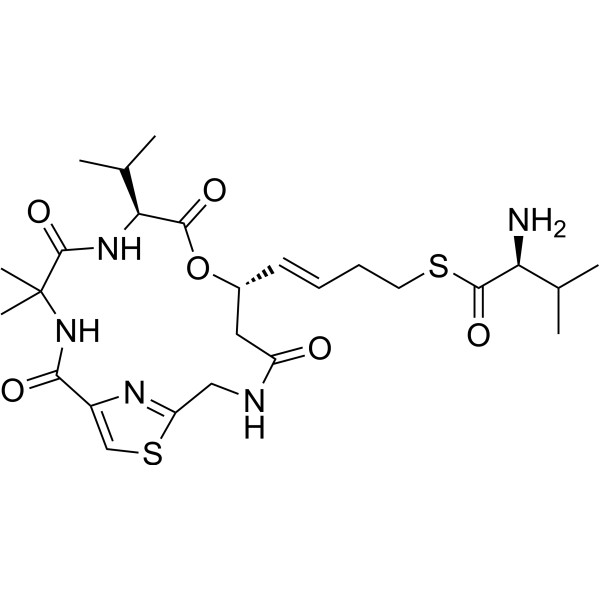
Bocodepsin (OKI-179) is an orally active class I HDAC inhibitor. Bocodepsin is metabolized in vivo to the active metabolite OKI-006 (HY-144893), which then targets and inhibits class I HDAC (HDAC-1, 2, 3, 8), activating the apoptosis pathway by increasing the acetylation levels of histone H3 and p21 (upregulating BIM, decreasing BCL-XL, and inducing Caspase-3 cleavage), while also upregulating the expression of MHC class I and class II molecules and PD-L1 on tumor cells in the immune microenvironment, thereby increasing intratumoral CD4+ and CD8+ T cell infiltration and restoring their antitumor immunity. Bocodepsin can be used for research on colorectal cancer, triple-negative breast cancer, and B-cell lymphoma.
Nos produits utilisent uniquement pour la recherche. Nous ne vendons pas aux patients.
- Pureté : 98.01%
- CAS No.: 1834513-65-3
- Formule: C26H39N5O6S2
- Masse moléculaire:581.75
-
Stockage:Powder -20°C, 3 years ; In solvent -80°C, 6 months , -20°C, 1 month

To place orders, for customer services and technical support, please contact: MedChemExpress USA
Tel: 609-228-6898 E-mail: [email protected] [email protected]


-
 Activité biologique
-
Chemical Information
- Protocole
- Pureté et documentation
- Références
-
 Help & FAQs


Voir tous les produits spécifiques à Isoform Caspase
More

Activité biologique
Description
|
HDAC1 |
HDAC2 |
HDAC3 |
HDAC8 |
Caspase-3 |
Bcl-xL |
Bim |
MHC I |
MHC II |
In Vitro
Bocodepsin (500 nM; 16 h) significantly upregulates PD-L1 transcriptional expression in G1XP mouse B-cell lymphoma cells and OCI-Ly7 human B-cell lymphoma cells[3].
Bocodepsin (250 nM-1 μM; 24 h) upregulates HLA-A, B, C in OCI-Ly3 and OCI-Ly7 human B-cell lymphoma cell lines, and upregulates HLA-DP, DQ, DR in OCI-Ly3 cells[3].
MedChemExpress (MCE) has not independently confirmed the accuracy of these methods. They are for reference only.
-
Cell Line:Mouse G1XP lymphoma cells
-
Concentration:250 nM, 500 nM, 1 μM
-
Incubation Time:24; 48 h
-
Result:Inhibited G1XP lymphoma growth in a dose-dependent manner.
-
Cell Line:Mouse G1XP lymphoma cells
-
Concentration:250 nM, 500 nM, 1 μM
-
Incubation Time:24; 48 h
-
Result:Arrested cells at G0-G1 and reduced the S-phase percentage; pH3 was reduced, with pH3+ values of 0.44% at 500 nM and 0.31% at 1 μM.
-
Cell Line:Mouse G1XP lymphoma cells
-
Concentration:250 nM, 500 nM, 1 μM
-
Incubation Time:24; 48 h
-
Result:Cleaved caspase-3+ G1-phase cells were 2.33% with vehicle, 4.90% at 250 nM, 9.66% at 500 nM, and 33.5% at 1 μM; G2-phase values were 0.59%, 2.74%, 3.15%, and 6.68%, respectively.
Western blot showed induction of cleaved caspase-3.
-
Cell Line:Primary murine T cells
-
Concentration:100 nM, 250 nM, 500 nM, 1 μM
-
Incubation Time:72 h
-
Result:Did not affect the proliferation and activation status of CD4+ and CD8+ T cells.
In Vivo
Bocodepsin (120 mg/kg; p.o.; once every other day; 24 days) inhibits tumor growth in the HCT-116 colorectal cancer xenograft mouse model[1].
Bocodepsin (40-80 mg/kg; p.o.; once daily; 17 days) inhibits tumor growth in the MDA-MB-231 triple-negative breast cancer xenograft mouse model[1].
Bocodepsin (120 mg/kg; p.o.; once every other day; 17 days) inhibits tumor growth in the MDA-MB-231 triple-negative breast cancer xenograft mouse model[1].
Bocodepsin (40-80 mg/kg; p.o.; once daily; continuous administration for 3 or 10 days) upregulates intratumoral histone H3 acetylation levels in the MDA-MB-231 triple-negative breast cancer xenograft mouse model[1].
Bocodepsin (60 mg/kg; p.o.; 5 days on, 2 days off) further inhibits tumor growth and significantly improves survival in the MCF-7 estrogen receptor-positive breast cancer xenograft mouse model (in combination with Tamoxifen (HY-13757A))[1].
Bocodepsin (80 mg/kg; p.o.; once daily; 36 days) inhibits tumor growth, reduces the production of tumor senescence markers (SA-β-gal), downregulates Ki67, and increases cleaved-caspase 3 expression in the MDA-MB-231 triple-negative breast cancer xenograft mouse model (alone or in combination with Doxorubicin (HY-15142))[2].
MedChemExpress (MCE) has not independently confirmed the accuracy of these methods. They are for reference only.
-
Animal Model:BALB/c nude[1]
-
Dosage:40 mg/kg; 80 mg/kg; 120 mg/kg
-
Administration:p.o.; once daily (40 and 80 mg/kg); every other day (120 mg/kg); 24 days
-
Result:Decreased HCT-116 tumor growth at day 24 with 40 mg/kg daily, 80 mg/kg daily, and 120 mg/kg every other day.
-
Animal Model:BALB/c nude[1]
-
Dosage:40 mg/kg; 60 mg/kg; 80 mg/kg; 120 mg/kg
-
Administration:p.o.; once daily (40, 60, and 80 mg/kg); every other day (120 mg/kg); 3-10 days (pharmacodynamic cohort); 17 days
-
Result:Produced tumor growth inhibition in the MDA-MB-231 xenograft at higher doses.
Acetylated histone H3 increased in MDA-MB-231 xenografts; the increase was greatest after 10 days compared with 3 days and greater at 60-80 mg/kg compared with 40 mg/kg.
Acetylated α-tubulin showed no consistent changes, with small increases at some dose levels.
-
Animal Model:Hsd: Athymic Nude-Foxn1nu (female, 12-13 weeks of age)[2]
-
Dosage:80 mg/kg (alone or with Doxorubicin 1.5 mg/kg)
-
Administration:p.o. once daily; i.p.; 36 days
-
Result:Increased in vivo senescence by SA-β-gal staining.
The combination with doxorubicin produced relatively minimal tumor growth compared with either single agent, and after 36 days the combination reduced specific growth rate compared with the single-agent group.
The combination limited senescence emergence in vivo and was associated with decreased Ki67 and increased cleaved-caspase 3.


Chemical Information
-
CAS No. 1834513-65-3
-
Appearance Solid
-
Masse moléculaire 581.75
-
Formule C26H39N5O6S2
-
Color White to off-white
-
SMILES
O=C1C2=CSC(CNC(C[C@H](OC([C@@H](NC(C(C)(N1)C)=O)C(C)C)=O)/C=C/CCSC([C@@H](N)C(C)C)=O)=O)=N2
-
Synonyms
OKI-179
-
Livraison
Room temperature in continental US; may vary elsewhere.
-
Stockage
Powder -20°C 3 years In solvent -80°C 6 months -20°C 1 month


Pureté et documentation
-
Fiche technique (287 KB)
-
SDS (251 KB)
- English - EN (251 KB)
- Français - FR (251 KB)
- Deutsch - DE (251 KB)
- Norwegian - NO (251 KB)
- Español - ES (251 KB)
- Swedish - SV (251 KB)
- Italian - IT (251 KB)
- Korean - KR (251 KB)
- Portuguese - PT (251 KB)
-
Instruction de manipulation (2659 KB)
Références
[1]. Diamond JR, et al. Preclinical Development of the Class-I-Selective Histone Deacetylase Inhibitor OKI-179 for the Treatment of Solid Tumors. Molecular cancer therapeutics. 2022 Mar 01;21(3):397-406. [Content Brief]
[2]. Smoots SG, et al. Overcoming doxorubicin resistance in triple-negative breast cancer using the class I-targeting HDAC inhibitor bocodepsin/OKI-179 to promote apoptosis. Breast Cancer Res. 2024 Mar 1;26(1):35. [Content Brief]

Calculators
Concentration (start) × Volume (start) = Concentration (final) × Volume (final)


Bocodepsin Related Classifications
HY-156602 Related Classifications
 Powered by Bioz
Keywords
- Bocodepsin
- 1834513-65-3
- OKI-179
- OKI179
- OKI 179
- HDAC
- Apoptosis
- Bcl-2 Family
- Caspase
- MHC
- PD-1/PD-L1
- Histone deacetylases
- Major Histocompatibility Complex
- PD-1/Programmed death-ligand 1
- HDAC inhibitor
- HDAC3
- PD-L1
- acetylated histones
- apoptosis
- cell-cycle arrest
- class I HDACs
- class IIb HDACs
- class IV HDACs
- senescence
- Inhibitor
- inhibitor
- inhibit