



Ecliptasaponin A

Based on 1 Customer Validation
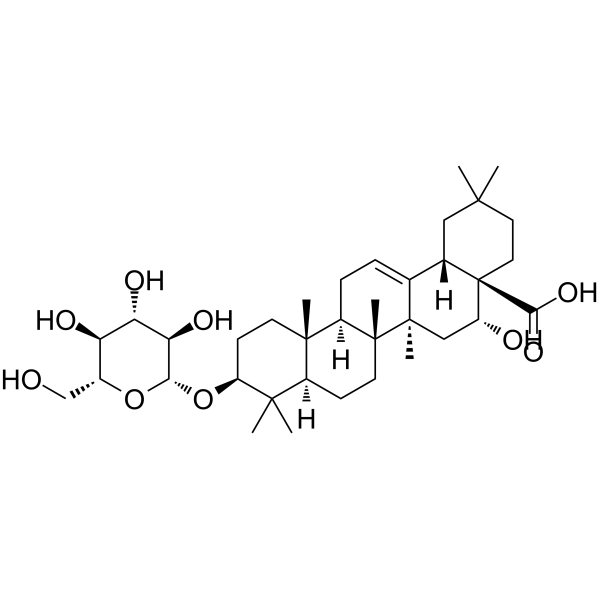
Ecliptasaponin A is an orally active pentacyclic triterpenoid saponin. Ecliptasaponin A exerts anti-tumor activity by activating ASK1/JNK pathway, inducing apoptosis and autophagy in lung cancer cells. Ecliptasaponin A exerts anti-inflammatory/anti-fibrotic effects and protects the cardiovascular system by inhibiting the HMGB1/TLR4/NF-κB pathway, and the expression of COX-2 and MMP-9. Ecliptasaponin A can enhance SOD activity, reduce MDA levels, and alleviate oxidative stress damage. Ecliptasaponin A exerts chondroprotective effects by inhibiting the expression of MMP13 and regulating inflammatory factors. Ecliptasaponin A improves ovarian function and regulates sex hormones by upregulating the expression of ESR1 receptors.
For research use only. We do not sell to patients.
- Purity : 99.81%
- CAS No.: 78285-90-2
- Formula: C36H58O9
- Molecular Weight:634.84
-
Storage:
4°C, protect from light
* In solvent : -80°C, 6 months; -20°C, 1 month (protect from light)

To place orders, for customer services and technical support, please contact: MedChemExpress USA
Tel: 609-228-6898 E-mail: [email protected] [email protected]


-
 Biological Activity
-
Chemical Information
-
Solvent & Solubility
- Protocols
- Purity & Documentation
- References
-
 Help & FAQs




Biological Activity
Description
|
MMP-9 |
MMP-13 |
MMP-2 |
NF-κB |
COX-2 |
TLR4 |
In Vitro
Ecliptasaponin A (5-20 μM) inhibits the HMGB1/TLR4/NF-κB pathway to play a protective role on H9C2 cells of oxygen-glucose deprivation (OGD)[3].
Ecliptasaponin A (0-120 μM, 24-48 h) exhibits dose- and time-dependent inhibition of H460 and H1975 cells viability and colony formation ability[4].
Ecliptasaponin A (0-30 μM, 24 h) induces apoptosis through the activation of ASK1/JNK pathway and autophagy in H460 and H1975 cells[4].
Ecliptasaponin A (5-30 μM, 48 h) inhibits ECM and MMP13 expression in human kidney-2 (HK-2) cells induced by transforming growth factor-beta1 (TGFβ1)[5].
Ecliptasaponin A (0-25 μM) targets the protein ESR1 to increase the viability and reduce apoptosis in Cyclophosphamide (HY-17420)-induced damage in AW-CCH252 cells[6].
Ecliptasaponin A (10-50 ng/mL, 25 h) shows the reduced expression of all osteoarthritis -related molecules in IL-1β-stimulated SW1353 cells[7].
MedChemExpress (MCE) has not independently confirmed the accuracy of these methods. They are for reference only.
-
Cell Line:H460 and H1975 cells
-
Concentration:0, 20, 40, 60, 80, 100 and 120 μM
-
Incubation Time:24 and 48 h
-
Result:Significantly induced cell death in both dose-dependent and time-dependent ways.
-
Cell Line:H460 and H1975 cells
-
Concentration:0, 10, 20 and 30 μM
-
Incubation Time:24 h
-
Result:Dose-dependently increased the proportion of apoptotic cells, with early apoptosis (Annexin V+/PI-) being the predominant type.
Displayed typical apoptotic features: nuclear shrinkage, chromatin condensation, nuclear fragmentation, and the formation of apoptotic bodies.
-
Cell Line:H460 and H1975 cells
-
Concentration:0, 10, 20 and 30 μM
-
Incubation Time:24 h
-
Result:Increased the Caspase-3/8/9 cleavage products and PARP cleavage.
Increased the LC3-II/I ratio, upregulated Beclin-1 expression, and accelerated the degradation of p62.
Increased the expression of p-ASK1 and p-JNK, and decreased the expression of p-ERK.
-
Cell Line:HK-2 cells
-
Concentration:20 nM
-
Incubation Time:48 h
-
Result:Inhibited the protein expression of ECM proteins such as FN, Col-1, Col-3, and CTGF.
Specifically inhibited MMP13 rather than MMP10.
Inhibited Col-1, α-SMA, and CTGF.
-
Cell Line:HK-2 cells
-
Concentration:5, 10, 15, 20, 25, 30 nM
-
Incubation Time:48 h
-
Result:Decreased the expression of type I collagen in a concentration-dependent manner.
Inhibited the gene expression of ECM proteins such as FN, Col-1, Col-3, and CTGF.
Significantly inhibited the mRNA expression of MMP10 (not obvious) and MMP13.
-
Cell Line:SW1353 cells
-
Concentration:10, 30, 50 ng/mL
-
Incubation Time:Pretreated at 1 h before IL-1β stimulation (24 h) for 25 h
-
Result:Decreased the mRNA expression of OA-related molecules (MMP13, TNF-α, IL-1β, COX1/2).
-
Cell Line:SW1353 cells
-
Concentration:10, 30, 50 ng/mL
-
Incubation Time:Pretreated at 1 h before IL-1β stimulation (24 h) for 25 h
-
Result:Decreased the protein expression of OA-related molecules (MMP13, Collagen type II, TNF-α, IL-1β, and COX-2).
Parmacokinetics
In Vivo
Ecliptasaponin A (80 mg/kg, p.o., once daily for 28 days) prevents the fibrosis in mice via inhibiting TGF-β1 expression[2].
Ecliptasaponin A (0.5-2.5 mg/kg, intramyocardial injection of the left ventricular myocardium, single dose) demonstrates a cardiac protective role in acute myocardial infarction (AMI) model in mice[3].
Ecliptasaponin A (25-50 mg/kg, i.p., for 21 days) causes a clear suppression of tumor growth in lung cancer-bearing nude mice[4].
Ecliptasaponin A (80 mg/kg, p.o., once daily for 10 days) reduces the renal collagen fiber deposition and renal extracellular matrix (ECM) protein expression in renal fibrosis unilateral ureteral obstruction (UUO) mice[5].
Ecliptasaponin A (200 mg/mL with Specnuezhenide (HY-N0665), p.o., once daily for 30 days) improves the basal characteristics and sex hormone levels premature ovarian failure (POF) mice[6].
MedChemExpress (MCE) has not independently confirmed the accuracy of these methods. They are for reference only.
-
Animal Model:Pulmonary fibrosis model induced by Bleomycin (HY-108345) established in adult male ICR mice (6-7 weeks)[2]
-
Dosage:80 mg/kg
-
Administration:Oral administration (p.o.), once daily for 28 days
-
Result:Blocked BLM-induced histological changes of lung tissue.
Decreased the high levels of TGF-β1 and α-SMA.
-
Animal Model:AMI model induced by underwent left anterior descending coronary artery (LAD) ligation established in male SPF C57/BL6 mice, aged 8-10 weeks and weighing 23-25 g[3]
-
Dosage:0.5, 1.25, and 2.5 mg/kg
-
Administration:Intramyocardial injection of the left ventricular myocardium, single dose
-
Result:Significantly improved ejection fraction (EF%) and short-axis shortening rate (FS%).
Significantly reduced the area of myocardial infarction.
Reduced myocardial cell apoptosis and inflammatory cell infiltration.
Significantly reduced the expressions of HMGB1 and TLR4, as well as the phosphorylation of p-IkBα and p-P65, and the levels of inflammatory factors IL-1β, IL-6, and TNF-α.
Significantly enriched HMGB1/TLR4/NF-κB pathway.
-
Animal Model:H460 cells induced xenograft tumor model established in male BALB-c nude mice (4-week-old)[4]
-
Dosage:25 and 50 mg/kg
-
Administration:Intraperitoneal injection (i.p.), for 21 days
-
Result:Decreased the tumor weight and volume.
No significant biological toxicity.
-
Animal Model:Renal fibrosis UUO model established in six-week-old C57BL/6 J mice[5]
-
Dosage:80 mg/kg
-
Administration:Oral administration (p.o.), once daily for 10 days
-
Result:Ameliorated the obstructive kidney weight ratio.
Attenuated histological damage and collagen deposition in the kidneys.
-
Animal Model:POF model established in SPF-grade female C57 mice, 6-8 weeks[6]
-
Dosage:200 mg/mL with Specnuezhenide
-
Administration:Oral administration (p.o.), once daily for 30 days
-
Result:Increased the ovarian index and serum estradiol (E2) levels.
Reduced the level of follicle-stimulating hormone (FSH).
Extended the emotional cycle.
Increased the number and diameter of follicles.
Promoted ovarian angiogenesis (increase the expression of CD31 and VEGFA).
- RNA extraction experimental
- Detection of Apoptosis
- TUNEL staining for apoptotic DNA fragmentation
- Mitochondrial membrane-potential fluorescent assay
- Annexin V plus membrane-impermeant dye apoptosis staining
- ROS/oxidative-stress fluorescent staining
- Autophagy
- Mitochondrial membrane-potential and mitochondrial mass staining
- Apoptosis Solutions
- Lysosome and acidic-vesicle live-cell staining
- Research Protocol for Inflammation-related Diseases
- Macroautophagy Solutions


Chemical Information
-
CAS No. 78285-90-2
-
Appearance Solid
-
Molecular Weight 634.84
-
Formula C36H58O9
-
Color White to off-white
-
SMILES
CC1(C)[C@@H](O[C@H]2[C@@H]([C@H]([C@@H]([C@@H](CO)O2)O)O)O)CC[C@]3(C)[C@@]4([H])CC=C5[C@]6([H])CC(C)(C)CC[C@@](C(O)=O)6[C@H](O)C[C@](C)5[C@@](C)4CC[C@@]13[H]
-
Structure Classification
-
Initial Source
-
Shipping
Room temperature in continental US; may vary elsewhere.
-
Storage
4°C, protect from light
* In solvent : -80°C, 6 months; -20°C, 1 month (protect from light)


Solvent & Solubility
In Vitro:
DMSO : 100 mg/mL (157.52 mM; Need ultrasonic; Hygroscopic DMSO has a significant impact on the solubility of product, please use newly opened DMSO)
Please refer to the solubility information to select the appropriate solvent. Once prepared, please aliquot and store the solution to prevent product inactivation from repeated freeze-thaw cycles.
Storage method and period of stock solution: -80°C, 6 months; -20°C, 1 month (protect from light). When stored at -80°C, please use it within 6 months. When stored at -20°C, please use it within 1 month.
Please refer to the solubility information to select the appropriate solvent. Once prepared, please aliquot and store the solution to prevent product inactivation from repeated freeze-thaw cycles.
Storage method and period of stock solution: -80°C, 6 months; -20°C, 1 month (protect from light). When stored at -80°C, please use it within 6 months. When stored at -20°C, please use it within 1 month.
Concentration (start) × Volume (start) = Concentration (final) × Volume (final)
In Vivo:
Select the appropriate dissolution method based on your experimental animal and administration route.
- For the following dissolution methods, please ensure to first prepare a clear stock solution using an In Vitro approach and then sequentially add co-solvents:
- To ensure reliable experimental results, the clarified stock solution can be appropriately stored based on storage conditions. As for the working solution for In Vivo experiments, it is recommended to prepare freshly and use it on the same day.
- The percentages shown for the solvents indicate their volumetric ratio in the final prepared solution. If precipitation or phase separation occurs during preparation, heat and/or sonication can be used to aid dissolution.
Add each solvent one by one: 10% DMSO 90% (20% SBE-β-CD in Saline)
Solubility: ≥ 2.5 mg/mL (3.94 mM); Clear solution
This protocol yields a clear solution of ≥ 2.5 mg/mL (saturation unknown).
Taking 1 mL working solution as an example, add 100 μL DMSO stock solution (25.0 mg/mL) to 900 μL 20% SBE-β-CD in Saline, and mix evenly.
Preparation of 20% SBE-β-CD in Saline (4°C, storage for one week): 2 g SBE-β-CD powder is dissolved in 10 mL Saline, completely dissolve until clear.
In Vivo Dissolution Calculator
Please enter the basic information of animal experiments:
-
-
-
-
Recommended: Prepare an additional quantity of animals to account for potential losses during experiments.
Please enter your animal formula composition:
-
%DMSO +
Recommended: Keep the proportion of DMSO in working solution below 2% if your animal is weak.
-
%+
-
+%Tween-80 + +
-
%Saline +
The co-solvents required include: DMSO, . All of co-solvents are available by MedChemExpress (MCE). , Tween 80. All of co-solvents are available by MedChemExpress (MCE).
Working solution concentration: 0.22 mg/mL
Method for preparing stock solution: mg drug dissolved in μL DMSO. Stock solution concentration: mg/mL. * In solvent : -80°C, 6 months; -20°C, 1 month (protect from light)
1. Take μL DMSO stock solution;
2. Add μL .
μL , mix evenly;
3. Then add μL Tween 80, mix evenly;
4. Then add μL
Please ensure that the stock solution in the first step is dissolved to a clear state, and add co-solvents in sequence. You can use ultrasonic heating (ultrasonic cleaner, recommended frequency 20-40 kHz), vortexing, etc. to assist dissolution.


Purity & Documentation
-
Data Sheet (292 KB)
-
SDS (252 KB)
- English - EN (252 KB)
- Français - FR (252 KB)
- Deutsch - DE (252 KB)
- Norwegian - NO (252 KB)
- Español - ES (252 KB)
- Swedish - SV (252 KB)
- Italian - IT (252 KB)
- Korean - KR (252 KB)
- Portuguese - PT (252 KB)
-
Handling Instructions (2659 KB)
References
[1]. Du G, et al. Validated UPLC-MS/MS method for quantification of seven compounds in rat plasma and tissues: Application to pharmacokinetic and tissue distribution studies in rats after oral administration of extract of Eclipta prostrata L. Biomed Chromatogr. 2018 Jun;32(6):e4191. [Content Brief]
[3]. Ge S, et al. Ecliptasaponin A protects heart against acute ischemia-induced myocardial injury by inhibition of the HMGB1/TLR4/NF-κB pathway. J Ethnopharmacol. 2024 Dec 5;335:118612. [Content Brief]
[4]. Han J, et al Ecliptasaponin A induces apoptosis through the activation of ASK1/JNK pathway and autophagy in human lung cancer cells. Ann Transl Med. 2019 Oct;7(20):539. [Content Brief]
[5]. Li X, Dong W, Yang Y, Ren S, Wang X, Zou M, Lu W, Liu L, Xue Y. Ecliptasaponin A attenuates renal fibrosis by regulating the extracellular matrix of renal tubular cells. In Vitro Cell Dev Biol Anim. 2023 Oct;59(9):684-696. doi: 10.1007/s11626-023-00803-0. Epub 2023 Oct 13. PMID: 37831322; PMCID: PMC10709264. [Content Brief]
[6]. Xu J, et al. Specnuezhenide and ecliptasaponin A from Ligustrum lucidum Ait and Ecliptae Herba improved premature ovarian failure by targeting the ESR1. J Pharmacol Sci. 2025 May;158(1):13-26. [Content Brief]
[7]. Hong GU, et al. Inhibition of Osteoarthritis-Related Molecules by Isomucronulatol 7-O-β-d-glucoside and Ecliptasaponin A in IL-1β-Stimulated Chondrosarcoma Cell Model. Molecules. 2018 Oct 29;23(11):2807. [Content Brief]


Complete Stock Solution Preparation Table
Please refer to the solubility information to select the appropriate solvent. Once prepared, please aliquot and store the solution to prevent product inactivation from repeated freeze-thaw cycles.
Storage method and period of stock solution: -80°C, 6 months; -20°C, 1 month (protect from light). When stored at -80°C, please use it within 6 months. When stored at -20°C, please use it within 1 month.
| Optional Solvent | Concentration Solvent Mass | 1 mg | 5 mg | 10 mg | 25 mg |
|---|---|---|---|---|---|
| DMSO | 1 mM | 1.5752 mL | 7.8760 mL | 15.7520 mL | 39.3800 mL |
| 5 mM | 0.3150 mL | 1.5752 mL | 3.1504 mL | 7.8760 mL | |
| 10 mM | 0.1575 mL | 0.7876 mL | 1.5752 mL | 3.9380 mL | |
| 15 mM | 0.1050 mL | 0.5251 mL | 1.0501 mL | 2.6253 mL | |
| 20 mM | 0.0788 mL | 0.3938 mL | 0.7876 mL | 1.9690 mL | |
| 25 mM | 0.0630 mL | 0.3150 mL | 0.6301 mL | 1.5752 mL | |
| 30 mM | 0.0525 mL | 0.2625 mL | 0.5251 mL | 1.3127 mL | |
| 40 mM | 0.0394 mL | 0.1969 mL | 0.3938 mL | 0.9845 mL | |
| 50 mM | 0.0315 mL | 0.1575 mL | 0.3150 mL | 0.7876 mL | |
| 60 mM | 0.0263 mL | 0.1313 mL | 0.2625 mL | 0.6563 mL | |
| 80 mM | 0.0197 mL | 0.0984 mL | 0.1969 mL | 0.4922 mL | |
| 100 mM | 0.0158 mL | 0.0788 mL | 0.1575 mL | 0.3938 mL |


Ecliptasaponin A Related Classifications
HY-N1508 Related Classifications
 Powered by Bioz