



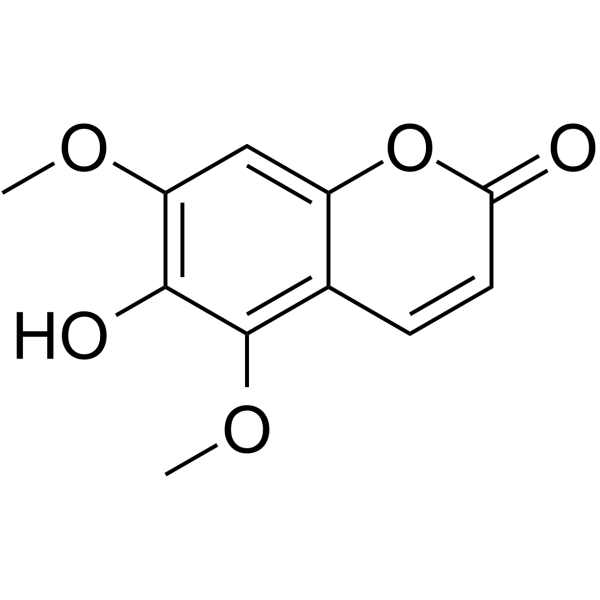
Fraxinol
Based on 1 publication(s) in Google Scholar
Fraxinol is an orally active, naturally derived coumarin. Fraxinol downregulates ACE and AT1R, upregulates ACE2 and MasR, and inhibits NLRP3 inflammasome activation and downstream ASC/caspase signaling, apoptosis, and inflammatory cytokine secretion, thereby alleviating LPS-induced acute lung injury. Fraxinol promotes melanogenesis through the PKA/CREB/MITF pathway. Fraxinol exhibits insecticidal activity against Agrilus planipennis larvae. Fraxinol can be used in research on acute lung injury, vitiligo, and the control of Agrilus planipennis larval infestation.
For research use only. We do not sell to patients.
- Purity : 98.82%
- CAS No.: 486-28-2
- Formula: C11H10O5
- Molecular Weight:222.19
-
Storage:
4°C, sealed storage, away from moisture and light
* In solvent : -80°C, 6 months; -20°C, 1 month (sealed storage, away from moisture and light)

To place orders, for customer services and technical support, please contact: MedChemExpress USA
Tel: 609-228-6898 E-mail: [email protected] [email protected]


-
 Biological Activity
-
Chemical Information
-
Solvent & Solubility
- Protocols
- Purity & Documentation
- References
-
 Help & FAQs




Biological Activity
Description
IC50 & Target
[1]|
TNF-α |
IL-1β |
ACE |
Caspase-1 |
NLRP3 |
Cellular Effect
|
Cell Line

|
Type | Value | Description | References |
|---|---|---|---|---|
| U-937 | CC50 |
>2 mM
Compound: BA-10, fraxinol
|
Cytotoxicity against human U937 cells after 48 hrs by trypan blue assay
Cytotoxicity against human U937 cells after 48 hrs by trypan blue assay
|
[PMID: 19716307] |
| U-937 | IC50 |
>400 μM
Compound: BA-10, fraxinol
|
Growth inhibition of human U937 cells assessed as [3H]5-methyl thymidine incorporation after 48 hrs by liquid scintillation counting
Growth inhibition of human U937 cells assessed as [3H]5-methyl thymidine incorporation after 48 hrs by liquid scintillation counting
|
[PMID: 19716307] |
In Vitro
Fraxinol (100 µM) upregulates TYR, TRP1, TRP2, and MITF mRNA expression in B16-F10 cells; increases MITF protein expression[2].
Fraxinol (100 µM; 48 h) increases TRP1 protein expression in B16-F10 cells, while not significantly increasing TYR or TRP2 protein[2].
Fraxinol (100 µM; 4-24 h) increases CREB phosphorylation and MITF expression in B16-F10 cells[2].
Fraxinol (100 µM) induces CREB/MITF/TRP1 signaling in B16-F10 cells, and this effect is attenuated by PKA inhibition[2].
MedChemExpress (MCE) has not independently confirmed the accuracy of these methods. They are for reference only.
-
Cell Line:Raw264.7 murine macrophages
-
Concentration:5, 10, and 25 µM
-
Incubation Time:48 h (after 6 h exposure to 100 ng/mL LPS)
-
Result:Reduced TNF-α and IL-1β levels in a dose-dependent manner.
-
Cell Line:Raw264.7 murine macrophages
-
Concentration:5, 10, and 25 µM
-
Incubation Time:48 h (after 6 h exposure to 100 ng/mL LPS)
-
Result:Inhibited apoptosis in a dose-dependent manner.
MLN-4760 and A779 promoted apoptosis and reversed the anti-apoptotic effect.
-
Cell Line:Raw264.7 murine macrophages
-
Concentration:5, 10, and 25 µM
-
Incubation Time:48 h (after 6 h exposure to 100 ng/mL LPS)
-
Result:Attenuated LPS-induced ACE and AT1R upregulation and ACE2 and MasR downregulation.
MLN-4760 and A779 reversed these effects.\nSuppressed LPS-induced NLRP3, ASC, and cleaved caspase-1 upregulation and restored pro-caspase-1.
-
Cell Line:B16-F10 mouse melanoma cells
-
Concentration:20, 40, 60, 80, 100 µM
-
Incubation Time:48 h
-
Result:Caused no significant changes in cell viability at any tested concentration.
-
Cell Line:B16-F10 mouse melanoma cells
-
Concentration:100 µM
-
Incubation Time:48 h
-
Result:Enhanced TRP1 protein expression after 48 h.
-
Cell Line:B16-F10 mouse melanoma cells
-
Concentration:100 µM
-
Incubation Time:4 h (CREB)
24 h (MITF) -
Result:Increased CREB phosphorylation and MITF expression in B16-F10 cells.
In Vivo
MedChemExpress (MCE) has not independently confirmed the accuracy of these methods. They are for reference only.
-
Animal Model:BALB/c (male, 22-25 g, were intratracheally injected with 10 lg of LPS in 50 μL PBS)[1]
-
Dosage:20 mg/kg; 40 mg/kg; 80 mg/kg
-
Administration:i.p.; single administration after intratracheal LPS; 12 h
-
Result:Attenuated LPS‑triggered acute lung injury, apoptosis and NLRP3 inflammasome activation in a dose‑dependent manner, regulated the ACE‑Ang II‑AT1R/ACE2‑Ang (1‑7)‑MasR axis, reduced lung wet/dry ratio, MPO activity, BALF total protein, TNF‑α, IL‑1β, NLRP3, ASC and cleaved caspase‑1, and restored pro‑caspase‑1.
-
Animal Model:laboratory-reared colony (fourth-instar larvae)[3]
-
Dosage:10 mg/g artificial diet
-
Administration:oral (dietary); continuous exposure
-
Result:Induced time‑dependent larval mortality and characteristic pathological phenotypes, disrupted midgut microbiota composition with enrichment of Serratia marcescens, triggered severe midgut histological injury, elevated midgut ROS, and altered the expression of multiple gut‑associated and immune genes.
-
Animal Model:laboratory-reared colony (fourth-instar larvae)[3]
-
Dosage:10 mg/g artificial diet
-
Administration:oral (dietary); continuous exposure
-
Result:Exhibited larval mortality by day 30, and co‑exposure with Serratia marcescens accelerated and aggravated lethality, while stressed larvae showed reduced body weight.


Product Details
-
Structure Classification
-
Initial Source


Chemical Information
-
CAS No. 486-28-2
-
Appearance Solid
-
Molecular Weight 222.19
-
Formula C11H10O5
-
Color Light yellow to yellow
-
SMILES
O=C1C=CC2=C(OC)C(O)=C(OC)C=C2O1
-
Shipping
Room temperature in continental US; may vary elsewhere.
-
Storage
4°C, sealed storage, away from moisture and light
* In solvent : -80°C, 6 months; -20°C, 1 month (sealed storage, away from moisture and light)


Publications (1)
-
Journal Impact Factor
-
Most Recent
-
Pharm Biol
Fraxinol attenuates LPS-induced acute lung injury by equilibrating ACE-Ang II-AT1R and ACE2-Ang (1-7)-Mas and inhibiting NLRP3. [Abstract]2022 Dec;60(1):979-989. PMID: 35588103


Solvent & Solubility
In Vitro:
DMSO : 25 mg/mL (112.52 mM; ultrasonic and warming and heat to 60°C; Hygroscopic DMSO has a significant impact on the solubility of product, please use newly opened DMSO)
Please refer to the solubility information to select the appropriate solvent. Once prepared, please aliquot and store the solution to prevent product inactivation from repeated freeze-thaw cycles.
Storage method and period of stock solution: -80°C, 6 months; -20°C, 1 month (sealed storage, away from moisture and light). When stored at -80°C, please use it within 6 months. When stored at -20°C, please use it within 1 month.
Concentration (start) × Volume (start) = Concentration (final) × Volume (final)
In Vivo:
Select the appropriate dissolution method based on your experimental animal and administration route.
- For the following dissolution methods, please ensure to first prepare a clear stock solution using an In Vitro approach and then sequentially add co-solvents:
- To ensure reliable experimental results, the clarified stock solution can be appropriately stored based on storage conditions. As for the working solution for In Vivo experiments, it is recommended to prepare freshly and use it on the same day.
- The percentages shown for the solvents indicate their volumetric ratio in the final prepared solution. If precipitation or phase separation occurs during preparation, heat and/or sonication can be used to aid dissolution.
Add each solvent one by one: 10% DMSO 40% PEG300 5% Tween-80 45% Saline
Solubility: ≥ 2.5 mg/mL (11.25 mM); Clear solution
This protocol yields a clear solution of ≥ 2.5 mg/mL (saturation unknown).
Taking 1 mL working solution as an example, add 100 μL DMSO stock solution (25.0 mg/mL) to 400 μL PEG300, and mix evenly; then add 50 μL Tween-80 and mix evenly; then add 450 μL Saline to adjust the volume to 1 mL.
Preparation of Saline: Dissolve 0.9 g sodium chloride in ddH₂O and dilute to 100 mL to obtain a clear Saline solution.
Add each solvent one by one: 10% DMSO 90% (20% SBE-β-CD in Saline)
Solubility: ≥ 2.5 mg/mL (11.25 mM); Clear solution
This protocol yields a clear solution of ≥ 2.5 mg/mL (saturation unknown).
Taking 1 mL working solution as an example, add 100 μL DMSO stock solution (25.0 mg/mL) to 900 μL 20% SBE-β-CD in Saline, and mix evenly.
Preparation of 20% SBE-β-CD in Saline (4°C, storage for one week): 2 g SBE-β-CD powder is dissolved in 10 mL Saline, completely dissolve until clear.
In Vivo Dissolution Calculator
Please enter the basic information of animal experiments:
-
-
-
-
Recommended: Prepare an additional quantity of animals to account for potential losses during experiments.
Please enter your animal formula composition:
-
%DMSO +
Recommended: Keep the proportion of DMSO in working solution below 2% if your animal is weak.
-
%+
-
+%Tween-80 + +
-
%Saline +
The co-solvents required include: DMSO, . All of co-solvents are available by MedChemExpress (MCE). , Tween 80. All of co-solvents are available by MedChemExpress (MCE).
Working solution concentration: 0.22 mg/mL
Method for preparing stock solution: mg drug dissolved in μL DMSO. Stock solution concentration: mg/mL. * In solvent : -80°C, 6 months; -20°C, 1 month (sealed storage, away from moisture and light)
1. Take μL DMSO stock solution;
2. Add μL .
μL , mix evenly;
3. Then add μL Tween 80, mix evenly;
4. Then add μL
Please ensure that the stock solution in the first step is dissolved to a clear state, and add co-solvents in sequence. You can use ultrasonic heating (ultrasonic cleaner, recommended frequency 20-40 kHz), vortexing, etc. to assist dissolution.
Purity & Documentation


References

Complete Stock Solution Preparation Table
Please refer to the solubility information to select the appropriate solvent. Once prepared, please aliquot and store the solution to prevent product inactivation from repeated freeze-thaw cycles.
Storage method and period of stock solution: -80°C, 6 months; -20°C, 1 month (sealed storage, away from moisture and light). When stored at -80°C, please use it within 6 months. When stored at -20°C, please use it within 1 month.
| Optional Solvent | Concentration Solvent Mass | 1 mg | 5 mg | 10 mg | 25 mg |
|---|---|---|---|---|---|
| DMSO | 1 mM | 4.5007 mL | 22.5033 mL | 45.0065 mL | 112.5163 mL |
| 5 mM | 0.9001 mL | 4.5007 mL | 9.0013 mL | 22.5033 mL | |
| 10 mM | 0.4501 mL | 2.2503 mL | 4.5007 mL | 11.2516 mL | |
| 15 mM | 0.3000 mL | 1.5002 mL | 3.0004 mL | 7.5011 mL | |
| 20 mM | 0.2250 mL | 1.1252 mL | 2.2503 mL | 5.6258 mL | |
| 25 mM | 0.1800 mL | 0.9001 mL | 1.8003 mL | 4.5007 mL | |
| 30 mM | 0.1500 mL | 0.7501 mL | 1.5002 mL | 3.7505 mL | |
| 40 mM | 0.1125 mL | 0.5626 mL | 1.1252 mL | 2.8129 mL | |
| 50 mM | 0.0900 mL | 0.4501 mL | 0.9001 mL | 2.2503 mL | |
| 60 mM | 0.0750 mL | 0.3751 mL | 0.7501 mL | 1.8753 mL | |
| 80 mM | 0.0563 mL | 0.2813 mL | 0.5626 mL | 1.4065 mL | |
| 100 mM | 0.0450 mL | 0.2250 mL | 0.4501 mL | 1.1252 mL |


Fraxinol Related Classifications
HY-N2372 Related Classifications
 Powered by Bioz
Keywords
- Fraxinol
- 486-28-2
- Insecticide
- Apoptosis
- TNF Receptor
- Interleukin Related
- Angiotensin-converting Enzyme (ACE)
- NOD-like Receptor (NLR)
- Caspase
- Tyrosinase
- TRP Channel
- Microphthalmia Associated Transcription Factor (MITF)
- Tumor Necrosis Factor Receptor
- TNFR
- IL
- Transient receptor potential channels
- Microphthalmia Associated Transcription Factor
- Mas receptor
- NLRP3 inflammasome
- acute lung injury
- angiotensin II receptor type 1
- angiotensin-converting enzyme
- angiotensin-converting enzyme 2
- apoptosis
- emerald ash borer
- melanogenesis
- vitiligo
- Inhibitor
- inhibitor
- inhibit