



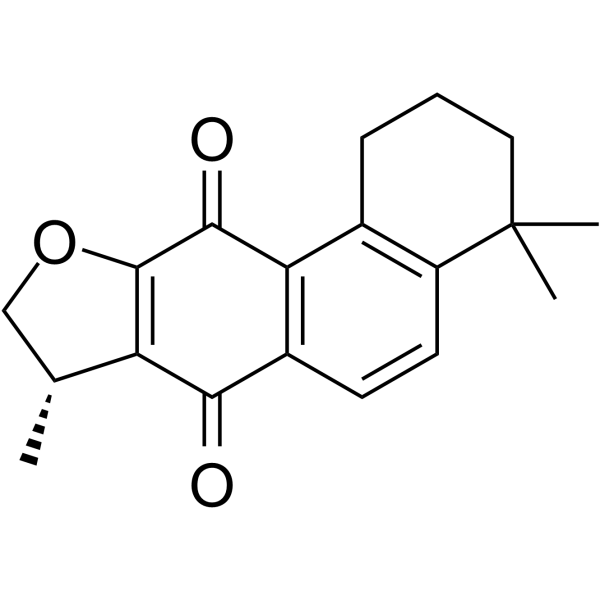
Isocryptotanshinone

Based on 1 Customer Validation
Isocryptotanshinone is a dual STAT3 and PTP1B (IC50 = 56.1 μM) inhibitor. Isocryptotanshinone inhibits STAT3 by binding to the STAT3 SH2 domain to block phosphorylation and nuclear translocation[1][2]. Isocryptotanshinone exerts its anti-proliferative effect via the induction of cell cycle arrest, apoptosis, and pro-death autophagy, through the regulation of STAT3, AKT/mTOR and MAPK signaling pathways. Isocryptotanshinone suppresses the xenograft gastric cancer (GC) tumor growth in BALB/c nude mice. Isocryptotanshinone can be used for cancer research, such as lung cancer, breast cancer and GC.
For research use only. We do not sell to patients.
- Purity : 98%
- CAS No.: 22550-15-8
- Formula: C19H20O3
- Molecular Weight:296.36
-
Storage:Powder -20°C, 3 years , 4°C, 2 years ; In solvent -80°C, 6 months , -20°C, 1 month

To place orders, for customer services and technical support, please contact: MedChemExpress USA
Tel: 609-228-6898 E-mail: [email protected] [email protected]


-
 Biological Activity
-
Chemical Information
- Protocols
- Purity & Documentation
- References
-
 Help & FAQs




Biological Activity
Description
|
STAT3 |
PTP1B 56.1 μM (IC50) |
In Vitro
Isocryptotanshinone (ICTS) (0-5 μM, 0-24 h) inhibits the constitutive STAT3 and p-STAT3 expression in A549 cells in a concentration- and time-dependent manner[1].
Isocryptotanshinone (5 μM, 12 h) decreases STAT3 in the cytoplasm and p-STAT3 in nucleus in A549 cells[1].
Isocryptotanshinone (5 μM, 0-4 h) inhibits the IL-6 (25 ng/mL)-stimulated expression of p-STAT3 in A549 cells in a time-dependent manner and almost completely abolishes p-STAT3 expression after 4 h[1].
Isocryptotanshinone (0-10 μM, 0-24 h) attenuates the expression of survival-related proteins (Bcl-2, Bcl-xL, survivin, Mcl-1) in a time-dependent manner, and suppresses the expression of upstream regulators (EGFR and JAK2) in a concentration-dependent manner[1].
Isocryptotanshinone (0-20 μM, 0-24 h) significantly inhibits the proliferation of A549 and 95D lung cancer cells in a concentration-dependent manner and induces apoptosis in A549 cells by remarkably increasing early apoptotic cell fractions, caspase 3/7 activity, and the expression of cleaved PARP[1].
Isocryptotanshinone (0-10 μM, 0-24 h) induces pro-death autophagy in A549 cells by upregulating LC3II expression, promoting the accumulation of autophagic vacuoles and autolysosomes, and inhibiting the AKT/mTOR signaling pathway, similar to Cryptotanshinone (HY-N0174)[1].
Isocryptotanshinone (0-20 μM, 24 h) inhibits proliferation (IC50 = 12.5 μM) and colony formation in MCF-7 cells by inducing G1 phase cell cycle arrest and triggering early apoptosis[3].
Isocryptotanshinone (2.5-10 μM, 0-24 h) triggers MAPK signaling activation in MCF-7 cells, which is characterized by the time- and concentration-dependent phosphorylation of JNK, ERK, and p38 MAPK[3].
Isocryptotanshinone (0-40 μM, 0-72 h) suppressed the proliferation of GC cells, with IC50 of 6.77 μM for SGC-7901 cells and 33.1 μM for MKN-45 cells[4].
Isocryptotanshinone (0-40 μM, 24 h) induces G1/G0 phase cell cycle arrest and apoptosis in GC cells (SGC-7901 and MKN-45), an effect mediated through the inhibition of the STAT3 signaling pathway and the subsequent downregulation of cell cycle- and apoptosis-associated proteins (Cyclin D1, E2F1, Mcl-1, Bcl-2, survivin)[4].
MedChemExpress (MCE) has not independently confirmed the accuracy of these methods. They are for reference only.
-
Cell Line:MCF-7 cells
-
Concentration:2.5, 5 and 10 μM
-
Incubation Time:0, 1, 3, 6, 12, and 24 h
-
Result:Induced phosphorylation of JNK (p-JNK), ERK (p-ERK), and p38 (p-p38) in MCF-7 cells without affecting total JNK, ERK, or p38, in a time- and concentration-dependent manner.
Increased the phosphorylation of JNK, ERK, and p38 at 10 μM.
-
Cell Line:MCF-7, MDA-MB-231, HepG2, A549, and 95D cells
-
Concentration:0-40 μM
-
Incubation Time:24 h
-
Result:Significantly inhibited the proliferation of MCF-7, MDA-MB-231, HepG2, A549 and 95D cells in a concentration-dependent manner.
Exhibited approximately 20% and 60% cell viability rates for A549 and 95D cells at 10 μM, respectively.
-
Cell Line:SGC-7901 and MKN-45 cells
-
Concentration:0,2.5, 5, 10, 20 and 40 μM
-
Incubation Time:24 h
-
Result:Significantly downregulated the phosphorylation of Rb at Ser-807/811, and the expression of Cyclin D1 and E2F1 at 20 or 40 μM in SGC-7901 cells.
Decreased the expression levels of Mcl-1, Bcl-2, and Survivin at 20 and 40 μM in SGC-7901 cells.
Induced the same changes of protein marker in MKN-45 cells.
Inhibited the phosphorylation of STAT3 at Tyr-705 in a dose-dependent manner and had weak effect on the total protein.
Increased the phosphorylation of Akt at Ser-473 and no significant effects were observed on the phosphorylation of Erk1/2 at Thr-202/Tyr-204.
Decreased the expression levels of Akt and Erk1/2 at a higher concentration.
Significantly suppressed the IL-6 (25 ng/ml)-induced phosphorylation of STAT3 in SGC-7901 cells.
Inhibited the increase of the expression of Cyclin D1, p-Rb, and Survivin in SGC-7901 cells.
Suppressed the restored proliferation and the expression of Cyclin D1, p-Rb, and Survivin that were enhanced by STAT3 overexpression.
-
Cell Line:A549 cells
-
Concentration:0, 2, 5, 7 and 10 μM
-
Incubation Time:0, 2, 6, 12, and 24 h
-
Result:Reduced STAT3 and p-STAT3 levels in a dose-dependent manner.
Reduced p-STAT3 levels in a time-dependent manner.
Decreased Bcl-2, Bcl-xL, Mcl-1, and survivin levels in a time-dependent manner.
Reduced EGFR and JAK2 levels in a concentration-dependent manner.
-
Cell Line:MCF-7 cells
-
Concentration:1.25, 2.5, 5, 10 and 20 μM
-
Incubation Time:24 h
-
Result:Resulted in a remarkable decrease in MCF-7 cell colony number.
Almost completely inhibited colony formation by MCF-7 cells at 20 μM.
-
Cell Line:SGC-7901 and MKN-45 cells
-
Concentration:0, 2.5, 10, 20, and 40 μM
-
Incubation Time:0,24, 48, and 72 h
-
Result:Inhibited the proliferation of SGC-7901 cells in a dose-dependent manner.
Suppressed the proliferation of SGC-7901 cells at 10 μM in a time-dependent manner.
Inhibited MKN-45 cell growth in a dose- and time-dependent manner.
-
Cell Line:A549 cells
-
Concentration:0, 2, 5, 7 and 10 μM
-
Incubation Time:4 and12 h
-
Result:Remarkably increased early apoptotic cell fractions in a concentration-dependent manner in A549 cells.
Increased caspase 3/7 activities by approximately 53 times at 10 μM after 5 h in A549 cells.
Increased the expression of cleaved PARP in A549 cells.
-
Cell Line:MCF-7 cells
-
Concentration:2.5, 5, 10 and 20 μM
-
Incubation Time:0, 4, 8, 20 and 24 h
-
Result:Induced MCF-7 cells apoptosis, with nuclear condensation and fragmentation.
Resulted DNA diffuse fragmentation in MCF-7 cells.
Decreased antiapoptotic proteins Bcl-2 and Bcl-XL, and increased proapoptotic proteins BAX and BAK in MCF-7 cells.
Increased cleaved PARP, cleaved caspase-3, and caspase-9 levels in MCF-7 cells.
Decreased MMP levels in a time-dependent manner.
-
Cell Line:A549 cells
-
Concentration:0, 2.5, 5 and 10 μM
-
Incubation Time:0, 1, 3, 6, 12 and 24 h
-
Result:Dramatically increased the expression of LC3II in a time-dependent manner.
Decreased the expression of p-AKT (Ser473), p-AKT (Thr308), and p-mTOR (Ser2448) without affecting p62.
Resulted in the accumulation of autophagic vacuoles and increased autolysosomes.
-
Cell Line:MCF-7 cells
-
Concentration:2.5, 5 and 10 μM
-
Incubation Time:24 h
-
Result:Showed a significant increase in the proportion of G1 phase cells in comparison with the control group at 10 μM.
-
Cell Line:SGC-7901 and MKN-45 cells
-
Concentration:0, 2.5, 5, 10, 20 and 40 μM
-
Incubation Time:24 h
-
Result:Arrested SGC-7901 cells in the G1/G0 phase of the cell cycle in a dose-dependent manner.
Markedly increased the proportion of SGC-7901 cells in the G1/G0 phase from 47.9% to 65.7% at 10 μM.
Decreased proportion of cells in the S and G2/M phases at 10 μM.
Increased the SGC-7901 cell number in the sub-G1 phase significantly at 10 μM.
Induced cell cycle arrest in the G1/G0 phase in MKN-45 cells and increased cell proportion in the sub-G1 phase of cell cycle at higher concentration.
-
Cell Line:SGC-7901 and MKN-45 cells
-
Concentration:0, 2.5, 5, 10, 20 and 40 μM
-
Incubation Time:24 h
-
Result:Significantly increased SGC-7901 apoptosis percentage from 3.8% to 44.2% in a concentration-dependent manner.
showed apoptosis-inducing effects even at 2.5 and 5 μM.
Remarkably increased apoptotic cell number at higher concentration (40 μM).
Significantly upregulated the expression of cleaved caspase-9 and PARP in MKN-45 and SGC-7901 cells.
Promoted MKN-45 cell apoptosis in a dose-dependent manner.
In Vivo
MedChemExpress (MCE) has not independently confirmed the accuracy of these methods. They are for reference only.
-
Animal Model:Male BALB/c nude mice (4 weeks old) subcutaneously injected with SGC-7901 cells[4]
-
Dosage:20 mg/kg
-
Administration:i.p., every other day for 4 weeks
-
Result:Significantly inhibited tumor growth compared to control.
Suppressed the phosphorylation of STAT3 in SGC-7901 tumor.
- Western Blot
- Annexin V plus membrane-impermeant dye apoptosis staining
- BrdU Incorporation Assay
- Patient-Derived Orthotopic Xenograft (PDOX)
- Protocol for Cell Cycle
- Breast Cancer Modeling
- Cell Viability Determination by MTT Colorimetric Assay
- Kinase activity and phosphorylation assays
- Cytoplasmic-Nuclear Fractionated Protein Extraction
- Detection of Apoptosis
- TUNEL staining for apoptotic DNA fragmentation
- Flow cytometric DNA-content cell-cycle staining
- Autophagy
- Patient-Derived Xenograft (PDX)
- Apoptosis Solutions
- Splenic/Portal-Vein Liver Metastasis Xenograft
- Protocol for Kinase activity and phosphorylation assays
- Lysosome and acidic-vesicle live-cell staining
- Subcutaneous Cell-Line-Derived Xenograft
- Macroautophagy Solutions
- Orthotopic Cell-Line Xenograft
- Intraperitoneal/Peritoneal Dissemination Xenograft


Chemical Information
-
CAS No. 22550-15-8
-
Appearance Solid
-
Molecular Weight 296.36
-
Formula C19H20O3
-
Color Pink to red
-
SMILES
O=C1C2=C(C3=C(C=C2)C(C)(C)CCC3)C(C4=C1[C@H](C)CO4)=O
-
Structure Classification
-
Initial Source
-
Shipping
Room temperature in continental US; may vary elsewhere.
-
Storage
Powder -20°C 3 years 4°C 2 years In solvent -80°C 6 months -20°C 1 month


Purity & Documentation
-
Data Sheet (301 KB)
-
SDS (251 KB)
- English - EN (251 KB)
- Français - FR (251 KB)
- Deutsch - DE (251 KB)
- Norwegian - NO (251 KB)
- Español - ES (251 KB)
- Swedish - SV (251 KB)
- Italian - IT (251 KB)
- Korean - KR (251 KB)
- Portuguese - PT (251 KB)
-
Handling Instructions (2659 KB)
References
[1]. Guo S, et al. Isocryptotanshinone, a STAT3 inhibitor, induces apoptosis and pro-death autophagy in A549 lung cancer cells. J Drug Target. 2016 Dec;24(10):934-942. [Content Brief]
[2]. Han YM, et al. PTP1B inhibitory effect of abietane diterpenes isolated from Salvia miltiorrhiza. Biol Pharm Bull. 2005 Sep;28(9):1795-7. [Content Brief]
[3]. Zhang X, et al. Isocryptotanshinone Induced Apoptosis and Activated MAPK Signaling in Human Breast Cancer MCF-7 Cells. J Breast Cancer. 2015 Jun;18(2):112-8. [Content Brief]
[4]. Chen ZM, et al. Inhibitory effects of isocryptotanshinone on gastric cancer. Sci Rep. 2018 Jun 18;8(1):9307. [Content Brief]

Calculators
Concentration (start) × Volume (start) = Concentration (final) × Volume (final)


Isocryptotanshinone Related Classifications
HY-N6651 Related Classifications
 Powered by Bioz