



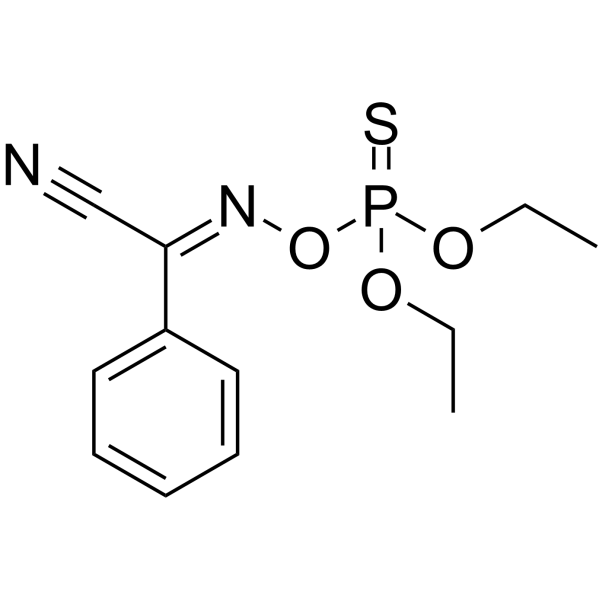
Phoxim
Phoxim is an organophosphorus pesticide and an orally active inhibitor of cholinesterase and CYP3A, which induces neurotoxicity in Caenorhabditis elegans and causes nephrotoxicity characterized by glomerular atrophy and interstitial fibrosis. Phoxim induces inhibition of the autophagy pathway. Phoxim induces dopaminergic neuron degeneration and exacerbates Aβ-induced paralysis. Phoxim damages enterocytes and disrupts intestinal barrier integrity. Phoxim induces ROS accumulation. Phoxim induces mitochondrial apoptosis, involving upregulation of Bad, Bax, caspase-3, and caspase-9 and downregulation of Bcl-2. Phoxim inhibits mitochondrial functional enzymes (COX, Ca2+-Mg2+-ATPase, SDH). Phoxim upregulates Nrf2 mRNA expression in the jejunal mucosa. Phoxim increases TNF-α and decreases IL-6 and IL-8 in the intestinal mucosa. Phoxim alters gut microbial composition by increasing total bacteria and Escherichia coli and reducing Lactobacillus. Phoxim enhances energy metabolism in silver carp by upregulating key glycolytic and gluconeogenic enzymes. Phoxim is used in research on neurodegenerative diseases, nephrotoxicity, intestinal oxidative stress and barrier dysfunction, and bacterial sepsis.
Nur für Forschungszwecke. Wir verkaufen nicht an Patienten.
- CAS. Nr.: 14816-18-3
- Formel: C12H15N2O3PS
- Molecular Weight:298.30
-
Speicherung:
Solution, -20°C, 2 years

To place orders, for customer services and technical support, please contact: MedChemExpress USA
Tel: 609-228-6898 E-mail: [email protected] [email protected]


-
 Biologische Aktivität
-
Chemical Information
- Protokoll
- Reinheit & Dokumentation
- Verweise
-
 Help & FAQs


Alle Caspase Isoform-spezifische Produkte anzeigen
MoreAlle TNF Receptor Isoform-spezifische Produkte anzeigen
More

Biologische Aktivität
Beschreibung
|
CYP3A |
TNF-α |
Caspase 8 |
Caspase 9 |
Caspase 3 |
IL-6 |
IL-8 |
In Vitro
Phoxim (1 mg/L; 12-24 h) induces oxidative stress in PK15 cells, manifested as increased ROS and MDA levels and decreased SOD activity[2].
Phoxim (1 mg/L; 12-24 h) induces severe mitochondrial ultrastructural damage in PK15 cells, including swelling, membrane deformation, and vacuolization, decreases COX, Ca2+-Mg2+-ATPase, and SDH activities, and induces a significant increase in apoptosis and a reduction in mitochondrial membrane potential[2].
Phoxim (1 mg/L; 12-24 h) upregulates pro-apoptotic genes (Bad, Bax, Caspase-3, Caspase-8, Caspase-9, cyto-c) and downregulates the anti-apoptotic gene Bcl-2 in PK15 cells, thereby activating the mitochondrial apoptotic pathway[2].
Phoxim (0.5-5 μg/mL; in NGM medium; exposure for 24-48 h) induces a dose-dependent increase in mortality in Caenorhabditis elegans, with an LC50 of 3.92 μg/mL, and inhibits growth, reduces body length and body width, decreases the number of dopaminergic neuronal processes in the BZ555 strain, accelerates Aβ-induced paralysis in the CL4176 strain, induces intestinal damage, and downregulates the expression of autophagy-related genes vps-34, atg-13, and unc-51[1].
Phoxim alters the intestinal microbial composition of silver carp, promotes the growth of beneficial bacteria such as Cetobacterium, and may enhance the host's disease resistance[4].
MedChemExpress (MCE) has not independently confirmed the accuracy of these methods. They are for reference only.
-
Cell Line:PK15 cells
-
Concentration:1 mg/L
-
Incubation Time:12 h; 24 h
-
Result:Declined COX activity to 315.29 IU/L, Ca2+-Mg2+-ATPase to 320.88 ng/L, and SDH to 475.46 U/L at 24 h.
Reduced COX to 354.54 IU/L, SDH to 580.26 U/L, and Ca2+-Mg2+-ATPase to 310.80 ng/L at 12 h.
-
Cell Line:PK15 cells
-
Concentration:1 mg/L
-
Incubation Time:12 h; 24 h
-
Result:Increased the apoptotic rate to 19.90% at 24 h.
Increased the apoptotic rate to 8.16% at 12 h.
-
Cell Line:PK15 cells
-
Concentration:1 mg/L
-
Incubation Time:12 h; 24 h
-
Result:Elevated Bad to 1.64, Bax to 1.13, Caspase-3 to 1.40, Caspase-8 to 1.35, Caspase-9 to 1.48, and cyto-c to 1.16, while decreasing Bcl-2 to 0.81 at 12 h.
Increased Bad to 1.68, Bax to 1.09, Caspase-3 to 1.75, Caspase-8 to 1.82, Caspase-9 to 2.24, and cyto-c to 1.35, while decreasing Bcl-2 to 0.76 at 24 h.
In Vivo
Phoxim (20-180 mg/kg·BW; gavage; once daily; 28 days) induces intestinal toxicity in rats by causing villus damage, oxidative stress, disruption of barrier and immune function, and alterations in microbial community profiles, with these effects being more pronounced at the high dose of 180 mg/kg·BW[3].
MedChemExpress (MCE) has not independently confirmed the accuracy of these methods. They are for reference only.
-
Animal Model:Piglets (5-week-old male, weighing 16.5 kg, healthy piglets fed a diet supplemented with phoxim)[2]
-
Dosage:500 mg/kg
-
Administration:diet; daily; 30 days
-
Result:Increased serum levels of blood urea nitrogen (BUN) to 3.68 mmol/L and creatinine (CRE) to 121.82 μmol/L.
Increased malondialdehyde (MDA) content to 1.96 nmol/mg protein and decreased superoxide dismutase (SOD) to 203.06 U/mg protein, total antioxidant capacity (T-AOC) to 0.31 U/mg protein, glutathione peroxidase (GPx) to 21.8 nmol/mg protein, catalase (CAT) to 7.41 U/mg protein, and glutathione (GSH) to 24.04 U/mg protein.
Induced serum ROS levels of 289.60 IU/mL.
Elevated mRNA expression of pro-apoptotic factors Bad (1.35), Bax (1.18), Caspase-3 (1.22), Caspase-8 (1.32), and Caspase-9 (1.34), while decreasing anti-apoptotic factor Bcl-2 (0.74).
-
Animal Model:Sprague-Dawley (SD) rats (male; 130-150 g; phoxim-induced intestinal toxicity)[3]
-
Dosage:20 mg/kg·BW; 180 mg/kg·BW
-
Administration:gavage; once a day; 28 days
-
Result:Decreased jejunum villus height at 180 mg/kg·BW.
Increased MDA content to 2.89 nmol/g mucosa and decreased GSH content to 61.6 mg/g mucosa and T-AOC to 0.88 U/mg mucosa in the jejunum at 180 mg/kg·BW.
Decreased GSH content to 49.0 mg/g mucosa and T-AOC to 0.78 U/mg mucosa in the ileum at 180 mg/kg·BW.
Increased mRNA expression of Nrf2 and GPx2 in jejunum mucosa and decreased SOD mRNA expression at 180 mg/kg·BW.
Increased TNF-α concentration to 400.1 ng/L in the jejunum and to 405.1 ng/L in the ileum, while decreasing IL-8 concentration to 467.4 ng/L in the ileum at 180 mg/kg·BW.
Decreased mRNA expression of IL-1β, IL-6, and IL-8 in jejunum and ileum mucosa and increased TNF-α mRNA expression in both tissues at 180 mg/kg·BW.
Decreased mRNA expressions of occludin and claudin-4 in the jejunum and ileum mucosa at 180 mg/kg·BW.
Increased total bacteria to 19.5 and E. coli to 8.6, and decreased Lactobacillus to 10.5 in cecal digesta at 180 mg/kg·BW.
- RT-PCR
- Neurotoxicity Study
- Collagen: Sirius Red Staining
- RNA extraction experimental
- Nephrotoxicity Study
- Annexin V plus membrane-impermeant dye apoptosis staining
- ROS/oxidative-stress fluorescent staining
- Connective Tissue: Masson's Trichrome/Collagen Trichrome Staining
- Ca2+ Staining Technique
- Real Time qPCR (Q-PCR)
- Alzheimer’s Disease Modeling
- Fibrosis/Collagen Morphometry
- Detection of Apoptosis
- TUNEL staining for apoptotic DNA fragmentation
- LPS-Induced Endotoxemia/Systemic Inflammation
- Autophagy
- Transepithelial/transendothelial electrical resistance assay
- Apoptosis Solutions
- Lysosome and acidic-vesicle live-cell staining
- Macroautophagy Solutions


Chemical Information
-
CAS. Nr. 14816-18-3
-
Appearance Liquid
-
Molecular Weight 298.30
-
Formel C12H15N2O3PS
-
Color Colorless to light yellow
-
SMILES
S=P(OCC)(OCC)O/N=C(C#N)\C1=CC=CC=C1
-
Versand
Room temperature in continental US; may vary elsewhere.
-
Speicherung
Solution, -20°C, 2 years


Reinheit & Dokumentation
-
Data Sheet (292 KB)
-
SDS (393 KB)
- English - EN (393 KB)
- Français - FR (393 KB)
- Deutsch - DE (393 KB)
- Norwegian - NO (393 KB)
- Español - ES (393 KB)
- Swedish - SV (393 KB)
- Italian - IT (393 KB)
- Korean - KR (393 KB)
- Portuguese - PT (393 KB)
-
Handling Instructions (2659 KB)
Verweise

Calculators
Konzentration (Stammlösung) × Volumen (Stammlösung) = Konzentration (Ziellösung) × Volumen (Ziellösung)


Phoxim Related Classifications
HY-B0819 Related Classifications
 Powered by Bioz
Keywords
- Phoxim
- 14816-18-3
- Insecticide
- Cholinesterase (ChE)
- Cytochrome P450
- Autophagy
- Reactive Oxygen Species (ROS)
- Apoptosis
- Bcl-2 Family
- Caspase
- COX
- Keap1-Nrf2
- TNF Receptor
- Interleukin Related
- Bacterial
- cholinesterase
- neurotoxicity
- dopaminergic neuron degeneration
- renal glomerular atrophy
- PK15 cells
- interstitial fibrosis
- CYP3A
- nephrotoxicity
- Aβ-induced paralysis
- Caenorhabditis elegans
- Inhibitor
- inhibitor
- inhibit